
Key takeaways
- Capacitive polymer sensors are the standard for most RH measurement. They are accurate (±1–2% RH), fast-responding, and recoverable after saturation, but they drift through polymer ageing and contamination.
- Saturated salt solutions create fixed humidity reference points (e.g. magnesium chloride: 33% RH; sodium chloride: 75.3% RH at 25°C) and are used in lower-tier calibration; precision humidity generators are used in SAC-SINGLAS accredited calibration for lower uncertainty.
- The expanded uncertainty on a humidity calibration certificate for a typical capacitive sensor is typically ±1–2% RH. If your process requires tighter control than ±2% RH, you need a precision reference sensor with demonstrated lower uncertainty.
- For pharmaceutical stability chamber monitoring in Singapore, HSA expects calibrated humidity sensors with SAC-SINGLAS accredited certificates covering the full operating range. Not just a single humidity point.
- A humidity sensor that has been exposed to 100% RH (condensation) should be reconditioned and recalibrated before returning to service, readings after saturation are unreliable.
Humidity sensor types: a comparison
| Sensor Type | Principle | Typical Accuracy | Range | Stability | Best Application |
|---|---|---|---|---|---|
| Capacitive polymer | Dielectric constant of hygroscopic polymer changes with water vapour | ±1–2% RH | 0–100% RH | Good | General purpose. Most common industrial and lab sensor |
| Resistive (bulk/thin film) | Resistance of conductive coating changes with humidity | ±2–3% RH | 10–95% RH | Moderate | HVAC control, general monitoring |
| Psychrometer (wet/dry bulb) | Temperature difference between wet and dry thermometers | ±2–5% RH | 20–100% RH | Excellent (no drift) | Reference standard; limited to above 20% RH |
| Chilled mirror | Dew point by optical detection of condensation on a cooled mirror | ±0.1°C dew point (≈±0.2% RH) | Full range | Very high | Reference calibration standard |
| Electrolytic (P₂O₅) | Electrolysis of absorbed water | ±0.1 ppm | Trace moisture (ppm) | Good | Trace moisture in gas streams (semiconductor, gas industry) |
Why humidity matters in Singapore
Singapore's ambient relative humidity sits at 80–90% RH through most of the year, with the lowest readings on dry December mornings and the highest during monsoon months. For most countries this would be an extreme, in Singapore it is the baseline. The consequence for instruments and processes is significant: any environment that is not actively conditioned is operating in persistently high-humidity conditions that accelerate corrosion, promote condensation, support mould growth, and degrade moisture-sensitive products and components far faster than temperate climates.
The industries where humidity control is most critical (and where calibration of humidity instruments is a regulatory or quality requirement), include:
- Pharmaceutical stability testing: ICH Q1A requires long-term stability studies at 25°C/60% RH and accelerated studies at 40°C/75% RH. The humidity sensors monitoring these chambers must be calibrated to confirm the conditions are truly being maintained. A sensor that reads 60% RH when the actual chamber humidity is 65% can invalidate years of stability data.
- Pharmaceutical cold storage: At 2–8°C cold room temperatures, humidity must be controlled to prevent condensation on glass vials and packaging. The cold room environment creates calibration challenges. Sensors calibrated at room temperature may behave differently at refrigerated temperatures.
- Food manufacturing: GMP production rooms, ingredient storage areas, and packaging lines all require humidity control to prevent microbial growth, caking of powders, and packaging integrity failures. HACCP plans identify humidity as a critical control point in many food processes.
- Semiconductor cleanrooms: ISO 14644 cleanroom standards require control of temperature and humidity to prevent electrostatic discharge events and maintain process yields. RH is typically held at 40–50%. Tight enough that a drifted sensor could contribute to yield variation without anyone identifying the root cause.
- HVAC commissioning and building services: Humidity sensors are installed in air handling units and fan coil systems across commercial buildings. Commissioning records for these systems require calibrated instrument readings to confirm performance to design specifications.
In each of these applications, a humidity sensor that has drifted (and in Singapore's climate, drift is not a theoretical risk, it is an expected outcome of operation), may be reporting incorrect readings with complete confidence. Calibration is the only mechanism to catch that drift before it causes a quality failure, a regulatory observation, or a product loss.
How humidity is defined and measured
Relative humidity (RH) is defined as the ratio of the actual partial pressure of water vapour in air to the saturation vapour pressure at the same temperature, expressed as a percentage. At 100% RH the air is saturated. It can hold no more water vapour at that temperature. At 50% RH the air contains half the water vapour it could hold at saturation.
The critical point for instrument calibration is that RH is temperature-dependent. If you fix the actual water vapour content (the dew point) and raise the temperature, the saturation vapour pressure increases (so the RH falls. Lower the temperature and the saturation vapour pressure decreases), RH rises, until at the dew point temperature the air becomes saturated and condensation forms. This means that a humidity sensor cannot be understood in isolation from the temperature at which it is operating, and a calibration certificate that does not state the temperature at which measurements were taken is incomplete.
Dew point temperature
The dew point is the temperature at which air of a given moisture content becomes saturated. The temperature at which condensation begins to form on a surface. Unlike relative humidity, the dew point is an absolute measure of water vapour content: it does not change with temperature. A dew point of 20°C at 30°C ambient corresponds to approximately 59% RH. The same dew point in a 5°C cold room corresponds to over 100% RH, condensation on every surface. Instruments that measure dew point directly (chilled mirror hygrometers) provide a more fundamental measure of moisture content than RH sensors, which is why they are used as reference standards in calibration.
Wet-bulb temperature and psychrometers
A psychrometer uses two thermometers: one with a dry bulb, and one with a bulb kept wet by a wick saturated in distilled water. As water evaporates from the wet bulb, it cools relative to the dry bulb. The temperature depression between the two thermometers, combined with the ambient temperature, allows the relative humidity to be calculated from published psychrometric tables or equations. Because the psychrometer derives RH from temperature measurements rather than a material sensor property, it has no polymer to age or contaminate. The measurement is physically governed and extremely stable over time. Meteorological services worldwide rely on aspirated psychrometers as primary humidity references. The limitation is practical: the wet bulb must remain genuinely wet (wick integrity), the measurement works only above 0°C (above freezing), and RH below approximately 20% cannot be reliably measured.
Why capacitive sensors dominate industrial use
For industrial and laboratory humidity measurement, the capacitive polymer sensor has become the dominant technology because it combines acceptable accuracy (±1–2% RH), a full operating range from 0 to 100% RH, fast response times, compact physical dimensions, low power consumption, and competitive pricing. These sensors are available as standalone humidity transmitters, as probes for handheld meters, and as integrated sensing elements in multi-parameter data loggers. Their main limitation (drift through polymer ageing and contamination), is manageable through periodic calibration.
Sensor types in detail
Capacitive polymer sensors
A capacitive humidity sensor consists of a hygroscopic polymer film deposited between two electrodes forming a capacitor. As the polymer absorbs water vapour from the surrounding air, its dielectric constant changes, altering the capacitance in proportion to the relative humidity. The sensor electronics convert this capacitance change to an RH reading.
The drift mechanism in capacitive sensors operates through two pathways. First, polymer ageing: the sensing polymer is a material with a finite service life. With each humidity cycle (absorbing and releasing water), the polymer's microstructure gradually changes, shifting the relationship between capacitance and actual RH. This ageing drift is slow and progressive, typically on the order of 1–2% RH per year in normal operating conditions, but faster in Singapore's continuously high-humidity environment where the polymer is under constant stress.
Second, chemical contamination: many common chemicals attack the polymer sensing element. Solvents used in pharmaceutical and laboratory cleaning processes, volatile organic compounds in manufacturing environments, and even certain cleaning agents used during routine maintenance can alter the polymer's dielectric properties, causing step-changes in the calibration offset. A sensor exposed to isopropanol vapours during equipment cleaning may shift by 5% RH or more without any visible sign of damage.
Recovery after saturation is possible for most capacitive sensors. When a sensor has been exposed to 100% RH or liquid condensation, standard practice is to place it in a dry environment at 40°C for 24 hours. This drives off the absorbed moisture and allows the polymer to equilibrate. After reconditioning, the sensor must be recalibrated. Pre-saturation certificates are no longer valid.
Resistive sensors
Resistive humidity sensors use a conductive coating whose electrical resistance changes with water vapour absorption. They are simpler and cheaper to manufacture than capacitive sensors, but their accuracy (typically ±2–3% RH) and stability are inferior. They are widely used in HVAC control applications where high precision is not required and replacement costs need to be low. For regulated industries requiring calibration certificates with stated uncertainties, capacitive sensors are almost always the appropriate choice.
Psychrometers as reference instruments
Because the psychrometer's measurement is derived from temperature thermometry rather than a material sensor, it has excellent long-term stability. There is no sensor to age or drift. Well-maintained aspirated psychrometers are used as reference standards by meteorological services and national metrology institutes. In a calibration laboratory context, the psychrometer's limitation is its lower bound of approximately 20% RH and the requirement for above-freezing temperatures, which rules it out for cold room calibration.
Chilled mirror hygrometers as calibration references
The chilled mirror hygrometer determines the dew point by optically detecting the exact temperature at which condensation forms on a mirror surface cooled by a Peltier element. An optical detector monitors the reflectivity of the mirror; when condensation forms, reflectivity drops, and the control system locks the mirror temperature at the dew point. From the dew point temperature, relative humidity is calculated using thermodynamic equations.
Because the measurement is based on a physical phase transition (condensation), rather than any material sensor property, there is no drift mechanism. The accuracy is governed by the precision of the mirror temperature measurement: a good chilled mirror instrument achieves ±0.1°C dew point, equivalent to approximately ±0.2% RH in the mid-humidity range. This is an order of magnitude better than a typical capacitive sensor, which is why chilled mirror instruments serve as the primary reference standard for laboratory humidity calibration worldwide. Unitest uses a chilled mirror hygrometer as the reference anchor for its accredited humidity calibration service.
How humidity calibration is performed
Two fundamentally different approaches are used to generate the reference humidity against which the instrument under test is compared.
Saturated salt solution method
A sealed chamber containing a saturated aqueous solution of a specific salt creates a stable, fixed relative humidity at a given temperature. The thermodynamic equilibrium between the saturated salt solution and the water vapour in the sealed space above it produces a characteristic RH at each temperature. A property that has been precisely measured by national metrology institutes and published in international standards.
Common salt solutions and their equilibrium RH at 25°C include:
- Lithium chloride (LiCl): approximately 11.3% RH
- Magnesium chloride (MgCl₂): approximately 32.8% RH
- Magnesium nitrate (Mg(NO₃)₂): approximately 52.9% RH
- Sodium chloride (NaCl): approximately 75.3% RH
- Potassium sulphate (K₂SO₄): approximately 97.3% RH
The salt solution method is simple and inexpensive. Its limitations are that it provides only fixed humidity points (not adjustable to any target RH), is sensitive to temperature variation (the equilibrium RH changes with temperature), requires adequate equilibration time (several hours for a large chamber), and carries a higher combined uncertainty than a humidity generator. For lower-cost, single-point checks or for in-house verification without an accreditation requirement, salt solutions are widely used. For a SAC-SINGLAS accredited calibration certificate covering multiple points with stated uncertainty, salt solutions alone are insufficient.
Precision humidity generator method
A precision humidity generator produces any specified relative humidity by mixing dry gas (typically nitrogen or dry air) and gas saturated with water vapour in precisely controlled proportions. By adjusting the flow ratio and controlling the temperature of the saturation chamber, any target RH across a wide range can be generated with high stability and low uncertainty. The generated humidity is verified by the chilled mirror reference instrument.
The humidity generator approach enables:
- Calibration at any RH point within the generator's range. Not limited to salt solution fixed points
- Calibration at multiple points across an operating range in a single session
- Dynamic stability during the measurement. The generator actively controls and maintains the setpoint RH
- Lower combined uncertainty. The generator's precise control plus the chilled mirror reference achieves uncertainties well below what salt solutions can provide
SAC-SINGLAS accredited humidity calibration uses the humidity generator method. The combination of a precision generator and a chilled mirror reference instrument is what enables Unitest to issue certificates with stated expanded uncertainty at each calibration point. The standard required by ISO/IEC 17025 and expected by GMP and HACCP auditors.
Calibration points. What range to cover
The selection of calibration points should be driven by the instrument's actual operating range and the regulatory requirements applicable to the application. Calibrating at a single point (even if that point is the nominal setpoint), leaves the sensor's behaviour at other humidity levels unverified.
For a pharmaceutical stability chamber operating at 25°C/60% RH (ICH Q1A long-term condition): calibrate at a minimum of three points spanning the operating range, for example 40%, 60%, and 80% RH. The sensor may be accurate at 60% but exhibit non-linearity at the extremes, a multi-point calibration reveals this. Some GMP quality systems require five calibration points for stability chamber sensors.
For a pharmaceutical cold room at 2–8°C: the calibration must be performed at the operating temperature, not at room temperature. A sensor calibrated at 25°C and deployed in a 5°C cold room has an unknown accuracy at the actual operating conditions. Request cold-temperature calibration explicitly when submitting sensors used in refrigerated storage.
For a semiconductor cleanroom held at 45% RH: calibrate across the expected control range (for example 30%, 45%, and 60% RH), at the cleanroom's operating temperature. This captures the full range the sensor will experience including transient excursions during maintenance periods.
For general HVAC monitoring sensors where the exact setpoint is variable: calibration at three points across the expected ambient range (for Singapore, approximately 50%, 70%, and 90% RH) provides adequate coverage of real operating conditions.
Calibration intervals for regulated industries in Singapore
Calibration intervals for humidity sensors should be based on the criticality of the measurement, the sensor's history of drift, the operating conditions, and the regulatory requirements applicable to the facility. The following intervals reflect common practice in Singapore's regulated sectors and should be reviewed against your specific quality management system requirements.
- Pharmaceutical stability chambers (ICH Q1A studies): Maximum 12 months; many GMP facilities recalibrate every 6 months as a risk-based decision, especially where the stability chamber is continuously critical to ongoing studies. Recalibration is also required after any temperature or humidity excursion that triggers an investigation, after sensor replacement, and after any modification to the monitoring system.
- Pharmaceutical cold rooms and controlled ambient stores: Same 12-month maximum; 6-month intervals where HSA GMP expectations or internal SOPs specify tighter control. Cold room sensors are particularly important. Condensation events in cold storage can cause product damage that is difficult to trace to a drifted humidity sensor without a calibration record.
- Food manufacturing (HACCP-registered sensors): 12-month maximum for sensors at critical control points; more frequently for sensors exposed to steam, cleaning chemicals, or steam-in-place (SIP) cycles, which accelerate polymer degradation. Document the rationale for any interval shorter than 12 months in the HACCP plan.
- Semiconductor cleanrooms (ISO 14644): Typically 6–12 months depending on the facility's equipment qualification schedule. ISO 14644-2 requires periodic re-verification of cleanroom environmental conditions; the calibration interval for humidity sensors should be aligned with the re-verification schedule.
- HVAC commissioning instruments: One-time calibration for commissioning documentation; the instrument is then transferred to the building's ongoing calibration programme with intervals determined by its criticality in the building management system.
- After any saturation event: Always recalibrate after a sensor has been exposed to 100% RH or condensation, regardless of the scheduled interval. The pre-saturation certificate is no longer valid.
- After chemical exposure: Recalibrate after any known exposure to solvents, cleaning agents, or other chemicals that could affect the polymer sensing element. Do not assume the calibration is still valid.
GMP requirements for humidity calibration in Singapore
Singapore's Health Sciences Authority (HSA) applies GMP requirements aligned with the ICH guidelines and the WHO Technical Report Series (TRS) standards. For pharmaceutical facilities, these requirements translate to specific expectations for humidity sensor calibration that are assessed during GMP inspections.
Instrument qualification. Critical humidity sensors in pharmaceutical manufacturing (including stability chambers, cold rooms, ambient controlled stores, and humidity-controlled manufacturing areas), must be qualified as part of the facility's instrument qualification programme. The calibration certificate is the core evidence of ongoing performance qualification. Replacement of a sensor requires re-qualification, which begins with calibration of the new sensor before first use.
ICH Q1A stability study compliance. The long-term stability condition (25°C/60% RH) and the accelerated condition (40°C/75% RH) must be maintained within the tolerances specified in ICH Q1A, typically ±2°C and ±5% RH. The calibration certificate confirms the humidity sensor is reading accurately enough to verify these conditions. A sensor drifted by 3% RH above 60% could be recording conditions outside the protocol specification without triggering an alarm.
21 CFR Part 11 and Annex 11 context. For facilities subject to FDA or EMA oversight (pharmaceutical exporters, medical device manufacturers with US or European market access), electronic monitoring systems must use calibrated sensors as part of the data integrity framework. The calibration record is audit evidence that the electronic data produced by the monitoring system can be trusted.
Calibration certificate requirements under GMP: HSA GMP inspectors and international inspectors under MRA frameworks expect humidity calibration certificates to state the calibration points, the measured deviations at each point, the expanded uncertainty, and the reference instruments used (with their own calibration traceability). A certificate that states only "calibrated. Within specification" without data and uncertainty is likely to draw an observation.
Humidity sensor calibration. Multiple points, stated uncertainty, GMP audit-ready
Unitest calibrates RH sensors and humidity data loggers using a precision humidity generator against chilled mirror references. SAC-SINGLAS accredited certificates for HSA GMP, ICH stability, and HACCP compliance.
What a compliant humidity calibration certificate must include
A humidity calibration certificate issued under ISO/IEC 17025 accreditation carries specific mandatory elements. Understanding what must be present (and what to look for when reviewing a certificate from any lab), helps quality engineers, regulatory affairs managers, and instrument custodians identify compliant documentation before an audit does it for them.
(a) Instrument identification. The certificate must unambiguously identify the instrument: make, model, serial number, and the facility's own asset identification number or tag. If the serial number does not match the instrument you submitted, the certificate does not apply to your instrument.
(b) Calibration date and environmental conditions. The date of calibration and (critically for humidity), the ambient temperature at the time of calibration. Because relative humidity is temperature-dependent, a humidity calibration conducted at a different temperature than the instrument's operating temperature may not represent the sensor's performance at operating conditions. The calibration temperature must be recorded.
(c) Calibration method and reference standards. The method used (humidity generator, salt solution, or other) and the reference instrument(s) used, including their certificate numbers and calibration dates. This forms the traceability link: from your instrument, through the lab's reference standard, back to the national standard.
(d) Results table. For each calibration point: the nominal humidity applied (from the humidity generator or reference), the humidity reading from the instrument under test, and the deviation (applied minus measured). The table must cover all calibration points, not a single combined summary.
(e) Expanded uncertainty. The expanded uncertainty U, stated as ±X% RH at a coverage factor k=2 (approximately 95% confidence). This is not the same as the instrument's specification or its deviation from the reference. It is the quantified doubt in the calibration measurement itself, calculated from all identified uncertainty sources. Without this, the certificate cannot satisfy ISO 9001:2015 clause 7.1.5 or GMP calibration requirements.
(f) SAC-SINGLAS accreditation logo and number. The certificate must display the SAC-SINGLAS accreditation mark and the accreditation number (LA-2023-0845-C for Unitest). The accreditation number must be verifiable at sac.gov.sg. Certificates from non-accredited labs may appear similar but cannot carry this mark.
(g) Authorised signatory. The certificate must be signed by a technically authorised person within the accredited laboratory. Someone whose competence for the relevant parameter has been assessed and documented under the lab's ISO/IEC 17025 management system.
A certificate that states only "calibrated at 75% RH. Within specification" fails on multiple counts: it lacks a results table, an expanded uncertainty, the calibration temperature, and the reference standard traceability link. Such a certificate is common from non-accredited providers and will draw an audit observation from a GMP inspector or ISO 9001 auditor applying the current standard.
Common problems with humidity sensors in Singapore
The combination of Singapore's tropical climate and the intensive use of humidity sensors in regulated industries creates a characteristic set of failure modes that calibration history reveals.
Saturation from tropical ambient conditions
Sensors transported from outdoor storage or delivery areas into air-conditioned laboratories or clean rooms can be exposed to near-saturation conditions during transit, particularly in the humid months. The sensor may register readings well above its previous calibration values for hours or days after the exposure. Before returning any sensor to a calibrated service position after outdoor exposure, store it at 40°C in a dry environment for 24 hours to recondition the polymer, then submit for recalibration.
Solvent and chemical vapour contamination
In pharmaceutical manufacturing, isopropanol (IPA) cleaning of equipment surfaces generates vapour concentrations that, over time, attack the polymer sensing elements of nearby RH sensors. A sensor in a pharmaceutical manufacturing area may read correctly when first calibrated but drift significantly in the months following an intensive cleaning campaign. Any sensor in close proximity to cleaning operations should be flagged for more frequent calibration and inspected visually for polymer discolouration or physical degradation.
Temperature mismatch between calibration and use conditions
One of the most commonly overlooked problems in pharmaceutical cold chain management is the use of room-temperature humidity calibration certificates for sensors operating in cold rooms at 2–8°C. The sensor's accuracy at 5°C may differ meaningfully from its 25°C performance. If your facility has cold room humidity monitoring sensors, verify that their calibration was performed at the cold room operating temperature, and if not, arrange for re-calibration at the correct temperature before the next regulatory inspection.
Single-point calibration applied across a wide operating range
A humidity sensor calibrated at 60% RH but used across a range of 40–80% RH has an unknown linearity profile outside the calibration point. The sensor may be accurate at 60% but exhibit a 4% RH offset at 40% and a 3% RH offset at 80%. Errors that would never be detected from a single-point certificate. For any application where the sensor operates across a range rather than at a fixed setpoint, insist on a multi-point calibration certificate.
Partial calibration of combined temperature/humidity loggers
Combined temperature and humidity data loggers are widely used in pharmaceutical and food facilities. A common oversight is sending the logger for calibration and receiving a certificate that covers only the temperature channel, because that is the only parameter for which the service provider has an accredited calibration capability. The humidity channel is left uncertified. When reviewing calibration certificates for combined loggers, verify that both channels (temperature and humidity), appear in the results table. If only temperature is shown, the humidity data from that logger is not covered by any traceable calibration.
Unitest's humidity calibration capability
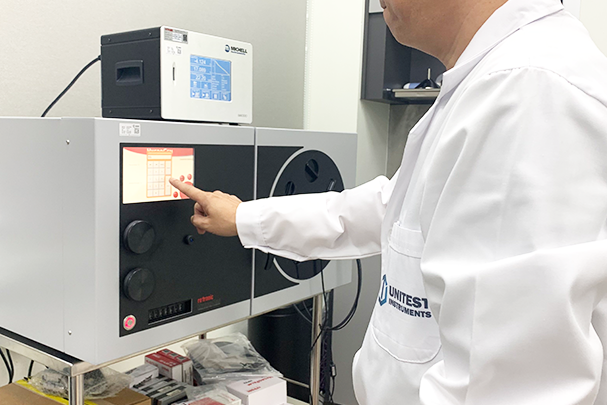
Unitest calibrates capacitive RH sensors, handheld hygrometers, and combined temperature/humidity data loggers as part of its SAC-SINGLAS accredited calibration service. The calibration is performed using a precision humidity generator that produces stable, controlled relative humidity at any point within the operating range. Not limited to the fixed points of a salt solution system.
The generated humidity is verified by a chilled mirror hygrometer reference instrument, providing the lowest achievable measurement uncertainty for a humidity calibration service: the chilled mirror's ±0.1°C dew point accuracy anchors the reference chain. The combined expanded uncertainty of the calibration service is stated on every certificate issued. Typically in the range of ±1–2% RH for standard capacitive sensors, depending on the calibration points and the sensor's own characteristics.
Calibration is conducted under controlled laboratory conditions with temperature and humidity monitoring during the measurement. Certificates include the full results table (applied RH, measured RH, deviation at each calibration point), the expanded uncertainty, the calibration date and ambient temperature, and the reference instrument traceability. The SAC-SINGLAS accreditation mark (LA-2023-0845-C) appears on all accredited certificates.
For pharmaceutical customers requiring cold-temperature humidity calibration or extended multi-point calibration for ICH stability chambers, contact Unitest to discuss your specific requirements before submission. For standard commercial, industrial, and HVAC humidity sensors, the standard submission process applies.
Frequently asked questions
Singapore's ambient humidity of 80–90% RH constantly stresses capacitive polymer sensing elements. The polymer absorbs and releases water vapour repeatedly, and over time the polymer ages. Its dielectric response shifts, and readings drift. Exposure to chemical vapours (solvents, cleaning agents) degrades the polymer faster. Sensors exposed to near-saturation conditions during outdoor transport or storage are especially vulnerable. Regular calibration is the only way to detect and quantify drift before it causes a quality or compliance issue.
For a certificate to be useful across an operating range, it should include a minimum of three calibration points spanning that range. Typically at the lower end, mid-range, and upper end of operation. A single-point calibration (e.g. only at 60% RH) tells you nothing about sensor behaviour at 40% or 80% RH. For pharmaceutical stability chambers, calibration at 40%, 60%, and 80% RH is a reasonable baseline. For wider-range applications, five points or more may be warranted. The certificate must state the deviation and expanded uncertainty at each point.
When a capacitive polymer sensor is exposed to 100% RH or liquid condensation, the polymer becomes fully saturated and readings typically shift high. Remaining elevated even after the ambient humidity drops. The remedy is reconditioning: place the sensor in a dry environment at 40°C for 24 hours to drive off absorbed moisture. After reconditioning, the sensor must be recalibrated before returning to service. Pre-saturation certificates are no longer valid. If the sensor has been repeatedly saturated, permanent polymer damage may require element replacement.
No. Not without evidence that the sensor's response at 5°C matches its 25°C performance. Relative humidity is inherently temperature-dependent, and many capacitive polymer sensors exhibit different accuracy characteristics at low temperatures. For cold room monitoring, the sensor should be calibrated at or near the operating temperature (2–8°C). Using a room-temperature certificate for a cold-room sensor is a recognised GMP gap that HSA inspectors and international regulatory bodies identify during audits. Request cold-temperature calibration explicitly when submitting sensors used in refrigerated storage.
The standard interval for pharmaceutical GMP environments is 12 months maximum. Many GMP facilities calibrate stability chamber sensors every 6 months as a risk-based decision, particularly where ICH Q1A stability studies are continuously running. Recalibration is required after any temperature or humidity excursion, after sensor replacement, after system disturbance, and if the sensor has been exposed to chemical vapours or saturation. Document the rationale for your chosen interval in the instrument qualification record, and align it with your overall calibration management SOP.
A chilled mirror hygrometer determines humidity by optically detecting the exact temperature at which condensation forms on a mirror cooled by a Peltier element, the dew point. Because it measures a physical phase transition rather than a sensor material property, it has no drift mechanism: the result is governed by the laws of physics, not polymer ageing. This gives it an expanded uncertainty of approximately ±0.1°C dew point (around ±0.2% RH), making it the primary reference standard for humidity calibration. Unitest uses a chilled mirror reference instrument as the anchor of its accredited humidity calibration chain.
Yes. Unitest calibrates combined temperature and humidity loggers. Covering both channels in a single submission. Temperature is calibrated using accredited temperature references; humidity is calibrated using the precision humidity generator against the chilled mirror reference. Each channel receives its own results table and expanded uncertainty statement on the certificate. This is important because many facilities inadvertently calibrate only the temperature channel of a combined logger, leaving the humidity channel uncertified. A gap that surfaces during GMP or HACCP audits.

Unitest Instruments Pte. Ltd. is a SAC-SINGLAS accredited calibration laboratory (ISO/IEC 17025, no. LA-2023-0845-C) based in Singapore. We calibrate electrical, temperature, pressure, humidity, and related instruments for manufacturers, pharmaceutical facilities, food producers, and regulated industries across Singapore and the region.
Humidity sensor calibration. Precision generator method, SAC-SINGLAS accredited
Unitest calibrates RH sensors and humidity loggers with stated expanded uncertainty. Precision humidity generator + chilled mirror reference. Audit-ready for GMP, HACCP, and cleanroom compliance.
Verifiable at sac.gov.sg · Acc. No. LA-2023-0845-C