
Key takeaways
- CAT III 1000V is the minimum rating for work near LV distribution boards, MCBs, and consumer unit terminals in Singapore; CAT IV 600V is required at the service entry point and meter tail connections.
- True RMS measurement is mandatory for any electrical work involving variable frequency drives (VFDs), switched-mode power supplies, or non-linear loads. Non-True-RMS meters under-read by 5–40% on distorted waveforms.
- The best multimeters for Singapore contractors are the Fluke 117/175/179 series (best ecosystem + local service), Hioki DT4253/4256 (best value, Japanese precision), and Kyoritsu KEW 1062 (CAT IV rated, strong in Singapore's electrical trade).
- Annual calibration by a SAC-SINGLAS accredited lab keeps your multimeter compliant with EMA licensing requirements and ISO 9001 clause 7.1.5.2. An uncalibrated meter used in a compliance test is a liability.
- Avoid cheap multimeters (unbranded, sub-S$50) for professional electrical work. They often do not meet the CAT rating printed on them; several have caused fatalities from arc flash events triggered by meter failures.
The Singapore electrical contractor context
Singapore's EMA-licensed electrical workers (Licensed Electrical Workers (LEW), licensed electricians, and registered electrical workers), operate in one of the region's most tightly regulated electrical environments. All new electrical installations require EMA inspection before energisation. Regular maintenance of consumer electrical installations is governed by CP 5:2018. Industrial facilities carry their own statutory and insurance-driven maintenance requirements that demand documented, traceable test results.
In this environment, the multimeter is the primary diagnostic tool in every contractor's kit. It measures supply voltage, verifies isolation, checks continuity of protective conductors, tests fuses, and confirms that a circuit is dead before work begins. For full insulation resistance testing, a separate megohmmeter (insulation resistance tester) is required. The multimeter's ohmmeter function does not generate the test voltage necessary for meaningful insulation resistance measurement on LV cables and equipment.
Given the regulatory stakes (EMA compliance, insurance liability, ISO 9001 audit trails, and the straightforward physical risk of electrical work), the safety category of the multimeter matters more than any feature on the spec sheet. A meter with excellent accuracy but the wrong CAT rating is the wrong meter for the job.
Understanding CAT ratings. The most important specification
IEC 61010-1 defines four overvoltage categories that describe the electrical environment a measurement instrument is rated to survive. This is the single most important specification for any multimeter used in electrical work, and it is also the most commonly misunderstood.
The four categories
CAT I. Signal circuits, electronic equipment, telecommunications, and measurement circuits not connected directly to the AC mains supply. Low-energy transients are possible but limited.
CAT II. Single-phase loads connected via a plug and socket to a fixed installation: appliances, portable tools, extension leads. Transient energy is higher than CAT I. This is the rating for most home-use and light-trade meters.
CAT III. Distribution-level circuits: three-phase equipment, distribution boards, sub-boards, bus bars, circuit breakers, wiring systems in buildings, and fixed equipment in industrial applications. Transient energy is substantially higher than CAT II. CAT III is the minimum for professional contractor work near panels.
CAT IV. The origin of the electrical installation: service entry points, energy meters, overhead line connections, street-level distribution equipment, and meter tails. Transient energy at CAT IV environments can be extremely high and very fast-rising. CAT IV rated instruments are required at incoming supply terminals.
Voltage rating and CAT number. Both matter
A multimeter's CAT rating combines two numbers: the category (I through IV) and the voltage (300V, 600V, 1000V). A meter marked CAT III 600V is rated for distribution-level circuits up to 600V. A meter marked CAT III 1000V is rated for distribution-level circuits up to 1000V. For Singapore's LV network (400V three-phase line-to-line, 230V phase-to-neutral), CAT III 1000V gives significant headroom for transient events that can be several times the nominal voltage.
The critical error contractors make is reading the voltage number (say, 600V) and concluding the meter is safe because the circuit is only 400V. The voltage rating is not the operating voltage. It is the voltage the meter can survive during a transient event. Using a CAT II 600V meter at a distribution board means a transient that a CAT III meter would handle safely can instead destroy the meter and cause an arc flash injury. CAT number and voltage number must both match the environment.
True RMS. Non-negotiable for Singapore industrial sites
Singapore's commercial and industrial buildings run on non-linear loads. Variable frequency drives (VFDs) control fans, pumps, compressors, and lifts. Switched-mode power supplies feed control panels and server rooms. Electronic ballasts drive fluorescent and LED lighting systems. All of these loads draw current in non-sinusoidal waveforms. The power supply voltage and current waveforms in a building with significant VFD penetration are not clean sine waves.
An average-responding multimeter (the measurement method used in many older and cheaper instruments), calculates RMS by assuming the waveform is a pure sine wave. It measures the average value of the rectified waveform and multiplies by 1.1107 (the ratio of RMS to average for a pure sine wave). When the waveform is distorted, this calculation produces a wrong answer. The meter is not measuring the true RMS. It is calculating what the RMS would be if the waveform were a sine wave, which it is not.
A True RMS meter uses thermal conversion or digital signal processing to mathematically integrate the actual waveform over time, producing the correct RMS value regardless of waveform shape. The difference in practice: measuring current on the output side of a VFD with an average-responding meter may under-read by 20–40%, making a significantly overloaded circuit appear to be within safe operating current. Under-reading voltage on a distorted supply can misdiagnose power quality problems.
All professional multimeters recommended in this guide are True RMS. For Singapore electrical contractors working anywhere near modern building services equipment, True RMS is not optional.
Multimeter comparison. Top models for Singapore contractors
The table below covers the ten models most relevant to Singapore electrical contractors, from professional workhorse instruments to value alternatives. Prices are indicative retail in Singapore dollars for 2026; purchase from authorised distributors.
| Model | CAT Rating | True RMS | AC Accuracy | Key Feature | Price (S$) | Best For |
|---|---|---|---|---|---|---|
| Fluke 117 | CAT III 600V | Yes | ±1.0% | Non-contact voltage, compact | ~S$250 | Electricians, panels, tight spaces |
| Fluke 175 | CAT III 1000V | Yes | ±0.75% | 10A current, basic bargraph | ~S$320 | General contractor use |
| Fluke 179 | CAT III 1000V | Yes | ±0.09% DC | Temperature input, backlight | ~S$380 | Tech electricians, measurement log |
| Fluke 287/289 | CAT III 1000V | Yes | ±0.025% DC | Data logging, 10,000 reading log | ~S$650 | Advanced, M&E consultants |
| Hioki DT4253 | CAT III 1000V | Yes | ±0.5% | Compact, safety-first design | ~S$180 | Value contractor option |
| Hioki DT4256 | CAT IV 600V | Yes | ±0.3% | CAT IV, high-energy entry points | ~S$250 | Meter tail/service entry work |
| Kyoritsu KEW 1062 | CAT IV 600V | Yes | ±0.7% | Singapore trade standard, durable | ~S$220 | Electrical trade, HDB work |
| Kyoritsu KEW 1061 | CAT III 1000V | Yes | ±0.7% | Budget professional | ~S$160 | Entry-level contractors |
| Extech EX330 | CAT III 600V | Yes | ±0.5% | Budget, basic use | ~S$80 | Light-duty; caution at panels |
| Unbranded | Uncertain | Often not | Uncertain | None. AVOID | S$20–50 | DO NOT USE for professional work |
Fluke. Singapore's dominant professional brand
Fluke Corporation (USA) is the most widely sold professional multimeter brand in Singapore, and the brand most familiar to ISO 9001, BCA Green Mark, and EMA-related auditors. The ecosystem advantages for Singapore contractors are substantial.
Fluke maintains authorised distributors and service centres in Singapore, which matters for warranty repairs, accessory procurement, and calibration support. The accessories (precision test leads, fused adaptor leads, alligator clips, mini-hook clips), are interchangeable across the Fluke 170 and 280 series and are available locally without long shipping waits. Fluke's three-year warranty is the longest standard warranty in this segment.
For daily contractor use, the Fluke 175 (CAT III 1000V, True RMS, ±0.75% AC accuracy) is the most practical starting point: robust enough for daily site use, accurate enough for panel verification and load measurement, and widely recognised in Singapore's electrical contracting community. The Fluke 117 (CAT III 600V) adds a built-in non-contact voltage detector, making it particularly useful for switchboard work where confirming a circuit is dead before opening a cover is a frequent task, though the lower CAT III 600V rating limits its headroom at higher-energy distribution points.
For contractors who need precision or data logging (M&E engineers, energy auditors, or contractors involved in BCA Green Mark submissions), the Fluke 289 (CAT III 1000V, 10,000-reading internal log, TREND mode, USB PC connectivity) brings a level of documentation capability that justifies its higher price for the right user.
Hioki. The Japanese precision alternative
Hioki E.E. Corporation (Japan) is the leading alternative to Fluke in Singapore's technical and industrial measurement segment. Hioki meters are designed with an explicit safety-first philosophy. The company's instrument interiors are engineered to minimise the energy released in the event of an internal fault, a design philosophy that goes beyond simply meeting IEC 61010 test requirements.
The Hioki DT4253 (CAT III 1000V, True RMS, ±0.5% AC accuracy) is the most direct alternative to the Fluke 175. It is slimmer, lighter, and typically available at roughly S$100 less than the Fluke equivalent through Singapore distributors such as Test & Measurement Singapore. For contractors who want professional-grade measurement without the Fluke price point, the DT4253 is the most defensible choice: comparable CAT rating, True RMS, good accuracy, and a reputable brand with local support.
For work specifically at service entry points and meter tails (where CAT IV 600V is the correct rating rather than CAT III 1000V), the Hioki DT4256 (CAT IV 600V, True RMS, ±0.3% AC accuracy) is a better specification than most Fluke 100-series models, which are typically rated CAT III. This makes the Hioki DT4256 the recommended choice for incoming supply measurement work, even for contractors who use Fluke elsewhere in their kit.
Kyoritsu. The Singapore electrical trade standard
Kyoritsu Electrical Instruments Works (Japan) has a strong historical presence in Singapore's electrical trade, built through decades of distribution via Rymsa International and other established trade suppliers. Kyoritsu meters are considered reliable workhorse instruments: mechanically robust, long battery life, simple rotary-switch operation, and a no-frills approach to measurement that suits electrical workers who need instruments that work reliably every day without complication.
The Kyoritsu KEW 1062 (CAT IV 600V, True RMS, ±0.7% AC accuracy) is particularly popular in the HDB-focused and commercial electrical trade. Its CAT IV 600V rating means it covers both distribution board work and service entry measurement from a single instrument. A practical advantage for contractors who work across a range of Singapore building types. The ±0.7% AC accuracy is adequate for the vast majority of contractor measurement tasks, where the question is generally "is this reading within acceptable range" rather than "what is the precise value."
Kyoritsu also manufactures the KEW 6305 insulation resistance tester and the KEW 3165 clamp meter, which allows contractors to standardise their measurement toolkit on one brand. Simplifying calibration management and ensuring consistent quality across instruments.
Calibrate your Fluke, Hioki, or Kyoritsu multimeter. Annual, SAC-SINGLAS accredited
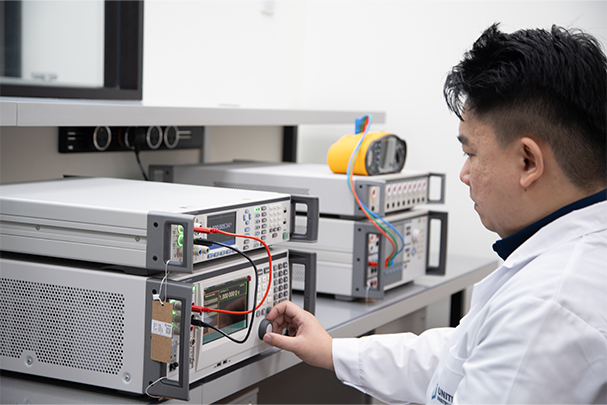
Unitest calibrates professional multimeters (Fluke, Hioki, Kyoritsu, and other brands) against NMC-traceable DC and AC voltage, current, and resistance references. SAC-SINGLAS accredited for EMA, ISO 9001, and IATF 16949.
Calibration for EMA licensing compliance
EMA-licensed electrical workers are required to use properly calibrated instruments for measurement and testing work under Singapore's Electricity (Electrical Installations) Regulations. While the regulations do not specify exact calibration intervals in numerical terms, the practical standard across Singapore's licensed electrical trade is annual calibration with a SAC-SINGLAS accredited certificate.
For contractors operating ISO 9001 quality management systems, the requirement is explicit: clause 7.1.5.2 of ISO 9001:2015 requires that measuring equipment used in quality-affecting activities be calibrated at defined intervals against measurement standards traceable to national or international standards, with results that include stated measurement uncertainties. An annual calibration certificate from a SAC-SINGLAS accredited laboratory (such as Unitest Instruments (acc. no. LA-2023-0845-C)), satisfies this requirement cleanly. An auditor asking for evidence of multimeter calibration under clause 7.1.5 will accept an accredited certificate on sight.
The practical risk of operating an uncalibrated multimeter is not just audit failure. If a multimeter has drifted out of specification and is used to verify that a circuit is within voltage tolerance, or to confirm that a load is within rated current, the measurements it produces cannot be trusted. An uncalibrated meter used in a compliance measurement (a commissioning test, an EMA inspection, a dispute resolution measurement), produces data with no verifiable accuracy. That is a significant professional and legal liability for a licensed electrical worker.
Annual calibration is also the practical mechanism for catching damage that is not visible. A multimeter that has been subjected to an overload event (a transient that it survived but that may have affected internal calibration), may appear functional but be reading incorrectly. Annual calibration identifies this drift before it creates a measurement problem in the field.
What to avoid. Dangerous practices for electrical contractors
The risks in professional electrical measurement are specific enough that naming them directly is worth doing.
Using a CAT II meter at a distribution board. This is the most common safety category error. A CAT II meter has not been tested to survive the transient energy levels present at panel interiors, sub-board bus bars, or MCB terminals. If the meter fails under a transient (which it may do without warning), it can arc, explode, or cause an arc flash event. The solution is a CAT III 1000V minimum for distribution board work, with no exceptions.
Trusting the CAT rating on an unbranded or cheap meter. IEC 61010 testing is performed by independent test laboratories and costs money. Counterfeit and non-compliant meters frequently print CAT ratings that were never tested, because there is no enforcement mechanism at the point of manufacture. The cost of a non-compliant meter is not just money. It is the difference between a meter that contains an arc flash inside the instrument in a controlled way and one that vents that energy towards the user. Purchase from authorised distributors of recognised brands.
Using a meter past its calibration due date for compliance measurements. A certificate with an expired calibration date means the readings are not currently traceable. For EMA inspections, ISO 9001 audits, or any measurement where the result is recorded as evidence, an out-of-calibration instrument creates a gap in the evidence chain that cannot be filled retrospectively. Check calibration due dates before important measurement work.
Using damaged or mismatched test leads. IEC 61010 covers the complete measurement system, not just the meter body. Test leads must match the CAT rating of the meter and the environment. A damaged test lead (cracked insulation, a loose banana plug, a frayed probe tip), breaks the safety system at the most exposed point (the part the user holds near live conductors). Inspect test leads before use, and replace them at the first sign of damage.
Not verifying meter function before use on a known source. The simplest functional check (measuring a known voltage source (a fully charged battery, a reference socket) before starting work), catches battery-low errors, dead meters, and gross measurement failures before they create problems on live circuits. It takes ten seconds and is good professional practice regardless of the meter's calibration status.
Frequently asked questions
For work inside distribution boards, MCBs, sub-boards, and bus bars in Singapore's LV network (230V single-phase, 400V three-phase), you need a minimum of CAT III 600V, and CAT III 1000V is strongly recommended for the added transient headroom. At the service entry point, meter tails, and incoming supply terminals, the correct rating is CAT IV 600V. Using a CAT II meter at a distribution board is a genuine safety hazard: the instrument is not rated for the energy level of transients present at distribution-level circuits and can fail catastrophically, triggering an arc flash event.
True RMS (Root Mean Square) is a measurement method that correctly calculates the RMS value of any waveform, regardless of its shape. Older average-responding meters assume a pure sine wave and multiply the average value by a fixed factor. When the waveform is distorted (as it is downstream of variable frequency drives, switched-mode power supplies, and electronic ballasts), average-responding meters give incorrect readings, often under-reading current by 5 to 40%. In Singapore's industrial and commercial buildings, non-linear loads are pervasive. A non-True-RMS meter can make overloaded circuits appear within rating, making fault diagnosis and load assessment unreliable. All professional multimeters for contractor use should be True RMS.
The best multimeter depends on your work type and budget. For daily contractor use on panels and distribution boards, the Fluke 175 (CAT III 1000V, True RMS, ~S$320) is the most widely used professional choice in Singapore, with the best ecosystem of local service and accessories. The Hioki DT4253 (CAT III 1000V, True RMS, ~S$180) is the best-value alternative at comparable technical performance. For work at service entry points and meter tails, the Hioki DT4256 or Kyoritsu KEW 1062 (both CAT IV 600V) provide the correct safety rating. Avoid unbranded meters for any professional electrical work.
Annual calibration is the standard interval for professional multimeters used in electrical contracting work. For EMA-licensed electrical workers, instruments used for compliance measurements should carry current, traceable calibration certificates. For contractors operating under ISO 9001 quality management systems, clause 7.1.5.2 requires all measuring equipment used in quality-affecting activities to be calibrated at defined intervals with traceable results and stated measurement uncertainties. Annual calibration by a SAC-SINGLAS accredited laboratory such as Unitest satisfies both the EMA licensing context and ISO 9001 audit requirements in a single, clean step.
All three are reputable professional instrument brands used by electrical contractors in Singapore. Fluke (USA) dominates the Singapore market with the best local service network, longest warranty (3 years), and broadest accessory ecosystem. The preferred choice when brand recognition in audit reports matters. Hioki (Japan) offers comparable accuracy at lower prices, with excellent build quality and a strong distributor presence in Singapore's technical and industrial segment. Kyoritsu (Japan) has deep roots in Singapore's electrical trade through established distributors, with mechanically robust instruments known for simplicity and long battery life. Particularly popular in the HDB-focused contractor trade. All three offer True RMS and appropriate CAT ratings across their professional ranges.
No. Unbranded or very cheap multimeters (typically S$20–50) should not be used for professional electrical work near distribution boards, panels, or any live LV circuits. The CAT rating printed on the case is often not tested to IEC 61010 standards. The instrument may fail at energy levels far below the stated rating, causing arc flash events. Several fatalities in the electrical trade have been linked to meter failures caused by under-rated or counterfeit instruments. For professional use, purchase from reputable brands (Fluke, Hioki, Kyoritsu, Chauvin Arnoux, or Megger) through authorised distributors.
Yes. Unitest Instruments calibrates professional multimeters from Fluke, Hioki, Kyoritsu, and other brands against NMC-traceable DC and AC voltage, current, and resistance references. All calibration is performed under SAC-SINGLAS accreditation (ISO/IEC 17025, accreditation no. LA-2023-0845-C). Certificates state measurement uncertainty and are accepted by ISO 9001, EMA-related, and IATF 16949 auditors. Contact us via the quote form or visit our accreditation page to confirm that your specific instrument model and measurement range fall within our current accredited scope.

Unitest Instruments Pte. Ltd. is a SAC-SINGLAS accredited calibration laboratory (ISO/IEC 17025, no. LA-2023-0845-C) based in Singapore. We calibrate electrical, temperature, pressure, humidity, and related instruments (including professional multimeters from Fluke, Hioki, and Kyoritsu), for contractors, manufacturers, and regulated industries across Singapore and the region.
Multimeter calibration (Fluke, Hioki, Kyoritsu), SAC-SINGLAS accredited
Annual calibration keeping your multimeter EMA-compliant and ISO 9001 audit-ready. NMC-traceable certificates with stated measurement uncertainty, issued under accreditation no. LA-2023-0845-C.
Verifiable at sac.gov.sg · LA-2023-0845-C