
Key Takeaways
- The legal permissible exposure limit is 85 dB(A) TWA over 8 hours; peak noise must never exceed 140 dB(C).
- Noise monitoring is mandatory whenever a noise hazard is identified, with repeat surveys after any process or equipment change.
- Only IEC 61672-1 Class 1 or Class 2 sound level meters and IEC 61252-compliant dosimeters are accepted for regulatory measurements.
- All instruments must hold a current accredited calibration certificate traceable to Singapore's National Metrology Centre.
- A full Hearing Conservation Programme (engineering controls, hearing protectors, audiometry, and training), is legally required once the 85 dB(A) action level is confirmed.
- Monitoring records must be retained for at least 5 years; audiometric records for 30 years or until the worker turns 70.
- Non-compliance penalties reach S$50,000 per offence and up to 2 years' imprisonment for repeat breaches.
The Legal Framework: WSH Act and Noise Regulations
Workplace noise in Singapore is governed by the Workplace Safety and Health Act (Cap. 354A) and its subsidiary legislation, the Workplace Safety and Health (Noise) Regulations 2011 (S 94/2011). The Regulations are administered by the Ministry of Manpower (MOM) and apply to all workplaces regulated under the WSH Act. Including factories, shipyards, construction sites, and any premise where employees are employed.
The Regulations place a duty on employers and occupiers to identify noise hazards, conduct noise monitoring, and take control action whenever workers' exposure meets or exceeds the action level. There is no exemption for small businesses; if the hazard exists, the duty applies regardless of headcount or industry.
It is important to note that the WSH (Noise) Regulations address occupational noise. The risk of noise-induced hearing loss from sustained workplace exposure. This is distinct from environmental noise governed by the Environmental Protection and Management Act (EPMA) under the National Environment Agency (NEA), which regulates noise nuisance to neighbours. Facilities managers must comply with both regimes where applicable, but they require separate measurement methodologies and instruments.
Permissible Exposure Limits and Action Levels
The WSH (Noise) Regulations specify two critical thresholds that every compliance officer must know:
| Threshold | Level | Measurement Basis | Regulatory Consequence |
|---|---|---|---|
| Action Level (AL) | 85 dB(A) TWA | 8-hour time-weighted average | Mandatory Hearing Conservation Programme |
| Permissible Exposure Limit (PEL) | 85 dB(A) TWA | 8-hour time-weighted average | Must not exceed; engineering controls required |
| Peak Limit | 140 dB(C) peak | Instantaneous C-weighted peak | Absolute ceiling; must never be exceeded |
| Exchange Rate | 3 dB doubling | Equal energy principle | Used for partial shift calculations |
Singapore adopts a 3 dB exchange rate (the equal energy rule), meaning that for every 3 dB increase in noise level, permissible exposure time is halved. At 88 dB(A) the limit is 4 hours; at 91 dB(A) it is 2 hours; at 94 dB(A) it is 1 hour. This is more conservative than the US OSHA 5 dB exchange rate and is consistent with WHO recommendations and ILO standards. Compliance officers who have previously worked under OSHA norms must recalibrate their mental benchmarks accordingly.
Step-by-Step Noise Monitoring Process
MOM's Code of Practice on Workplace Safety and Health: Risk Management and the WSH (Noise) Regulations together define how noise monitoring must be conducted. The following process reflects current regulatory expectations.
Step 1. Initial Noise Hazard Identification
Before formal measurement, conduct a walkthrough survey to identify areas and tasks where noise may be a concern. Sources include heavy machinery, compressors, pneumatic tools, production lines, grinders, and HVAC plant. Use a Class 2 sound level meter for screening; if readings approach or exceed 80 dB(A), proceed to a full assessment.
Step 2. Select the Right Measurement Strategy
Two measurement approaches are recognised under the Regulations. Area (task-based) monitoring uses a sound level meter positioned at the worker's ear height to measure the noise level during each distinct task. The TWA is then computed by combining the measured levels weighted by time spent on each task. Personal noise dosimetry uses a miniature microphone clipped to the worker's shoulder that records exposure continuously throughout the shift; the dosimeter integrates all levels and outputs a direct TWA readout. Personal dosimetry is preferred when workers move between noisy areas or when tasks are irregular.
Step 3. Instrument Selection and Pre-Survey Calibration
Only instruments meeting the following standards are acceptable for regulatory measurements in Singapore:
- Sound level meters: IEC 61672-1, Class 1 or Class 2 (integrating-averaging, with A and C frequency weighting)
- Personal noise dosimeters: IEC 61252 (personal sound exposure meters)
- Acoustic calibrators: IEC 60942, Class 1 or Class 2
Immediately before and after each measurement session, perform a field calibration check using a calibrated acoustic calibrator at a known reference level (typically 94 dB SPL or 114 dB SPL). Record the pre- and post-survey calibration readings; if the difference exceeds ±1 dB, discard the data and re-survey with a re-calibrated instrument. Understanding what an accredited calibration certificate covers (and what it does not), is explained in our article on how to read a calibration certificate.
Step 4. Conduct the Survey
Position the sound level meter microphone at ear height (approximately 1.5 m from the floor), at least 0.5 m from any reflective surface, and within the worker's breathing zone. The microphone should be oriented as specified by the instrument manufacturer (typically 0° or 70° incidence). Measure during representative production conditions. Normal machine loading, typical shift patterns. Document start time, stop time, production conditions, and any anomalies such as unexpected shutdowns or unusual workloads.
Step 5. Compute the 8-Hour TWA
For task-based monitoring, calculate the equivalent continuous sound level (Leq) for each task, then compute the combined 8-hour TWA using the equal energy summation formula. Dosimeters compute this automatically; verify that the instrument is programmed with the correct criterion level (85 dB), exchange rate (3 dB), and threshold (80 dB) before the survey begins. A noise dose of 100% corresponds to exactly 85 dB(A) TWA for 8 hours.
Step 6. Document and Report
Prepare a formal noise monitoring report containing: the date and location of measurement; names and job titles of workers monitored; instruments used with serial numbers and calibration certificate references; field calibration check results; measured Leq values per task or area; calculated 8-hour TWA for each worker group; conclusions on whether the action level is met; and recommended control measures. Retain this report for at least 5 years.
Need your sound level meter or dosimeter calibrated for a WSH noise survey?
Unitest Instruments is SAC-SINGLAS accredited (Acc. No. LA-2023-0845-C) to calibrate acoustic instrumentation to IEC 61672-1 and IEC 61252. Certificates are accepted by MOM-appointed Noise Consultants and ISO 9001 auditors.
Calibration Requirements for Noise Monitoring Instruments
One of the most common compliance gaps identified during MOM inspections is the use of noise monitoring instruments whose laboratory calibration certificates have expired or were issued by a non-accredited provider. The Regulations do not specify a numerical calibration interval, but MOM's enforcement guidance and international best practice under ISO/IEC 17025 both point firmly to the same expectation: instruments must have a current accredited calibration certificate.
In practice, a calibration interval of 12 months is standard for sound level meters and dosimeters used in regulatory surveys. Instruments subjected to heavy field use, physical shock, or high humidity should be calibrated more frequently. Our guide on how often to calibrate your instruments sets out the risk-based framework for determining the right interval.
What the Calibration Certificate Must Show
For a noise monitoring instrument calibration certificate to be accepted in a regulatory context, it must:
- Be issued by a laboratory accredited to ISO/IEC 17025 by SAC-SINGLAS or an ILAC-MRA signatory body
- Reference the applicable standard (IEC 61672-1 for sound level meters; IEC 61252 for dosimeters)
- Report measured values with stated measurement uncertainty at a defined coverage probability (typically k=2, 95% confidence)
- Include traceability to national measurement standards, in Singapore, the National Metrology Centre (NMC) at A*STAR
- Be signed by a technically responsible person at the calibrating laboratory
Certificates that report only a pass/fail result, or that lack measurement uncertainty, do not meet the ISO/IEC 17025 requirement and may not satisfy MOM auditors. The distinction between accredited and non-accredited calibration is not cosmetic. It directly affects the legal defensibility of your noise survey data. See our detailed comparison of accredited versus non-accredited calibration for a fuller treatment.
Hearing Conservation Programme Requirements
Where noise monitoring confirms that any worker's 8-hour TWA equals or exceeds 85 dB(A), or where peak noise equals or exceeds 140 dB(C), the employer must implement a Hearing Conservation Programme (HCP). The HCP is not optional and must be documented.
A compliant HCP under the WSH (Noise) Regulations contains four pillars:
1. Engineering and Administrative Controls
The Regulations require employers to explore engineering controls before relying on personal protective equipment. Engineering controls include: enclosing noisy machinery; installing vibration isolation mounts; fitting acoustic panels or barriers; using quieter alternative equipment; and scheduling noisy tasks to minimise the number of workers exposed. Administrative controls include job rotation, restriction of time in high-noise zones, and scheduling maintenance for off-peak periods. Document what controls were evaluated, which were implemented, and why any were deemed not reasonably practicable.
2. Hearing Protectors
Where engineering controls do not reduce exposure below 85 dB(A) TWA, hearing protectors must be provided free of charge and their use enforced. Protectors must be selected to provide adequate attenuation. Using the Singapore Standard SS 98 or EN 458 SNR/HML/octave band methods to verify that the protected exposure falls below 80 dB(A) at the ear. Comfort and fit are critical: a protector that workers remove because it is uncomfortable provides zero protection. Conduct annual fit-testing for earmould-type protectors.
3. Audiometric Testing
Workers regularly exposed at or above 85 dB(A) TWA must undergo audiometric testing conducted by a designated workplace doctor (DWD) appointed by the Commissioner for Workplace Safety and Health. Baseline audiometry must be conducted within 6 months of assignment to a noisy role. Annual audiometry follows. Records must be retained for 30 years or until the worker reaches age 70, whichever is longer, under the WSH (Medical Examinations) Regulations.
4. Information, Training, and Supervision
All workers exposed to noise at or above the action level must receive training covering: the health effects of noise-induced hearing loss; the results of the workplace noise survey relevant to their role; the proper use, care, and limitations of their hearing protectors; and their rights under the HCP. Training records must be documented and refreshed at least every 3 years or when working conditions change.
Penalties for Non-Compliance
MOM takes occupational noise violations seriously. The Workplace Safety and Health Act provides a graduated penalty regime:
| Offence Category | Maximum Fine | Imprisonment | Notes |
|---|---|---|---|
| First offence. General WSH Act breach | S$20,000 | , | Applies to most Regulation breaches by individuals |
| Subsequent offence. Individual | S$50,000 | Up to 2 years | , |
| First offence. Body corporate | S$500,000 | , | Under WSH Act s.48 |
| Reckless endangerment causing death or injury | S$500,000 | Up to 2 years (individual) | More serious charges possible under Penal Code |
| Work Injury Compensation (WICA) liability | Occupational deafness claim per schedule | , | Employer liable even without proving fault |
Beyond financial penalties, MOM may issue improvement notices requiring specific corrective actions within a defined timeframe, or stop-work orders halting operations immediately. Stop-work orders for noise violations are rare but have been issued in particularly hazardous environments such as shipyards and foundries. Repeated infractions are also taken into account when assessing bizSAFE certification, which can affect eligibility for government tenders.
Employers should also be aware that occupational deafness is a prescribed occupational disease under the Work Injury Compensation Act (WICA). A worker who develops noise-induced hearing loss attributable to workplace exposure can claim compensation even if the employer was unaware of the hazard. The no-fault liability framework makes monitoring and records the first line of defence.
Sector-Specific Considerations
While the WSH (Noise) Regulations apply broadly, certain sectors have additional overlapping requirements that facilities managers should be aware of.
Construction sites are regulated under the WSH (Construction) Regulations as well as the Noise (Limitations) Act administered by NEA, which restricts construction noise at site boundaries and sets permitted working hours. Both MOM (occupational) and NEA (environmental) noise obligations must be managed concurrently on large construction projects.
Marine and offshore workplaces fall under the jurisdiction of the Maritime and Port Authority (MPA) for certain vessels and port facilities, and the Energy Market Authority (EMA) for power generation plant. These regulators generally adopt WSH Act requirements for occupational noise but may have additional guidance specific to their sectors.
Aviation maintenance facilities near Changi Airport must comply with Civil Aviation Authority of Singapore (CAAS) safety management system requirements, which incorporate WSH Act obligations for ground staff exposed to aircraft engine noise. Jet engine and APU run-ups typically generate levels well above 100 dB(A) and require careful engineering controls and personal dosimetry programmes.
Healthcare facilities and laboratories generally have lower ambient noise levels, but specific areas such as sterile processing departments, plant rooms, and engineering workshops may still trigger the 85 dB(A) threshold. Do not assume clinical settings are automatically compliant.
Frequently Asked Questions
Under the Workplace Safety and Health (Noise) Regulations 2011, the permissible exposure limit (PEL) is 85 dB(A) as an 8-hour time-weighted average (TWA). For exposures shorter than 8 hours, higher instantaneous levels are permitted (using a 3 dB exchange rate), but the peak sound pressure level must never exceed 140 dB(C) regardless of duration.
Employers whose workers may be exposed to noise levels at or above an action level of 85 dB(A) TWA, or where peak noise exceeds 140 dB(C), must conduct noise monitoring. This includes factories, shipyards, construction sites, and any workplace regulated by the Workplace Safety and Health Act. The duty lies with the employer or occupier of the premises. There is no minimum employee headcount exemption.
Initial noise monitoring must be carried out as soon as practicable once a noise hazard is identified. Repeat monitoring is required whenever there is a change in production process, machinery, or work practices that could increase noise exposure. MOM recommends at minimum annual reviews for workplaces where noise exceeds 85 dB(A) TWA. Changes in layout, new equipment, or altered shift patterns are all triggers for a fresh survey.
The WSH (Noise) Regulations require the use of a sound level meter complying with IEC 61672-1 (Class 1 or Class 2) for area measurements, and a personal noise dosimeter complying with IEC 61252 for individual exposure assessment. Field calibration must be performed before and after each survey session using an acoustic calibrator meeting IEC 60942 Class 1 or Class 2. All instruments must hold a current accredited laboratory calibration certificate.
Yes. MOM expects that sound level meters and dosimeters used for regulatory noise assessments carry calibration certificates from a SAC-SINGLAS accredited laboratory or an equivalent ILAC-MRA signatory laboratory. Certificates must document measurement uncertainty and be traceable to national measurement standards. Field calibration checks with an acoustic calibrator are also required before and after each monitoring session, and any deviation exceeding ±1 dB should prompt the survey to be repeated.
Under the Workplace Safety and Health Act, employers who fail to comply with the WSH (Noise) Regulations may face fines of up to S$20,000 for a first offence and up to S$50,000 or imprisonment of up to 2 years for subsequent offences. MOM may also issue improvement notices, stop-work orders, or prosecution. Where occupational deafness results in a Work Injury Compensation claim, employers face additional no-fault financial liability. Body corporates can face fines up to S$500,000.
Employers must retain noise monitoring records (including the measurement report, instrument calibration certificates, and a list of workers exposed), for at least 5 years. Where audiometric testing is conducted as part of a Hearing Conservation Programme, those records must be kept for 30 years or until the employee reaches 70 years of age, whichever is longer, in line with the WSH (Medical Examinations) Regulations.
Yes. Where noise monitoring confirms that workers are exposed at or above 85 dB(A) TWA, employers must implement a documented Hearing Conservation Programme (HCP). The HCP must include engineering and administrative controls to reduce noise at source, provision and enforcement of appropriate hearing protectors, audiometric testing conducted by a designated workplace doctor, and worker training on noise hazards. Simply providing earplugs without a documented programme does not satisfy the Regulations.
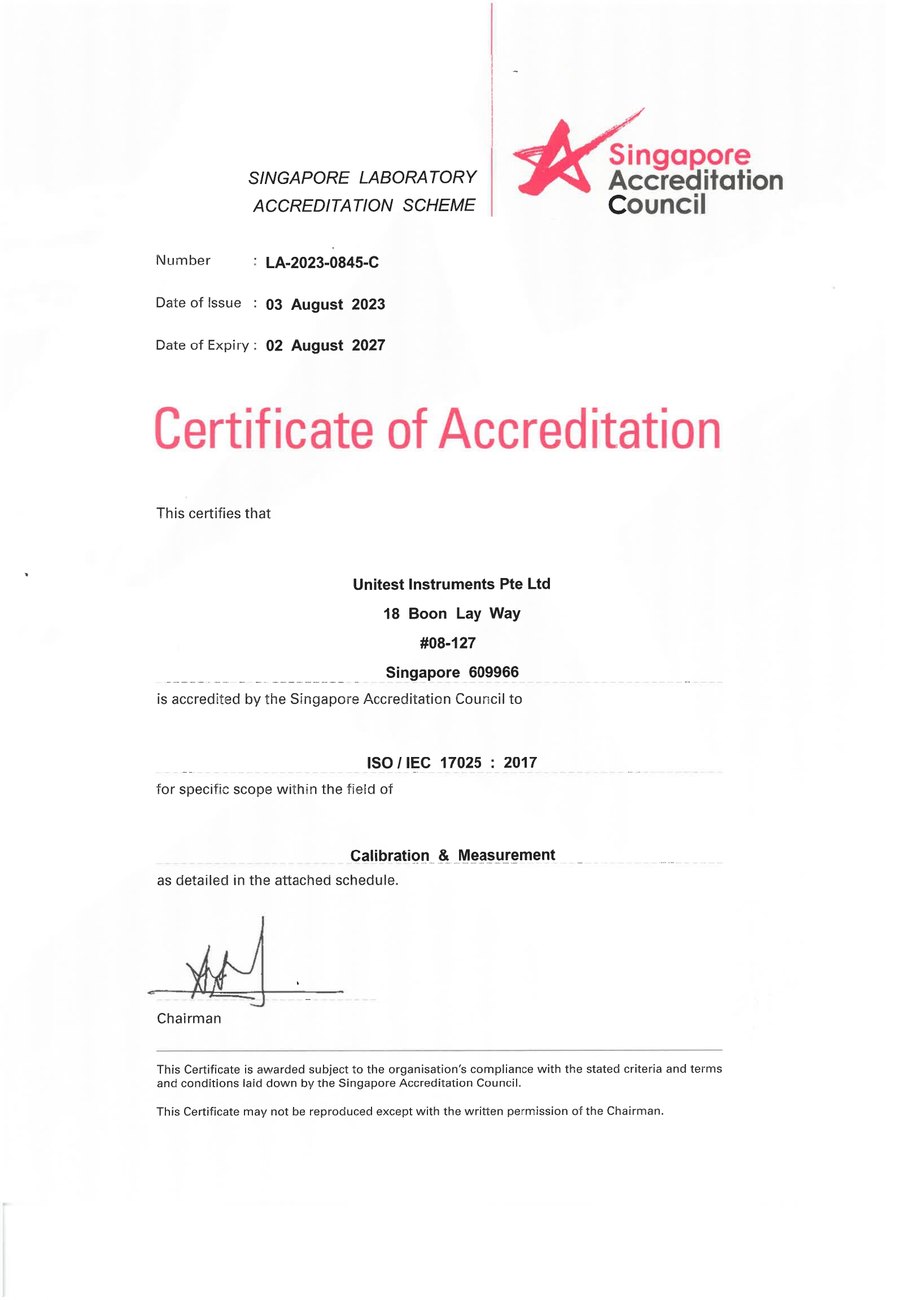
SAC-SINGLAS accredited calibration laboratory (Acc. No. LA-2023-0845-C) serving Singapore's industrial, pharmaceutical, and manufacturing sectors. All content reflects our ISO/IEC 17025 accredited scope and is reviewed by our technical calibration team.
Need acoustic instrument calibration in Singapore?
Unitest Instruments is SAC-SINGLAS accredited (Acc. No. LA-2023-0845-C) to ISO/IEC 17025. Same-week turnaround, certificates accepted by ISO 9001 auditors and MOM-appointed Noise Consultants.