
Key Takeaways
- 21 CFR Part 11 applies to any Singapore facility creating electronic environmental records for US-regulated products. Including temperature, humidity, pressure, and particle count data.
- Your environmental monitoring software must be formally validated (IQ/OQ/PQ) and maintain a tamper-evident, time-stamped audit trail covering all data entries, modifications, and alarm events.
- Access controls must enforce unique user IDs; shared login credentials are a direct Part 11 violation and a common FDA Warning Letter trigger.
- Monitoring instruments must be calibrated at defined intervals using SAC-SINGLAS accredited laboratories with NMC-traceable standards. The calibration record itself is an electronic record subject to Part 11.
- HSA's GMP Annex 11 (Computerised Systems) is substantively equivalent. Achieving Part 11 compliance covers both regulators simultaneously.
What is 21 CFR Part 11 and Why Does It Reach Singapore?
Title 21 of the US Code of Federal Regulations, Part 11, published by the Food and Drug Administration (FDA), establishes requirements for electronic records and electronic signatures in all FDA-regulated industries. Pharmaceuticals, biologics, medical devices, and food. The regulation was enacted in 1997 in response to the growing digitalisation of GMP documentation and has been reinforced by subsequent FDA guidance, most notably the 2003 Guidance for Industry on Scope and Application.
For Singapore, Part 11 is not a distant US concern. Any local manufacturer or contract laboratory that exports pharmaceutical finished products, active pharmaceutical ingredients (APIs), or medical devices to the United States is subject to FDA jurisdiction and therefore to Part 11 whenever electronic records are used in lieu of paper. The FDA routinely inspects Singapore facilities (the country is one of the US's top pharmaceutical suppliers), and Warning Letters citing Part 11 failures have been issued to APAC sites on multiple occasions.
Simultaneously, Singapore's Health Sciences Authority (HSA) mandates GMP compliance for all licensed manufacturers under the Health Products Act. HSA's GMP framework is based on the PIC/S Guide to GMP (PE 009), and Annex 11 of that guide (Computerised Systems), contains requirements that are substantively identical to 21 CFR Part 11. A Singapore facility that builds robust Part 11 compliance into its environmental monitoring systems therefore satisfies both regulators at once.
Scope: Which Environmental Records Are Covered?
Not every digital reading requires Part 11 compliance. The regulation applies when an electronic record is created, modified, maintained, archived, retrieved, or transmitted in place of a paper record that would otherwise be required under another FDA regulation. For environmental monitoring, the trigger regulations are primarily 21 CFR Part 211 (Current Good Manufacturing Practice for Finished Pharmaceuticals) and 21 CFR Part 820 (Quality System Regulation for medical devices).
In practice, the following environmental monitoring data types are almost always within Part 11 scope for regulated Singapore facilities:
- Temperature and humidity records for cleanrooms, cold rooms, stability chambers, and warehouses used for regulated products
- Differential pressure monitoring data for classified cleanroom cascades
- Airborne particle count data from online particle monitoring systems
- Microbial environmental monitoring logs where data is entered or managed electronically
- Alarm event logs. Including acknowledgements, excursion investigations, and corrective action records
- Calibration records for monitoring instruments, if managed within an electronic calibration management system
Records that are purely paper (handwritten logs never entered into a computer system), are outside Part 11 scope. However, if paper data is later scanned and the scanned image is the record of primary reliance, Part 11 may apply to the digital copy.
The Seven Core Requirements of 21 CFR Part 11
For facilities managers and compliance officers, Part 11 is best understood through its seven operational requirements. Each maps directly to specific controls that your environmental monitoring system must implement.
| Part 11 Requirement | CFR Reference | Environmental Monitoring Application | Common Gap Found at Inspection |
|---|---|---|---|
| System Validation | §11.10(a) | EMS software, SCADA, BMS, data loggers must have IQ/OQ/PQ documentation | Validation not repeated after software upgrade |
| Audit Trail | §11.10(e) | Every data entry, modification, and alarm event logged with user, timestamp, and reason | Audit trail disabled or overwritable by administrators |
| Access Controls | §11.10(d) | Unique user IDs, role-based permissions, no shared credentials | Generic "admin" login used by multiple operators |
| Operational System Checks | §11.10(f) | System enforces permissible sequencing of steps (e.g. cannot approve without completing review) | Workflow bypass possible via back-end database access |
| Authority Checks | §11.10(g) | Only authorised users can create, modify, or delete environmental records | Inadequate role segregation. Operators can edit alarm limits |
| Record Copies and Protection | §11.10(b)(c) | Records must be accurately retrievable throughout retention period; backups verified | Backup never tested for restoration; proprietary format unreadable after software retirement |
| Electronic Signatures | §11.50, §11.70 | Approval of alarm limit changes, OOS investigations, periodic reviews must be electronically signed | Signature not linked to record; copy-paste of signature possible |
Facilities that use cloud-based environmental monitoring platforms (increasingly common for multi-site Singapore operations), must additionally ensure that the cloud vendor's infrastructure is covered by a validated Computer System Validation (CSV) agreement and that data residency does not conflict with HSA's expectations for record access during inspection.
Need Part 11-compliant calibration certificates for your environmental monitoring instruments?
Unitest Instruments issues fully traceable calibration certificates accepted by FDA and HSA auditors. Same-week turnaround, on-site service available across Singapore.
Calibration Instrument Requirements Under 21 CFR Part 11
The calibration of environmental monitoring instruments sits at the intersection of Part 11 and 21 CFR Part 211.68 (Automatic, Mechanical, and Electronic Equipment), which requires that instruments used in GMP operations be adequately calibrated, inspected, and checked. The calibration records generated by this activity are themselves electronic records subject to Part 11 if managed in an electronic calibration management system (ECMS).
Traceability Requirements
Part 211.68 and FDA inspection standards require calibration traceability to national standards, in Singapore's case, to the National Metrology Centre (NMC) maintained by A*STAR. The practical pathway for Singapore facilities is to use a SAC-SINGLAS accredited calibration laboratory, whose accreditation scope and measurement traceability chain is formally recognised. As explained in our article on accredited vs non-accredited calibration, using a non-accredited supplier creates a documentation gap that FDA investigators will flag. The traceability chain cannot be substantiated without ILAC-MRA-recognised accreditation.
Calibration Intervals for GMP Environmental Monitoring
Neither Part 11 nor Part 211 prescribes fixed calibration intervals. The expectation is that intervals are determined based on instrument criticality, historical performance data, and manufacturer recommendations, and that the rationale is documented. For GMP environmental monitoring in Singapore, the following intervals are widely accepted by both FDA and HSA inspectors:
- Temperature sensors (cleanrooms, cold storage): every 6 to 12 months, with more frequent checks after any excursion or maintenance event
- Humidity sensors: every 6 to 12 months; humidity probes are more susceptible to drift and may require shorter intervals in high-humidity environments
- Differential pressure transmitters: every 6 to 12 months
- Particle counters: annually, with laser sensor validation per ISO 21501-4
- Data loggers used for transport monitoring: at least annually, or per manufacturer specification
Understanding how to set the right interval for your specific instruments is covered in detail in our guide on how often calibration should be performed. The key principle: the interval must be formally risk-assessed and documented. An arbitrary "once a year" without justification is insufficient for a Part 11 inspection.
What the Calibration Certificate Must Show
For Part 11 compliance, the calibration certificate itself (whether paper or electronic), must contain sufficient information to establish the instrument's fitness for use. A certificate that merely states "PASS" without reference data does not meet FDA expectations. As detailed in our article on reading a calibration certificate, a compliant certificate must include: the instrument identity and serial number, measurement results before and after adjustment (as-found and as-left data), the reference standards used and their traceability, the uncertainty of measurement, the calibration date and due date, and the signature of the authorised signatory. This level of detail is what SAC-SINGLAS accredited laboratories are required to provide under ISO/IEC 17025.
Step-by-Step Compliance Implementation for Singapore Facilities
Building Part 11 compliance into an environmental monitoring system is a project that typically spans three to six months for a mid-size Singapore pharmaceutical or medical device site. The following phased approach is aligned with both FDA guidance and HSA's expectations under Annex 11.
Phase 1: Gap Assessment (Weeks 1–4)
Conduct a formal gap assessment against the Part 11 requirements table above. Document the current state of your environmental monitoring system. Software version, validation status, audit trail configuration, user access roles, calibration records management, and backup procedures. This assessment becomes the baseline for your remediation plan and must itself be stored as a Part 11-compliant record if generated electronically.
Phase 2: System Validation (Weeks 4–12)
If your EMS software lacks IQ/OQ/PQ documentation, commission formal validation. Engage a qualified validation specialist or the software vendor's validation team. Ensure the validation protocol is approved before execution and that all deviations are documented and resolved. Cloud-hosted systems require a vendor audit and a formal agreement covering their quality management system, audit trail capabilities, and data recovery procedures.
Phase 3: Access Control Remediation (Weeks 4–8)
Implement unique user IDs for every operator. Disable shared or generic credentials. Define role-based access tiers (typically Read Only (operators), Write (supervisors), and Administrator (system managers)), and document the authorisation rationale in a User Access Matrix. Enable automatic session timeout and enforce password complexity and expiry policies consistent with your site's IT security standard.
Phase 4: Audit Trail Verification (Weeks 8–12)
Verify that your system's audit trail is enabled, tamper-evident, and captures all required fields (user, timestamp, original value, new value, reason for change). Test that administrator-level users cannot disable or modify the audit trail. Confirm that audit trail records are retained for at least as long as the underlying environmental records. Typically a minimum of one year beyond product expiry or two years after product distribution, whichever is longer under the applicable regulation.
Phase 5: Calibration Programme Formalisation (Weeks 8–16)
Document a calibration master plan for all environmental monitoring instruments within scope. For each instrument, record the calibration interval rationale, the accredited laboratory used, and the traceability chain. Ensure all current calibration certificates are on file and that overdue instruments are immediately quarantined from use in regulated operations until recalibrated. Integrate calibration due-date alerts into your electronic quality management system.
Phase 6: Electronic Signature Implementation (Weeks 12–20)
Identify all records requiring approval signatures under your GMP procedures. Alarm limit change approvals, OOS investigation sign-offs, periodic environmental review reports. Configure electronic signature controls in your EMS or quality management system. Submit the mandatory one-time declaration to FDA (per §11.100) certifying that electronic signatures are the legally binding equivalent of handwritten signatures. This is a simple letter submission but is frequently overlooked.
Phase 7: Training and SOPs (Weeks 16–22)
Update all relevant standard operating procedures to reflect the electronic system. Train all users on Part 11 requirements, including the prohibition on sharing credentials, the procedure for correcting electronic records (no deletions. Corrections must be additive and signed), and the escalation path for suspected data integrity incidents. Training records must be retained and are themselves subject to Part 11 if maintained electronically.
Penalties for Non-Compliance: What Singapore Facilities Risk
FDA enforcement for Part 11 violations is proportionate to the degree of risk posed to product quality and patient safety, but the consequences can be severe and commercially disruptive.
Warning Letters are the most common initial action. They are publicly published on FDA's website and require a formal response within 15 working days. A Warning Letter citing Part 11 failures in environmental monitoring systems signals to customers, auditors, and regulators that your data integrity posture is deficient, with downstream effects on audit outcomes and business relationships. Singapore facilities that have received Warning Letters have seen contract cancellations from US pharmaceutical customers within weeks of publication.
Import Alerts (also known as "detention without physical examination"), allow FDA to detain products from a flagged facility at the US border without individual shipment inspection. An Import Alert triggered by Part 11 findings can effectively block all US exports until the facility achieves compliance and receives a satisfactory follow-up inspection.
Consent Decrees are the most serious enforcement action, requiring the facility to cease certain manufacturing operations and submit to ongoing FDA oversight, often with mandatory third-party auditors at the facility's cost. These are reserved for systematic, repeated, or egregious violations, but inadequate audit trails and disabled access controls in environmental monitoring systems have contributed to Consent Decrees at APAC sites.
Under Singapore's Health Products Act, HSA has equivalent powers to suspend or revoke manufacturing licences, require product recalls, and pursue criminal prosecution where GMP violations (including data integrity failures), are found to endanger public health. Harmonising Part 11 compliance with Annex 11 compliance therefore protects against both enforcement regimes simultaneously.
Frequently Asked Questions
21 CFR Part 11 is a US FDA regulation governing electronic records and electronic signatures used in FDA-regulated industries. It applies to any Singapore facility that exports pharmaceutical, medical device, or biotech products to the United States or that is subject to FDA inspection. Including manufacturing sites, contract laboratories, and clinical trial facilities. Singapore's Health Sciences Authority (HSA) also references equivalent electronic records principles under its Good Manufacturing Practice (GMP) guidelines aligned to PIC/S Annex 11, so compliance is doubly relevant for local manufacturers.
Any environmental monitoring data captured electronically and used to demonstrate GMP compliance falls under Part 11 scope. This includes temperature and humidity records for cleanrooms, cold storage, and stability chambers; differential pressure monitoring; particle count data from online particle counters; microbial monitoring logs where data is entered electronically; and CO2 or oxygen levels in controlled atmospheres. If the record is created, modified, maintained, archived, retrieved, or transmitted electronically to support regulated activities, Part 11 applies.
An audit trail is a secure, computer-generated, time-stamped record that independently captures the date and time of operator entries and actions that create, modify, or delete electronic records. Under 21 CFR Part 11.10(e), audit trails must be retained for a period at least as long as required for the underlying records and must be available for review and copying by FDA investigators. For environmental monitoring systems, every data point, alarm acknowledgement, and calibration event must be logged with user identity, timestamp, and the reason for any change, and no record can be deleted or altered without a traceable audit entry.
21 CFR Part 11 itself does not specify calibration intervals. It governs the integrity of electronic records. Calibration requirements derive from 21 CFR Part 211 and Part 820, which require instruments to be calibrated at suitable intervals using standards traceable to national standards. In practice, temperature and humidity sensors in GMP environments are typically calibrated every 6 to 12 months. Singapore facilities exporting to the US should use SAC-SINGLAS accredited laboratories to obtain certificates traceable to the Singapore National Metrology Centre (NMC), which satisfies the FDA's traceability requirement.
FDA enforcement actions for Part 11 violations range from Warning Letters and Import Alerts (which can halt shipments from a Singapore facility to the US), to Consent Decrees requiring costly remediation and third-party oversight. Warning Letters citing inadequate audit trails or lack of access controls in environmental monitoring systems have been issued to international sites. HSA may also take action under Singapore's Health Products Act if equivalent local GMP standards are breached, potentially resulting in licence suspension, product recall, or prosecution.
Yes. Part 11.10(a) requires that systems used to create, modify, maintain, or transmit electronic records be validated to ensure accuracy, reliability, consistent intended performance, and the ability to discern invalid or altered records. For environmental monitoring, this means the data acquisition software, SCADA systems, or building management systems (BMS) must have documented Installation Qualification (IQ), Operational Qualification (OQ), and Performance Qualification (PQ) completed before use in regulated activities. Validation must be re-executed after any significant software upgrade or configuration change.
Electronic signatures in an environmental monitoring context are most commonly required for approval of alarm limit changes, calibration record reviews, out-of-specification (OOS) investigations, and periodic data review sign-offs. Under Part 11.50, each electronic signature must contain the full name of the signer, the date and time, and the meaning of the signature (e.g. review, approval). Signatures must be linked to their records so they cannot be excised, copied, or otherwise transferred. Facilities must also submit a one-time declaration to FDA certifying that electronic signatures are intended to be the legally binding equivalent of handwritten signatures.
HSA's GMP requirements for pharmaceutical manufacturers are based on the PIC/S GMP Guide (PE 009), which contains equivalent principles to 21 CFR Part 11 under Annex 11 (Computerised Systems). Both require validation, audit trails, access controls, data integrity, and backup/recovery procedures. A Singapore facility that achieves robust Part 11 compliance for its US-export operations will, in most cases, also satisfy HSA's computerised systems and data integrity expectations, since the underlying technical controls (tamper-evident audit trails, role-based access, validated software), are materially identical.
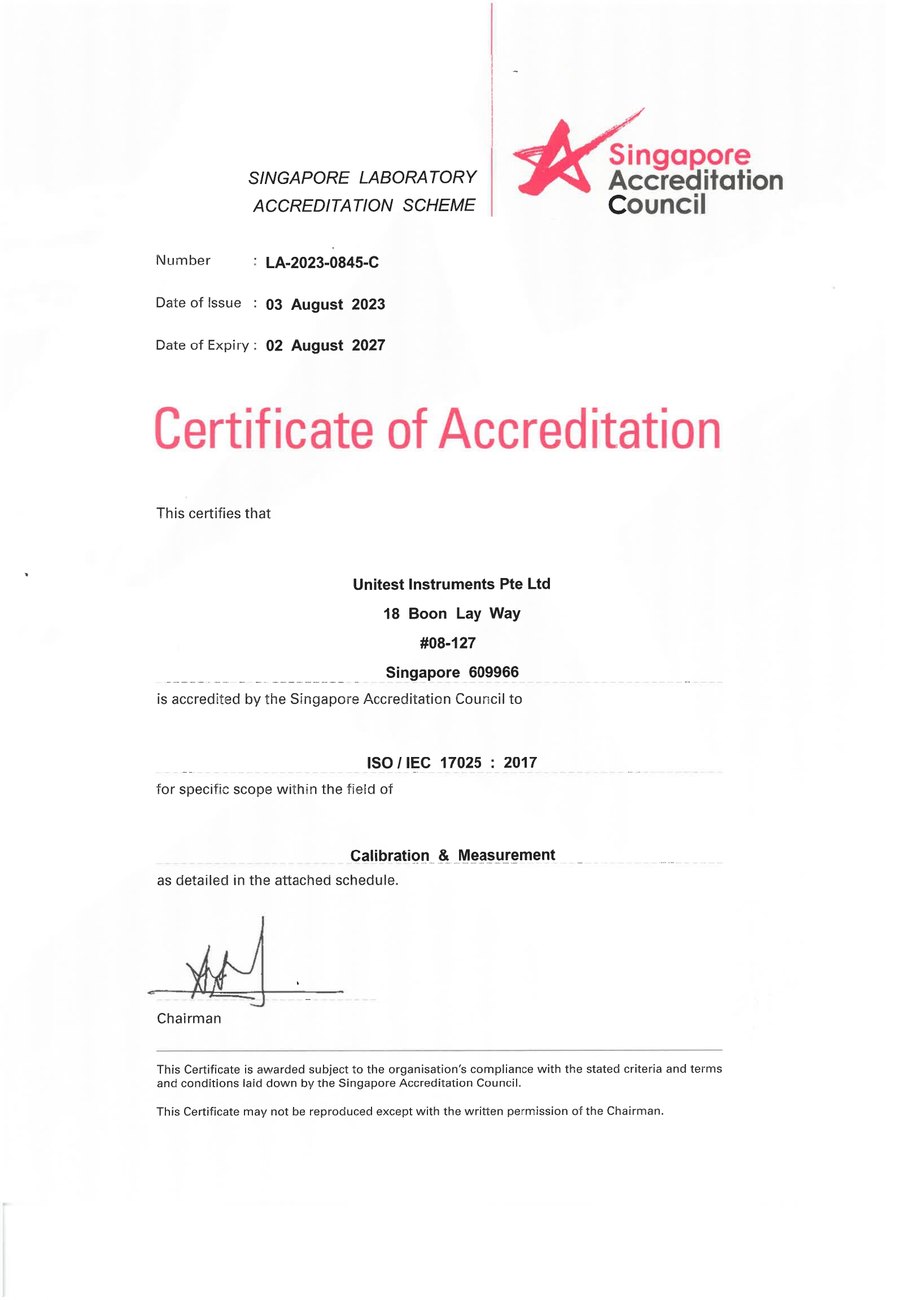
SAC-SINGLAS accredited calibration laboratory (Acc. No. LA-2023-0845-C) serving Singapore's industrial, pharmaceutical, and manufacturing sectors. All content reflects our ISO/IEC 17025 accredited scope and is reviewed by our technical calibration team.
Need GMP-compliant environmental monitoring calibration in Singapore?
Unitest Instruments is SAC-SINGLAS accredited (Acc. No. LA-2023-0845-C) to ISO/IEC 17025. Same-week turnaround, certificates accepted by FDA and HSA auditors.