
Key Takeaways
- Singapore's WSH (Noise) Regulations require measurement at or above 85 dB(A) TWA using a Type 1 or Type 2 IEC 61672-1 compliant instrument.
- Always choose an integrating (Leq-capable) meter. Instantaneous-only meters cannot calculate time-weighted averages for compliance.
- A-weighting [dB(A)] is mandatory for exposure assessment; C-weighting [dB(C)] is needed for hearing protector selection and impulse noise.
- Field calibration with an acoustic calibrator (94 dB or 114 dB) is required before and after every measurement session under WSH guidelines.
- Laboratory calibration by a SAC-SINGLAS accredited lab must be performed at least annually. Certificates from non-accredited workshops may not satisfy MOM or ISO 9001 auditors.
Who Needs a Sound Level Meter in Singapore?
Under the Workplace Safety and Health (Noise) Regulations 2011, any employer whose workers may be exposed to noise levels at or above 85 dB(A) as an 8-hour time-weighted average (TWA) is legally required to conduct a noise risk assessment. This is not a voluntary measure. Failure to assess, control, and monitor occupational noise is a WSH Act offence that can result in fines of up to S$500,000 or imprisonment.
The industries most commonly affected in Singapore include shipbuilding and ship repair at Jurong Island and Tuas yards, metal fabrication and press-work, semiconductor clean-room tool noise, construction (pile-driving, pneumatic tools), food and beverage processing lines, printing and packaging, and power generation facilities. Even office-adjacent workplaces (mechanical plant rooms, loading bays, and commercial kitchens), can breach 85 dB(A) thresholds when HVAC or catering equipment is running at full load.
Beyond WSH legal compliance, sound level meters are used for: product quality testing of motors and HVAC units, CONQUAS and BCA noise level assessments for building handover, environmental noise monitoring under the Environmental Protection and Management Act (EPMA), and ISO 45001 occupational health management system audits.
What to Look for When Buying a Sound Level Meter
Not all sound level meters are equal. Before shortlisting models, confirm they satisfy these core requirements for WSH noise work in Singapore:
IEC 61672-1 Type Classification
The international standard IEC 61672-1:2013 defines two classes of sound level meter. Type 1 instruments have tighter tolerances (±1.0 dB at 1 kHz reference) and are used when measurements may be challenged legally, when very high precision is needed, or when measuring near the permissible exposure limits where small errors have big compliance consequences. Type 2 instruments (±1.5 dB) are sufficient for routine occupational hygiene surveys and are significantly less expensive. Both types are accepted by MOM for WSH noise risk assessments.
Integrating (Leq) Capability
The key parameter for WSH compliance is the equivalent continuous sound level, Leq. The steady sound level that contains the same acoustic energy as the measured time-varying noise over the assessment period. Only an integrating sound level meter (sometimes called an "integrating-averaging" or "IEC 61672 integrating" meter) can calculate Leq directly. Standard non-integrating meters measure instantaneous SPL only and cannot produce the time-weighted averages that MOM requires in a noise risk assessment report.
Frequency Weighting: A and C
You need at least A-weighting [dB(A)]. The standard weighting that approximates the human ear's sensitivity and is specified in Singapore's WSH Noise Regulations for exposure limit compliance. C-weighting [dB(C)] is essential when selecting appropriate hearing protection equipment (HPE) (regulators specify that hearing protectors must achieve adequate attenuation from the C-weighted sound pressure level), and for impulsive noise characterisation. Many modern meters measure both simultaneously.
Data Logging and PC Connectivity
MOM's WSH guidelines expect noise risk assessors to retain time-history data that demonstrates measurement validity. A meter with internal data logging (storing Leq, Lmax, Lmin, and peak readings at configurable intervals) and PC software for report generation significantly reduces post-measurement documentation effort. Some meters also log octave-band spectra, which are needed when designing engineering noise controls.
Measurement Range and Dynamic Range
For typical industrial and construction environments in Singapore, a measurement range of 30–130 dB with a dynamic range (no range-switching required) of at least 80 dB is practical. Meters with auto-ranging eliminate the risk of over-range errors in unpredictably loud environments like shipyards or pile-driving sites.
Top Sound Level Meters Available Through Unitest
Unitest Instruments supplies and calibrates instruments from leading brands including Fluke, Amprobe, and Comark. The following models cover the range from entry-level Type 2 surveying to professional Type 1 dosimetry and noise mapping work.
| Model | Type | Key Specifications | Price Range (SGD) | Best For |
|---|---|---|---|---|
| Fluke 945 | Type 1 | 20–140 dB, A/C/Z weighting, Leq/Lmax/Lmin/Lpeak, octave bands, data logging, USB | S$2,800–3,400 | Professional WSH assessors, legal-grade measurements, octave-band analysis |
| Amprobe SM-20A | Type 2 | 30–130 dB, A/C weighting, Leq, Lmax, fast/slow response, data hold | S$480–620 | Routine industrial noise surveys, HVAC noise checks, safety officers |
| Fluke 931 | Type 2 | 35–130 dB, A weighting, Leq, Lmax, fast/slow, PC software included | S$680–820 | Maintenance teams, building services contractors, entry-level WSH surveys |
| Amprobe SM-10 | Type 2 | 35–130 dB, A weighting, max hold, fast/slow response, compact | S$260–340 | Screening surveys, spot checks, confined space noise pre-entry checks |
| Fluke 979 | Type 1 | 20–140 dB, A/C/Z weighting, Leq/TWA/dose, octave bands, Bluetooth data transfer, IP65 | S$4,200–5,000 | Shipyard and construction site hygienists, full ISO 9612 noise surveys, dusty/wet environments |
All models listed above are available for purchase through unitestshop.com. Unitest also offers a calibration-on-purchase service. Your new instrument ships with a valid SAC-SINGLAS calibration certificate ready for use on WSH assessments from day one.
Need your sound level meter calibrated for WSH compliance?
Unitest Instruments (Acc. No. LA-2023-0845-C) issues calibration certificates accepted by MOM, ISO 9001, and ISO 45001 auditors. Same-week turnaround available for most acoustic instruments.
Understanding Calibration Requirements for Noise Instruments
Purchasing the right instrument is only half the equation. A sound level meter that is not properly calibrated can produce readings that are systematically biased, in a noisy shipyard environment, a 2 dB error is the difference between a legally compliant workplace and one where workers are being overexposed without their employer knowing. Two levels of calibration apply:
Field Calibration (Before and After Each Session)
Before beginning any noise assessment, the sound level meter must be field-calibrated using a handheld acoustic calibrator. A device that generates a known, stable sound pressure level (typically 94.0 dB at 1 kHz, or 114.0 dB for higher-level calibrators). The meter reading is compared to the calibrator's reference level, and any offset is noted. If the offset exceeds ±1.0 dB for a Type 1 meter or ±1.5 dB for a Type 2 meter, the session must be paused and the instrument sent for laboratory recalibration. This field check is documented in the noise assessment report.
Laboratory Calibration (Annual, Traceable to NMC)
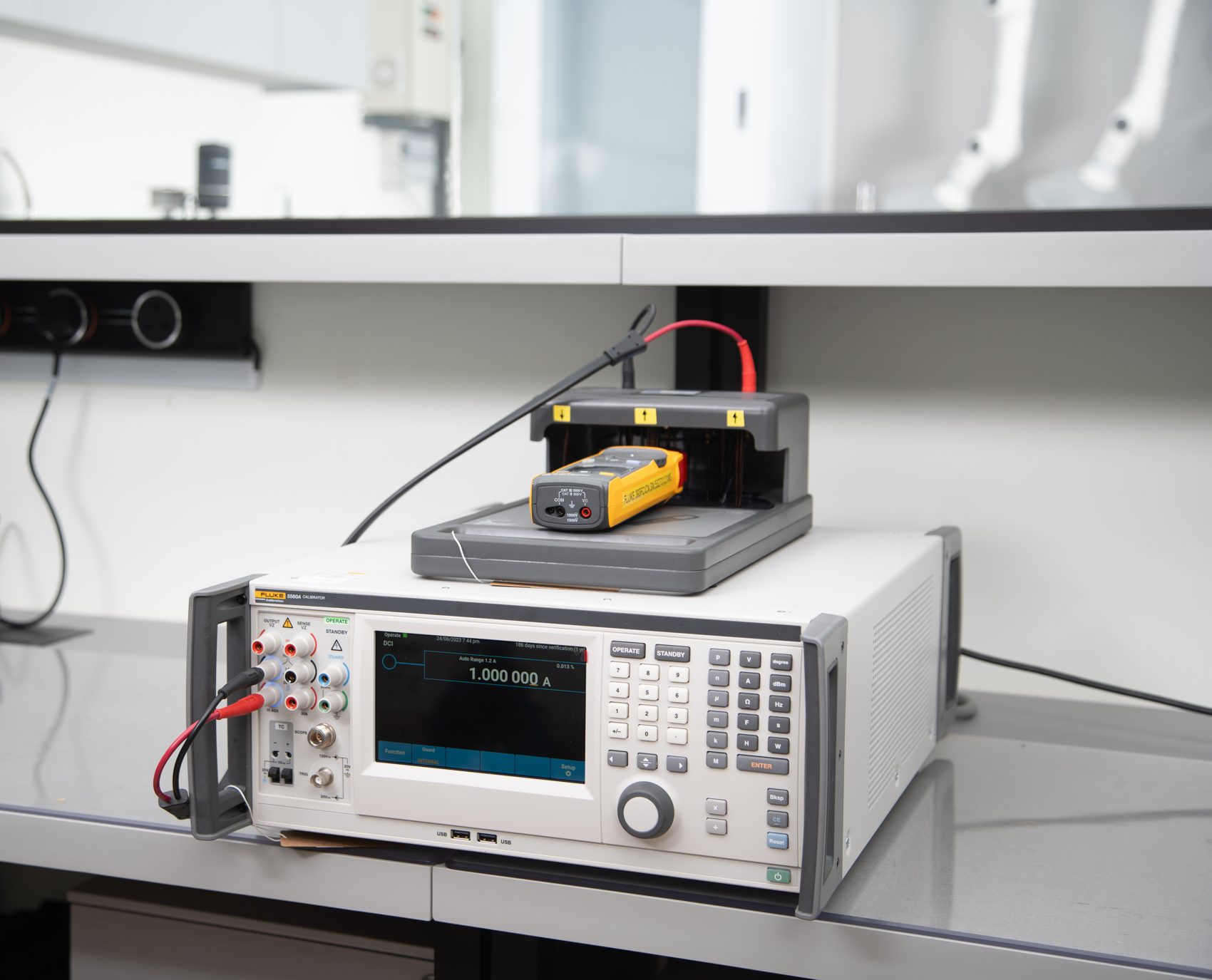
Full laboratory calibration of a sound level meter involves characterising its frequency response, linearity, time-weighting accuracy, and calibrator tracking across its full measurement range. This must be performed by an accredited laboratory using reference-standard equipment traceable to Singapore's National Metrology Centre (NMC) or equivalent national metrological institutes. As explained in our article on accredited versus non-accredited calibration, only certificates from SAC-SINGLAS accredited laboratories carry the formal traceability chain that MOM and ISO auditors expect.
Our guide to reading a calibration certificate explains the key fields you should check when receiving a certificate for your sound level meter. Including measurement uncertainty, reference conditions, and the accreditation scope statement. Unitest Instruments (Acc. No. LA-2023-0845-C) provides full acoustic instrument calibration with next-business-day certificate issuance for most instruments.
Singapore Standards and Regulations You Need to Know
Workplace noise in Singapore sits at the intersection of several regulatory frameworks. Understanding which applies to your industry and activities will help you specify the right instrument and calibration interval.
WSH (Noise) Regulations 2011
This is the primary legislation governing occupational noise exposure in Singapore, administered by the Ministry of Manpower (MOM). Key provisions: the 8-hour TWA exposure limit of 85 dB(A); peak sound pressure level ceiling of 140 dB(C); mandatory noise risk assessment for workplaces where 85 dB(A) TWA exposure may occur; hearing conservation programmes including audiometric testing; provision of adequate hearing protection; and engineering and administrative controls hierarchy. Regulations require the noise risk assessment to be reviewed at least once every three years or whenever there is a significant change to the work process.
SS 521:2011. Code of Practice on Noise Management in Workplaces
This Singapore Standard provides detailed technical guidance supplementing the WSH Noise Regulations. It specifies measurement methodology aligned with ISO 9612 (determination of occupational noise exposure), calibrator use requirements, uncertainty estimation, and reporting formats. SS 521 is the benchmark that competent WSH noise assessors and industrial hygienists follow when conducting assessments.
Environmental Protection and Management Act (EPMA)
Beyond the workplace, construction sites and industrial facilities must also comply with EPMA noise limits enforced by the National Environment Agency (NEA). EPMA limits apply at the boundary of the noise-generating activity rather than at the worker's ear, and they use different reference periods (day/evening/night). Some construction sites require both WSH occupational noise assessments (for workers) and NEA boundary noise monitoring (for neighbours). Often using the same sound level meter with different measurement positions and report formats.
Practical Tips for Your First Noise Assessment
For safety officers and WSH officers conducting noise assessments for the first time, or for teams upgrading from an old instrument to a compliant modern meter, these practical points will save time and avoid common errors:
- Position the microphone correctly. ISO 9612 specifies 0.2 m from the worker's ear closest to the dominant noise source, or at head height (1.0–1.6 m from the floor for standing workers) when the worker is not present. Using a tripod at the wrong height is one of the most common measurement errors in field surveys.
- Measure during representative conditions. The assessment must cover normal production rates and all relevant noise sources in operation. If a particularly loud machine is only used during one shift, that shift must be included in the measurement period.
- Use the correct time constant. For continuous noise, use "Slow" time-weighting (1-second averaging). For impulsive noise environments (presses, pile-driving, pneumatic tools), ensure your meter can capture peak C-weighted sound pressure level and that you enable "Fast" or "Impulse" response as appropriate.
- Document everything. MOM inspectors may request the original measurement data, not just the summary table. A meter with internal data logging and the ability to export time-history records to PDF or CSV provides a defensible audit trail.
- Recalibrate after transport. If your meter has been shipped, dropped, or stored in extreme temperatures, field-check it against your acoustic calibrator before use. Physical shock can shift the microphone sensitivity by several dB. Enough to cause a false-compliant reading in a genuinely hazardous environment.
From Measurement to Engineering Control: Using Octave-Band Data
A dB(A) reading tells you whether a workplace exceeds the exposure limit, but it does not by itself tell you how to fix the problem. This is where octave-band (or one-third octave-band) frequency analysis, available on Type 1 instruments like the Fluke 945 and 979, earns its place in a more capable meter, and understanding how to use this data separates a compliance-only noise survey from one that genuinely helps a facility reduce exposure.
Breaking a broadband noise measurement into its constituent frequency bands (typically 31.5 Hz to 8 kHz for occupational noise work) reveals which frequency range is actually driving the overall sound level, information a single dB(A) number cannot provide. A noise source dominated by low-frequency energy (large rotating machinery, compressors) responds very differently to engineering controls than one dominated by high-frequency energy (pneumatic tools, metal-on-metal impact), and selecting the wrong control measure, an acoustic enclosure designed for the wrong frequency range, or hearing protection with inadequate attenuation at the actual dominant frequency, wastes budget without meaningfully reducing worker exposure. Octave-band data is also essential for correctly specifying hearing protector attenuation using the octave-band method described in SS 521 and ISO 4869-2, a more accurate approach than relying on a hearing protector's single-number NRR rating alone, particularly for noise environments with an unusual spectral shape.
Integrating Noise Monitoring with a Hearing Conservation Programme
Noise measurement is only the first half of Singapore's WSH obligation; the Noise Regulations also require employers whose workers are exposed at or above the action level to run a formal hearing conservation programme, and the sound level meter data feeds directly into how that programme is designed and evidenced, a connection worth understanding when selecting and using an instrument.
The noise zones identified and quantified by the sound level meter survey determine which workers are enrolled in audiometric testing, which areas require mandatory hearing protection signage and enforcement, and which job roles trigger the noise induced deafness (NID) reporting requirements under the WSH (Incident Reporting) Regulations if a worker's audiometric results show a significant threshold shift. A survey that only produces a pass/fail compliance statement, without a properly documented noise zone map tied to specific work areas and job roles, leaves the WSH officer without the underlying data needed to correctly scope the hearing conservation programme that the regulation actually requires alongside the measurement itself. Building the noise zone map as a deliverable of the survey, not as an afterthought, is what turns a compliance measurement exercise into the operational tool the hearing conservation programme actually needs to function.
Renting vs Owning: A Practical Decision for Occasional Users
Not every organisation conducting a WSH noise assessment needs to own a sound level meter outright, and for facilities or consultants running only occasional surveys, the rent-versus-buy decision is worth a deliberate look rather than defaulting to purchase.
A single annual noise risk assessment, or a one-off survey following a change in a work process (which the regulations require you to reassess), may not justify the capital cost of a Type 1 instrument plus its ongoing annual calibration obligation, particularly for a smaller organisation with only one or two noise-affected work areas. Renting a calibrated instrument for the specific assessment period, available through several Singapore test-equipment rental houses, transfers the calibration currency responsibility to the rental provider and avoids the instrument sitting unused (and, in acoustic instruments, potentially drifting) for most of the year between assessments. For organisations running frequent surveys across multiple sites, quarterly hearing conservation programme reviews, or an internal WSH team conducting several assessments a year, ownership becomes the more economical and more practically convenient option, since the instrument is immediately available whenever a spot-check or unplanned assessment is needed rather than subject to rental scheduling. Either path is legitimate; the deciding factor is simply how frequently the organisation genuinely needs the instrument in hand.
Frequently Asked Questions
The Workplace Safety and Health (Noise) Regulations in Singapore require a Type 1 or Type 2 sound level meter (per IEC 61672-1) for occupational noise risk assessments. Type 1 instruments offer higher accuracy (±1.0 dB) and are preferred when measurements may be disputed or used in legal proceedings. Type 2 instruments (±1.5 dB) are acceptable for routine monitoring. Both must be calibrated before and after each measurement session using a certified acoustic calibrator.
Under Singapore's WSH Noise Regulations and international best practice, sound level meters should be field-calibrated before and after every measurement session using an acoustic calibrator (e.g. a 94 dB or 114 dB pistonphone). Full laboratory calibration traceable to national standards should be performed at least once every 12 months, or immediately after any physical shock, repair, or suspected drift. SAC-SINGLAS accredited laboratories like Unitest Instruments issue calibration certificates that satisfy MOM and ISO 9001 audit requirements.
Under the Workplace Safety and Health (Noise) Regulations 2011, workers in Singapore must not be exposed to noise exceeding 85 dB(A) as an 8-hour time-weighted average (TWA). The permissible exposure limit follows a 3 dB exchange rate, for every 3 dB increase above 85 dB(A), the allowable exposure time is halved. The absolute ceiling is 140 dB(C) peak sound pressure level. Employers must conduct a noise risk assessment if any worker is likely to be exposed to 85 dB(A) or above.
An integrating (or integrating-averaging) sound level meter measures and logs sound pressure levels over a defined period and calculates the equivalent continuous sound level (Leq). It is handheld and used by a hygienist to assess noise zones. A personal noise dosimeter is worn by the worker on their shoulder near the ear and records actual personal exposure over the full shift. Important when workers move between areas of different noise levels. For WSH compliance, personal dosimetry is often required when a worker's exposure zone cannot be adequately characterised by fixed-point measurements.
MOM's WSH guidelines specify that noise measurement instruments must be calibrated by an accredited laboratory. SAC-SINGLAS (Singapore Accreditation Council) accreditation under ISO/IEC 17025 is the recognised standard in Singapore. Calibration certificates from SAC-SINGLAS accredited labs (such as Unitest Instruments (Acc. No. LA-2023-0845-C)), are accepted by MOM enforcement officers, ISO 9001 auditors, and ISO 45001 certification bodies. Certificates from non-accredited workshops may not satisfy audit requirements.
Industries with the highest occupational noise risk in Singapore include shipbuilding and ship repair (Sembcorp, Keppel yards), metal fabrication and stamping, construction, semiconductor wafer fabrication (tool noise in clean rooms), food and beverage manufacturing, printing and packaging, and power generation. MOM's WSH statistics consistently identify manufacturing and marine industries as the sectors with the highest proportion of workers exposed to harmful noise levels above 85 dB(A).
No. Smartphone apps using the device's built-in microphone do not meet the IEC 61672-1 Type 1 or Type 2 accuracy requirements, cannot be calibrated to national standards, and their measurements are not legally defensible under Singapore's WSH Noise Regulations. Smartphone apps may be useful for rough screening to decide whether a formal assessment is needed, but any assessment submitted to MOM or used in a risk register must use a calibrated, IEC 61672-1 compliant sound level meter with a valid calibration certificate.
For a complete WSH noise assessment you typically need: (1) an acoustic calibrator (e.g. 94 dB or 114 dB pistonphone) for field verification before and after measurement; (2) a windscreen to reduce airflow noise in outdoor or ventilated areas; (3) a tripod or stand to position the microphone at the correct measurement position (1.0–1.6 m above floor for standing workers, 0.8 m for seated workers, per ISO 9612); (4) data logging capability or a PC interface to record time-history data; and (5) a valid calibration certificate for both the meter and the calibrator.
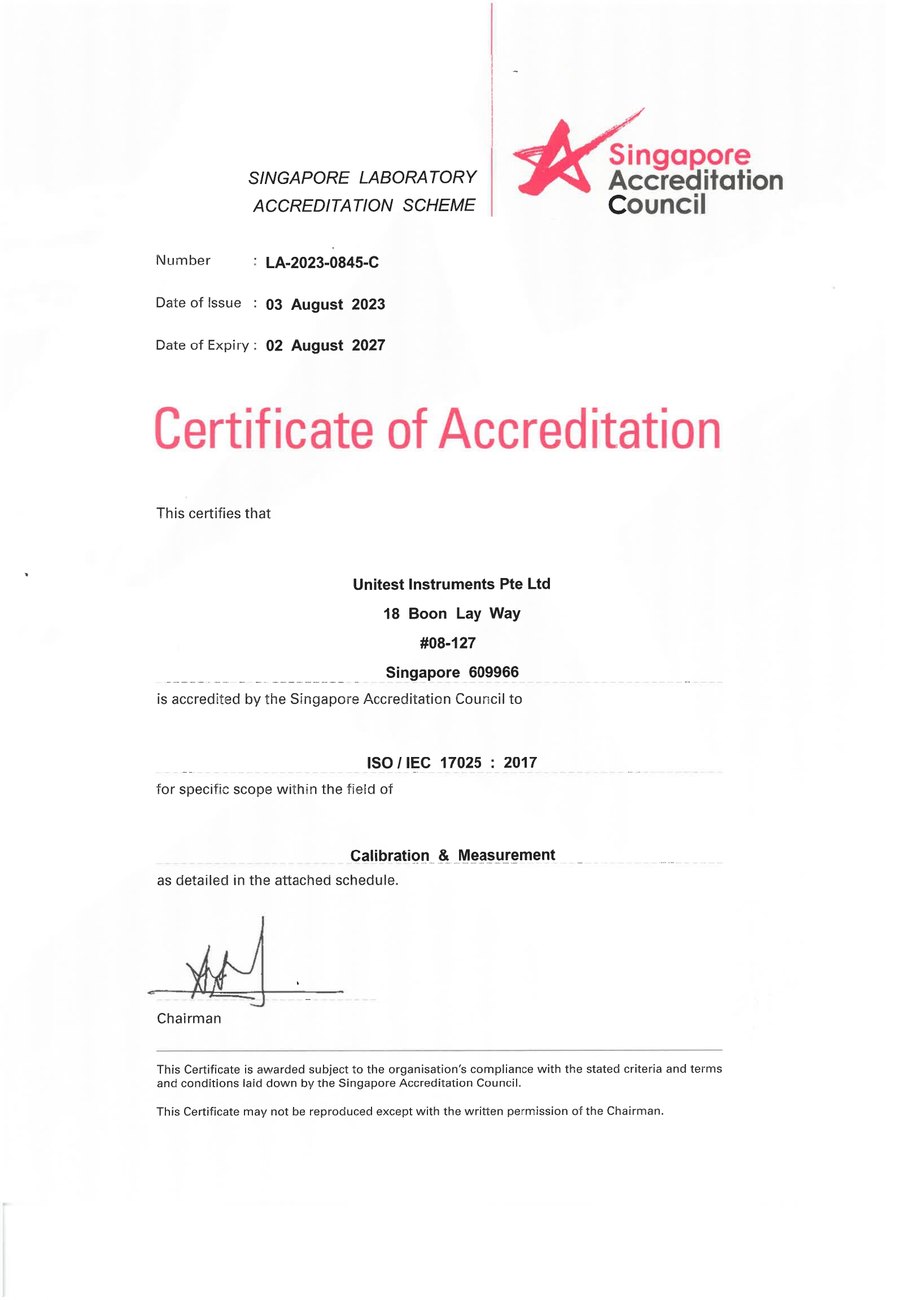
SAC-SINGLAS accredited calibration laboratory (Acc. No. LA-2023-0845-C) serving Singapore's industrial, pharmaceutical, and manufacturing sectors. All content reflects our ISO/IEC 17025 accredited scope and is reviewed by our technical calibration team.
Need acoustic instrument calibration in Singapore?
Unitest Instruments is SAC-SINGLAS accredited (Acc. No. LA-2023-0845-C) to ISO/IEC 17025. Same-week turnaround, certificates accepted by MOM, ISO 9001, and ISO 45001 auditors.