Key Takeaways
- Certification = third-party type testing against a published standard; produces a certificate with a defined scope and validity period.
- Qualification = design-phase environmental endurance testing; proves a cable design survives its intended service life conditions. Required in nuclear, defence, and critical-infrastructure applications.
- Verification = on-site or incoming-inspection electrical measurements (resistance, insulation, hi-pot) to confirm the correct, undamaged product was delivered and installed.
- Singapore's SS 299 (IEC 60331-based) governs fire-resistant cables; BS 6387 CWZ adds simultaneous mechanical shock. The two are not equivalent and should not be substituted without PE sign-off.
- Calibrated test instruments are legally required for verification measurements; an uncalibrated milliohm meter or insulation tester undermines the evidential value of the entire commissioning record.
1. Defining the Three Terms Precisely
In the electrical and construction industries, precision of language matters because regulators, auditors, and insurers interpret these words literally. Using "certified" when you mean "verified" (or "qualified" when you mean "certified"), can invalidate a commissioning record or create a compliance gap that surfaces only during a fire investigation or a PE endorsement review.
Cable Certification
Certification is the process by which an independent, accredited third-party body subjects a representative sample of a cable to standardised type tests and, upon passing, issues a certificate of conformity to a named standard. The certificate identifies: the exact cable construction tested (conductor cross-section, insulation material, sheath compound, overall diameter), the standard and edition tested against, the test date, the issuing laboratory's accreditation number, and the validity period (typically three to five years, subject to surveillance audits).
Key standards that require third-party certification before a certificate can be issued include: IEC 60332-1-2 (single-wire flame propagation), IEC 60332-3-22/24/25 (bunched-cable flame propagation categories A/B/C/D), IEC 60331-11/21/23/25/31 (circuit integrity under fire), and BS 6387:2013 (cables for high temperature with mechanical shock and water). In Singapore, SS 299:2016 Parts 1 and 2 mandate fire-resistant cable certification for essential-services wiring, referenced in the Singapore Code of Practice for Fire Precautions in Buildings (CP 10) and BCA circulars.
A certificate is a document about a specific cable design tested at a specific point in time. It does not guarantee that every reel of cable produced under that design is identical, that assurance comes from the manufacturer's quality management system (typically ISO 9001) and from incoming-inspection verification at site.
Cable Qualification
Qualification is a more extensive, design-phase endurance process used in high-consequence applications. Nuclear power plant instrumentation and control cables (per IEEE 323 / IEC 60780), offshore oil and gas fire survival cables (per IEC 60092-359), defence cabling, and certain rail-infrastructure applications. Qualification asks not just "does this cable pass a type test today?" but "will this cable maintain its specified performance after 40 years of radiation, temperature cycling, mechanical vibration, and then a design-basis accident?"
A qualification programme typically follows IEC 60068 (environmental testing methods) and involves: thermal ageing (often equivalent to 40–60 years of service life, accelerated using the Arrhenius model at elevated temperatures), radiation ageing (for nuclear applications, typically 200 kGy or more), mechanical seismic simulation, followed by the design-basis accident simulation (steam, temperature, pressure, chemical spray). Only cable designs that survive the full sequence are considered "qualified" for that application. Qualification is performed once per cable design and documented in a Qualification Test Report (QTR); if the design changes materially, re-qualification is required.
Most commercial and industrial building projects in Singapore do not require formal qualification. The term is sometimes misused to mean "we have a certificate," which is incorrect. If your specification mentions "qualified cables," clarify whether the author means type-tested (certified) or formally qualified per a named qualification standard.
Cable Verification
Verification is the measurement and inspection process carried out after cables are delivered to site and after installation, confirming that the physical product matches its specified and certified parameters. It is an ongoing, project-phase activity, not a one-time laboratory event. Verification answers: Did the correct cable arrive? Was it stored correctly? Was it pulled without damage? Does each circuit meet its electrical requirements before energisation?
Verification measurements typically include: conductor DC resistance per IEC 60228, insulation resistance (IR) at 500 V or 1000 V DC per IEC 60502, dielectric withstand (hi-pot), phase-to-phase and phase-to-earth continuity, and (for data cables), insertion loss, return loss, and NEXT per ISO/IEC 11801 or TIA-568. Results must be recorded, signed off, and retained as part of the project's commissioning O&M documentation.
2. The Physics and Chemistry Behind Cable Performance Standards
Understanding why cables require type testing (and why the tests are structured as they are), requires a look at the failure physics. Cables fail under fire or fault conditions through four main mechanisms: insulation decomposition, conductor resistance increase, dielectric breakdown, and structural collapse.
Insulation Decomposition
Polymer insulation (PVC, XLPE, LSOH/LSZH, silicone) begins to soften and decompose at temperatures that vary significantly by material. PVC insulation starts to soften around 80°C and loses mechanical integrity above 150°C; it releases HCl gas above ~200°C, a hazard in enclosed spaces. XLPE (cross-linked polyethylene) maintains better high-temperature mechanical properties due to the covalent cross-link network, retaining some integrity up to approximately 250°C. Silicone rubber insulation (used in fire-survival cables), can withstand continuous service at 180°C and retains circuit integrity in fire because it converts to a ceramic-like matrix (silicon dioxide) rather than liquefying. This ceramic residue supports the conductor and prevents shorts. The mechanism tested under IEC 60331 and SS 299.
Conductor Resistance and Temperature
Copper conductor resistance increases with temperature at a coefficient of approximately 0.393% per °C (α₂₀ = 0.00393 K⁻¹). A conductor measuring 1.000 Ω at 20°C will measure 1.393 Ω at 120°C, a 39% increase. This matters for verification because IEC 60228 specifies maximum conductor resistance at 20°C, but site measurements are typically taken at ambient temperature (often 28–35°C in Singapore). Technicians must apply a temperature correction factor: R₂₀ = R_meas / [1 + 0.00393 × (T_meas − 20)]. An uncorrected reading on a 35°C day will overstate resistance by approximately 5.9%, potentially causing a compliant conductor to appear marginal.
Dielectric Strength and Humidity
Insulation resistance (IR) is highly sensitive to temperature and moisture. IR halves for approximately every 10–12°C rise in conductor temperature (for most polymer insulations), and absorbed moisture can reduce IR by several orders of magnitude. In Singapore's humid climate (relative humidity typically 70–90%), cables stored outdoors without end-caps can absorb sufficient moisture to give IR readings below specification even before any fault. A common source of false-fail outcomes during commissioning. Testing cables immediately after pulling (when conductor is warm from friction), or in wet conditions, without applying the standard temperature correction and IR-moisture-correction procedures, produces unreliable results.
3. Singapore Regulatory Context: Which Standards Apply Where
| Application | Governing Standard | Certification Required | Relevant Authority |
|---|---|---|---|
| Fire alarm / emergency lighting wiring | SS 299:2016 Pt 1 & 2 (IEC 60331) | Yes. Third-party cert mandatory | SCDF / BCA |
| Low-voltage building wiring (general) | SS 638 (harmonised IEC 60364) | Manufacturer declaration; SAC-approved mark preferred | EMA / BCA |
| Bunched cable flame retardancy | SS EN 60332-3-22 (Category A) | Yes. Type test required for plenum/riser | BCA / SCDF |
| High-rise essential services (above 24 m) | CP 10 / SS 299 + BS 6387 CWZ (if specified) | Yes. Both cert and site verification required | SCDF / QP/PE |
| Shipboard / marine cables | IEC 60092-350 series / MAS / class rules | Class society type approval required | Class society (BV/DNV/LR) |
| Data / structured cabling (Cat 6A / Cat 8) | SS EN 50173 / TIA-568 | Channel performance verified by certified installer | Project spec / IMDA |
The key regulatory point for Singapore practitioners: the Building Control Act and the Electricity Act both require that electrical installations comply with the relevant Singapore Standards, which in turn reference IEC test standards. Non-certified cables used in fire-protection circuits can result in prosecution of the Qualified Person (QP) and the contractor under the Fire Safety Act, and void fire insurance coverage for the building owner.
Need calibration for your cable test instruments?
Unitest Instruments calibrates milliohm meters, insulation resistance testers, hi-pot sets, and LCR bridges to ISO/IEC 17025 accredited standards. Certificates accepted by BCA, SCDF, and ISO 9001 auditors. Same-week turnaround available.
4. Measurement Methods for Cable Verification
Site verification measurements require calibrated instrumentation and correct methodology. The four primary electrical tests are described below with the specific parameters that determine pass/fail.
DC Conductor Resistance (IEC 60228)
DC resistance is measured using a calibrated milliohm meter or micro-ohmmeter (four-wire Kelvin method to eliminate lead resistance error). IEC 60228 specifies maximum resistance values at 20°C for each conductor cross-section: for example, a 2.5 mm² Class 1 solid copper conductor must not exceed 7.41 Ω/km at 20°C, and a 10 mm² Class 2 stranded conductor must not exceed 1.83 Ω/km. Measurements on a reel are straightforward; on an installed circuit, loop resistance is measured (phase + return) and halved, then temperature-corrected to 20°C. As noted above, a 1% error in the temperature correction factor translates directly to a 1% error in resistance, which matters when margins are tight. For detailed guidance on how calibration uncertainty flows through to measurement results, see our article on measurement uncertainty in calibration.
Insulation Resistance (IEC 60502 / IEC 60364-6)
Insulation resistance (IR) is measured by applying a DC test voltage between the conductor and earth (or between conductors) and measuring the resulting leakage current. LV cable IR is typically measured at 500 V DC (for systems up to 500 V) or 1000 V DC (for 1 kV-rated cables). The minimum acceptable IR varies by standard and application: IEC 60364-6 requires IR ≥ 0.5 MΩ for LV final circuits, while many cable manufacturers specify ≥ 100 MΩ·km for new cables. Note the distinction: the IEC minimum is a commissioning pass/fail threshold; the manufacturer's value is a quality expectation for new product. A reading of 2 MΩ on a new cable is technically a commissioning pass but should be investigated. It may indicate moisture ingress or a splice fault.
High-Voltage Withstand (Hi-Pot)
Dielectric strength testing applies an elevated AC or DC voltage for a defined duration to confirm the insulation's ability to withstand transient overvoltages. For 600/1000 V rated LV cables, the factory acceptance test per IEC 60502-1 applies 3.5 kV AC for 5 minutes. Field hi-pot testing of installed cables is less common for LV systems but is standard practice for MV cables (3.6/6 kV and above), where a DC hi-pot at 1.5–2× rated voltage is applied for 15 minutes and leakage current monitored. The leakage current trend during the test (whether it increases, stabilises, or drops) is diagnostically important. A rising trend indicates a degraded or moisture-contaminated insulation system even if the current remains below the absolute pass threshold.
Structured Cabling Channel Tests (ISO/IEC 11801 / TIA-568)
For data and communications cables, verification goes beyond basic DC tests. A channel certification test using a Level III field tester (e.g. Fluke DSX-8000 or equivalent) measures: wiremap (correct pin termination), length (via time-domain reflectometry), insertion loss, NEXT (near-end crosstalk), FEXT, return loss, and propagation delay skew. Cat 6A channel limits at 500 MHz include: insertion loss ≤ 35.0 dB, ANEXT ≤ 39.9 dB. The test result is a Pass/Fail/Marginal against the category specification for a 100 m permanent link or up to 100 m channel. Calibrated field testers must be returned to the manufacturer for calibration on a 12-month cycle to maintain their Level III accuracy class. An expired calibration status invalidates the channel pass record.
5. Common Mistakes and How to Avoid Them
These errors are encountered frequently during cable inspection, commissioning, and compliance audits in Singapore and the wider region.
Mistake 1: Accepting a "Certified" Cable Without Checking Certificate Scope
A fire-resistant cable certificate issued to IEC 60331-11 (rated 750°C for 90 minutes, no mechanical shock) does not satisfy a specification requiring BS 6387 Category CWZ (750°C for 3 hours, plus water spray, plus mechanical shock simultaneously). The former is a less demanding test. Always read the certificate's "tested to" clause, not just the headline "fire resistant" claim on the datasheet. Similarly, a certificate for a 1.5 mm² cable does not cover a 2.5 mm² cable of the same brand, iec type tests are construction-specific.
Mistake 2: Performing IR Tests on Warm or Wet Cables
As discussed in the physics section above, IR is temperature- and humidity-dependent. Testing cables immediately after they have been pulled through conduit in a tropical climate (conductor temperature 40–50°C from friction and ambient) will give artificially low IR readings. Standard practice is to allow cables to stabilise to ambient temperature before testing, record the conductor temperature at the time of measurement, and apply the temperature correction factor per the manufacturer's published data or IEC 60502 guidance. Failing to do this is the most common cause of spurious IR fail results on new installations.
Mistake 3: Using an Uncalibrated or Expired Instrument
An insulation resistance tester or milliohm meter that has not been calibrated within its recommended interval may have drifted beyond its specified accuracy. A ±2% accuracy instrument that has drifted by 5% will give readings that appear to pass when the cable is at margin. If this is later discovered during an audit, the entire commissioning dataset for circuits tested with that instrument must be re-evaluated. The cost of re-testing installed and commissioned circuits far exceeds the cost of regular instrument calibration. As explained in our guide on what a calibration certificate tells you, the certificate records the actual error found, not just a pass/fail. Allowing you to assess whether any measurements taken during that interval were materially affected.
Mistake 4: Confusing "LSOH" and "Fire Resistant" as Synonyms
Low-Smoke Zero-Halogen (LSOH / LSZH) refers to the sheath and insulation compound's combustion by-product properties. It describes what the cable emits when it burns, not whether it maintains circuit integrity during a fire. An LSOH cable that is not also fire-resistant (per IEC 60331 or SS 299) will lose circuit function at elevated temperatures despite producing less smoke and no HCl. Fire alarm and emergency power circuits require fire-resistant and LSOH construction. Both properties, not one or the other.
Mistake 5: No Baseline Verification After Pull
Many projects measure IR at drum (before installation) and at final commissioning (after termination), but skip the measurement immediately after pull and before termination. This intermediate measurement is critical for identifying installation damage (cuts, crush damage, or excessive bend radius), before the conduit is concealed. Adding this step costs very little time during installation but avoids the significant rework cost of discovering a damaged circuit only at final commissioning.
6. The Role of Calibrated Instruments in the Certification Chain
Calibration sits at the base of the cable compliance chain. Consider the chain of evidence: a cable receives its IEC 60332 type-test certificate from an accredited laboratory, that laboratory's furnaces, thermocouples, and measurement equipment must be calibrated to traceable national standards, or the test result has no metrological validity. On site, the instruments used for commissioning verification must likewise carry valid calibration certificates to make the site measurements defensible. The concept of measurement traceability (the unbroken chain of calibrations connecting a field instrument to national and international measurement standards), is what gives each measurement its evidentiary standing in a compliance or insurance context.
In Singapore, the national measurement standards are maintained by the National Metrology Centre (NMC) under A*STAR. SAC-SINGLAS accredited calibration laboratories like Unitest Instruments are audited to ISO/IEC 17025 and must demonstrate that their reference standards are traceable to NMC (or to equivalent national metrology institutes via BIPM/CIPM mutual recognition arrangements). When you receive a calibration certificate from an SAC-SINGLAS accredited laboratory bearing accreditation number LA-2023-0845-C, that certificate is recognised by regulators, auditors, and courts as evidence of traceable, technically valid measurement.
The calibration interval for cable test instruments depends on type and use intensity. Insulation resistance testers and continuity meters in active site use should be recalibrated on a 12-month cycle at minimum, and before any critical commissioning project if the last calibration was more than six months prior. High-precision milliohm meters used for IEC 60228 conductor resistance measurements may warrant a 6-month interval if used daily in a high-temperature environment. See our comprehensive guide on calibration interval selection for a risk-based framework for determining the right interval for your equipment.
Frequently Asked Questions
Cable certification is a third-party conformity assessment confirming that a cable product meets a defined standard (e.g. IEC 60332, SS 299, or BS 6387). It results in a certificate issued by an accredited test body. Cable qualification is a design-phase process (typically per IEC 60068 or nuclear/defence standards), proving that a cable's construction survives specific environmental extremes (temperature cycling, radiation, vibration) over its intended service life. Qualification is usually performed once per cable design; certification may be renewed periodically. The two terms are not interchangeable.
Cable verification on a construction project is the on-site or incoming-inspection process of confirming that the cables actually delivered and installed match the certified or qualified specification. Typical verification checks include: conductor resistance per IEC 60228, insulation resistance, voltage withstand (hi-pot), continuity, and labelling against the approved cable schedule. Verification does not re-run the type tests; it checks that the correct product arrived and was not damaged in transit or installation.
SS 299:2016 (Parts 1 and 2) is the primary Singapore standard for fire-resistant cables, covering cables that must maintain circuit integrity under fire conditions. It is aligned with IEC 60331. For fire-retardant (flame-propagation) cables, SS EN 60332-1-2 and SS EN 60332-3-22/24/25 apply. The BCA and SCDF reference these standards in their fire safety requirements for essential services wiring such as emergency lighting, fire alarm, and life-safety circuits.
No. BS 6387:2013 (Cables for use in high temperature conditions) is a British Standard specifying performance under fire, water spray, and mechanical shock simultaneously. It uses a three-letter classification code (e.g. CWZ). SS 299 is the Singapore Standard for fire-resistant cables based on IEC 60331, which tests circuit integrity only under a defined fire curve without simultaneous mechanical shock. Some Singapore projects accept BS 6387 CWZ-rated cables for critical circuits, but you should confirm with your PE and the relevant authority (BCA/SCDF) which standard is required for your specific application.
Electrical verification of cables typically covers: (1) DC conductor resistance per IEC 60228 (measured in Ω/km at 20°C; (2) insulation resistance), typically >100 MΩ·km for LV cables, measured at 500 V or 1000 V DC; (3) high-voltage withstand (hi-pot). AC or DC dielectric test per IEC 60502 or manufacturer spec; (4) continuity check; (5) capacitance and inductance for signal/data cables. Each measurement requires a calibrated instrument traceable to national measurement standards to ensure the results are defensible.
Yes, directly. If the milliohm meter, insulation tester, or hi-pot set used during acceptance testing is not calibrated with traceable uncertainty, measured values carry unknown error. A reading that appears to pass may actually fail once measurement uncertainty is accounted for. ISO/IEC 17025 accredited calibration ensures that test equipment uncertainty is characterised and within the limits required by the relevant cable standard, protecting both the contractor and the client from false-pass outcomes.
Recalibration interval depends on instrument type, usage frequency, and the risk consequence of a false reading. For insulation resistance testers and milliohm meters used on critical circuits (fire alarm, emergency power), a 12-month interval is the most common industry practice, consistent with ISO/IEC 17025 guidance. High-use site instruments or those subjected to drops or harsh conditions should be recalibrated before each project phase, or whenever a reading appears anomalous. Your instrument's calibration certificate should state the recommended interval.
Yes, and this is a common source of confusion. Certification (type testing) evaluates a cable sample under extreme, standardised conditions. A fire test at 750°C for 90 minutes, for example. Site verification tests the installed cable's electrical properties at ambient conditions. A cable that lacks a valid fire-test certificate will pass an insulation resistance test on site because that test does not evaluate fire performance. This is why regulators require both: a valid certification document at procurement, and site verification measurements at installation. One does not substitute for the other.
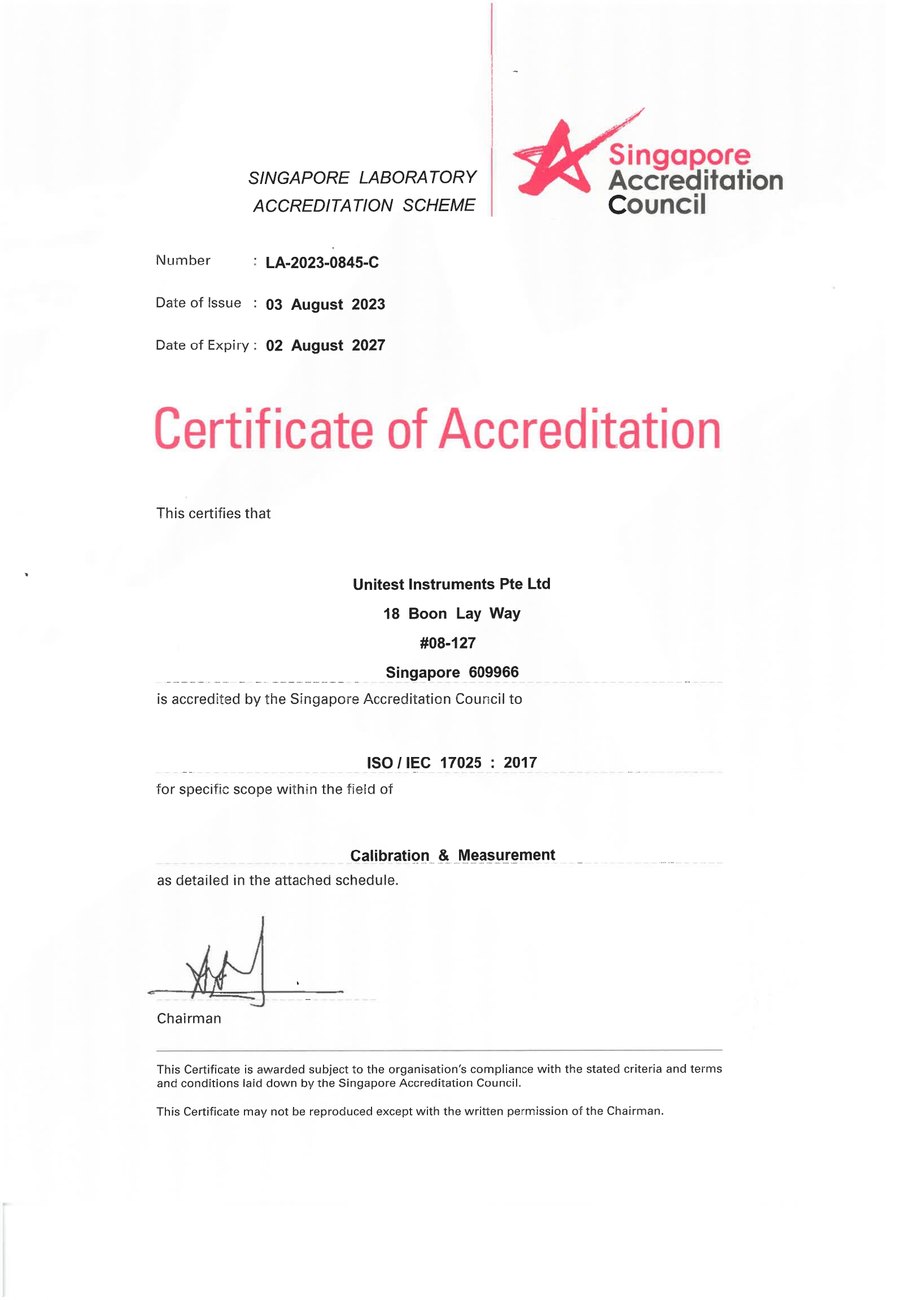
SAC-SINGLAS accredited calibration laboratory (Acc. No. LA-2023-0845-C) serving Singapore's industrial, pharmaceutical, and manufacturing sectors. All content reflects our ISO/IEC 17025 accredited scope and is reviewed by our technical calibration team.
Need cable instrument calibration in Singapore?
Unitest Instruments is SAC-SINGLAS accredited (Acc. No. LA-2023-0845-C) to ISO/IEC 17025. We calibrate insulation resistance testers, milliohm meters, hi-pot sets, and structured cabling field testers. Same-week turnaround, certificates accepted by ISO 9001 auditors.