
Key Takeaways
- ISO 14644-1 defines nine cleanliness classes (ISO 1 to ISO 9) based on airborne particle concentration limits at specified particle sizes.
- Singapore's HSA GMP guidelines reference ISO 14644 directly. Pharmaceutical cleanrooms must be classified, monitored, and re-verified on a defined schedule (every 6 or 12 months depending on class).
- MOM, BCA, and NEA each carry obligations that affect cleanroom design, operation, and hazardous-substance handling, compliance is not HSA-only.
- All instruments used in classification testing (particle counters, anemometers, differential pressure gauges, temperature/humidity sensors) must carry calibration certificates traceable to national standards.
- SAC-SINGLAS accredited calibration certificates (such as those issued by Unitest Instruments, Acc. No. LA-2023-0845-C) satisfy HSA and ISO 9001 auditor requirements for metrological traceability.
What ISO 14644 Actually Requires
ISO 14644 is not a single document. It is a suite of standards, each addressing a different aspect of cleanroom design, operation, and verification. The three parts most directly relevant to certification in Singapore are:
- ISO 14644-1:2015. Classification of air cleanliness by particle concentration. This part defines the nine ISO classes and prescribes the statistical sampling methodology used to classify a cleanroom.
- ISO 14644-2:2015. Monitoring to provide evidence of cleanroom performance related to air cleanliness by particle concentration. This part governs the ongoing monitoring programme, including sampling frequency and response to excursions.
- ISO 14644-3:2019, test methods. This part specifies the test procedures for airflow, air pressure difference, installed filter system integrity, recovery, containment, and other performance parameters used during classification and re-verification.
Additional parts cover cleanroom design (ISO 14644-4), operations (ISO 14644-5), and biocontamination (ISO 14644-9), among others. However, for the purposes of regulatory certification in Singapore, Parts 1, 2, and 3 form the core compliance framework that auditors will examine.
The nine ISO classes are defined by the maximum permitted concentration of particles at or larger than specified sizes. ISO Class 1 is the cleanest, permitting only 10 particles per cubic metre at ≥0.1 µm, while ISO Class 9 is the least restrictive at 35,200,000 particles/m³ at ≥0.5 µm. Broadly equivalent to ambient room air. Most pharmaceutical manufacturing environments in Singapore fall between ISO Class 5 and ISO Class 8.
| ISO Class | Max particles/m³ ≥0.5 µm | Max particles/m³ ≥5 µm | Typical Singapore application | Re-verification interval |
|---|---|---|---|---|
| ISO 5 | 3,520 | 29 | Aseptic filling, critical zone (Grade A/B) | Every 6 months |
| ISO 6 | 35,200 | 293 | Aseptic preparation background | Every 12 months |
| ISO 7 | 352,000 | 2,930 | Sterile filling background (Grade C) | Every 12 months |
| ISO 8 | 3,520,000 | 29,300 | Non-sterile pharma, medical device assembly (Grade D) | Every 12 months |
Singapore's Regulatory Landscape for Cleanrooms
Unlike some jurisdictions where a single agency governs cleanroom requirements, Singapore distributes oversight across several bodies. Facilities managers need to understand which agencies have jurisdiction over their specific operations before embarking on certification.
Health Sciences Authority (HSA)
HSA is the primary driver of cleanroom certification requirements for pharmaceutical manufacturers, medical device manufacturers, and health product importers. HSA's GMP guidelines (which align with the Pharmaceutical Inspection Co-operation Scheme (PIC/S) Guide to GMP), require cleanrooms used in manufacture or packaging of sterile and non-sterile health products to be formally classified to ISO 14644-1 standards. A valid classification report, current monitoring data, and evidence of instrument calibration are all standard items on an HSA GMP inspection checklist. Failure to maintain a classified and monitored cleanroom can result in HSA issuing a Non-Conformance Report (NCR), requiring corrective action within a defined timeframe, or in severe cases suspending the manufacturer's GMP licence under the Health Products Act.
Ministry of Manpower (MOM)
MOM's jurisdiction over cleanrooms stems from the Workplace Safety and Health Act (WSHA) and its subsidiary regulations, particularly the Workplace Safety and Health (General Provisions) Regulations and the Factories (Noise) Regulations. Cleanroom environments that involve chemical fume exposure, biological hazards, or noise from HVAC and process equipment fall under MOM's purview. Facilities managers must ensure that risk assessments cover cleanroom-specific hazards such as chemical exposure from solvents used in cleaning, slip risks from epoxy floors, and ergonomic factors associated with gowning requirements. MOM enforcement officers have powers to issue improvement notices and, where there is imminent danger, prohibition notices that halt operations immediately.
Building and Construction Authority (BCA)
BCA governs the physical construction of cleanroom facilities. Cleanrooms typically involve specialist M&E systems including high-efficiency particulate air (HEPA) filtration, controlled HVAC with specific air change rates, raised access floors, and specialist wall and ceiling systems. Any construction or major modification of cleanroom infrastructure requires BCA-compliant permits and, where relevant, a Qualified Person (QP) sign-off. BCA also enforces the Code on Accessibility to enable persons with disabilities. A factor relevant to cleanroom facility design where gowning lobbies and airlocks must remain navigable.
National Environment Agency (NEA)
Where cleanrooms handle scheduled chemicals, biological agents, or generate controlled waste streams, NEA requirements under the Environmental Protection and Management Act (EPMA) and the Radiation Protection Act apply. Pharmaceutical cleanrooms that discharge chemical effluent must comply with NEA's trade effluent limits. Cleanrooms using ionising radiation equipment (such as those in medical device sterilisation), additionally fall under the Singapore Nuclear Science and Technology Act administered through the National Environment Agency and the Singapore Nuclear Science and Technology Department.
Need calibration certificates accepted by HSA auditors?
Unitest Instruments (Acc. No. LA-2023-0845-C) calibrates particle counters, anemometers, differential pressure gauges, and temperature/humidity instruments for cleanroom classification. Same-week turnaround available across Singapore.
Step-by-Step Compliance Process
Achieving ISO 14644 certification for a Singapore cleanroom is a structured process. The following sequence applies whether you are certifying a new facility or re-certifying an existing one.
Step 1. Define the cleanroom classification requirement
Before any testing begins, the facility must document the required ISO class for each zone, the occupancy states (at rest and in operation) that will be classified, and the particle sizes to be measured. For pharmaceutical facilities, this determination is driven by the GMP grade (A through D) required for each manufacturing activity. The classification requirement should be captured in a Validation Master Plan or a Cleanroom Qualification Protocol, which forms the basis for all subsequent testing and documentation.
Step 2. Ensure instruments are calibrated before classification testing
This step is frequently underestimated. ISO 14644-1 requires that instruments used in classification testing be calibrated. ISO 21501-4 specifically governs the calibration of airborne particle counters, requiring calibration at the particle sizes used in classification. Differential pressure gauges used to verify airlocks, anemometers used to measure air velocity, and temperature/humidity sensors used to characterise environmental conditions must all carry valid calibration certificates before testing commences.
In Singapore, HSA auditors expect calibration certificates to demonstrate traceability to national measurement standards. This means certificates must come from a laboratory accredited by SAC under the SINGLAS scheme, or from an equivalent accredited body overseas. As discussed in our article on accredited versus non-accredited calibration, only accredited certificates carry the SAC mark and the documented uncertainty that auditors need to evaluate fitness for purpose. Understanding what information a calibration certificate must contain (including measurement uncertainty), is covered in detail in our guide to reading a calibration certificate.
Step 3. Determine sampling locations and volumes
ISO 14644-1 Annex B specifies the minimum number of sampling locations using the formula NL = √A, where A is the cleanroom floor area in square metres and NL is rounded up to the nearest whole number. Each location must be sampled for a minimum volume of air calculated to detect at least 20 particles at the 95% upper confidence limit for the classification. For ISO Class 5, this typically requires sampling volumes of 2.83 litres or more per location. The sampling locations should be distributed evenly across the working zone and must represent the actual conditions under which the cleanroom operates.
Step 4. Conduct classification testing
A qualified testing party. Either an in-house team with calibrated instruments and documented procedures, or a specialist third-party testing contractor. Carries out particle count measurements at each sampling location. Testing must be performed in the defined occupancy states. If both at-rest and in-operation states are required by the qualification protocol, both states must be tested and reported separately. Results for each location are compared against the ISO class limits, and a statistical evaluation (95% UCL where NL < 10) is performed to determine whether the cleanroom meets its declared class.
Step 5. Document and issue the classification report
The classification report must include the cleanroom details, the ISO class tested, the occupancy states, the instruments used with their calibration certificate references, the sampling locations with coordinates, the raw particle count data, the statistical calculations, and a clear pass or fail determination. This report forms the primary evidence document for HSA GMP audits and ISO 9001 surveillance audits. It should be version-controlled and retained in the facility's quality management system for a period consistent with HSA GMP guidance. Typically a minimum of five years for pharmaceutical facilities.
Step 6. Implement the ongoing monitoring programme
ISO 14644-2 requires that classified cleanrooms have a documented ongoing monitoring programme. The programme defines the monitoring locations (which may be a subset of the classification locations), the monitoring frequency, the instruments and methods used, alert and action limits, and the escalation procedure when limits are exceeded. For pharmaceutical cleanrooms, the monitoring programme must integrate with the facility's environmental monitoring system and deviation management process. Any excursion above an action limit must be investigated, root-caused, and corrected before manufacturing continues in the affected zone.
Calibration Instrument Requirements in Detail
The calibration obligation for cleanroom testing instruments is one of the most frequently misunderstood aspects of ISO 14644 compliance. It is not sufficient to have instruments that are "recently serviced" or "factory checked". Calibration to a traceable standard with a documented uncertainty statement is required.
Airborne particle counters
Particle counters used for ISO 14644-1 classification must be calibrated in accordance with ISO 21501-4. This standard specifies calibration requirements for optical particle counters, including size resolution verification, counting efficiency testing, and false count rate assessment. The calibration must be performed by a laboratory with demonstrated competence in optical particle counter calibration, in Singapore, this means a SAC-SINGLAS accredited laboratory with the relevant scope. Calibration certificates for particle counters should state the particle sizes covered, the counting efficiency, and the expanded uncertainty at each particle size.
Air velocity and volume flow instruments
Anemometers and flow hoods used to verify HVAC system performance and air change rates must be calibrated against traceable velocity or volume flow standards. Calibration uncertainty directly affects the confidence with which air change rates can be confirmed. An anemometer with a large uncorrected error could give a false pass for air change adequacy. For ISO/IEC 17025 requirements for calibration in general, see our guide to ISO 17025 calibration requirements.
Differential pressure gauges and transmitters
Differential pressure (DP) is the primary control mechanism for cleanroom cascade. Higher-classified zones are maintained at higher pressure than adjacent lower-classified or unclassified areas to prevent particle ingress. DP gauges and transmitters used to monitor and record the pressure cascade must be calibrated across their operating range, with calibration points selected to bracket the alert and action limits. Calibration uncertainty must be small relative to the alert limit. If the action limit is 5 Pa and the instrument uncertainty is ±3 Pa, the instrument is not fit for purpose.
Temperature and humidity instruments
While temperature and humidity are not ISO class parameters under ISO 14644-1, they are controlled parameters in most pharmaceutical cleanrooms (typically 18–22 °C and 30–65% RH for sterile areas). Temperature and humidity sensors used in classification reports and ongoing monitoring must carry valid calibration certificates. Calibration of temperature and humidity instruments in Singapore should be traceable to NMC Singapore standards via a SAC-SINGLAS accredited laboratory.
Consequences of Non-Compliance in Singapore
Operating a cleanroom that fails to meet its declared ISO class, or operating without a valid classification report, carries significant regulatory and commercial consequences in Singapore.
For pharmaceutical manufacturers, HSA can issue a Non-Conformance Report requiring corrective action within a defined period (typically 15 to 30 working days for major findings). Repeated or uncorrected non-conformances can trigger a for-cause inspection and, in the most serious cases, suspension or revocation of the GMP licence. Once a GMP licence is suspended, the manufacturer cannot legally supply health products to the Singapore market and may face import/export prohibitions that affect international operations.
Under the Workplace Safety and Health Act, MOM can issue improvement notices requiring identified deficiencies to be rectified within a stated period. Prohibition notices can be issued with immediate effect where there is imminent risk of serious bodily harm. For corporations, fines for WSH Act offences can reach S$500,000 for a first offence. Directors and senior managers can be held individually liable if they consented to or connived in the offence.
Beyond direct regulatory penalties, a failed HSA inspection or MOM enforcement action creates significant commercial risk: product recalls, reputational damage with customers and suppliers, loss of export certifications (such as PIC/S GMP certificates required for export to regulated markets), and potential civil liability if a product quality failure is linked to a non-compliant cleanroom environment.
Practical Guidance for Facilities Managers
The most effective approach to ISO 14644 compliance is to treat cleanroom certification not as a one-time project but as an ongoing operational discipline integrated into the facility's quality management system.
Maintain a calibration register that tracks every instrument used in classification and monitoring, including the calibration due date, the accredited laboratory used, and the certificate reference number. Set reminders at least four weeks before calibration due dates. Calibration turnaround at accredited laboratories in Singapore is typically three to ten working days, but lead times can extend during peak periods or when specialist instruments require out-of-scope calibration.
When engaging a cleanroom testing contractor, verify that they are using instruments with current calibration certificates from accredited laboratories. Ask to see the instrument calibration certificates before classification testing begins. Not after the report is issued. Any report based on out-of-calibration instruments is invalid and will not be accepted by HSA or ISO auditors. Understanding measurement uncertainty will help you evaluate whether the calibration uncertainties of the instruments used are appropriate for the classification limits being tested.
Document every change to the cleanroom environment, HVAC system, or process that could affect particle generation or air quality. ISO 14644-2 requires re-verification after significant change, but "significant" must be defined in your monitoring programme. Err on the side of re-verifying after any change that might plausibly affect cleanliness: replacing a HEPA filter bank, changing gowning procedures, modifying the production process, or adding new equipment are all candidates.
Frequently Asked Questions
ISO 14644 is a multi-part international standard governing the classification and operation of cleanrooms and associated controlled environments. In Singapore, Parts 1 (classification of air cleanliness by particle concentration), 2 (monitoring to demonstrate continued compliance with ISO 14644-1), and 3 (test methods) are most directly applicable. HSA's GMP guidelines for pharmaceutical manufacturers reference ISO 14644-1 classification limits, and HSA expects cleanrooms used in drug manufacturing to be formally classified and periodically re-verified in accordance with these parts.
ISO 14644-2 recommends that cleanrooms classified to ISO Class 5 or cleaner be re-verified at least every six months, while ISO Class 6 through 9 facilities should be re-verified at least every twelve months. HSA's pharmaceutical GMP requirements typically align with these intervals. However, a cleanroom must also be re-verified after any significant change to HVAC systems, layout, processes, or following a contamination event, regardless of the scheduled interval.
Several agencies intersect with cleanroom requirements in Singapore. The Health Sciences Authority (HSA) requires GMP-compliant cleanrooms for pharmaceutical and medical device manufacturers. The Ministry of Manpower (MOM) enforces workplace safety requirements under the Workplace Safety and Health Act that affect cleanroom design and operation. The Building and Construction Authority (BCA) governs the construction and M&E installation standards for cleanroom facilities. The National Environment Agency (NEA) may be involved where chemical or biological hazardous substances are handled within cleanrooms.
Cleanroom classification and monitoring under ISO 14644 requires several categories of calibrated instrumentation. Airborne particle counters must be calibrated to traceable standards. ISO 21501-4 governs particle counter calibration and is referenced in ISO 14644-1. Air velocity and airflow volume meters, differential pressure gauges, temperature and humidity sensors, and anemometers used during testing all require valid calibration certificates. In Singapore, certificates from a SAC-SINGLAS accredited laboratory such as Unitest Instruments (Acc. No. LA-2023-0845-C) are accepted by HSA auditors as evidence of metrological traceability.
Penalties depend on the regulatory framework that applies to the specific operation. Under the Health Products Act (Chapter 122D), HSA can issue warning letters, suspend or revoke a manufacturer's GMP licence, or initiate enforcement action that prevents products from being sold. Under the Workplace Safety and Health Act, MOM can issue improvement notices, prohibition orders, or prosecute responsible parties. Fines can reach S$500,000 for corporations and up to two years imprisonment for individuals in serious cases. Operating without a required licence or with a suspended GMP certificate can also trigger import and export prohibitions.
ISO 14644-1 defines two occupancy states for cleanroom classification. 'At rest' refers to the condition where the cleanroom is complete, all services are running, and production equipment is installed but there is no production activity and no personnel are present. 'In operation' refers to the condition during normal production with the defined number of personnel working. HSA GMP guidelines for pharmaceuticals require that both states be defined and monitored, since particle counts in operation typically exceed at-rest levels by a significant margin. The classification limits must be met in both defined states.
No. HSA's GMP inspection programme expects calibration certificates to demonstrate metrological traceability to national standards. In Singapore, the Singapore Accreditation Council (SAC) operates the SINGLAS (Singapore Laboratory Accreditation Scheme) which accredits laboratories to ISO/IEC 17025. Certificates issued by SAC-SINGLAS accredited laboratories carry the SAC accreditation mark and provide the traceability documentation required by auditors. Unitest Instruments (Acc. No. LA-2023-0845-C) is a SAC-SINGLAS accredited calibration laboratory whose certificates are accepted across HSA GMP audits, ISO 9001 surveillance, and MOM regulatory inspections.
The number of sampling locations is determined by the cleanroom floor area. ISO 14644-1 Annex B provides a formula: the minimum number of locations (NL) equals the square root of the cleanroom area in square metres, rounded up to the next whole number. For example, a 100 m² cleanroom requires a minimum of 10 sampling locations. Each location must be sampled for a minimum volume of air calculated to detect at least 20 particles at the 95% upper confidence limit for the relevant ISO class. The sampling plan must be documented and the locations must be representative of the entire working zone.
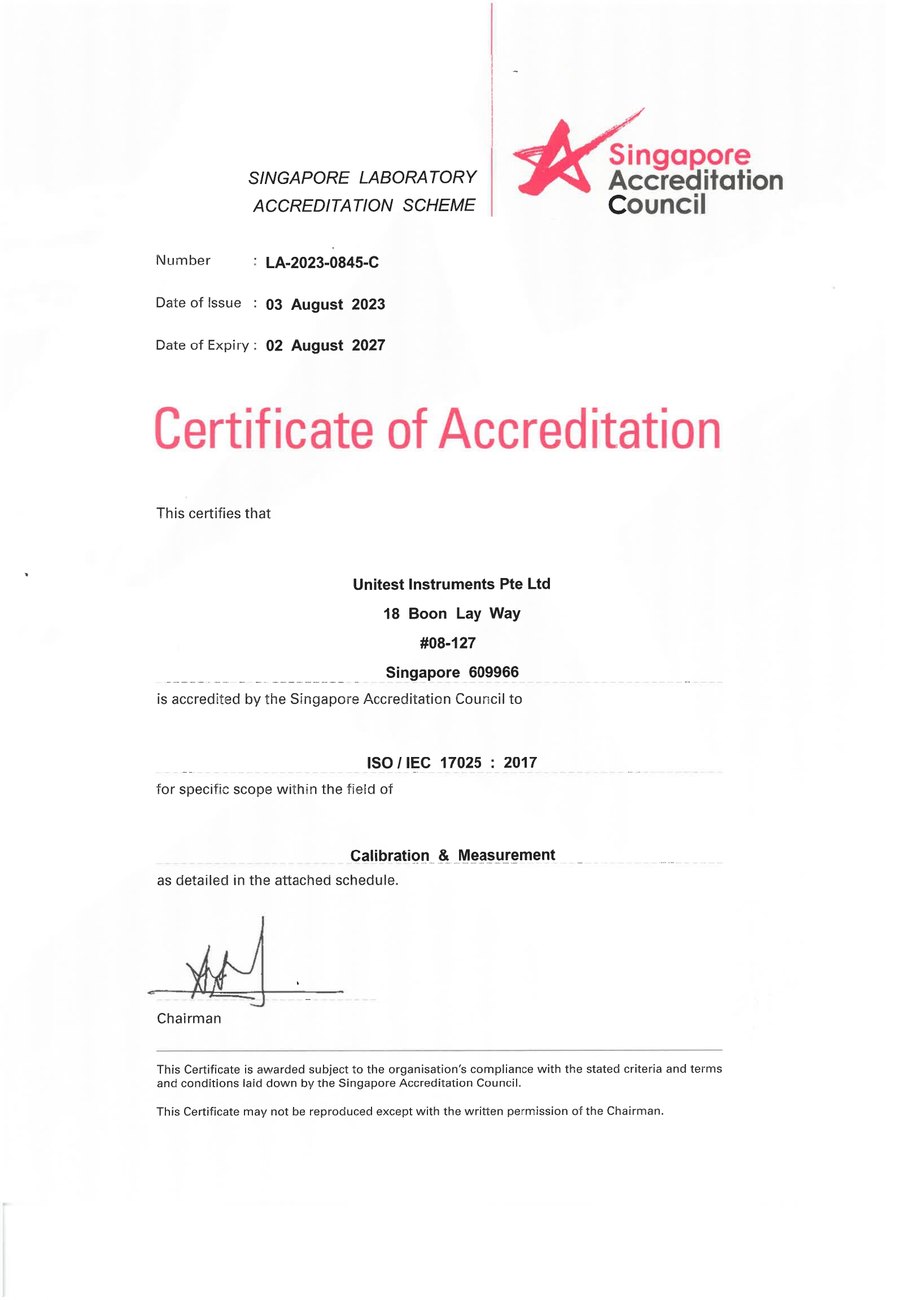
SAC-SINGLAS accredited calibration laboratory (Acc. No. LA-2023-0845-C) serving Singapore's industrial, pharmaceutical, and manufacturing sectors. All content reflects our ISO/IEC 17025 accredited scope and is reviewed by our technical calibration team.
Need cleanroom instrument calibration in Singapore?
Unitest Instruments is SAC-SINGLAS accredited (Acc. No. LA-2023-0845-C) to ISO/IEC 17025. We calibrate particle counters, differential pressure gauges, anemometers, and temperature/humidity instruments. Same-week turnaround, certificates accepted by HSA and ISO 9001 auditors.