
Key takeaways
- Calibration reports a measurement result with uncertainty. It does not pass or fail anything. That judgement is yours to make.
- Verification applies a decision rule to the calibration result: does the deviation fall within the allowable tolerance? Yes or no.
- ISO 9001 clause 7.1.5 mentions both ("calibrated or verified"), but they are not interchangeable for instruments that control product quality.
- A calibration certificate without a stated tolerance or decision rule is calibration only. You must apply your own acceptance criteria to determine conformity.
- An accredited calibration certificate provides the traceable measurement result; your in-house verification procedure defines whether it passes for your application.
The mix-up that causes audit findings
Walk into almost any quality audit involving measuring equipment and the conversation around calibration and verification will, at some point, get tangled. Technicians hand auditors a certificate and call it "verified." Quality managers present a pass/fail log and call it "calibration records." Procurement teams ask for "calibration certificates" when what they actually need is a conformity statement. Each of these mix-ups looks minor on the surface and produces real non-conformances in practice.
The confusion has a structural cause: the two activities are related, sequential, and (until the 2015 revision of ISO 9001), were often lumped together in quality management documentation. They are not the same. Calibration is a measurement activity. Verification is a decision activity. One produces a number. The other produces a verdict. You cannot produce a defensible verdict without the number, and a number alone (however traceable), tells you nothing about whether the instrument is fit for your specific process.
Audit findings in this area almost always follow one of three patterns. The first: a certificate shows measurement results but no stated uncertainty, so the auditor cannot assess fitness for purpose. The second: a "pass/fail" log exists but the acceptance criteria are not documented. No-one can verify what tolerance was applied, by whom, or on what basis. The third: the calibration certificate was issued by a non-accredited provider, so the traceability of the underlying measurement is unverifiable. All three are avoidable. Understanding the distinction between calibration and verification is the prerequisite for avoiding them.
What calibration actually produces
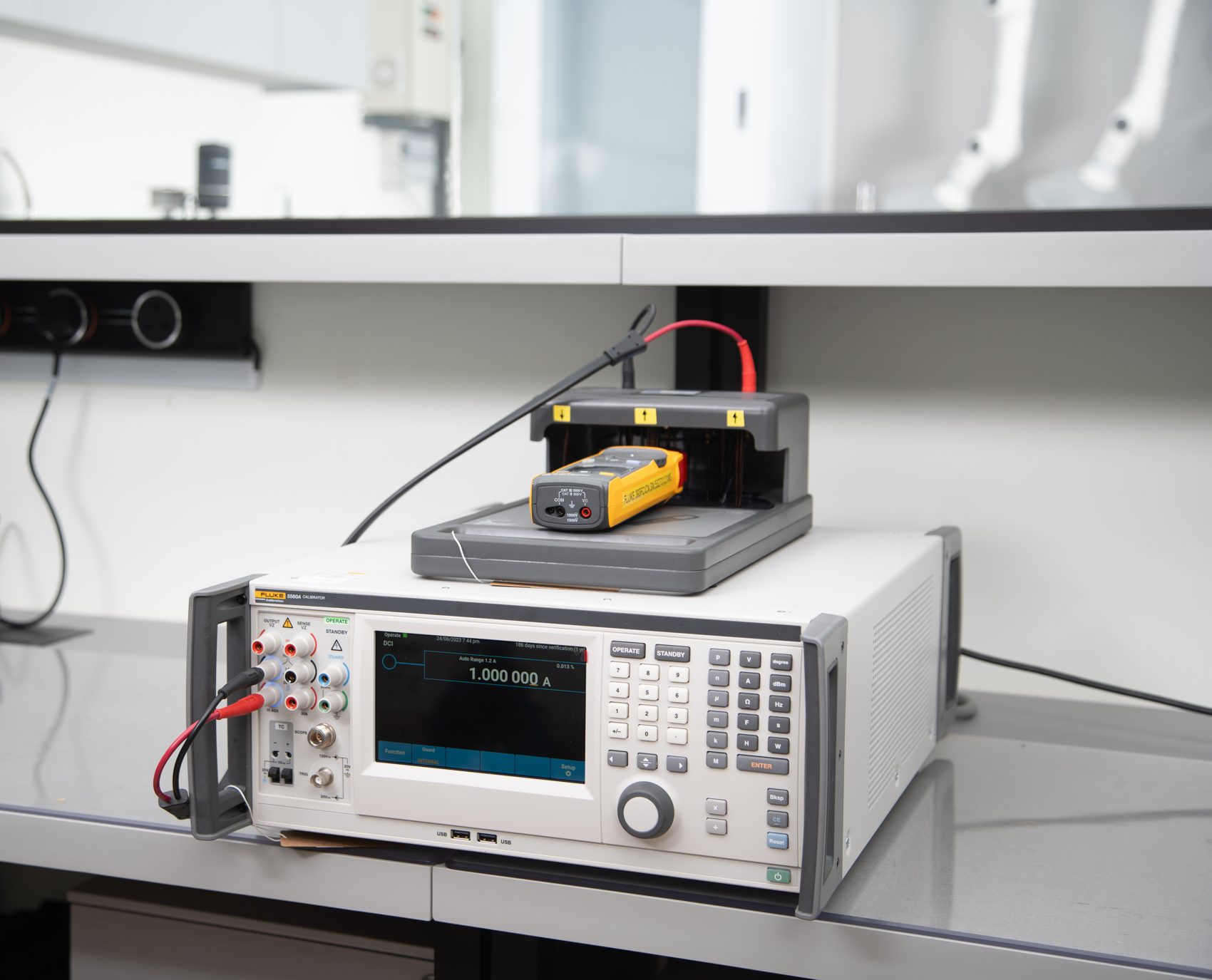
Calibration is the process of comparing a measurement instrument against a reference standard of known and documented accuracy, and recording the difference between them. That is all calibration does. It records what it finds. It does not change the instrument, it does not judge the instrument, and it does not decide whether the instrument should be put back into service.
The output of calibration is a measurement result: a series of readings showing how the instrument under test deviates from the reference standard across its operating range, together with the measurement uncertainty associated with each result. A calibration certificate for a digital thermometer might state: at a reference temperature of 100.00°C, the instrument reads 100.34°C, with an expanded uncertainty of ±0.18°C at 95% confidence. That is the entirety of what the calibration has established.
The deliberate absence of a pass/fail statement is not an omission. It is the correct boundary of the activity. Calibration can only report what it measures. It has no knowledge of your process: your product tolerances, your regulatory requirements, your customer specifications. Only you have that information. The decision about whether a 0.34°C deviation is acceptable for your temperature-controlled storage room is yours to make, and that decision is verification, not calibration.
Measurement uncertainty is not optional on an accredited calibration certificate. ISO/IEC 17025:2017 clause 7.8.2 requires every calibration certificate to include the measurement uncertainty of the measurement result. This requirement exists because a result without stated uncertainty is uninterpretable for verification purposes: you cannot determine whether your instrument is within tolerance if you do not know how much doubt attaches to the measurement of the deviation itself. An accredited lab's uncertainty calculations are technically reviewed by SAC assessors during the accreditation process, which is one of the core reasons accredited certificates carry more evidential weight than non-accredited ones.
It is also worth being precise about what calibration does not include by default. Calibration does not include adjustment. The physical or electronic modification of an instrument to reduce its deviation. Calibration does not include a statement of conformity unless one is explicitly requested and a decision rule is agreed. And calibration does not include a recommendation on whether to continue using the instrument, that decision remains with the instrument's owner.
What verification actually produces
Verification applies a decision rule to a measurement result and produces a conformity statement: the instrument either meets its stated specification, or it does not. The output is binary. Pass, or fail.
Three elements are required to make a verification decision meaningful. First, a calibrated measurement result (the deviation of the instrument from the traceable reference, with stated uncertainty. Second, a specification), the maximum allowable deviation for the instrument in its intended use. This might come from the equipment manufacturer's datasheet, from your process control requirement, from a regulatory standard, or from a customer requirement. Third, a decision rule. The criteria used to translate the measurement result and uncertainty into a pass or fail conclusion, taking into account the overlap between the uncertainty interval and the specification boundary.
Who defines the specification? This is the question that often goes unanswered in poorly documented quality systems. The specification is not set by the calibration laboratory. It is set by whoever owns the quality requirement for the measurement. For a balance in a GMP-regulated pharmaceutical process, the specification might be set by the process validation report. For a pressure gauge controlling a safety system, it might be set by the engineering drawing or the relevant safety standard. For a thermometer in a HACCP critical control point, it might be set by the HACCP plan. The calibration laboratory provides the measurement; you supply the standard against which it is judged.
There are several types of verification in practice. In-house verification against an accredited calibration certificate is the most common: the external lab provides the traceable result, and the organisation's quality team applies its own acceptance criteria. Manufacturer verification is performed by the equipment supplier at the point of manufacture or after service. Statutory verification (required for legal-for-trade instruments), is performed by an approved verifier under the Weights and Measures Act. Each type involves the same logical structure: a measurement result, a specification, a decision.
What each produces
The distinction between the two activities becomes clearest when viewed side by side across the dimensions that matter most for compliance and quality management.
| Aspect | Calibration | Verification |
|---|---|---|
| What it produces | Measurement result + uncertainty | Pass / Fail against a specification |
| Who defines the standard? | National metrology institute (traceable SI unit) | You. Or the equipment manufacturer |
| Is uncertainty stated? | Mandatory (on accredited certs) | Not required. Only the decision counts |
| Does it adjust the instrument? | Never. Calibration reports only | May include adjustment if needed |
| ISO 9001 clause 7.1.5 | Satisfies traceability + uncertainty requirement | Satisfies fitness-for-use requirement |
| Suitable as standalone evidence? | Yes, for traceability | Depends. Needs calibration behind it |
| Who can perform it? | Accredited lab (for traceable cert) | Internal team, if competence is documented |
| Frequency | Set by calibration interval policy | May be more frequent than full calibration |
The "standalone evidence" row deserves attention. A calibration certificate from an accredited lab stands on its own as evidence of traceability. The chain from your instrument to the national standard is documented and independently verified. A verification record, by contrast, is only as strong as the calibration result it is based on. A pass/fail log built on non-traceable measurements is not meaningful evidence for a compliance audit, because the underlying measurement cannot be independently verified.
When you need calibration vs verification
The practical question for most quality managers is not abstract: it is "what do I need to produce for this audit, this regulatory submission, or this customer requirement?"
ISO 9001:2015 clause 7.1.5 requires organisations to ensure that measuring equipment is calibrated or verified at specified intervals against measurement standards traceable to international or national standards, and that the measurement results include stated measurement uncertainties. For quality-critical instruments (those used to make accept/reject decisions on product, or to control a process parameter that affects product conformity), the practical requirement is calibration with stated uncertainty, followed by a documented verification against your process tolerance. The phrase "calibrated or verified" is not a free choice between two equivalent options; it reflects that for different instrument types and uses, different levels of evidence are proportionate.
GMP environments (pharmaceutical manufacturing, medical device production, food processing under BRC or SQF schemes), typically require both. Critical instruments must be calibrated by a traceable method (which in Singapore means an accredited lab for externally calibrated equipment) and formally verified against the qualification limits defined in the equipment qualification documentation (IQ/OQ/PQ). The verification record links the calibration certificate to the acceptance criteria and produces a documented conformity decision.
HACCP temperature instruments at critical control points must demonstrate that the measurement is reliable enough to support a food safety decision. The calibration certificate provides the traceability evidence; the verification check confirms the instrument remains within the HACCP plan's stated tolerance for that CCP. Where instruments drift between scheduled calibrations, intermediate verification checks (using an in-house calibrated reference), provide additional assurance between full calibration events.
ISO/IEC 17025 laboratories calibrate their own reference equipment using the formal calibration process and maintain verification checks as part of ongoing quality control. Intermediate checks between calibration intervals using reference materials or check standards to confirm performance has not shifted.
Need calibration evidence that your verification can rely on?
Every Unitest certificate states measurement uncertainty and carries full NMC traceability. The foundation your acceptance decision depends on.
The correct sequence: calibrate first, then verify
The sequencing is not arbitrary. You cannot perform a meaningful verification without first having a calibrated measurement result to apply your decision rule to. This seems obvious in principle and is regularly violated in practice. Particularly in organisations that rely on in-house or supplier-performed checks without a documented traceability chain behind them.
Consider the logic: verification is the act of comparing an instrument's measured deviation against a stated tolerance. The measured deviation is produced by calibration. The comparison against a traceable reference. If you skip or shortcut the calibration step, the number you are comparing against your tolerance has unknown accuracy. You are not verifying; you are guessing with documentation.
In a well-structured quality system, the sequence works as follows. At each calibration interval, the instrument is sent to an accredited laboratory. The lab returns a calibration certificate stating the measured deviation at each calibration point, with the expanded uncertainty for each result. The quality team then performs verification: they compare the measured deviation (considering the uncertainty) against the process tolerance for that instrument, apply the decision rule, and record a pass or fail. If the instrument passes, it is returned to service. If it fails, a non-conformance is raised, and the instrument is adjusted, repaired, or retired.
Between scheduled calibrations, organisations may perform intermediate verification checks. Using a calibrated in-house reference to confirm the instrument has not drifted significantly since its last external calibration. These intermediate checks do not replace the scheduled calibration; they provide additional confidence that an out-of-tolerance condition will be detected before it affects product quality. Their frequency should be set by the instrument's historical drift rate and the criticality of its role in the quality system.
The documentation of this sequence matters as much as the sequence itself. Auditors look for a traceable link between the calibration certificate, the specification, the decision rule, and the conformity record. A calibration certificate filed without a corresponding verification record, or a verification pass/fail log that cannot be traced to a specific calibration certificate, both leave gaps that experienced auditors will probe.
Guard bands: the link between calibration uncertainty and your verification decision
When you apply a verification decision rule to a calibration result, measurement uncertainty creates a complication at the boundary of the specification. If an instrument's tolerance is ±1.0°C and its calibration result shows a deviation of +0.85°C with an uncertainty of ±0.25°C, the uncertainty interval spans from +0.60°C to +1.10°C, straddling the specification limit. Should it pass or fail?
The answer depends on your decision rule and your risk tolerance. The simple acceptance rule (often called the "shared risk" approach) says: pass if the measured value is within the specification, regardless of whether the uncertainty interval extends beyond it. This is pragmatic but means there is a nonzero probability that the instrument is actually out of specification. The guard-banded approach tightens the acceptance zone by the uncertainty amount: pass only if the measured value plus the expanded uncertainty falls within the specification. This is more conservative and reduces the risk of accepting a non-conforming instrument, at the cost of rejecting some instruments that might actually be within specification.
ISO/IEC 17025:2017 clause 7.8.6 requires accredited laboratories to document and apply a decision rule when issuing statements of conformity, and to clearly communicate which rule was applied. ILAC G8:09/2019 provides detailed guidance on decision rules and guard banding. For high-stakes applications (medical devices, safety systems, pharmaceutical manufacturing), the choice of decision rule is a quality engineering decision that should be documented in your calibration and verification procedure. For most general-purpose industrial instruments, the simple acceptance rule is proportionate, provided the calibration uncertainty is small relative to the specification tolerance (a ratio of 4:1 or better is commonly cited as good practice).
The practical implication: when your calibration uncertainty is large relative to your process tolerance, you have two options. Request a higher-accuracy calibration that reduces the uncertainty (accredited labs can often provide this for an additional charge, as it requires more capable reference equipment). Or apply a guard band, accepting that you will occasionally reject instruments that are marginally within specification in order to ensure you never accept instruments that are marginally outside it. Which approach is right depends on the consequences of a false acceptance in your specific application.
Common mistakes and how to avoid them
Mistake 1: Treating a calibration certificate as a verification record. A calibration certificate shows what the instrument reads. It does not say whether that reading is good enough for your application (because the calibration lab does not know your application. The verification step), applying your tolerance as the decision criterion. Must be performed and documented separately. The fix is straightforward: create a verification record that links each calibration certificate to the acceptance criteria and records the pass/fail decision. This can be a simple table in your calibration management system.
Mistake 2: Using calibration certificates without stated measurement uncertainty. ISO 9001:2015 clause 7.1.5 requires calibration results to include stated measurement uncertainties. A certificate that shows only the measured reading (or only a pass/fail), without the associated uncertainty is insufficient evidence for an auditor applying the current standard. Non-accredited laboratories frequently omit uncertainty because calculating it correctly requires investment in metrology expertise that not all providers have made. The fix is to use an accredited laboratory: SAC-SINGLAS accreditation requires uncertainty to be stated on every accredited result, and the calculation methodology is technically reviewed during the accreditation assessment.
Mistake 3: Defining acceptance criteria after the fact. Verification is only meaningful if the acceptance criteria were defined before the calibration result was known. Acceptance criteria that are set after seeing the result (or that are adjusted to match whatever the calibration returned), are not calibration management; they are post-hoc rationalisation. The fix is to document acceptance criteria in your calibration plan before instruments are sent for calibration, linking each instrument to the process or regulatory requirement that sets its tolerance.
Mistake 4: Applying the same verification tolerance across all instruments. Different instruments serve different purposes in a quality system, and their tolerances should reflect those purposes. A thermometer controlling a product sterilisation step has a different criticality (and therefore a different justified tolerance), than a thermometer indicating ambient temperature in a storage area. Applying a uniform ±2% tolerance to every measuring instrument in a facility is not quality engineering; it is administrative convenience. The fix is to trace each instrument's acceptance criteria back to the process requirement or specification it is intended to satisfy, and document that link.
Mistake 5: Not re-verifying after calibration that includes adjustment. When a calibration reveals that an instrument is out of tolerance and it is adjusted to bring it back into specification, the adjustment must be followed by a second calibration to confirm the post-adjustment performance. The pre-adjustment result shows the instrument was out of tolerance; the post-adjustment result shows whether it has been successfully corrected. Only the post-adjustment result should be used as the basis for the verification decision. Certificates that include adjustment should clearly distinguish pre-adjustment and post-adjustment results, and your verification record should reference the post-adjustment data.
Frequently asked questions
No. Calibration and adjustment are distinct operations that are frequently confused. Calibration is a purely measurement activity: it compares your instrument against a traceable reference standard and records the difference, along with measurement uncertainty. It does not change the instrument in any way. Adjustment is a separate corrective action taken after calibration if the deviation is unacceptably large. It involves physically or electronically modifying the instrument to bring its output closer to the true value. Crucially, after any adjustment, the instrument must be calibrated again to confirm the new performance. ISO/IEC 17025 and the GUM (Guide to the Expression of Uncertainty in Measurement) both treat calibration and adjustment as separate, sequential processes. A calibration certificate that shows pre-adjustment and post-adjustment results is documenting two separate calibrations, not one.
In principle you can compare an instrument's reading against a specification without a full traceable calibration, but this is not what compliance frameworks mean by verification. A meaningful verification requires a calibrated measurement result as its input: you need to know what the instrument actually reads (with stated uncertainty) before you can decide whether that reading is within tolerance. Without calibration, you are guessing rather than deciding. ISO 9001 clause 7.1.5 is explicit that fitness-for-purpose evidence must be grounded in a traceable measurement result with stated uncertainty. Verification without prior calibration will not withstand audit scrutiny and cannot be relied on for process control decisions where product quality or safety is at stake.
A decision rule is the documented criteria used to accept or reject a measurement result as conforming to a specification, taking measurement uncertainty into account. Under ISO/IEC 17025:2017 clause 7.8.6, laboratories must document and apply a decision rule when reporting statements of conformity, that is, when a certificate states that an instrument passes or fails a specification. The most common approach is the simple acceptance rule: the instrument passes if its measured value falls within the specification limits, regardless of whether the uncertainty interval extends beyond them. More conservative approaches (guard banding), tighten the acceptance zone by subtracting the measurement uncertainty from the tolerance, so the instrument passes only if the measured value plus the full uncertainty remains within specification. ILAC G8 provides detailed guidance on implementing decision rules.
ISO 9001:2015 clause 7.1.5 uses the phrase "calibrated or verified", which has caused widespread confusion. The standard is not saying the two are equivalent alternatives. It acknowledges that different instruments and contexts require different levels of evidence. For instruments used to control product quality or make acceptance decisions, the standard requires results with stated measurement uncertainties, which means calibration must underpin the process. For indicating instruments with no direct bearing on quality decisions, a functional verification check may be proportionate. In practice, for any instrument where your quality system depends on the measurement result, auditors trained to the 2015 standard expect calibration with stated uncertainty, not verification alone. See our guide to ISO 17025 vs ISO 9001 for a deeper comparison.
A guard band is a safety margin applied to a tolerance limit to account for measurement uncertainty when making a pass/fail decision. If an instrument's specification allows a maximum deviation of ±1.0°C, and the calibration uncertainty is ±0.3°C, a guard-banded acceptance zone would be ±0.7°C, the tolerance minus the uncertainty. This ensures that even accounting for the doubt in the measurement result itself, accepted instruments genuinely meet the specification. Without guard banding, an instrument could pass verification yet actually be out of specification because the uncertainty interval spans the tolerance boundary. ILAC G8 and OIML D 10 provide guidance on guard band approaches. For regulated industries (pharmaceuticals, medical devices, aerospace), guard banding is often explicitly required by the applicable standard or customer contract.
Verification does not have to be performed by an accredited laboratory, but it must be performed by a competent party using a documented procedure, against a stated specification, and based on a calibrated measurement result. In practice, many organisations perform in-house verification after receiving a calibration certificate from an accredited lab: the external lab provides the traceable measurement result, and the internal team applies their process tolerance as the decision rule to determine pass or fail. What matters for compliance is that the verification procedure is documented, the acceptance criteria are defined and justified, the competence of the person performing the verification is recorded, and the underlying calibration result carries measurement uncertainty from a traceable source. Statutory verification (for legal-for-trade instruments), is a separate category and must be performed by an approved verifier under the Weights and Measures Act.
The documentation should link the calibration certificate, the specification being verified against, the decision rule applied, and the outcome. A practical verification record includes: the instrument identification and calibration certificate reference number; the applicable specification or tolerance with its source (equipment datasheet, process requirement, regulatory standard); the calibration results used. The measured deviation and expanded uncertainty from the certificate; the decision rule applied (e.g. simple acceptance or guard-banded acceptance at a stated guard band width); the conformity statement. Pass or fail for each measurement point; and the date, the name of the person who performed the verification, and their signature or authorisation reference. In GMP, ISO 9001, or ISO 13485 contexts, this record must be retained for the duration required by your document control procedure and available for review during external audits.
Unitest Instruments Pte. Ltd. is a SAC-SINGLAS accredited calibration laboratory (ISO/IEC 17025, no. LA-2023-0845-C) based in Singapore. We calibrate electrical, temperature, pressure, humidity, and related instruments for manufacturers, service providers, and regulated industries across Singapore and the region.
Get calibration results your verification can stand on
Unitest's SAC-SINGLAS accredited certificates state measurement uncertainty and carry NMC traceability. Exactly what your ISO 9001 or GMP verification process needs as its foundation.
Verifiable at sac.gov.sg · Acc. No. LA-2023-0845-C