Key Takeaways
- Both Fluke Networks DSX and Softing WireXpert meet IEC 61935-1 Level V accuracy for Cat6A and Class FA. The highest accuracy tier required for structured cabling acceptance testing.
- Fluke Networks holds a decisive advantage on large commercial, data centre, and public-sector projects in Singapore where the M&E consultant specifies Fluke test reports by name.
- Softing WireXpert costs 20–35% less than comparable Fluke configurations. A meaningful saving for high-volume residential or SME contractors who are not restricted by specification.
- Software and cloud ecosystem maturity differs significantly: Fluke's LinkWare Live is more mature and widely accepted for project report handover than Softing's network.reporter.
- Annual calibration by a SAC-SINGLAS accredited laboratory is required for both brands to maintain ISO 9001, BCA, and project-quality compliance in Singapore.
- Unitest Instruments sells and calibrates both Fluke Networks and Softing equipment. We have no commercial incentive to favour either brand in this comparison.
Why This Comparison Matters for Singapore Buyers
Cable certifiers are not a commodity purchase. The brand and model you choose determines which projects you can bid for, how your handover reports are received by consultants and main contractors, and whether your calibration certificates satisfy an ISO 9001 audit or a BCA inspection. In Singapore's structured cabling market (where project specs are often written by M&E consultants with strong brand preferences), the wrong choice can cost you a contract.
Fluke Networks has dominated the professional cable certification market for over two decades. Softing, a German test and measurement company, entered the segment with the WireXpert series and has built genuine credibility, particularly in Europe and Asia-Pacific. Both are serious instruments. Neither is obviously "better" in isolation. The right choice depends on the projects you run and the specifications you are required to meet.
We at Unitest Instruments calibrate both brands under SAC-SINGLAS accreditation no. LA-2023-0845-C. We also sell both. This guide is written from a calibration and metrology perspective, not a sales perspective. We will flag trade-offs that resellers typically do not mention.
Technical Specification Comparison
At the core of any cable certifier comparison is measurement accuracy. IEC 61935-1 defines accuracy levels from Level I to Level V, with Level V being the most stringent and required for Cat6A (Class EA) and above. Both the Fluke Networks DSX-600 and Softing WireXpert 500 are Level V certified, so on paper, both instruments are technically qualified for the same scope of work.
Where they diverge is in measurement speed, frequency range on flagship models, Cat8 support, adapter ecosystem, and software integration. The table below summarises the key specification differences between the most commonly purchased configurations in the Singapore market.
| Feature / Specification | Fluke Networks DSX-600 | Softing WireXpert 500 |
|---|---|---|
| Accuracy Level (IEC 61935-1) | Level V (IV for older firmware) | Level V |
| Maximum Test Frequency | 600 MHz (DSX-600); 2000 MHz (DSX2-8000) | 500 MHz (WireXpert 500); 1000 MHz (WireXpert 4500) |
| Cat6A Certification | Yes, tia-568-C.2 & ISO/IEC 11801 Class EA | Yes, tia-568-C.2 & ISO/IEC 11801 Class EA |
| Cat8 / Class I & II Certification | Yes (DSX2-8000 model required) | Limited. WireXpert 4500 only, less established |
| Fibre (MPO/MTP) Testing | Yes. OptiFiber Pro add-on | Yes. FiberXpert module |
| Typical Test Time (Cat6A link) | ~9 seconds | ~10–12 seconds |
| Cloud Report Management | LinkWare Live, mature, widely adopted | network.reporter. Functional, less widely adopted |
| Approximate Singapore List Price (Cat6A bundle) | SGD 14,000–18,000 | SGD 9,000–12,000 |
| Warranty | 3 years (main unit) | 3 years (main unit) |
| Adapter Replacement Cost | Higher. Fluke-proprietary | Moderate. Softing proprietary |
| Accepted in SG Gov / GLC projects | Near-universally accepted | Accepted where spec does not name Fluke |
| SAC-SINGLAS Calibration Available (Unitest) | Yes | Yes |
Where Fluke Networks Wins Clearly
Fluke Networks holds the dominant position in three specific market segments in Singapore, and buyers in these segments should treat Fluke as the default unless there is a compelling reason to deviate.
1. Large Commercial and Government Projects
On Integrated Project Delivery (IPD), design-build, or traditional BCA-notified projects, the M&E consultant's specification sheet frequently names Fluke Networks by brand. This is not because Softing is technically inferior. It is because Fluke reports are the de facto standard that quantity surveyors, project managers, and BCA inspectors are trained to read. Presenting Softing WireXpert reports on a Fluke-specified project creates friction at handover, and in some cases, re-testing has been required at the contractor's expense.
2. Data Centre Cabling Acceptance Testing
Tier III and Tier IV data centre operators in Singapore (particularly those adhering to TIA-942-B or Uptime Institute standards), routinely specify Fluke Networks test reports for structured cabling acceptance. The DSX2-8000 (2000 MHz) is required for Cat8/Class I and Class II channels used in high-density server environments. Softing's WireXpert 4500 covers 1000 MHz but Cat8 support is less mature and acceptance is not guaranteed without prior consultant sign-off.
3. Projects Requiring LinkWare Live Integration
Major main contractors in Singapore increasingly require contractors to submit cabling test reports via cloud-based platforms that integrate with their project management software. Fluke's LinkWare Live is purpose-built for this, supports multi-site project management, and exports in formats accepted by most quality management systems. If your client or main contractor is already on LinkWare Live, using a Softing instrument creates a workflow gap that adds administrative cost.
Need your Fluke Networks or Softing certifier calibrated in Singapore?
Unitest Instruments calibrates both brands under accreditation no. LA-2023-0845-C. Certificates are accepted by ISO 9001 auditors, BCA inspectors, and project QA teams. Same-week turnaround available.
Where Softing WireXpert Makes Sense
Softing WireXpert is not a budget compromise. It is a genuinely capable instrument that makes economic and practical sense for specific buyer profiles. The case for Softing is strongest when the following conditions apply.
1. High-Volume Residential and SME Structured Cabling
Contractors who certify hundreds or thousands of Cat6 and Cat6A links per year in residential developments, light commercial offices, or retail fit-outs (where project specs do not name a tester brand), can achieve identical technical compliance with the WireXpert at a 20–35% lower capital cost. The savings compound across a fleet of instruments and, for a small M&E firm running two or three testers, can represent SGD 10,000–20,000 in reduced tool cost.
2. European-Standard Projects
Softing is headquartered in Germany and its WireXpert is particularly well-integrated with EN 50173 European cabling standards. For Singapore projects with European main contractors or European-standard specifications (increasingly common in pharmaceutical, semiconductor, and logistics facilities), WireXpert reports may actually be the more natural deliverable.
3. Price-Sensitive Procurement Where Spec Allows
If you are a structured cabling subcontractor or a small-medium M&E firm and your main contractor accepts any IEC 61935-1 Level V tester, the WireXpert 500 delivers full Cat6A certification compliance at a meaningfully lower capital cost. The annual calibration cost is comparable between brands, so the total cost of ownership advantage is sustained over the instrument's lifetime.
The Calibration Requirement: What Both Brands Share
Regardless of which brand you choose, the calibration requirement is identical. IEC 61935-1 specifies that the accuracy of a cable certifier must be verified at calibration intervals defined by the manufacturer, typically annually. In Singapore's context, this means calibration by a SAC-SINGLAS accredited laboratory to ensure traceability to the national measurement standard maintained by the National Metrology Centre (NMC).
An out-of-calibration cable certifier produces test reports that cannot be used as valid evidence of cable plant compliance. On a project with a quality audit or a warranty claim, this is a serious liability. As explained in our guide to understanding your calibration certificate, the certificate must carry an accredited laboratory's scope and traceability statement to be legally defensible.
Both Fluke Networks and Softing adapters (the channel adapters attached to the main unit), also require calibration. Many contractors calibrate only the main unit and overlook adapter verification. This is a significant gap: adapter wear is a leading cause of measurement drift, and a calibrated main unit with worn adapters can still produce inaccurate results. Unitest includes adapter verification as part of our standard cable certifier calibration service.
For further background on why calibration intervals matter and how to set them correctly for your instruments, see our article on how often instruments should be calibrated.
Use-Case Recommendation Summary
The right choice between Fluke Networks and Softing WireXpert is ultimately determined by your project profile, not by technical superiority. The table below provides a clear recommendation framework for the most common procurement scenarios in Singapore.
| Use Case / Buyer Profile | Recommended Brand | Reason |
|---|---|---|
| Large commercial / government / GLC projects | Fluke Networks | Spec often names Fluke; avoids handover risk |
| Data centre acceptance testing (Cat8, Tier III/IV) | Fluke Networks | DSX2-8000 covers 2000 MHz; ecosystem maturity |
| High-volume residential / SME Cat6A cabling | Softing WireXpert | 20–35% cost saving; spec-agnostic projects |
| European-standard or European main contractor projects | Softing WireXpert | EN 50173 integration; familiarity with European QA teams |
| Price-sensitive firm, first cable certifier purchase | Softing WireXpert | Lower capex; technically equivalent for Cat6A scope |
| Firm bidding mixed project types (large + small) | Fluke Networks | Universally accepted; reduces re-testing risk on large projects |
| Fibre certification (OM4/OM5) as primary scope | Either | Both support fibre modules; compare OptiFiber Pro vs FiberXpert on feature detail |
Total Cost of Ownership Over Five Years
Capital cost is only one component of the total cost of ownership (TCO) for a cable certifier. Over a typical five-year ownership period, the following cost elements accumulate and should be factored into the procurement decision.
- Annual calibration: SGD 600–1,200 per unit per year, depending on scope and laboratory. Comparable between brands.
- Adapter replacement: RJ45 and fibre adapters wear with use. Fluke adapters are generally more expensive to replace than Softing equivalents. A set of Cat6A channel adapters can cost SGD 800–1,500 for Fluke versus SGD 500–900 for Softing.
- Software subscription: Fluke's LinkWare Live has a subscription component for advanced features. Softing's network.reporter is included in the base purchase with no ongoing subscription for standard features.
- Battery and consumables: Comparable between brands.
Over five years, the TCO difference narrows compared to the initial capital gap. A rough model suggests that the Softing WireXpert remains SGD 4,000–8,000 cheaper than the equivalent Fluke DSX-600 bundle on a five-year TCO basis, after accounting for calibration, adapters, and software. For a high-volume contractor running two or three units, this is a meaningful saving, but only if the project mix permits it.
Field Workflow and the Technician Experience
Specifications tell only part of the story. What actually separates the two instruments on a live site is how they behave in the hands of a technician running fifty, a hundred, or three hundred links in a shift. This is the layer of the comparison that a datasheet never captures, and it is where opinions between installation crews genuinely diverge.
Screen, autotest flow, and error interpretation
The Fluke DSX series uses a large, high-contrast touchscreen with an autotest workflow that most Singapore technicians describe as faster to learn, particularly for newer hires who have never certified cable before. Fail conditions are reported with a diagnostic breakdown (which parameter failed, at what frequency, against which limit) that experienced technicians use to triage a fault on the spot, rather than re-pulling the whole run. The Softing WireXpert's interface is functionally complete and covers the same diagnostic depth, but several Singapore-based M&E supervisors we have spoken with note that the menu structure takes longer for a new operator to become fluent in, which matters on projects where junior technicians rotate through the certification role.
Battery life and jobsite endurance
Both instruments are designed for a full working day on a single charge under normal test loads, and both support hot-swappable battery packs for extended shifts. The practical difference shows up on high-link-count days: contractors running back-to-back Cat6A autotests report that the Fluke unit's faster per-link test time (roughly 9 seconds versus 10–12 seconds on the WireXpert) compounds into a real productivity gap only when the crew is certifying 200 or more links a day, which is common on large fit-out projects but less relevant for smaller residential or SME jobs.
Talkset and remote unit communication
Both systems use a main unit and a remote unit connected via the cable under test, with a built-in talkset function so the two technicians can communicate without a separate radio. Fluke's talkset audio quality is generally rated slightly clearer in noisy construction environments, though this is a marginal difference that rarely factors into a purchase decision on its own.
Training time for new operators
For a small M&E firm hiring junior technicians on rolling contracts (a common pattern in Singapore's project-based cabling industry), the learning curve of the instrument has a real cost. Supervisors we work with generally estimate that a new technician reaches confident, unsupervised competency on the Fluke DSX within one to two days of guided use, largely because the fail-diagnostic screens are self-explanatory. The Softing WireXpert requires a comparable but slightly longer onboarding period, closer to two to three days, before a junior technician is reliably interpreting autotest results without supervisor intervention. Neither gap is large, but on a firm running frequent staff turnover, it accumulates into real supervisory time across a year.
Warranty, Local Support, and Service Turnaround in Singapore
A cable certifier is a working tool, not a shelf item, and how quickly it can be repaired or serviced when something goes wrong matters as much as the initial purchase price. This is an area where authorised local support, rather than brand prestige, should drive the buying decision.
Both Fluke Networks and Softing are represented in Singapore through authorised distributors and resellers who carry local stock of common consumables (adapters, batteries) and can arrange factory repair when required. Fluke's larger regional presence in Asia-Pacific generally means faster access to loaner units during a repair cycle, which is a meaningful consideration for a contractor who cannot afford downtime mid-project. Softing's regional support network has matured considerably, but loaner-unit availability in Singapore specifically should be confirmed with the local reseller before purchase rather than assumed.
Standard warranty on the main unit is three years for both brands, though extended warranty programmes are available from most resellers at additional cost. What the warranty typically does not cover is calibration: a manufacturer's warranty protects against hardware defects, not measurement drift, which is a separate maintenance obligation regardless of brand. Booking your annual calibration alongside any warranty service visit is a practical way to minimise instrument downtime, since both activities often require the unit to be sent to the same service point.
For buyers weighing this decision, our recommendation is to request a written service-level commitment from the local reseller (turnaround time for repair, loaner-unit availability, and calibration lead time) before finalising a purchase of either brand. A cable certifier that is technically superior but sits in a repair queue for three weeks during a live project delivers worse business outcomes than a slightly less capable instrument with same-week local support.
Frequently Asked Questions
Both the Fluke Networks DSX-600 and Softing WireXpert 500 meet the IEC 61935-1 Level V accuracy specification required for Cat6A and Class FA certification. In practice, the Fluke DSX is widely regarded as the industry benchmark for accuracy, particularly for near-end crosstalk (NEXT) and insertion loss measurements at high frequencies. Softing's WireXpert matches Level V accuracy on paper, but independent comparative studies have noted that the Fluke DSX produces more consistent pass/fail margins at the Cat6A limit. For labs requiring certified reference, both brands' adapters should be calibrated annually by an accredited laboratory.
Yes. The Softing WireXpert produces certification reports that reference TIA-568 and ISO/IEC 11801 standards, which are accepted by the Building and Construction Authority (BCA) of Singapore and align with SS 608 for structured cabling. However, project specifications increasingly call for Fluke Networks test reports specifically (particularly on public-sector and government-linked company (GLC) projects), so buyers should verify the M&E consultant's accepted brands list before purchasing.
Both Fluke Networks and Softing recommend annual calibration for their cable certifiers. The IEC 61935-1 standard and most quality management frameworks (including ISO 9001) require that test instruments used for acceptance testing be calibrated at defined intervals by a traceable laboratory. In Singapore, calibration should be performed by a SAC-SINGLAS accredited laboratory to ensure traceability to the national measurement standard (NMC). Unitest Instruments calibrates both brands under accreditation no. LA-2023-0845-C.
This depends on the project specification. Some M&E consultants and main contractors in Singapore accept any IEC 61935-1 Level V-certified tester, which includes both brands. Others (particularly on large commercial, data centre, or government projects), specify Fluke Networks test reports explicitly. Always clarify with the project engineer or consultant before committing to a tester brand, as re-testing with a different instrument after handover is expensive.
List price guidance: the Fluke Networks DSX-600 with Cat6A adapter set typically retails between SGD 14,000 and SGD 18,000 depending on bundle and reseller. The Softing WireXpert 500 with equivalent adapters is generally priced 20–35% lower, in the SGD 9,000–12,000 range. Both are available through authorised distributors in Singapore. Unitest sells and provides calibration support for both brands. Contact us for current pricing and calibration bundles.
Yes. Unitest Instruments is a SAC-SINGLAS accredited calibration laboratory (Acc. No. LA-2023-0845-C) and calibrates cable certifiers from both Fluke Networks and Softing, as well as other brands. Our calibration certificates are issued under ISO/IEC 17025 accreditation and are accepted by ISO 9001 auditors, BCA inspectors, and project quality teams across Singapore.
For data centre cabling certification (particularly Cat6A, Cat8, or OM4/OM5 fibre), Fluke Networks holds a clear advantage. The DSX-600 and its successor models support the full TIA-568-C.2-1 Cat8 specification and integrate with Fluke's LinkWare Live cloud platform for centralised report management, which is a frequent requirement in Tier III/IV data centre acceptance testing. Softing WireXpert covers Cat6A and fibre well, but Cat8 support is more limited and the ecosystem for report management is less mature.
Adapter condition is critical to certification accuracy. Both Fluke and Softing use dedicated RJ45 and fibre adapters that wear with use. Best practice is to inspect adapter contacts after every 2,000–3,000 test runs, replace worn adapters promptly, and include adapters in the annual calibration cycle. A calibration certificate that covers only the main unit but not the adapters may not satisfy a rigorous project audit. Specify adapter inclusion when booking calibration with any accredited laboratory.
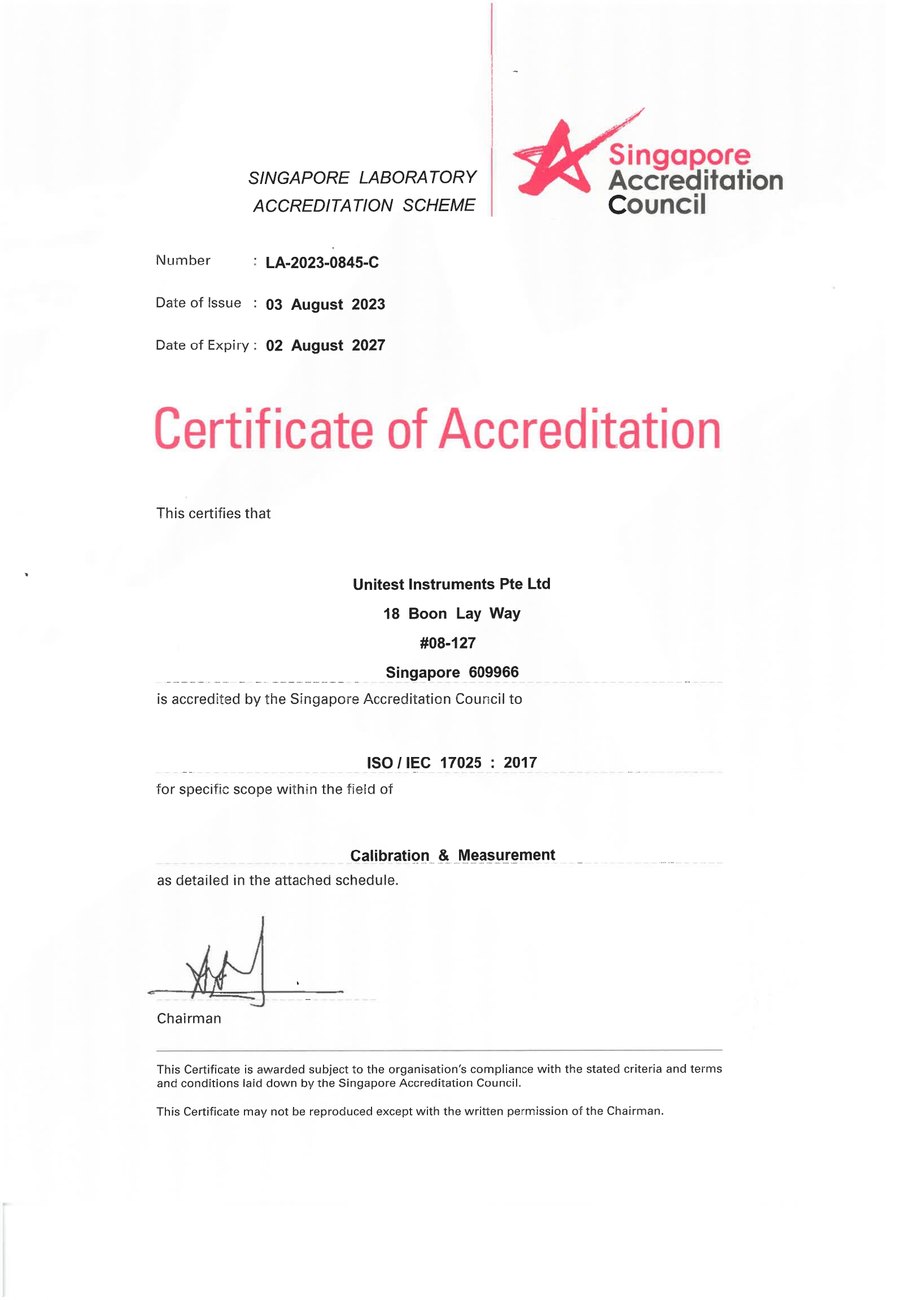
SAC-SINGLAS accredited calibration laboratory (Acc. No. LA-2023-0845-C) serving Singapore's industrial, pharmaceutical, and manufacturing sectors. All content reflects our ISO/IEC 17025 accredited scope and is reviewed by our technical calibration team.
Need cable certifier calibration in Singapore?
Unitest Instruments is SAC-SINGLAS accredited (Acc. No. LA-2023-0845-C) to ISO/IEC 17025. Same-week turnaround, certificates accepted by ISO 9001 auditors and BCA inspectors. We calibrate both Fluke Networks and Softing instruments.