
Key Takeaways
- Level V accuracy (IEC 61935-1) is required for Cat 8 certification and recommended for any Cat 6A project where margin to the limit is tight.
- The DSX2-8000 (2 GHz, Level V) is the benchmark for high-density data-centre work; the DSX2-5000 is the value pick for Cat 6A-only contractors.
- Fibre certification requires a separate OLTS/OTDR. The CertiFiber Pro handles both single-mode and multimode to TIA-568 and ISO/IEC 14763-3.
- Singapore's SS 568 is harmonised with ISO/IEC 11801; TIA-942 applies to data-centre topology and Tier classification requirements.
- SAC-SINGLAS calibration (Acc. No. LA-2023-0845-C) before first use validates that your instrument's pass/fail decisions are metrologically sound.
Who Needs a Cable Certifier, and Who Doesn't
A cable certifier is not the same as a network cable tester. A basic continuity tester tells you whether wires are connected in the right order and whether there are shorts or opens. It costs a few hundred dollars and is adequate for checking a patch lead. A cable certifier sweeps the full frequency range defined by a cabling standard (up to 500 MHz for Cat 6A, up to 2 GHz for Cat 8) and measures a suite of electrical parameters (insertion loss, near-end crosstalk (NEXT), return loss, propagation delay, and more), then issues a PASS or FAIL verdict against the standard's performance limits.
You need a cable certifier if you are a structured cabling contractor handing over a project to a client under a warranty or compliance obligation; a facilities engineer commissioning a new data hall; a telecom contractor working on projects that must comply with Singapore's SS 568 standard; or a testing and inspection organisation producing third-party verification reports. You do not need one if you are simply troubleshooting a single patch lead or checking a home network run. A continuity tester or a basic qualification tester is sufficient for those tasks.
What to Look for When Choosing a Cable Certifier
Five specifications determine whether a certifier is right for your application: accuracy level, bandwidth, test speed, adapter ecosystem, and reporting software.
Accuracy Level (IEC 61935-1)
IEC 61935-1 defines four accuracy levels (I–IV) for field test equipment, with Level V introduced later for Cat 8. Level IV is the minimum for Cat 6A. Level V provides tighter measurement uncertainty across the full Cat 6A frequency range and is mandatory for Cat 8. In practice, most serious contractors choose Level V instruments even for Cat 6A work, because tighter uncertainty means fewer marginal FAIL results that have to be investigated and re-tested.
Bandwidth
Bandwidth determines which cabling categories the instrument can certify. Cat 5e requires 100 MHz; Cat 6 requires 250 MHz; Cat 6A requires 500 MHz; Cat 8 requires 2000 MHz. Buying a 2 GHz instrument for a Cat 6A project means you are paying for headroom, but for a data-centre environment that will be in service for 10–15 years, that headroom is often worthwhile.
Test Speed
In a data-centre project with hundreds or thousands of links to certify, test speed directly affects labour cost. The DSX2-8000 completes a full Permanent Link or Channel test in approximately 10 seconds. Older or lower-cost instruments can take 30–60 seconds per link. On a 1,000-link project, that difference is 5–8 hours of billable time.
Adapter Ecosystem and Fibre Support
Adapters define which connector types and cabling categories your certifier can test. The DSX2 platform supports a wide range of snap-in adapters for RJ45 (Cat 5e through Cat 8), coax, and specialty connectors. For fibre, you need a separate instrument (the CertiFiber Pro), which connects to the DSX2's LinkWare Live cloud platform for unified reporting.
Top Cable Certifiers Available Through Unitest
The following models represent the current generation of cable certifiers recommended for data-centre and enterprise network work in Singapore. All are available through unitestshop.com, and all can be calibrated by Unitest Instruments under our SAC-SINGLAS accredited scope before or after purchase.
| Model | Bandwidth | Accuracy Level | Test Time (per link) | Fibre | Price Range (SGD) | Best For |
|---|---|---|---|---|---|---|
| Fluke DSX2-8000 | 2 GHz | Level V | ~10 sec | No (add CertiFiber Pro) | $18,000–$24,000 | Cat 6A + Cat 8 data centres, Tier III/IV, large-scale enterprise |
| Fluke DSX2-5000 | 1 GHz | Level IV/V | ~12 sec | No (add CertiFiber Pro) | $12,000–$16,000 | Cat 6A enterprise and campus projects, value-conscious contractors |
| Fluke CertiFiber Pro | N/A (optical) | OLTS + OTDR | ~15 sec (OLTS) | Yes. SM & MM | $8,000–$13,000 | Fibre backbone, MPO/MTP trunk certification, spine-leaf data-centre fibre |
| Fluke DSX2-8000 + CertiFiber Pro Kit | 2 GHz + optical | Level V + OLTS | ~10–15 sec | Yes | $26,000–$36,000 | Full infrastructure projects with mixed copper and fibre. Recommended for data-centre contractors |
| Fluke MicroScanner XT | Qualification only | Qualification tester | ~5 sec | No | $900–$1,400 | Troubleshooting, pre-certification checks, moves-adds-changes. Not a replacement for certification |
Prices above are indicative Singapore retail ranges and may vary based on adapter bundles and promotional pricing. Contact unitestshop.com for current pricing and availability.
Understanding Singapore's Cabling Standards for Data Centres
Singapore's primary structured cabling standard is SS 568, published by Enterprise Singapore (ESG) and administered through the Singapore Standards Council. SS 568 is harmonised with ISO/IEC 11801 (international) and broadly aligned with TIA-568 (American). For most practical purposes, an instrument that can certify to ISO/IEC 11801 Class EA (Cat 6A) or Class I (Cat 8) will satisfy SS 568 requirements.
For data-centre-specific requirements, TIA-942 and ISO/IEC 24764 are the reference documents. These standards define topology (two-tier vs three-tier), spine-leaf cabling distances, and the performance tier requirements for each section of the data-centre infrastructure. A Tier III or IV Uptime Institute-certified data centre in Singapore will typically require documented cable certification results as part of the commissioning evidence package.
Singapore's Infocomm Media Development Authority (IMDA) also publishes technical codes of practice for telecommunications infrastructure that reference SS 568. For new commercial building PABX and structured cabling installations, compliance with these codes is mandatory for obtaining the relevant approvals from IMDA and BCA.
Calibrate your cable certifier before your next project handover
Unitest Instruments (Acc. No. LA-2023-0845-C) provides accredited calibration for Fluke Networks and other cable test equipment. Certificates are accepted by ISO 9001 auditors, BCA submissions, and data-centre commissioning teams across Singapore.
Why SAC-SINGLAS Calibration Matters for Cable Certifiers
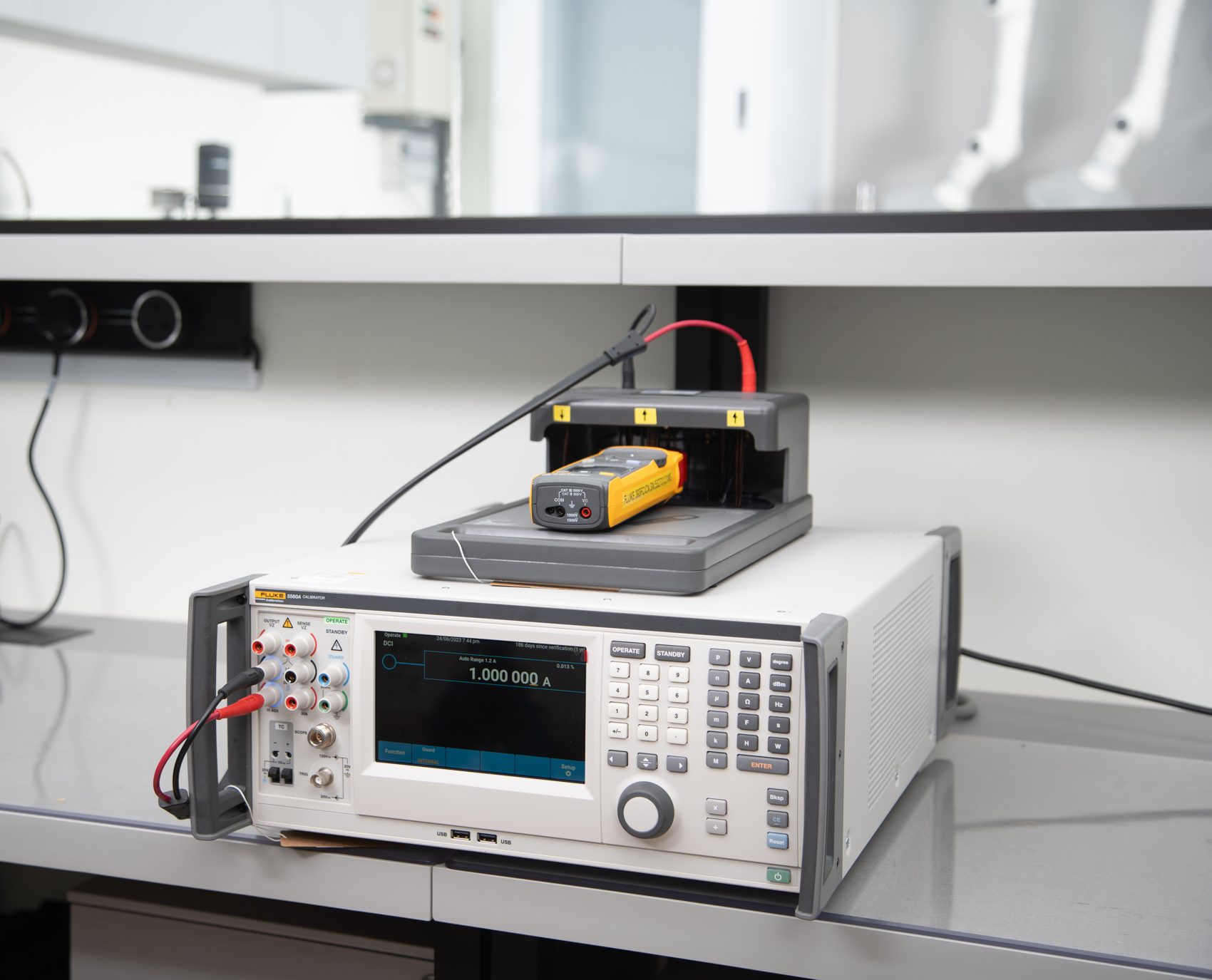
A cable certifier is a precision RF measurement instrument. Its accuracy depends on the integrity of its internal reference values and the physical condition of its measurement ports and adapters. Over time (and especially after drops, temperature cycling on job sites, or heavy daily use), drift can occur. An instrument that is out of tolerance will still issue PASS and FAIL results, but those results may not accurately reflect the physical performance of the cable under test.
This matters in two ways. First, a cable that genuinely passes may be called FAIL, leading to unnecessary re-termination work and project delays. Second (and more seriously), a cable that genuinely fails may be called PASS, meaning a non-compliant installation is handed over to a client as certified. When that installation fails in service (perhaps years later when the network is upgraded to a higher speed), liability questions arise.
SAC-SINGLAS accreditation (Singapore Accreditation Council. Singapore Laboratory Accreditation Scheme) means that a calibration laboratory has been independently assessed against ISO/IEC 17025 by SAC. Calibration certificates issued by an SAC-SINGLAS accredited laboratory carry metrological traceability to Singapore's National Metrology Centre (NMC), which is in turn traceable to the international SI system through mutual recognition arrangements (MRA). This chain of traceability is what makes the certificate meaningful to auditors and regulators. As our article on accredited vs non-accredited calibration explains, only accredited calibration provides this assurance. A non-accredited certificate, however well-intentioned, cannot guarantee the same metrological rigour.
For cable certifiers specifically, Unitest recommends calibration at the point of purchase (before the instrument is used on any project that will require a compliance handover) and annually thereafter. The calibration interval can be adjusted based on usage intensity. See our guidance on how often to calibrate instruments for a framework to justify your chosen interval to auditors.
Buying New vs Renting a Cable Certifier in Singapore
The rent-vs-buy decision for cable certifiers follows a straightforward calculation. A DSX2-8000 costs approximately SGD 18,000–24,000 new; a DSX2-5000 approximately SGD 12,000–16,000. Rental from a test equipment house in Singapore typically runs SGD 400–700 per week for a DSX2-class instrument, depending on the adapter set included. Annual calibration adds approximately SGD 400–800 per instrument per year.
At three or more substantial projects per year, ownership is almost always the better economics, and ownership means your instrument is always available at short notice rather than subject to rental availability. More importantly, ownership lets you build a consistent calibration record for the instrument, which strengthens your credibility with clients who ask to see your quality management documentation.
If you are buying a second-hand instrument (which is common in the Singapore contractor market), insist on a calibration certificate dated within the last 12 months from an accredited laboratory. A used DSX2 with a valid SAC-SINGLAS calibration certificate is a lower risk than a new unit that has never been formally verified, because at least you know its current performance has been objectively checked.
Maintaining Your Cable Certifier: Adapters, Storage and Cleaning
The weakest link in any cable certification kit is not the main unit, it is the adapters. RJ45 channel and permanent link adapters wear with use; the spring contacts inside the RJ45 port degrade over thousands of insertions. Fluke Networks recommends replacing adapters every 5,000 insertions for channel adapters and every 10,000 for permanent link adapters. Worn adapters introduce contact resistance that can cause marginal FAIL results on links that are physically good.
Keep adapters in the supplied case when not in use and avoid dropping them. The alignment mechanism is precision-machined and can shift on impact. Clean RJ45 ports with compressed air periodically; do not use solvents. For fibre, clean every connector end face before every test. A dirty end face is the single largest source of false FAIL results in fibre certification, and it takes less than 30 seconds with a proper fibre cleaning kit to eliminate it as a variable.
Store the main unit in a temperature-controlled environment when not in use. Singapore's humidity and temperature swings between air-conditioned interiors and outdoor job sites can accelerate drift in precision instruments. Bringing the instrument to ambient temperature before testing (allow 30 minutes after moving from a cold van to a hot plant room) improves the reliability of your results.
Building the Test Plan Before You Start Certifying
The single biggest efficiency gain on a large data-centre certification job comes before the first link is ever tested: a properly configured test plan loaded into the certifier. The DSX2 and comparable instruments let you pre-load a project profile that specifies the cable category, the test standard, the connector type, and the naming convention for every link, so the technician on the floor is selecting from a dropdown rather than manually configuring parameters for each run.
For a Tier III or IV data-hall project with a structured naming convention (rack-row-port, or a similar scheme mandated by the client's DCIM system), setting this up correctly at the start avoids a painful reconciliation exercise later, when hundreds of test results need to be matched against an as-built cable schedule. Fluke's LinkWare software supports importing a cable ID list directly from a spreadsheet, which is significantly faster than manual entry for projects exceeding a few hundred links, and reduces the transcription errors that otherwise show up during the commissioning documentation review.
It is worth assigning one person on the project team, usually the lead technician or QA coordinator, to own the test plan and cable ID list before certification begins, rather than allowing each technician to configure their own naming approach. Inconsistent naming across a multi-technician team is one of the most common causes of rework during data-centre handover, when the commissioning agent cannot reconcile the submitted test reports against the physical infrastructure.
What a Complete Handover Package Should Include
A cable certification report on its own is rarely sufficient for a data-centre commissioning handover. Clients, commissioning agents, and Uptime Institute assessors typically expect a complete package, and knowing what belongs in it before the project closes out avoids a scramble at handover.
- The full LinkWare (or equivalent) test report export, covering every link tested, in both the native software format and a PDF summary for non-technical stakeholders.
- A pass/fail summary with any waived or re-tested links clearly flagged, including the reason for any retest (adapter replacement, connector re-termination, or investigation of a marginal result).
- The calibration certificate for the instrument used, current at the time of testing, from a SAC-SINGLAS accredited laboratory. Some clients specifically request this be dated within the test period, not just "within 12 months," so confirm the requirement early.
- An as-built cable schedule reconciled against the test report cable IDs, so any discrepancy between the design documentation and what was actually installed is documented rather than discovered later.
- Fibre-specific documentation, where applicable: OTDR trace files in addition to the OLTS pass/fail summary, since some clients and commissioning agents require trace-level evidence for backbone and trunk fibre, not just the loss measurement.
Assembling this package as testing proceeds, rather than reconstructing it after the fact, is significantly less effort and produces a cleaner audit trail if a warranty or performance question arises later in the data centre's operational life.
Common Causes of Marginal Fail Results and How to Investigate Them
On any large data-centre project, a subset of links will produce marginal FAIL results, close to the pass/fail limit rather than a clear-cut failure. How the project team investigates these results has a direct bearing on both the schedule and the credibility of the final handover.
The most common root causes, in rough order of frequency on Singapore installations, are: poor termination technique (excessive untwisting of pairs at the connector, a frequent issue with less experienced technicians under schedule pressure); a worn or contaminated adapter on the test instrument itself, which is why re-testing a marginal FAIL with a freshly cleaned or swapped adapter is standard first-line diagnostics; cable damage from excessive bend radius or crush during containment installation, which is more common in tight cable tray runs than most contractors expect; and, less commonly, a genuine cable manufacturing defect, which is why keeping a sample of the cable reel's batch information is useful if a pattern of failures emerges from the same reel.
A disciplined approach is to re-test any marginal FAIL immediately with a known-good adapter before assuming the cable itself is at fault, then physically inspect the termination if the retest confirms the failure. Treating every marginal result as an automatic re-termination without this diagnostic step wastes labour on cables that were never actually the problem, while skipping the diagnostic step entirely risks certifying a genuinely marginal installation that degrades further once the data hall goes into live service and thermal cycling begins.
Frequently Asked Questions
A cable certifier is a test instrument that verifies structured cabling (copper or fibre), meets the performance limits defined by international standards such as TIA-568, ISO/IEC 11801, and Singapore's SS 568. Unlike a simple continuity tester, a certifier measures parameters such as insertion loss, NEXT, return loss, and propagation delay across the full frequency sweep required by the standard. You need one whenever you are installing or commissioning network cabling in a data centre, office, or campus environment and need a standards-compliant test report for the handover to your client, building owner, or auditor.
The Fluke Networks DSX2-8000 is widely regarded as the benchmark for Cat 6A and Cat 8 certification. Its Level V accuracy, 2 GHz bandwidth, and 10-second per-link test time make it the preferred choice for high-density data-centre work. The DSX2-5000 (1 GHz, Level IV/V) is a strong value option for Cat 6A installations that do not require Cat 8 headroom. Both are available through Unitest at unitestshop.com.
Yes. Like all precision measurement instruments, cable certifiers should be calibrated against traceable reference standards before first use and at least annually thereafter. This ensures that the pass/fail results your instrument generates are metrologically valid. Critical when test reports are submitted to clients, building authorities, or ISO 9001 auditors. Unitest Instruments (SAC-SINGLAS Acc. No. LA-2023-0845-C) provides accredited calibration for Fluke Networks cable certifiers and other network test equipment in Singapore.
Accuracy levels for cable certifiers are defined in IEC 61935-1. Level IV accuracy is required for certifying Cat 6A channels at up to 500 MHz. Level V accuracy is required for Cat 8 certification at up to 2 GHz and also provides tighter measurement uncertainty at Cat 6A frequencies. Important when your margin to the pass/fail limit is small. If you are building a data centre that may need to support 25GBASE-T or 40GBASE-T in the future, a Level V instrument gives you forward headroom.
The primary standard for structured cabling in Singapore is SS 568, which is harmonised with ISO/IEC 11801 and aligned with TIA-568. For data-centre environments specifically, TIA-942 and ISO/IEC 24764 provide additional guidance on topology and performance requirements. Compliance is often required for BCA Green Mark submissions and for data-centre operators seeking Uptime Institute Tier III or IV certification.
With the right adapters, yes. The Fluke Networks DSX2-8000 is a copper certifier; it requires the CertiFiber Pro module for fibre certification. The CertiFiber Pro is a dedicated fibre OLTS and OTDR that handles both single-mode and multimode fibre, and integrates with the DSX2's LinkWare Live cloud platform for unified reporting. Many contractors carry both instruments to cover full-infrastructure projects. Unitest can supply and calibrate both.
The typical calibration interval is 12 months, consistent with the manufacturer's recommendation and best practice under ISO/IEC 17025. In high-throughput environments where instruments are used daily on job sites, a 6-month interval reduces the risk of out-of-tolerance results invalidating previously issued test reports. Our article on calibration intervals provides a framework for setting and justifying your chosen interval based on your usage pattern.
A new Fluke Networks DSX2-8000 typically costs in the region of SGD 18,000-24,000 including a set of channel adapters. The DSX2-5000 is typically SGD 12,000-16,000. Short-term rental from a test-equipment house is available at approximately SGD 400-700 per week. Buying makes financial sense if you are running three or more cabling projects per year. Renting is preferred for one-off projects or when you need a specific adapter class you do not own. Always factor in annual calibration costs (~SGD 400-800 per instrument) when calculating total cost of ownership.
Yes. Unitest Instruments is an authorised distributor for Fluke Networks products in Singapore, including the DSX2-8000, DSX2-5000, and CertiFiber Pro families. You can browse and purchase online at unitestshop.com, or contact our team for volume pricing, bundled adapter sets, and trade-in options on older certifiers. As a SAC-SINGLAS accredited laboratory, we can also calibrate instruments at the point of sale so they arrive job-ready with a traceable certificate.
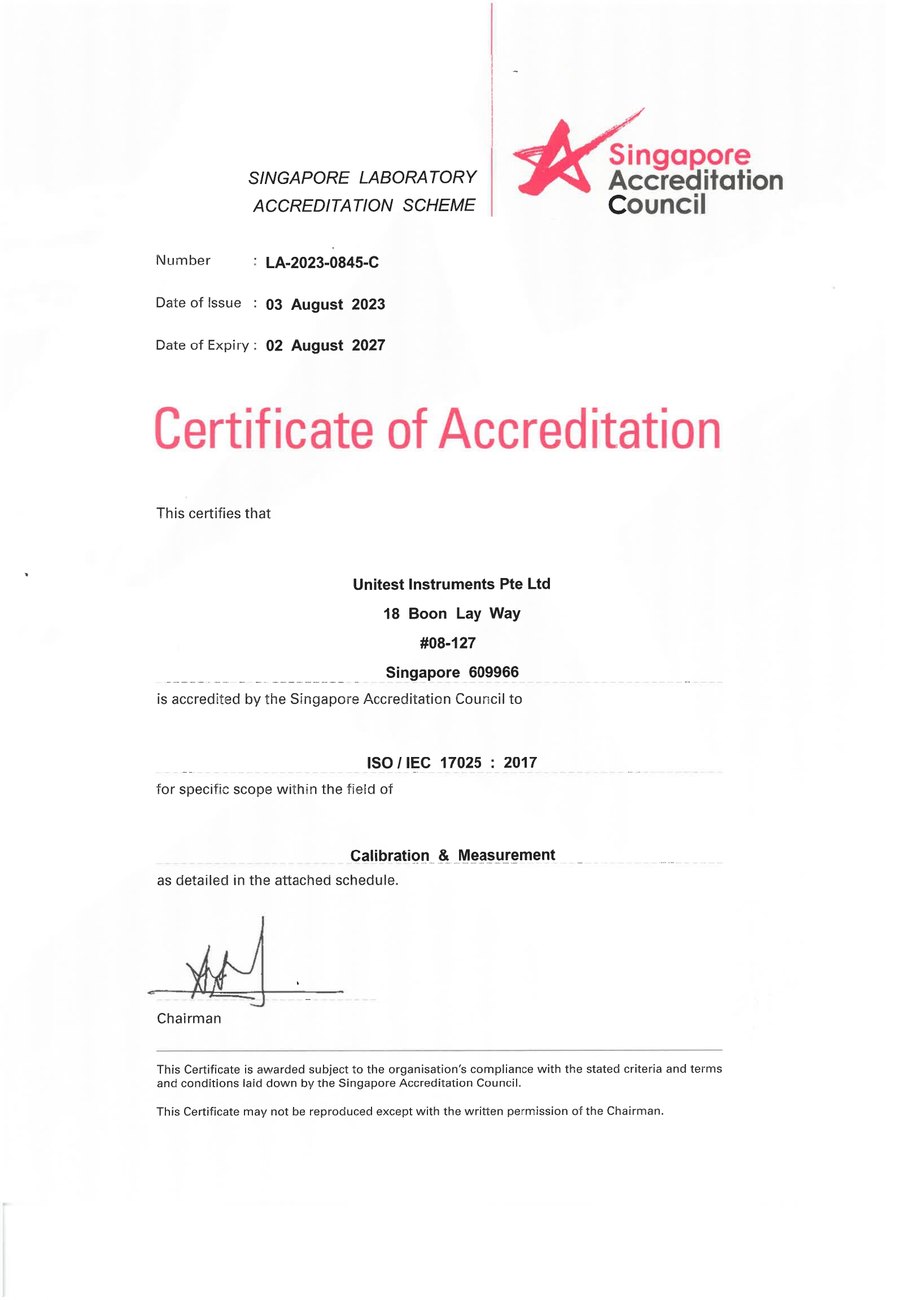
SAC-SINGLAS accredited calibration laboratory (Acc. No. LA-2023-0845-C) serving Singapore's industrial, pharmaceutical, and manufacturing sectors. All content reflects our ISO/IEC 17025 accredited scope and is reviewed by our technical calibration team.
Need cable certifier calibration in Singapore?
Unitest Instruments is SAC-SINGLAS accredited (Acc. No. LA-2023-0845-C) to ISO/IEC 17025. Same-week turnaround, certificates accepted by ISO 9001 auditors and data-centre commissioning teams.