

Key Takeaways
- MPA Singapore enforces SOLAS and Load Line Convention requirements; surveys are conducted by recognised Classification Societies and MPA PSC officers.
- Watertight integrity applies to hull, bulkheads, and below-waterline closures; weathertight integrity applies to hatch covers, deck openings, ventilators, and closing appliances.
- Two accepted test methods: traditional hose test (IACS UR Z17) and ultrasonic leak detection. Both require calibrated instruments with traceable certificates.
- Pressure gauges, ultrasonic detectors, and torque wrenches used in marine surveys must be calibrated by a SAC-SINGLAS accredited laboratory.
- Survey intervals: annual, intermediate (2.5 years), and special dry-dock survey (5 years). Plus mandatory out-of-cycle surveys after damage.
- Non-compliance consequences include vessel detention, loss of class, withdrawal of seaworthiness certificates, and criminal prosecution under the Merchant Shipping Act.
Why Watertight Integrity Matters: The Regulatory Context
The sea is the most hostile operating environment any industrial facility can face. A single failed hatch cover seal, a degraded bulkhead penetration, or a corroded closing appliance can allow progressive flooding that sinks a vessel faster than crew can respond. This is not theoretical. High-profile casualties such as the MV Derbyshire and MV Bulk Jupiter were attributed in part to weathertight failures on bulk carriers operating in heavy weather.
Singapore, as one of the world's busiest ports and a major flag state through the Singapore Registry of Ships (SRS), takes these risks seriously. The Maritime and Port Authority of Singapore (MPA) administers the Merchant Shipping Act (Cap. 179) and gives effect to international conventions ratified by Singapore, including SOLAS and the Load Line Convention. MPA's Port State Control (PSC) directorate conducts inspections of all foreign vessels calling at Singapore ports under the Tokyo MOU framework, with deficiency codes specifically targeting watertight and weathertight appliances.
For facilities managers, marine superintendents, and compliance officers responsible for vessel operations or shore-based support services, understanding these requirements (and ensuring the instrumentation used to demonstrate compliance is properly calibrated), is not optional. It is a fundamental duty of care.
The Regulatory Framework: SOLAS, Load Line, and IACS
Three layers of regulation define what is required:
SOLAS Chapter II-1. Construction, Subdivision and Stability
Part B of SOLAS Chapter II-1 sets out the requirements for watertight subdivision of passenger ships and the general principles for cargo vessels. Regulation 11 requires that all watertight bulkheads, decks, and closing appliances are constructed to withstand water pressure with an adequate margin of safety. Regulation 15 covers openings in watertight bulkheads. Regulation 22 requires periodic testing of watertight doors and their remote operating systems. These regulations are not aspirational. They are minimum statutory requirements, and a vessel that does not meet them cannot lawfully proceed to sea.
The International Load Line Convention 1966 (as amended by the 1988 Protocol)
The Load Line Convention governs the assignment of load lines (Plimsoll marks) and, crucially, the conditions of assignment that must be met to justify those marks. Annex I, Regulation 16 covers hatch covers, requiring them to be weathertight. Regulation 17 covers machinery space openings; Regulation 18, miscellaneous openings; Regulation 19, ventilators; and Regulation 21, air pipes. A vessel's Load Line Certificate is only valid if all conditions of assignment (including the weathertight integrity of all closures), are maintained throughout the voyage.
IACS Unified Requirements and Recommendations
Classification Societies that are members of the International Association of Classification Societies (IACS) are required to implement Unified Requirements. UR Z17 defines the hose test procedure for weathertight hatch covers. UR S26 covers closing appliances for cargo ship hatches. IACS Recommendation No. 14 provides guidance on the ultrasonic testing of hatch covers as an alternative or supplement to hose testing. These requirements are given legal effect by SOLAS Regulation II-1/3-1, which requires vessels to be built and maintained in compliance with the structural and mechanical requirements of a recognised Classification Society.
Watertight vs Weathertight: Understanding the Distinction
These two terms are often used interchangeably in casual conversation, but they have precise technical meanings that determine which test method and which acceptance criteria apply.
| Property | Watertight | Weathertight |
|---|---|---|
| Definition | Prevents ingress of water under a static head in any sea condition | Prevents ingress of water in any sea condition the vessel is designed for, but not necessarily under a full hydrostatic head |
| Applies to | Hull shell plating, watertight bulkheads, double-bottom tanks, below-waterline closures, watertight doors | Hatch covers, ventilators, air pipes, deck openings above waterline, closing appliances on exposed decks |
| Typical test method | Hydrostatic test (tank filling) or air-pressure leak test on bulkheads | Hose test (IACS UR Z17) or ultrasonic leak detection (IACS Rec. 14) |
| Acceptance criterion | No water ingress at specified head; no air leakage above pressure threshold | No continuous jet penetration under hose test; signal level below threshold on ultrasonic test |
| Survey category | Special (dry-dock) survey; after damage | Annual survey; intermediate survey; Load Line renewal |
| SOLAS reference | Chapter II-1, Regs 11–22 | Load Line Convention Annex I, Regs 16–21 |
In practice, the weathertight integrity of hatch covers is the most frequently tested (and most frequently failed), element on bulk carriers and general cargo vessels. Hatch cover seals degrade through UV exposure, mechanical damage during cargo operations, and simple age. A compression bar that is 10 mm out of alignment can create a gap sufficient to admit tonnes of water per hour in heavy weather.
Step-by-Step Compliance Process
The following process applies to routine annual surveys and Load Line renewal surveys for cargo vessels. Dry-dock and damage surveys involve additional steps.
Step 1: Pre-Survey Preparation
Before the surveyor boards, the ship's officer or superintendent should: verify that all hatch cover seals (gaskets/packings) have been visually inspected and any visibly damaged sections replaced; confirm that compression bar alignment has been checked with feeler gauges; ensure all closing appliances (cleats, wedges, cross-joint blocks) are in place and operational; and confirm that all test instruments (hose-test pressure gauges, ultrasonic detectors), carry current calibration certificates. Presenting uncalibrated instruments to a class surveyor is a common reason for deficiency codes to be raised, even when the structure itself is sound.
Step 2: Hose Test (IACS UR Z17 Procedure)
The hose test must be conducted with a nozzle of minimum 12 mm internal bore, water pressure of at least 1 bar at the nozzle, and the nozzle held no more than 1.5 m from the surface being tested at an angle of approximately 45 degrees. The jet is directed along all seams, joints, and closing appliances. Any water entering the hold constitutes a failure. The surveyor witnesses the test; the ship's officer documents the results. The pressure gauge on the hose rig must have a valid calibration certificate. This is a hard requirement, not a courtesy.
Step 3: Ultrasonic Leak Detection (IACS Rec. 14 Procedure)
When ultrasonic testing is used (either as the primary method or following a doubtful hose test), an ultrasonic transmitter is placed inside the closed hold and the surveyor or designated tester scans the exterior with a directional receiver. The transmitter emits a signal in the 40 kHz range. Any gap in the seal manifests as a localised increase in signal level at the receiver. IACS Recommendation 14 specifies the acceptance threshold. Typically any reading above 50% of the maximum scale on the calibrated receiver requires investigation and repair. The ultrasonic detector must be calibrated, with a certificate referenced in the survey report.
Step 4: Bulkhead and Tank Air-Pressure Testing
For watertight bulkheads (particularly after structural repairs), air-pressure testing is the standard method. The compartment is pressurised to a low positive pressure (typically 0.15–0.25 bar above ambient) and a soap-solution or equivalent leak-detection fluid is applied to all joints, welds, and penetrations. Any bubble formation indicates a leak. The air pressure must be monitored with a calibrated pressure gauge throughout the test period (typically a minimum hold period of 30 minutes after pressure stabilisation).
Step 5: Survey Documentation and Certification
Following satisfactory testing, the surveyor endorses the relevant certificates: the Load Line Certificate (Condition of Assignment), the Cargo Ship Safety Construction Certificate, or the Classification Certificate as applicable. The ship is required to retain survey reports and calibration certificates for all instruments used on board as part of its ISM Code documentation. MPA PSC officers routinely request these records during port-state control inspections.
Need calibration certificates for marine survey instruments?
Unitest Instruments (Acc. No. LA-2023-0845-C) calibrates pressure gauges, ultrasonic instruments, and test equipment to traceable standards accepted by all major Classification Societies. Same-week turnaround available in Singapore.
Calibration Instrument Requirements for Marine Integrity Testing
Classification Society surveyors and MPA PSC inspectors increasingly ask to see calibration certificates for all instruments used in hull integrity testing. This is not merely good practice. It is a requirement under the ISM Code's maintenance and verification procedures, and it directly affects whether a survey result is accepted or challenged.
Pressure Gauges
Hose-test rigs and air-pressure test setups require pressure gauges calibrated to an accuracy of ±1.0% of full scale or better. Calibration must be traceable to national measurement standards, in Singapore, this means traceability to A*STAR's National Metrology Centre (NMC). Calibration intervals are typically 12 months or per the manufacturer's recommendation, whichever is shorter. A gauge that reads 0.8 bar when the actual pressure is 1.0 bar will cause a ship to fail a test that the structure actually passes. Or worse, pass a test at an insufficient pressure. Understanding what information appears on a calibration certificate helps marine superintendents verify that a gauge's certificate is fit for purpose before use.
Ultrasonic Leak Detectors
Ultrasonic detectors must be calibrated against a reference sound source of known output. Calibration establishes the instrument's sensitivity curve and confirms that the threshold settings used during the test are accurate. Most manufacturers specify annual calibration. Instruments that have been dropped, exposed to shock, or operated outside their rated temperature range should be returned for calibration before the next survey regardless of the scheduled interval. The calibration certificate must identify the specific instrument by serial number. A certificate for a different unit of the same model is not valid.
Torque Wrenches
Hatch cover cleats and bolted closures are tightened to specified torque values defined in the vessel's approved maintenance records. Torque wrenches used for this work must be calibrated. An over-torqued cleat can crack the compression bar; an under-torqued one will fail to seat the gasket properly. Calibration of torque wrenches to ±4% accuracy (Class 2 per ISO 6789) is the typical requirement for marine maintenance applications. As explained in our guide on how to determine the right calibration interval, usage frequency and working environment both affect how often a torque wrench needs re-calibration.
Feeler Gauges
Compression bar gap measurements using feeler gauges are an important pre-survey diagnostic. While feeler gauges are simpler instruments, they should be checked periodically for blade wear and blade parallelism. For formal survey use, a calibration record demonstrating that the blade thicknesses are within tolerance is advisable.
Penalties for Non-Compliance in Singapore
Non-compliance with watertight and weathertight integrity requirements carries significant commercial and legal consequences in Singapore. The consequences operate at three levels.
Vessel Detention
Under the Merchant Shipping Act and MPA's PSC powers, a vessel with structural deficiencies (including failed watertight or weathertight closures), can be detained in port until the deficiencies are rectified to the satisfaction of the surveyor. Detention is a hard stop: the vessel cannot earn freight, incurs port costs, and may face cargo claims if delivery is delayed. In 2023, MPA recorded detention rates broadly in line with the Tokyo MOU average for Asia-Pacific ports. Hatch cover and closing appliance deficiencies consistently appear in the top deficiency categories across Tokyo MOU member states.
Loss of Class and Certificates
If deficiencies are not rectified within a period agreed with the Classification Society, the vessel's class can be suspended or withdrawn. Without valid class, the vessel's statutory certificates (Safety Construction Certificate, Load Line Certificate) become invalid, and the vessel cannot lawfully operate on international voyages. Reinstating class after suspension is significantly more expensive and time-consuming than maintaining it through routine surveys.
Criminal Prosecution
The Merchant Shipping Act provides for fines and, in the case of deliberate falsification of survey records or operating a vessel known to be unseaworthy, imprisonment of the master or shipowner. Sending a vessel to sea in a condition known to be dangerous (including known watertight integrity failures), constitutes an offence. While prosecutions are rare, the legal risk is real, and the consequences for a master's certificate of competency are severe.
Survey Planning for Facilities Managers and Marine Superintendents
Effective compliance management for vessel operators is a year-round activity, not a last-minute scramble before a surveyor boards. The following practices reduce survey risk and keep calibration costs predictable.
Maintain a calibration register: All instruments used in hull integrity testing (pressure gauges, ultrasonic detectors, torque wrenches), should be listed in a calibration register with serial numbers, calibration due dates, and the accredited laboratory that issued each certificate. This register should be reviewed at least 60 days before any scheduled survey to allow time for recalibration if needed.
Schedule calibration with survey planning: Calibration certificates have expiry dates. A certificate that expires one week before a scheduled class survey is a problem. Build a 30-day buffer. Send instruments for calibration at least a month before the survey. SAC-SINGLAS accredited laboratories such as Unitest Instruments can typically turn around marine survey instruments within the same week for standard items.
Use accredited laboratories only: Classification Societies and MPA surveyors accept calibration certificates from SAC-SINGLAS accredited laboratories because accreditation to ISO/IEC 17025 provides independent assurance of technical competence and measurement traceability. Certificates from non-accredited workshops (however experienced), may not be accepted, and a survey result backed by an unaccepted certificate can be voided. Understanding the distinction between accredited and non-accredited calibration is essential for anyone procuring calibration services for safety-critical applications.
Document seal and compression bar condition: Between surveys, ship's officers should record visual inspections of hatch cover seals and compression bars in the vessel's planned maintenance system. Photographic records of seal condition, compression bar gap measurements, and cleat settings provide evidence of proactive maintenance. Evidence that is useful in the event of a dispute with a surveyor over a borderline condition.
Frequently Asked Questions
Watertight integrity means a structure prevents water ingress under a static head of water. Essential for bulkheads, tanks, and below-waterline closures. Weathertight integrity means a structure resists water penetration under the sea conditions the vessel is designed to operate in, but is not necessarily subjected to a full hydrostatic head. SOLAS Chapter II-1 and the Load Line Convention both define minimum requirements for each category. In practice, watertight standards are stricter and apply to hull structure, while weathertight standards apply to deck openings, hatch covers, ventilators, and closing appliances.
The Maritime and Port Authority of Singapore (MPA) is the flag-state authority for Singapore-registered vessels. MPA administers the Merchant Shipping Act and enforces SOLAS, Load Line Convention, and ISM Code requirements. Actual surveys are typically delegated to MPA-recognised Classification Societies (e.g. Lloyd's Register, DNV, Bureau Veritas, ClassNK, ABS). Port-state control inspections are conducted by MPA officers under the Tokyo MOU framework. Non-Singapore flag vessels calling at Singapore ports are subject to the same PSC regime.
The primary standards are: SOLAS Chapter II-1 (construction and subdivision), the International Load Line Convention 1966 (as amended 1988), IACS Unified Requirements (UR S26 on closing appliances, UR Z17 on hatch cover testing), and each Classification Society's own rules. For hatch covers specifically, IACS Recommendation No. 14 and the ultrasonic leak detection method are widely accepted. Testing instruments must be calibrated to traceable standards, in Singapore, this means calibration by a SAC-SINGLAS accredited laboratory such as Unitest Instruments.
Two main methods are used. The traditional hose test (per IACS UR Z17) uses a pressurised water jet directed at seams and closures. Simple but it wets the cargo hold and may miss micro-leaks. The ultrasonic method involves placing a transmitter inside the closed hatch and scanning the outside with a receiver; it detects gaps without wetting the hold and is increasingly preferred by class surveyors. Both methods require the instruments to be in calibration. Ultrasonic leak detectors must be calibrated annually or per the manufacturer's schedule; pressure gauges on hose-test rigs also require current calibration certificates.
The key instruments are: (1) Pressure gauges on hose-test rigs (calibrated to traceable pressure standards, typically ±1% FS accuracy class. (2) Ultrasonic leak detectors), calibrated against reference sound sources with documented calibration intervals. (3) Air-pressure test gauges for tank and bulkhead tests, calibrated to ±0.5% FS or better. (4) Torque wrenches used during closure tightening. In Singapore, all calibration must be traceable to the national measurement standards maintained by A*STAR's National Metrology Centre (NMC). SAC-SINGLAS accredited laboratories such as Unitest Instruments (Acc. No. LA-2023-0845-C) issue calibration certificates accepted by classification societies and MPA surveyors.
Under the Merchant Shipping Act (Cap. 179), MPA can detain a vessel that fails to meet statutory structural requirements, including watertight integrity. A detention notice prevents the vessel from departing Singapore port until deficiencies are rectified and a satisfactory re-survey is completed. Repeated or serious failures can result in loss of class, withdrawal of the vessel's certificate of seaworthiness, and potential prosecution of the shipowner or master. For Singapore-registered vessels, MPA may also refer matters to the relevant Classification Society for flag-state action. Port-state control detentions are publicly recorded in the Tokyo MOU database, affecting a vessel's PSC inspection history and charter prospects.
Survey intervals are set by the vessel's Classification Society rules and the Load Line Convention. For most commercial vessels: Annual surveys check the condition of closures and seals. Intermediate surveys (every 2.5 years) include more detailed inspection of weathertight closures. Special (dry-dock) surveys every 5 years include full underwater hull and watertight bulkhead inspection. After any grounding, collision, or structural damage, an out-of-cycle survey is mandatory before the vessel returns to service. Facilities managers and superintendents should maintain a survey calendar tied to the vessel's class renewal cycle.
Yes, and this is precisely why ultrasonic testing is gaining ground. The hose test at standard pressure may not detect hairline gaps in compression bars or minor seal degradation that the ultrasonic method readily identifies. IACS UR Z17 acknowledges that where doubts remain after a hose test, the surveyor may require an ultrasonic test as confirmation. A vessel that passes the hose test but fails ultrasonic will typically be required to carry out repairs and re-test before the surveyor endorses the Load Line Certificate. Keeping test instruments properly calibrated ensures both methods give reliable, defensible results.
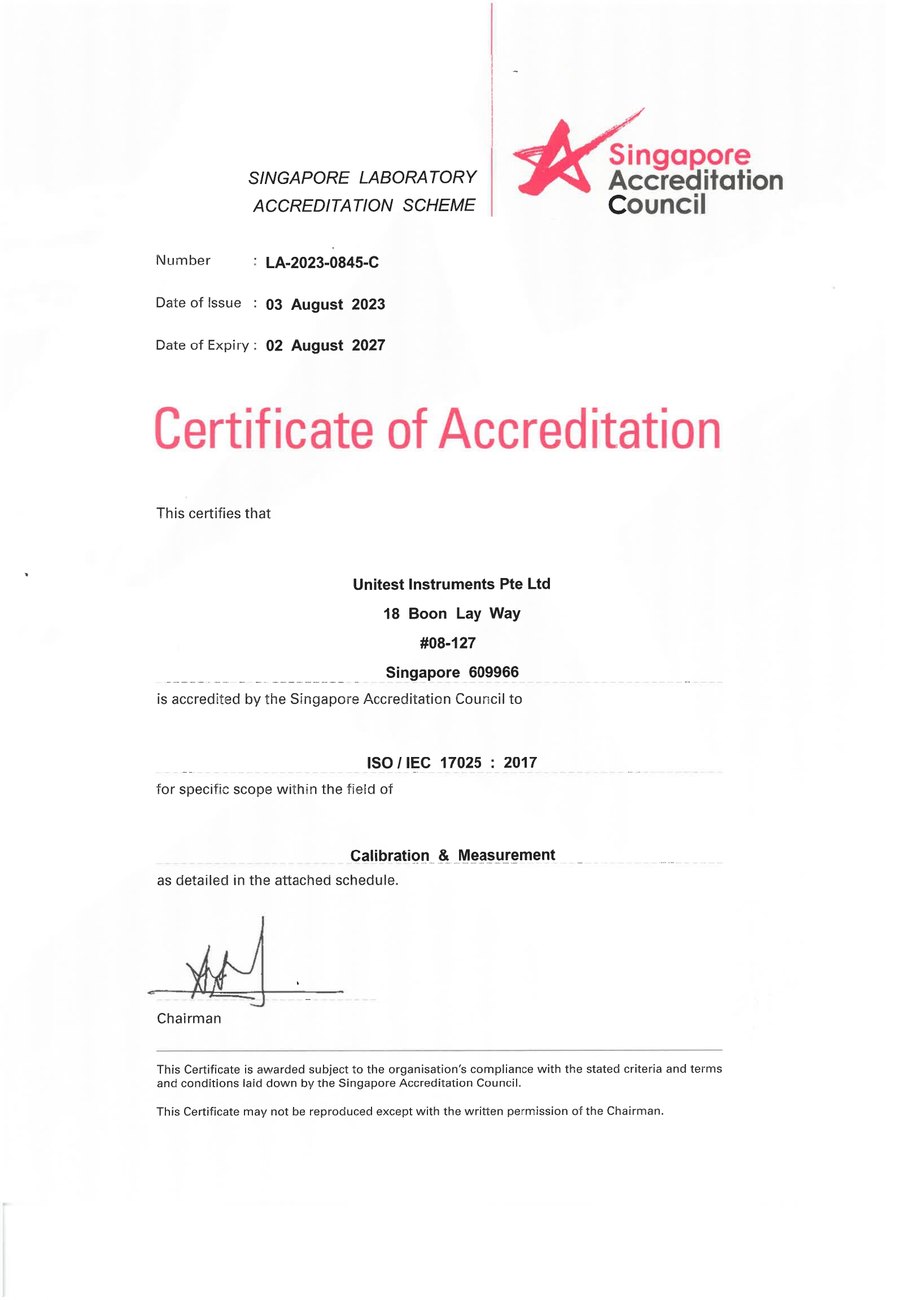
SAC-SINGLAS accredited calibration laboratory (Acc. No. LA-2023-0845-C) serving Singapore's industrial, pharmaceutical, and manufacturing sectors. All content reflects our ISO/IEC 17025 accredited scope and is reviewed by our technical calibration team.
Need marine survey instrument calibration in Singapore?
Unitest Instruments is SAC-SINGLAS accredited (Acc. No. LA-2023-0845-C) to ISO/IEC 17025. Same-week turnaround, certificates accepted by ISO 9001 auditors and Classification Society surveyors.