
Key Takeaways
- SS 555:2010 is the primary technical standard; EMA, BCA, NEA, and PUB each add regulatory layers depending on system type and location.
- A Licensed Electrical Worker (LEW) must sign off every grid-connected solar PV commissioning report before SP Group allows export.
- Systems above 1 MW require an EMA generation licence; smaller rooftop systems still need notification and grid connection approval.
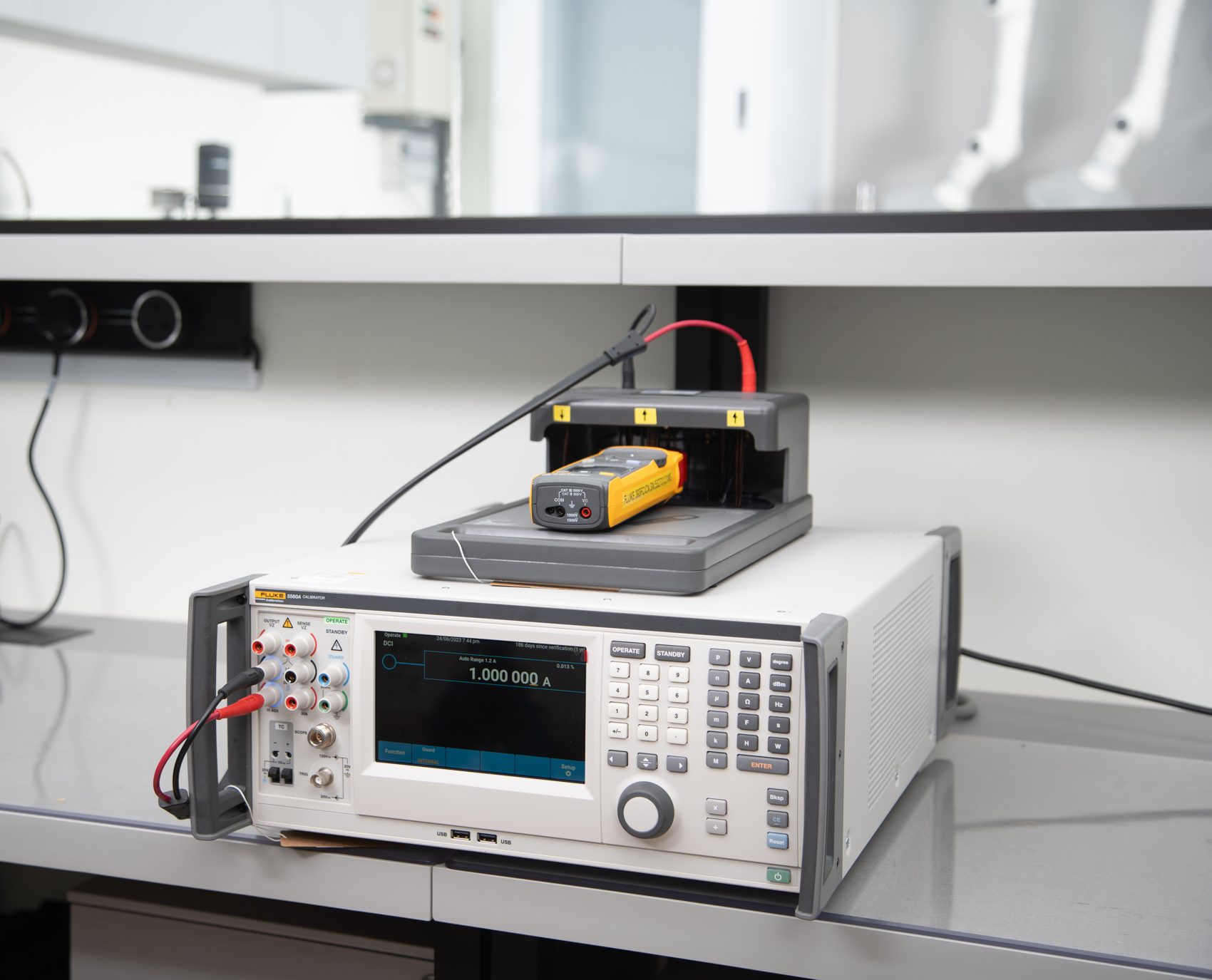
- All commissioning instruments (megohmmeter, DMM, pyranometer, earth tester), must carry current calibration certificates from an accredited laboratory.
- Non-compliance with the Electricity Act can attract fines up to S$1,000,000; BCA contraventions carry up to S$200,000 per offence.
The Regulatory Landscape: Who Governs Solar PV in Singapore?
Singapore's rapid push toward solar energy (targeting 2 GWp of installed capacity by 2030 under the Singapore Green Plan), has been matched by a tightly coordinated multi-agency regulatory framework. Understanding which agency governs which aspect of your installation is the first step toward a compliant commissioning process.
Energy Market Authority (EMA) is the primary electricity regulator. It administers the Electricity Act (Cap. 89A), the Electricity (Contestable Consumers) Regulations, and the Connection and Use of System Code (CUSC). EMA sets the rules for who needs a generation licence, how systems connect to the grid, and what technical standards inverters and protection relays must meet. For facilities managers, EMA's Solar Irradiance Data portal and the SolarNova programme are also key resources for planning.
Building and Construction Authority (BCA) governs the structural and envelope aspects of rooftop installations. Under the Building Control Act, any addition or alteration affecting structural integrity (including panel racking and mounting), requires a Qualified Person (QP) submission and BCA approval before works begin.
National Environment Agency (NEA) regulates environmental siting, noise during construction, and end-of-life panel disposal under Singapore's Extended Producer Responsibility (EPR) framework. NEA's guidelines on the proper disposal and recycling of PV modules are mandatory under the Resource Sustainability Act.
PUB, Singapore's National Water Agency, is the relevant authority for any solar installation on or near reservoirs, water treatment works, or drainage reserves. Floating solar projects on reservoirs require PUB's direct approval and a detailed commissioning plan review.
SP Group (as the Market Support Services Licensee and grid operator) manages the practical grid connection process. Reviewing SLDs, conducting metering checks, and authorising export before a system goes live.
SS 555:2010. What the Standard Actually Requires
SS 555:2010, "Code of Practice for Solar Photovoltaic Systems," is Singapore's national standard for the design, installation, and commissioning of PV systems. Published by the Singapore Standards Council and closely aligned with IEC 62446, it covers everything from system design documentation through to the test records that must accompany a commissioning sign-off.
Design Documentation Requirements
Before a single panel is installed, SS 555 requires that the system design documentation include: a site survey report, a shading analysis, a string sizing calculation with Voc and Vmp at the expected temperature range for Singapore's climate, a Single Line Diagram (SLD) stamped by an LEW, equipment datasheets (modules, inverters, combiners, isolators), and an earthing and bonding design. This documentation set is also what BCA's QP and SP Group's connection team will review.
Installation Inspection Checklist
SS 555 specifies that before commissioning tests are carried out, a visual inspection must confirm: correct module orientation and tilt, secure mechanical fixing of all racking, correct cable routing and UV-rated cable selection, proper labelling of all isolators and junction boxes, correct installation of surge protection devices (SPDs), and verification that all equipment matches the approved SLD. Any discrepancy must be corrected and documented before proceeding to electrical tests.
Step-by-Step Commissioning Process
The commissioning process for a grid-connected solar PV system in Singapore follows a defined sequence. Skipping or reordering steps risks both safety incidents and regulatory rejection by SP Group.
| Step | Test / Activity | Instrument Required | Pass Criterion (SS 555 / EMA) |
|---|---|---|---|
| 1 | Visual inspection of all mechanical and electrical components | Inspection checklist; torque wrench | All items per SS 555 Annex A checklist confirmed |
| 2 | Open-circuit voltage (Voc) per string | Calibrated DC voltmeter / DMM | Within ±5% of calculated Voc at measured irradiance & temperature |
| 3 | Short-circuit current (Isc) per string | Calibrated DC clamp meter | Within ±5% of expected Isc at measured irradiance |
| 4 | Insulation resistance (IR) test. DC side | Calibrated megohmmeter (500 V or 1000 V DC) | ≥ 1 MΩ between all conductors and protective earth |
| 5 | Earth continuity / bonding test | Calibrated low-resistance ohmmeter | ≤ 0.5 Ω between module frame and main earth bar |
| 6 | Earth resistance test (earthing system) | Calibrated earth resistance tester | ≤ 1 Ω (or per design specification / EMA requirement) |
| 7 | Polarity check. DC strings and combiner outputs | Calibrated DC voltmeter / DMM | Correct polarity confirmed; no string reverse-polarity |
| 8 | Anti-islanding protection test | Protection relay tester or inverter test mode | Grid disconnection within 2 seconds of simulated island condition per EMA grid code |
| 9 | Inverter start-up and grid synchronisation | Power quality analyser; calibrated AC voltmeter | Voltage, frequency, and THD within SP Group limits at PCC |
| 10 | Performance ratio (PR) measurement | Calibrated pyranometer / reference cell; energy meter | PR ≥ design value (typically ≥ 75% for Singapore conditions) |
Need calibration for your solar PV commissioning instruments?
Unitest Instruments provides SAC-SINGLAS accredited calibration for megohmmeters, DMMs, clamp meters, earth testers, and pyranometers, with certificates accepted by EMA, BCA, and SP Group auditors.
Calibration Instrument Requirements for Solar PV Commissioning
The reliability of your commissioning results depends entirely on the accuracy of the instruments used. SS 555 and IEC 62446-1 both require that test equipment be calibrated and that calibration records be retained as part of the commissioning documentation package. This is not merely good practice. Auditors from EMA, ISO 9001 certification bodies, and lenders' technical advisors will all request evidence of instrument calibration.
Understanding what "properly calibrated" means is critical. A calibration sticker from an uncredited lab is not equivalent to a certificate from a SAC-SINGLAS accredited laboratory. For your commissioning certificates to be unambiguously accepted, the calibration must be traceable to national measurement standards (specifically to Singapore's National Metrology Centre (NMC)), through an accredited chain. For more on this distinction, see our article on accredited vs non-accredited calibration.
Key Instruments and Their Calibration Requirements
- Digital Multimeter (DMM): Must cover the system's maximum DC Voc (often 600–1500 V DC for commercial arrays). Calibration should include DC voltage and DC current ranges. Recommended calibration interval: 12 months for field instruments.
- DC Clamp Meter / String Current Logger: Used for non-contact Isc measurement. Calibration must cover the expected string current range. A Class 0.5 instrument is preferred for accurate string balancing diagnostics.
- Megohmmeter (Insulation Resistance Tester): For SS 555 compliance, must be capable of 500 V DC test voltage for systems below 120 V, and 1000 V DC for higher-voltage systems. Calibration interval: 6–12 months depending on usage frequency.
- Earth Resistance Tester: A 3-electrode or 4-electrode (Wenner) earth tester is required for site earthing system verification. Annual calibration is standard practice.
- Pyranometer or Reference Cell: Used to measure in-plane solar irradiance during performance testing. Secondary Standard or Class A pyranometers (ISO 9060) should be recalibrated annually by an accredited laboratory, as sensitivity degrades with UV exposure and soiling.
- Module Temperature Sensor / IR Thermometer: Required to correct Voc and Isc measurements to STC (25°C). Annual calibration traceable to temperature standards is required for thermocouples and RTDs; spot-check calibration for IR thermometers.
- Power Quality Analyser: Used at the Point of Common Coupling (PCC) to verify voltage, frequency, power factor, and THD against SP Group grid code limits before export authorisation.
For a deeper understanding of why calibration traceability matters for your instrument certificates, see our guide on how to read a calibration certificate. Including what the uncertainty values mean and why they matter for your commissioning reports.
EMA Licensing and Grid Connection: What Facilities Managers Must Know
The EMA's grid connection process is triggered the moment you plan to export solar energy to the public grid. The process runs in parallel with your design and commissioning work, and the timelines are non-trivial. Facilities managers who start the EMA process late often find their commissioned systems sitting idle while approvals catch up.
Generation Licensing Thresholds
Under the Electricity Act, any person who generates electricity for sale or export to the public grid requires a generation licence unless specifically exempted. The key thresholds are: installations above 1 MW of AC output require a full generation licence; installations of 1 MW and below connecting under the Simplified Interconnection Process (SIP) are exempt from a generation licence but must still comply with the SIP technical requirements. Crucially, even SIP-exempt systems must have their commissioning certified by an LEW and the SLD submitted to SP Group before export is authorised.
Connection and Use of System Code (CUSC)
The CUSC specifies the technical requirements that generating systems must meet to connect to Singapore's transmission and distribution network. For solar PV, the key CUSC requirements cover: voltage and frequency operating ranges, power factor correction, low-voltage ride-through (LVRT) capability for systems above certain thresholds, anti-islanding protection relay settings (under/over voltage, under/over frequency, and rate-of-change-of-frequency or ROCOF), harmonic limits at the PCC (generally aligned with IEC 61000-3-6 and SP Group's Distribution Code), and metering requirements for import/export measurement.
BCA, NEA, and PUB Requirements: The Non-Electrical Compliance Layers
Facilities managers often focus exclusively on the electrical commissioning and EMA approval process, overlooking the structural, environmental, and drainage compliance obligations that run alongside it. Missing these can result in stop-work orders mid-installation.
BCA Structural Approval
Under the Building Control Act, roof-mounted solar installations that add load to the structure require a QP (Architect or PE) to submit plans for BCA approval before work commences. The structural PE must certify that the roof and supporting structure can bear the additional dead load (typically 0.15–0.25 kPa for standard crystalline silicon panels and racking) plus the wind uplift loads calculated per SS EN 1991 (Eurocode 1) for Singapore's wind conditions. BCA also requires a supervision plan during installation. For buildings covered by the Fire Safety Act, SCDF must be consulted regarding access routes and fire suppression considerations for rooftop arrays.
NEA Environmental Requirements
NEA's involvement in solar PV is primarily at two stages: construction (noise and dust management under the Environmental Protection and Management Act) and end-of-life (PV module disposal under the Resource Sustainability Act's EPR framework, which will phase in mandatory take-back obligations for solar panels). Facilities managers should ensure that procurement contracts specify EPR-compliant end-of-life handling and that construction noise management plans are submitted to NEA where required.
PUB Drainage and Reservoir Considerations
For any installation where panel run-off will discharge into a drain, canal, or watercourse, PUB requires compliance with the Code of Practice on Surface Water Drainage. If your installation changes the impervious area of a roof or redirects water flow, a drainage impact assessment may be required. Floating solar projects on PUB-managed reservoirs are subject to a separate and more extensive approval process, including environmental impact assessment requirements and specialised commissioning procedures for the floating platform structures.
Penalties for Non-Compliance
The penalty framework for solar PV non-compliance in Singapore is severe. Designed to match the safety and system stability risks of improper installations. Facilities managers and compliance officers should be aware of the following schedules.
| Legislation | Offence | Maximum Penalty |
|---|---|---|
| Electricity Act (Cap. 89A) | Operating generation facility without required licence | Fine up to S$1,000,000 and/or imprisonment up to 10 years |
| Electricity Act | Breach of EMA code or technical standard by market participant | Fine up to S$1,000,000 per breach |
| Electricity (Licensing) Regulations | Electrical work by unlicensed person | Fine up to S$10,000 per offence |
| Building Control Act | Structural works without BCA approval or PE certification | Fine up to S$200,000 and/or imprisonment up to 2 years |
| Environmental Protection and Management Act | Noise nuisance during construction without approved plan | Fine up to S$100,000 for first offence |
| Resource Sustainability Act | Non-compliance with EPR obligations for solar panels | Fine up to S$10,000 per day of non-compliance |
Beyond statutory penalties, non-compliant solar systems risk disconnection by SP Group, voiding of equipment warranties, rejection of green certification claims (such as BCA Green Mark), and increased insurance premiums or claim rejections. For commercial buildings targeting BCA Green Mark Platinum or LEED certification, a properly documented and calibrated commissioning process is a prerequisite, not an optional extra.
Frequently Asked Questions
Solar PV installations in Singapore are governed primarily by SS 555:2010 (Code of Practice for Solar Photovoltaic Systems), published by the Singapore Standards Council. In addition, the Energy Market Authority (EMA) Electricity Act and its subsidiary regulations apply to all grid-connected systems. Structural requirements fall under BCA's building regulations and the Code on Envelope Thermal Performance, while environmental siting and waste requirements are covered by NEA guidelines.
Yes. Any solar PV system connected to the public electricity grid must comply with the EMA's Electricity (Contestable Consumers) Regulations and the Connection and Use of System Code (CUSC). Systems above 1 MW require a generation licence. For rooftop solar, the licensed electrical worker (LEW) must submit the commissioning report and Single Line Diagram (SLD) to SP Group and/or EMA before the system can export power. Non-grid-connected systems above certain capacities also require notification.
Mandatory commissioning tests under SS 555 and EMA guidelines include: open-circuit voltage (Voc) and short-circuit current (Isc) verification per string, insulation resistance testing (minimum 1 MΩ between conductors and earth at 500 V DC or 1000 V DC depending on system voltage), earth continuity testing, polarity checks, anti-islanding protection verification, inverter function tests, and string current balancing checks. A calibrated solar irradiance meter (pyranometer or reference cell) is required to normalise performance measurements to Standard Test Conditions (STC).
The key calibrated instruments required include: a digital multimeter (DMM) with DC voltage range covering the system's maximum Voc, a clamp meter or string current logger calibrated for DC current, an insulation resistance tester (megohmmeter) rated to at least 1000 V DC, a solar irradiance meter (Class A pyranometer or calibrated reference cell), a module temperature sensor or infrared thermometer, and an earth resistance tester. All instruments used in a formal commissioning report should carry current calibration certificates traceable to national standards. Ideally from a SAC-SINGLAS accredited laboratory.
Under the Electricity Act (Cap. 89A), operating a generation facility without a licence where one is required carries a fine of up to S$1,000,000 and/or imprisonment of up to 10 years. For contraventions of EMA codes and technical standards, fines of up to S$1,000,000 per breach apply to market participants. Under the Building Control Act, carrying out structural work without BCA approval can result in fines up to S$200,000 and/or imprisonment. Improper electrical work by unlicensed persons under the Electricity (Licensing) Regulations carries fines up to S$10,000 per offence.
Yes, in most cases. Under the Building Control Act, any addition or alteration that affects the structural integrity of a building (including mounting solar panels on a roof), requires a Qualified Person (QP) to submit plans to BCA for approval before works commence. A Professional Engineer (PE) must certify the structural adequacy of the roof to bear the additional load. For minor installations on certain building types, simplified approval routes may apply, but you must confirm with BCA and your QP before proceeding.
PUB's involvement is primarily relevant for solar PV installations on reservoirs, water treatment facilities, and any installation where stormwater runoff management is affected. PUB may require drainage impact assessments to ensure that panels do not redirect water in ways that cause flooding or pollution. For floating solar systems on reservoirs, PUB is the land authority and must grant permission and review the commissioning plan. Facilities near drains or waterways should also consult PUB's Code of Practice on Surface Water Drainage.
Calibration intervals depend on instrument type and usage conditions. As a general industry practice: pyranometers and reference cells should be recalibrated at least annually, as soiling and UV exposure degrade their sensitivity over time. Insulation resistance testers and multimeters used in regular commissioning work should be recalibrated at 6- to 12-month intervals. Earth resistance testers should be calibrated annually. All calibration should be performed by an ISO/IEC 17025 accredited laboratory with traceability to national measurement standards to ensure the certificates are accepted by auditors, EMA, and BCA.
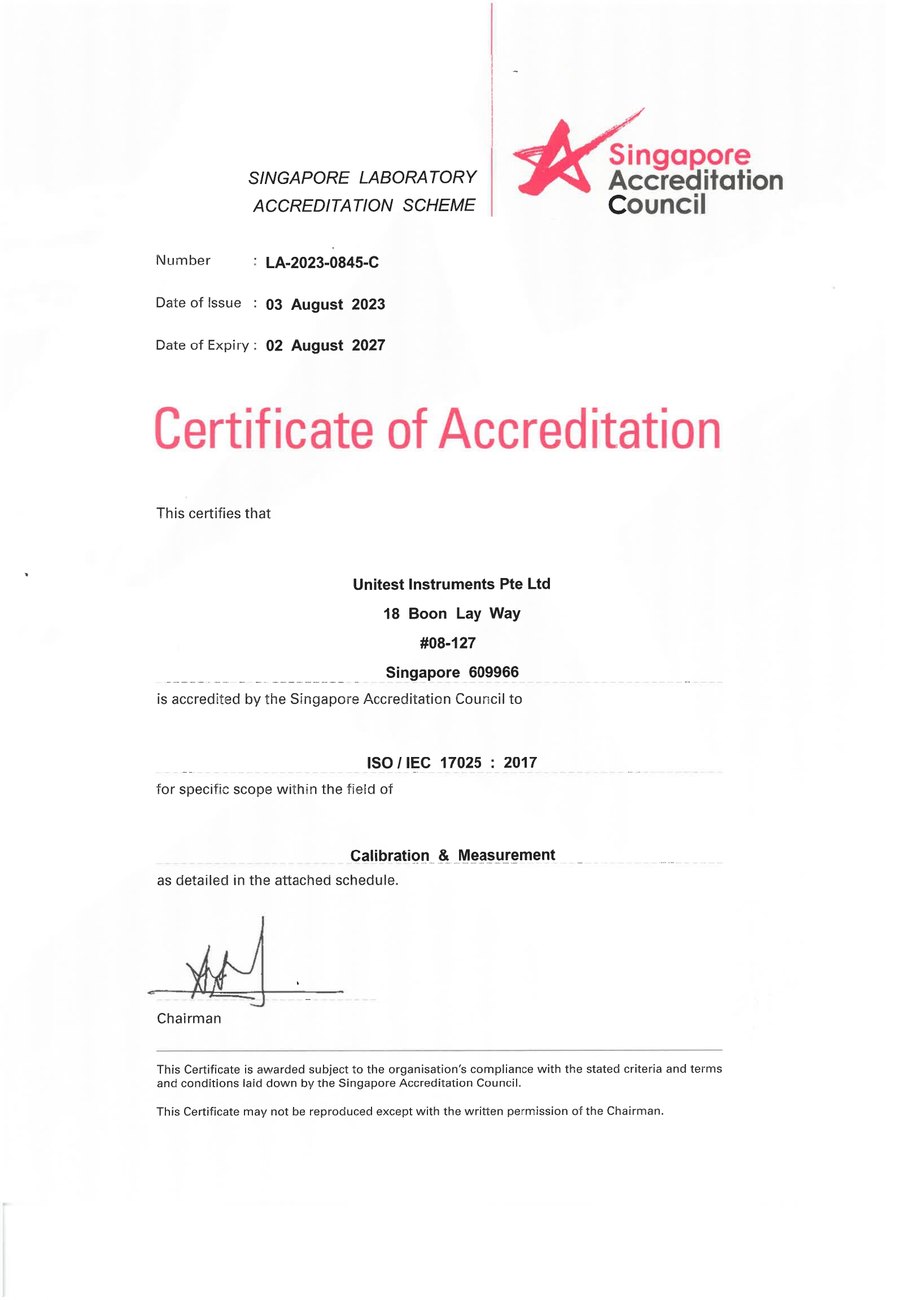
SAC-SINGLAS accredited calibration laboratory (Acc. No. LA-2023-0845-C) serving Singapore's industrial, pharmaceutical, and manufacturing sectors. All content reflects our ISO/IEC 17025 accredited scope and is reviewed by our technical calibration team.
Need solar PV instrument calibration in Singapore?
Unitest Instruments is SAC-SINGLAS accredited (Acc. No. LA-2023-0845-C) to ISO/IEC 17025. Same-week turnaround, certificates accepted by ISO 9001 auditors.