
Key Takeaways
- Potable water in buildings must meet the Environmental Public Health (Quality of Piped Drinking Water) Regulations 2008, aligned with WHO Guidelines for Drinking-Water Quality (4th edition).
- Large buildings with storage tanks exceeding 5,000 litres have mandatory testing obligations. Microbiological tests every six months, physicochemical tests annually.
- NEA's Legionella Control Programme requires monthly sampling and biannual cleaning for all premises with cooling towers.
- All compliance instruments (pH meters, turbidimeters, chlorine analysers, conductivity meters) must be calibrated by a SAC-SINGLAS accredited laboratory with traceable certificates.
- Non-compliance penalties reach S$10,000 per offence under the EPH Act; NEA can mandate immediate system shutdown for Legionella exceedances.
- Calibration records, test logs, and remediation reports must be retained and made available to PUB or NEA inspectors on request.
The Regulatory Landscape: Who Governs Water Quality in Singapore?
Water quality in Singapore sits at the intersection of several regulatory bodies, and understanding their respective jurisdictions is the first step toward structured compliance. PUB, the National Water Agency, owns and operates Singapore's potable water supply network up to the consumer's water meter. Beyond that boundary (inside your building), the obligation shifts to the building owner or facilities manager.
The primary legislative instrument is the Environmental Public Health Act (Cap. 95), administered by the National Environment Agency (NEA). The Act empowers NEA to regulate the quality of potable water in premises, set standards for water systems, and inspect and enforce compliance. Subsidiary legislation (specifically the Environmental Public Health (Quality of Piped Drinking Water) Regulations 2008), defines the exact parameters and limits that drinking water must meet.
For facilities with cooling towers, evaporative condensers, or large decorative water features, NEA's Legionella Control Programme applies an additional and separate compliance layer. Legionella bacteria thrive in warm, stagnant water systems and can cause Legionnaires' disease, which makes these systems a public health priority. The Building and Construction Authority (BCA) also has a role in mandating water tank hygiene provisions at the design and construction approval stage under the Code on Environmental Sustainability of Buildings.
Key Water Quality Parameters and Permissible Limits
The Regulations adopt the WHO Guidelines for Drinking-Water Quality (4th edition) as the benchmark. Facilities managers should familiarise themselves with the parameters most likely to be tested during compliance sampling and NEA inspections.
| Parameter | Permissible Limit | Instrument Used | Calibration Required |
|---|---|---|---|
| Turbidity | ≤ 1 NTU (ideally ≤ 0.5 NTU) | Turbidimeter / Nephelometer | Yes. Traceable to NMC Singapore |
| pH | 6.5 – 9.5 | pH Meter / Electrode | Yes. Buffer solution traceability |
| Free Residual Chlorine | 0.2 – 5.0 mg/L | Colorimeter / DPD Analyser | Yes. Concentration standards |
| Total Coliforms | Not detectable / 100 mL | Laboratory microbiological analysis | Lab accreditation required |
| E. coli | Not detectable / 100 mL | Laboratory microbiological analysis | Lab accreditation required |
| Conductivity / TDS | ≤ 1,000 µS/cm (indicative) | Conductivity Meter | Yes. Conductivity standards |
| Temperature (cooling tower) | Target < 35°C; risk above 20°C | Calibrated thermometer / RTD probe | Yes. ITS-90 traceable |
| Legionella spp. (cooling tower) | < 1,000 CFU/L (action level) | Laboratory culture / PCR | Lab accreditation required |
This table covers the parameters most directly relevant to routine facility-level compliance. The full schedule of chemical parameters (including nitrate, fluoride, arsenic, and various disinfection by-products), is set out in the First Schedule of the Regulations and should be reviewed in full for any facility with unusual water chemistry or treatment processes.
Step-by-Step Compliance Process for Facilities Managers
Compliance is not a one-time exercise. It requires systematic, documented action across four phases: assessment, testing, record-keeping, and remediation. Here is the structured process that facilities managers should follow.
Phase 1. System Assessment and Registration
Begin by mapping your building's water distribution system. Identify all storage tanks (noting their capacity), hot water systems, cooling towers, evaporative condensers, and any dead-leg pipework where stagnant water may accumulate. If you operate a cooling tower, you must register it with NEA via the NEA Mandatory Cooling Tower Registration scheme before operation commences. Registration is renewed annually and requires disclosure of the system's capacity, treatment regime, and the identity of your appointed water treatment operator.
Buildings with cold water storage tanks exceeding 5,000 litres and buildings in sectors specified by NEA (hospitals, hotels, large commercial premises) have automatic testing obligations. If you are uncertain whether your premises fall within scope, submit a written query to NEA's Environmental Health Department for a written confirmation. This protects you from later enforcement disputes.
Phase 2. Instrument Selection and Calibration
Select instruments appropriate to the parameters you will be measuring on-site. At a minimum, most facilities need a calibrated pH meter, a free chlorine (residual chlorine) analyser, and a turbidimeter. For cooling tower operators, a calibrated thermometer and conductivity meter are also essential.
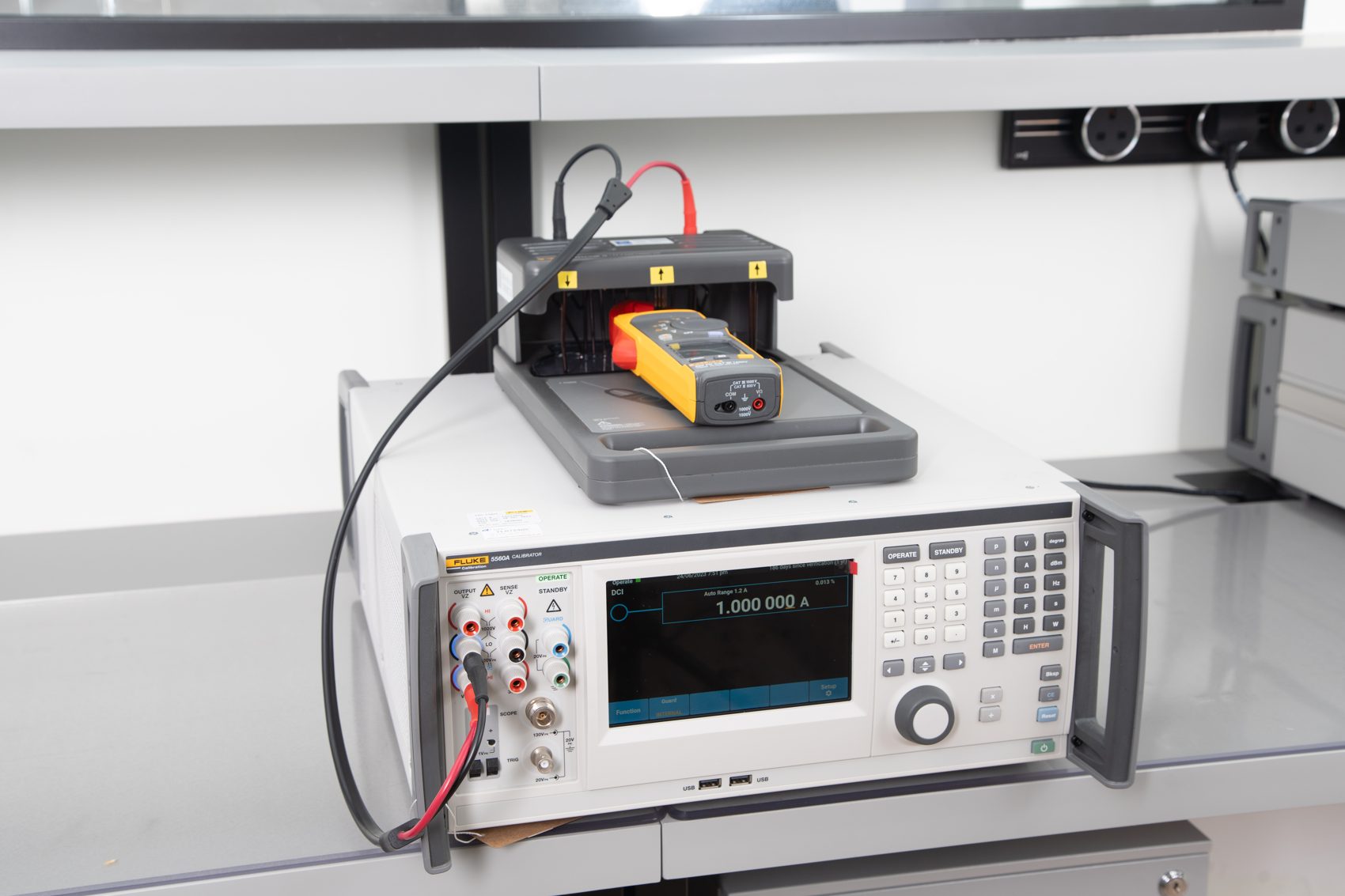
Every instrument must carry a valid calibration certificate issued by a SAC-SINGLAS accredited laboratory. The certificate should state the calibration date, the next due date, the instrument serial number, the reference standards used, and the measurement uncertainty of the calibration. Instruments without a current certificate are not acceptable for regulatory compliance measurements. A fact that NEA and PUB inspectors will verify. Understanding what calibration traceability means is essential: every measurement made in the field can be traced back to Singapore's National Metrology Centre (NMC) through an unbroken chain of comparisons.
Phase 3. Scheduled Testing and Sampling
For potable water systems in large buildings, the minimum testing schedule is:
- Microbiological parameters (total coliforms, E. coli): at least every six months, by an accredited laboratory.
- Physicochemical parameters (pH, turbidity, residual chlorine, and others): at least annually, with on-site readings logged more frequently as part of your building management routine.
- Post-maintenance testing: immediately after any tank cleaning, pipe replacement, or event that may have introduced contamination.
For cooling towers under NEA's Legionella Control Programme:
- Monthly: Legionella culture and total bacterial count by an accredited laboratory.
- Biannual: physical cleaning, disinfection, and inspection of the tower internals.
- Continuous / weekly: on-site monitoring of disinfectant concentration (biocide residuals), pH, and conductivity using calibrated instruments.
Need your water quality instruments calibrated for PUB or NEA compliance?
Unitest Instruments provides traceable calibration for pH meters, turbidimeters, chlorine analysers, conductivity meters, and thermometers, with certificates accepted by NEA, PUB, and ISO 9001 auditors. Same-week turnaround available.
Phase 4. Record-Keeping and Remediation
Maintain a dedicated water quality register for the premises. Each entry should record the date, parameter tested, instrument used (including its calibration certificate reference number), test result, and the name of the person who conducted the test. If a result exceeds the permissible limit, document the immediate corrective action taken (flushing, re-dosing, or system isolation), and the follow-up verification test result.
NEA may request access to these records during inspections, and PUB can issue a formal notice requiring production of records at any time. Records should be retained for a minimum of two years, though industry best practice (and the standard expected of ISO 9001-certified facilities), is five years.
Calibration Instrument Requirements in Detail
The calibration of water quality instruments is often the weakest link in a facility's compliance chain. Instruments drift over time. Electrode membranes age, optical surfaces accumulate deposits, and sensor junctions become contaminated. A pH meter that reads 0.3 units high may indicate that a tank is within the 6.5–9.5 band when it is actually outside it. A chlorine analyser that reads 0.5 mg/L low may mask a residual that has fallen below the minimum safe level of 0.2 mg/L.
The ISO/IEC 17025 calibration standard specifies the requirements that a laboratory must meet to produce technically valid calibration results. When you obtain calibration from a SAC-SINGLAS accredited laboratory, you are obtaining a result that has been produced under this standard, with documented uncertainty, reference traceability, and independent quality oversight. This is the standard of evidence that regulatory inspectors expect.
The frequency at which you send instruments for recalibration should be determined by their drift characteristics and the criticality of the measurements they make. For compliance-critical instruments in water quality applications, annual calibration is the usual industry norm, but higher-use instruments in aggressive environments (high chlorine, high temperature) may warrant six-monthly calibration cycles.
Penalties and Enforcement Under Singapore Law
Regulatory enforcement in Singapore's water quality space is real and active. Facilities managers should understand the penalty structure. Not to live in fear of it, but to accurately weight the cost of non-compliance against the cost of a systematic testing and calibration programme.
Environmental Public Health Act Penalties
Under Section 111 of the Environmental Public Health Act, any person who fails to comply with any provision of the Act or any direction issued under it is liable to a fine of up to S$10,000, and where the offence is a continuing one, to a further fine not exceeding S$1,000 for every day or part of a day during which the offence continues. For second or subsequent convictions, the maximum fine doubles.
NEA's enforcement approach typically begins with advisory notices and remedial orders before escalating to prosecution, but in cases where contamination poses an immediate public health risk (or where records are falsified or withheld), enforcement action can be immediate. Directors and managers of companies can be held personally liable if the offence was committed with their consent or connivance.
NEA Cooling Tower Enforcement
For Legionella-related breaches, NEA's approach is stricter because of the acute public health risk. Any cooling tower where Legionella spp. counts exceed 1,000 CFU/L must be shut down immediately and must not resume operation until a full remediation (cleaning, disinfection, and independent verification sampling), has been completed and records submitted to NEA. Failure to notify NEA of an exceedance, or operating a tower after an exceedance notification, constitutes a separate and more serious offence.
NEA conducts unannounced inspections of registered cooling towers and takes its own samples for independent laboratory analysis. Discrepancies between the facility's own test records and NEA's independent results trigger investigations that may include document audits and interviews with the appointed water treatment operator.
Practical Compliance Checklist for Facilities Managers
Use this checklist as a quick reference during your next internal compliance review or in preparation for a NEA or PUB inspection:
- All water storage tanks above 5,000 litres are identified and included in the testing schedule.
- Cooling towers are registered with NEA and registration is current.
- An appointed water treatment operator holds the required credentials and is under a current service contract.
- All on-site water quality instruments have current SAC-SINGLAS calibration certificates (not expired).
- Microbiological samples are sent to an accredited laboratory (not an in-house or uncertified lab).
- Test results, calibration records, and remediation reports are filed in a water quality register accessible to inspectors.
- Staff responsible for on-site testing are trained on instrument operation and sample collection procedures.
- A corrective action procedure exists and has been tested for scenarios where parameters exceed permissible limits.
- Post-maintenance verification testing is built into the engineering change control process.
For facilities that hold ISO 9001 certification, this checklist integrates naturally into your existing quality management system. The calibration certificate requirements, in particular, overlap directly with ISO 9001 Clause 7.1.5 on monitoring and measuring resources. Making a well-run water quality compliance programme a straightforward extension of your QMS rather than a separate burden.
Understanding how often to calibrate your instruments is a strategic decision, not just an administrative one. Instruments calibrated too infrequently carry compliance risk; instruments calibrated more frequently than necessary carry unnecessary cost. A risk-based calibration interval, set with reference to instrument drift history and regulatory criticality, is the professional standard.
Working With Your Appointed Water Treatment Operator
Most cooling tower and large potable water systems in Singapore are managed day-to-day by a contracted water treatment operator rather than in-house facilities staff, and the calibration status of the operator's own field instruments is a compliance blind spot that many building owners never actually verify. When an operator visits site to dose biocide, test residual chlorine, or log conductivity, the readings they record become part of your facility's compliance file, which means an out-of-calibration instrument on the operator's side creates the same audit exposure as one you own directly, even though you may have no visibility into their equipment's calibration history.
Building owners and facilities managers should build a specific clause into every water treatment service contract requiring the operator to provide, on request, current SAC-SINGLAS accredited calibration certificates for every field instrument used on your premises, not just a general assurance that "our equipment is calibrated." Request this documentation at contract renewal and periodically mid-contract, and cross-check the certificate dates against the actual site visit dates in your water quality register; an operator whose pH meter certificate expired three months before a logged reading is a finding you want to catch internally, not one NEA discovers first during an inspection. This same diligence should extend to the microbiological laboratory the operator uses for Legionella and coliform testing, confirm independently that the laboratory itself holds SAC-SINGLAS accreditation for the specific test methods being used, since not every laboratory offering water microbiology services in Singapore is accredited for every parameter.
Common On-Site Testing Mistakes That Undermine an Otherwise Compliant Programme
Even facilities with a fully calibrated instrument fleet and a diligent testing schedule can generate misleading results through avoidable sampling and handling errors. The most frequent issue we see reviewing client compliance files is inconsistent sample point selection, testing at a tap near the point of entry one month and a tap at the far end of the distribution system the next, which produces readings that are not genuinely comparable over time and makes trend analysis (the early-warning signal that catches a developing problem before it becomes a compliance breach) effectively useless. Fixing designated, labelled sampling points and testing the same points on every cycle is a simple change that materially improves the value of your data.
A second common error is delayed testing after sample collection, particularly for free residual chlorine, which is chemically unstable and can drop measurably within 15–30 minutes of collection if the sample sits in a warm vehicle or on a bench before analysis. On-site, real-time testing with a calibrated instrument at the point of collection avoids this entirely and is the practice NEA inspectors expect to see for chlorine and pH; sending samples off-site for these two parameters, rather than testing them immediately, introduces an avoidable source of error that has nothing to do with instrument calibration and everything to do with sampling technique. Finally, electrode and probe maintenance is often neglected between calibrations: a pH electrode with a dried-out or contaminated junction can produce sluggish, drifting readings well within its calibration due date, and rinsing electrodes with deionised water and storing them in the manufacturer's specified storage solution between uses (rather than leaving them dry) preserves both accuracy and the electrode's working life between accredited calibrations.
Bringing all of this together, a defensible water quality compliance programme rests on three legs that must all hold simultaneously: instruments that are genuinely within their SAC-SINGLAS calibration window, a sampling and testing routine that is consistent and well-documented, and a contractual chain (covering your own staff and any appointed operator or laboratory) where every party's equipment and accreditation status is verified rather than assumed. A gap in any one of these three undermines the other two, since even perfectly calibrated instruments produce misleading trend data if sampling points shift, and even disciplined sampling technique is worthless if the instrument itself is silently out of tolerance.
Frequently Asked Questions
Facilities must comply with the Environmental Public Health (Quality of Piped Drinking Water) Regulations 2008, which adopt the WHO Guidelines for Drinking-Water Quality (4th edition). Key parameters include turbidity (≤1 NTU), pH (6.5–9.5), free residual chlorine (0.2–5.0 mg/L), total coliforms (not detectable per 100 mL), and over 100 additional chemical and microbiological indicators. Large buildings with internal water distribution systems (such as those with cooling towers or water storage tanks exceeding 5,000 litres), have additional obligations under the EPH Act.
Under the Environmental Public Health Act (Cap. 95), building owners and facilities managers of premises with large water storage tanks (generally above 5,000 litres), cooling towers, and any system identified as a risk of Legionella proliferation must conduct regular water quality testing. This includes hotels, hospitals, shopping malls, industrial facilities, and large residential developments. NEA regulates cooling tower water quality separately under its Legionella Control Programme.
The testing frequency depends on the system type and risk level. Potable water systems in large buildings require microbiological testing at least once every six months and physicochemical testing at least once per year. Cooling tower systems regulated by NEA require monthly Legionella and bacterial counts. Post-maintenance or post-incident testing must be conducted immediately after any event that may have compromised water quality. Facilities managers should review their building-specific testing schedule with a licensed testing laboratory.
Common on-site instruments include pH meters, turbidimeters, conductivity meters, dissolved oxygen meters, and free chlorine (residual chlorine) analysers. All instruments used for compliance measurements must be calibrated against traceable reference standards. Under the Weights and Measures Act and good laboratory practice aligned with ISO/IEC 17025, calibration certificates must be issued by an accredited laboratory such as a SAC-SINGLAS accredited facility. Uncalibrated instruments can produce systematic errors that result in false compliance readings and regulatory liability.
Under the Environmental Public Health Act, failure to maintain potable water quality can result in fines of up to S$10,000 per offence, with daily fines for continuing offences. If contamination leads to public health incidents, criminal liability can extend to company directors. NEA can also issue remedial orders, require system shutdowns, and mandate independent audits at the operator's cost. Repeat offenders or those who obstruct inspections face enhanced penalties.
Both agencies have inspection powers. PUB focuses on the integrity of the public distribution network up to the water meter; beyond the meter, building owners are responsible. NEA conducts inspections and audits of internal water systems (particularly cooling towers), under the Legionella Control Programme. Inspectors may take water samples, review testing records, and examine calibration certificates for testing instruments. Facilities managers should maintain organised water quality records for at least two years.
NEA's Legionella Control Programme requires all premises with cooling towers to register with NEA and implement a risk management plan. This includes monthly water sampling for Legionella bacteria, maintaining disinfectant residuals, conducting biannual cleaning and disinfection, and keeping records of all chemical dosing and test results. Premises must also engage a trained operator. Any cooling tower with Legionella counts exceeding 1,000 CFU/L must be immediately shut down for remediation.
Between formal calibration events, facilities managers should implement in-house verification checks using certified reference solutions or buffer standards. Log the results with date and instrument ID in a maintenance register. If a verification check shows a reading outside the instrument's stated accuracy specification, remove the instrument from service and arrange recalibration before the next compliance test. The calibration interval should be set based on instrument drift history and usage intensity. A topic covered in detail in our guide on how often to calibrate your instruments.
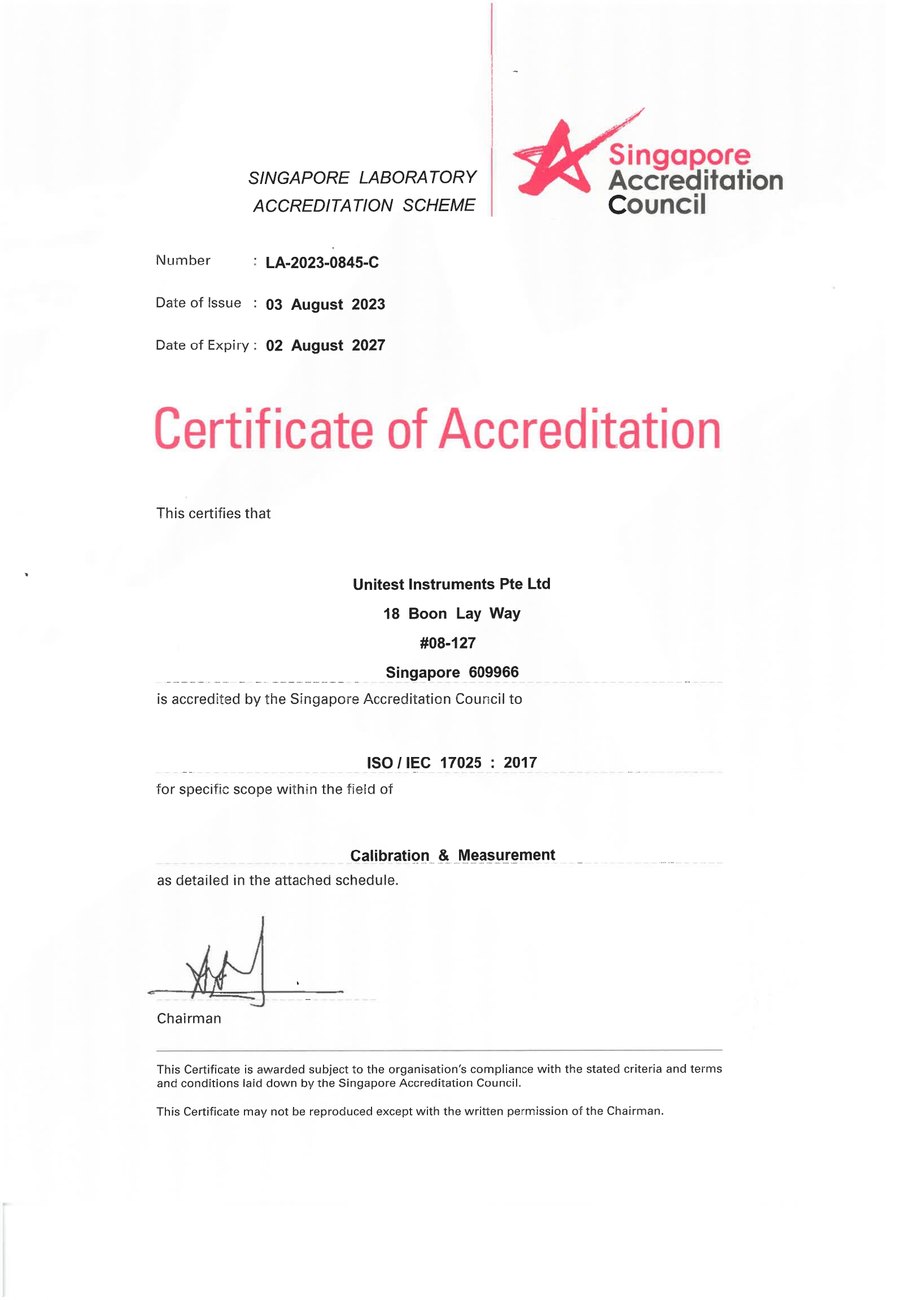
SAC-SINGLAS accredited calibration laboratory (Acc. No. LA-2023-0845-C) serving Singapore's industrial, pharmaceutical, and manufacturing sectors. All content reflects our ISO/IEC 17025 accredited scope and is reviewed by our technical calibration team.
Need water quality instrument calibration in Singapore?
Unitest Instruments is SAC-SINGLAS accredited (Acc. No. LA-2023-0845-C) to ISO/IEC 17025. Same-week turnaround, certificates accepted by NEA, PUB, and ISO 9001 auditors.