
Key Takeaways
- Water activity (aw) is dimensionless (0–1.0) and is formally defined as p/p₀. The ratio of partial vapour pressure of water in the product to the saturation vapour pressure of pure water at the same temperature.
- Most bacteria cannot grow below aw 0.90; Staphylococcus aureus is the most tolerant pathogen at aw 0.83. Shelf-stable products are typically formulated to aw ≤ 0.60.
- Chilled-mirror dewpoint hygrometry is the primary reference measurement method, achieving expanded uncertainty of ±0.003 aw or better. Superior to capacitance-sensor instruments used on production floors.
- Calibration must use certified saturated salt reference solutions traceable to national standards; ASTM E104 and ISO 18787 govern the preparation and use of these solutions.
- Singapore Food Agency (SFA) requires aw ≤ 0.85 for many shelf-stable low-acid food categories, and HSA GMP guidelines align with ICH Q1A(R2) for pharmaceutical products.
1. The Physics Behind Water Activity
Water activity is grounded in classical thermodynamics. In any system containing water, water molecules exert a partial pressure (vapour pressure) above the liquid or solid surface. For pure liquid water at 25°C this is 3.169 kPa, the saturation vapour pressure, p₀. When water is dissolved in a solution or adsorbed onto a solid matrix, solute–solvent interactions and surface adsorption reduce the freedom of water molecules to escape into the vapour phase. The ratio of the resulting partial pressure (p) to p₀ is the thermodynamic water activity:
aw = p / p₀ = ERH / 100
where ERH (equilibrium relative humidity) is the relative humidity of the headspace gas that is in thermodynamic equilibrium with the product at a given temperature. This equivalence (aw of the product equals ERH/100 of the surrounding air at equilibrium), is what makes vapour-pressure-based measurement possible and is codified in AOAC Official Method 978.18 and ISO 18787:2017 (Determination of water activity).
Raoult's Law provides the simplest theoretical description: for an ideal dilute solution, aw = mole fraction of water. In real food and pharmaceutical matrices, solute–solute and solute–water interactions mean that measured aw is usually lower than the Raoult's Law prediction, requiring empirical sorption isotherms rather than pure calculations. The Guggenheim–Anderson–de Boer (GAB) model is the most widely used isotherm equation for food systems across the aw range 0.05–0.95.
2. Critical Thresholds: Microbial and Chemical Stability
Understanding the aw limits for different deterioration pathways is fundamental to product formulation and shelf-life design. The table below summarises the most important reference limits, drawn from published data and international standards including ICMSF (International Commission on Microbiological Specifications for Foods) and Codex Alimentarius.
| aw Range | Limiting Organism / Reaction | Typical Product Examples | Regulatory Reference |
|---|---|---|---|
| 0.97–1.00 | Gram-negative pathogens (Salmonella, E. coli, Listeria) | Fresh meat, fish, most dairy | Codex CAC/RCP 1-1969 |
| 0.91–0.97 | Most spoilage bacteria; Clostridium botulinum type E | Cooked cured meats, aged cheese | ICMSF Microorganisms in Foods 5 |
| 0.87–0.91 | Staphylococcus aureus (toxin limit: 0.87); C. botulinum types A/B | Fermented sausages, some jams | SFA Food Regulations; FDA 21 CFR |
| 0.80–0.87 | Halophilic bacteria; most yeasts | Dried fruit, marzipan, high-sugar confections | AOAC 978.18 |
| 0.70–0.80 | Most xerophilic moulds; Aspergillus flavus (aflatoxin threshold ~0.72) | Biscuits, nuts, cereals | CAC/RCP 59-2005 (mycotoxins) |
| 0.60–0.70 | Osmophilic yeasts; accelerated Maillard browning | Honey, toffee | ISO 18787:2017 |
| < 0.60 | No microbial growth; lipid oxidation dominant degradation | Milk powder, freeze-dried products, crackers | ASTM E104 calibration standard |
Beyond microbiology, aw governs the rate of enzymatic browning (active above aw 0.25–0.30), non-enzymatic Maillard browning (maximum reaction rate at aw 0.60–0.70), and lipid oxidation (minimum at aw 0.20–0.30, accelerating above and below). In pharmaceuticals, hydrolysis of ester and amide bonds in drug molecules is negligible below aw 0.3 but increases sharply above 0.5, making aw specification in finished product release specifications a regulatory expectation under ICH Q6A.
3. Measurement Methods: From Production Floor to Reference Lab
Three principal instrument technologies are in commercial use. Understanding their operating principles, typical uncertainties, and suitable applications is essential for selecting the right tool and designing an appropriate calibration programme.
Chilled-Mirror Dewpoint Hygrometry
The chilled-mirror method is the highest-accuracy technique available and is the reference method in ISO 18787:2017. A small sample is placed in a sealed chamber. A thermoelectrically cooled mirror inside the chamber is chilled until condensation is detected by an optical sensor. The temperature at which condensation forms (the dewpoint), is measured with a precision thermistor or platinum resistance thermometer (PRT). A second thermistor measures sample temperature. The instrument computes aw = p(Tdew) / p(Tsample) from the ratio of saturation vapour pressures at the two temperatures.
Well-maintained, calibrated chilled-mirror instruments routinely achieve expanded measurement uncertainty (k=2) of ±0.003 aw across the full 0.03–1.00 range. Equilibration time is typically 5–15 minutes per sample. This method is the benchmark for regulatory submission data, official arbitration, and primary calibration of secondary instruments.
Capacitance (Polymer) Sensor Hygrometry
Capacitance sensors use a hygroscopic polymer film whose dielectric constant changes proportionally to the relative humidity of the surrounding gas. When equilibrated with the sample headspace, the sensor output is converted to aw. These instruments are faster (2–5 minutes), more portable, and less expensive than chilled-mirror devices. Typical expanded uncertainty is ±0.005–0.010 aw, adequate for routine in-process control but not for method validation or regulatory reference measurements. Sensor drift over time means frequent verification checks against certified salt standards are essential.
Resistance (Electrolytic) Hygrometry
Older resistive sensors change electrical resistance with humidity. This technology is less accurate (±0.010–0.020 aw), more susceptible to contamination, and has largely been superseded for food and pharma applications. It may still be encountered in legacy installations.
Need your water activity meter or humidity instrument calibrated in Singapore?
Unitest Instruments provides accredited calibration of humidity and moisture measurement equipment with full traceability to Singapore's NMC. Certificates accepted by SFA, HSA, and ISO 9001 auditors.
4. Calibration Requirements and Traceability
A water activity meter, regardless of its operating principle, is a relative humidity sensor measuring equilibrium headspace humidity. Its calibration requirements are therefore essentially the same as those for any relative humidity instrument: traceability to national standards, use of certified reference materials, and documented uncertainty. For a deeper treatment of what calibration traceability means in practice, see our article on what is traceability in calibration.
Reference Standards: Certified Saturated Salt Solutions
Saturated aqueous salt solutions in equilibrium with excess solid salt produce a precisely defined, temperature-dependent ERH (= aw × 100%). The values are internationally published in ASTM E104-02 (Standard Practice for Maintaining Constant Relative Humidity by Means of Aqueous Solutions) and verified against primary humidity generators traceable to NIST, PTB, or Singapore's NMC. Key salt standards and their nominal aw values at 25°C are:
- Lithium chloride (LiCl): 0.113 ± 0.001
- Magnesium chloride (MgCl₂): 0.328 ± 0.001
- Magnesium nitrate (Mg(NO₃)₂): 0.529 ± 0.001
- Sodium chloride (NaCl): 0.753 ± 0.001
- Potassium chloride (KCl): 0.843 ± 0.002
- Potassium sulphate (K₂SO₄): 0.973 ± 0.005
For instrument calibration to be metrologically valid, the certified aw value of each reference solution must be stated with its measurement uncertainty at a specified confidence level (typically 95%), and the certificate must be traceable to a national metrology institute. A three-point calibration spanning the expected measurement range of the application (not merely a single-point check), is required for compliance with ISO/IEC 17025. Understanding measurement uncertainty is covered in detail in our explainer on measurement uncertainty in calibration.
Calibration Intervals in Food and Pharma
ISO/IEC 17025:2017 Clause 6.4.7 requires that calibration intervals be reviewed and adjusted based on calibration history, usage, and risk. In practical terms:
- High-throughput food QC (daily use): Full calibration every 3–6 months; daily verification against NaCl (aw 0.753) and MgCl₂ (aw 0.328) reference standards before each batch.
- Pharmaceutical QC laboratory (GMP): Calibration at a frequency defined in the instrument qualification protocol (IQ/OQ/PQ), typically every 6–12 months, with daily or weekly verification records required by HSA GMP inspectors.
- Infrequent production monitoring: Annual calibration minimum; verification before and after each measurement campaign.
Any instrument that fails a verification check (i.e. reads outside its specified tolerance on a certified reference standard), must be taken out of service, recalibrated, and any affected measurements assessed for impact. This requirement is explicit in Codex HACCP principles and in HSA's Good Distribution Practice guidelines for pharmaceutical products. The question of how frequently instruments require calibration is explored further in our article on calibration intervals and how often to calibrate.
5. Temperature: The Hidden Variable
Temperature control is the most commonly overlooked source of error in water activity measurement. Because water activity is defined at a specific temperature, and because the equilibrium vapour pressure of water changes approximately 2.4% per degree Celsius near 25°C, even a 1°C temperature differential between the sample and the instrument sensor can introduce an error of 0.008–0.015 aw. Equivalent to the full accuracy specification of many capacitance-sensor instruments.
Best practice requires that samples be equilibrated to the measurement temperature (25°C ± 0.5°C is the AOAC 978.18 requirement) before the measurement is initiated, that the instrument chamber temperature be independently monitored with a calibrated temperature sensor, and that any temperature correction be applied if the instrument does not automatically compensate. For chilled-mirror instruments, the sample chamber is Peltier-controlled and the measurement temperature is recorded on the calibration certificate. This information must be reported alongside the aw value in regulatory submissions.
6. Common Mistakes and How to Avoid Them
Despite its apparent simplicity, water activity measurement is prone to systematic errors that invalidate results. The following are the most frequently encountered problems in food and pharmaceutical laboratories.
Confusing aw with Moisture Content
This is the most fundamental error. Honey has approximately 17–20% moisture content but aw 0.55–0.60. A sugar-based confection may have 5% moisture but aw 0.65, while a protein gel at 5% moisture may have aw 0.30. Only measuring aw directly tells you the actual microbial and chemical stability. Moisture content alone does not, yet many smaller food producers in Singapore still rely on moisture content as their primary stability specification.
Failure to Equilibrate the Sample
Inserting a product into the instrument before the sample has equilibrated to measurement temperature, or before the headspace has reached equilibrium with the sample, produces a reading that is meaningless. Equilibration time varies from 5 minutes (chilled-mirror, fine powders) to 60+ minutes (dense solid samples in capacitance instruments). Rushing equilibration is a major source of inter-laboratory variability and failed proficiency tests.
Sample Preparation Errors
Cutting, grinding, or homogenising samples increases exposed surface area and can temporarily alter aw due to evaporation or heat generation. The ISO 18787 procedure specifies that samples should be representative and prepared in a manner that minimises time between preparation and measurement. Volatile compounds in some food matrices (e.g. ethanol in fermented products) can interfere with sensor readings on capacitance instruments; chilled-mirror instruments are less susceptible but should still be noted.
Uncalibrated or Unverified Instruments
An instrument that has not been calibrated with traceable reference standards (or that has drifted since its last calibration without being verified), produces data that cannot be used for regulatory compliance. SFA auditors and HSA GMP inspectors routinely request calibration certificates during inspections; an instrument with an expired calibration or a certificate from a non-accredited provider is treated as out-of-service for compliance purposes. All calibration certificates issued by Unitest Instruments carry SAC-SINGLAS accreditation (Acc. No. LA-2023-0845-C) and full traceability to Singapore's NMC. The same standard required for accredited versus non-accredited calibration.
Using Wrong Reference Standards or Expired Solutions
Saturated salt reference solutions have defined shelf lives and can be contaminated by mould growth (particularly near aw 0.75–0.85). A solution that has evaporated below saturation no longer produces a valid reference aw. Reference solutions must be prepared fresh from reagent-grade salts in distilled water, stored in sealed containers, and discarded if visual contamination or colour change is observed. Commercially supplied certified reference materials from accredited suppliers are preferable for laboratories that lack the analytical chemistry infrastructure to prepare and verify their own.
7. Using Water Activity in Product Development and Shelf-Life Design
Beyond quality control on an established formulation, water activity is a primary design tool during new product development, because it lets a formulator predict microbial and chemical stability before committing to a full shelf-life trial. The standard technique is to build a moisture sorption isotherm for the product matrix, plotting aw against equilibrium moisture content across a range of humidity conditions, typically using the same set of saturated salt solutions described above but as controlled storage environments for the product rather than as instrument calibration points. The resulting curve, usually fitted to the GAB model, tells a formulator exactly how much water needs to be removed (through drying, added solutes, or humectants such as glycerol and sorbitol) to push the product's aw below a target threshold, for example below 0.85 to eliminate the pathogen growth risk that would otherwise require refrigerated distribution, or below 0.60 to achieve genuine shelf-stability without preservatives.
This approach is particularly valuable for Singapore food manufacturers developing export products, since different destination markets sometimes apply different regulatory aw thresholds for "shelf-stable" or "ambient" classification, and a formulator who understands the full sorption isotherm, rather than a single measured aw value at one moisture content, can adjust a formulation to meet multiple markets' requirements simultaneously. The same isotherm data also predicts moisture migration risk in composite products (a moist filling in contact with a dry biscuit shell, for instance), where the two components will exchange moisture over shelf life until their water activities equilibrate, often degrading the texture of the drier component well before any microbial risk emerges. Formulators use the isotherm to select packaging barrier properties and shelf-life claims that account for this migration rather than being surprised by a texture complaint months after launch.
8. Choosing the Right Instrument for Your Application
The three measurement technologies described above are not interchangeable, and selecting the wrong one for a given use case is a common and avoidable source of both wasted capital and unreliable data. For regulatory submissions, product release specifications, method validation, and any measurement that may be challenged in an audit or dispute, a chilled-mirror dewpoint instrument is the appropriate choice; its accuracy is the only one of the three technologies that reliably meets the ±0.003 aw precision regulators and auditors expect to see referenced against ISO 18787. For routine in-process quality control on a production floor, where a technician is checking dozens of samples per shift against a pass/fail specification with reasonable margin, a capacitance sensor instrument offers a better balance of speed and cost, provided it is verified daily against certified salt standards and its full calibration is not allowed to lapse beyond the 3–6 month interval appropriate to high-throughput use. Resistive sensor technology, while still found in older installed equipment, should generally be phased out in favour of capacitance or chilled-mirror instruments when equipment is next replaced, since its accuracy and contamination resistance no longer meet the expectations of SFA and HSA inspectors reviewing modern food safety and GMP programmes.
Frequently Asked Questions
Water activity (aw) is the ratio of the vapour pressure of water in a material to the vapour pressure of pure water at the same temperature, expressed on a dimensionless scale from 0 to 1. Moisture content, by contrast, is simply the mass of water per unit mass of dry material (expressed as a percentage). Two products can have identical moisture content but very different water activity values, because some water is tightly bound to solutes or surfaces and is unavailable to support microbial growth or chemical reactions. Water activity is therefore a far more reliable predictor of spoilage, shelf life, and product stability than moisture content alone.
Most bacteria cannot grow below aw 0.90. Staphylococcus aureus, one of the most resilient foodborne pathogens, can grow down to aw 0.83 under aerobic conditions but toxin production ceases below aw 0.87. Moulds and yeasts are generally more tolerant: common spoilage moulds grow down to aw 0.70, and xerophilic fungi such as Aspergillus flavus (which produces aflatoxin) can grow at aw values as low as 0.70–0.72. The critical control limit for most refrigerated ready-to-eat products under Singapore's SFA framework is aw ≤ 0.88 for products intended to inhibit L. monocytogenes growth without refrigeration.
There are three principal measurement methods. (1) Chilled-mirror dewpoint hygrometry. The most accurate technique, achieving uncertainties of ±0.003 aw or better; the instrument chills a mirror until condensation forms and calculates aw from the dewpoint temperature. (2) Capacitance (polymer sensor) hygrometry. Faster and more portable, typically ±0.005–0.010 aw; used widely on production floors. (3) Resistance hygrometry, older technology, less precise (±0.010–0.020 aw), largely replaced for compliance measurements. AOAC Official Method 978.18 and ISO 21807 both reference equilibrium relative humidity (ERH) methods, of which chilled-mirror dewpoint is the primary reference method for food.
Calibration frequency depends on the application, usage intensity, and regulatory requirements. For food safety compliance in Singapore under SFA guidelines, calibration at least annually is the minimum; high-throughput QC labs often calibrate every three to six months. For pharmaceutical applications governed by Singapore HSA GMP guidelines (aligned with ICH Q6A and USP Chapter 921), calibration intervals are typically defined in the site's instrument qualification protocol and validated by calibration history data. The instrument should also be verified against certified salt standards before each batch of measurements.
Certified saturated salt reference solutions are the primary standards for water activity calibration. Commonly used salts and their nominal aw values at 25°C are: Lithium chloride (LiCl) (0.113; Magnesium chloride (MgCl₂)), 0.328; Magnesium nitrate (Mg(NO₃)₂) (0.529; Sodium chloride (NaCl)), 0.753; Potassium chloride (KCl) (0.843; Potassium nitrate (KNO₃)), 0.936; Potassium sulphate (K₂SO₄) , 0.973. The aw values of these solutions are temperature-dependent; published tables (e.g. from NIST or ASTM E104) give values at specific temperatures. For traceable calibration, reference solutions must carry certified values with stated measurement uncertainty from an accredited source.
Yes, temperature has a significant effect on water activity. Because aw is defined as a ratio of vapour pressures, and vapour pressure is temperature-dependent, most solid and semi-solid products show an increase in aw as temperature rises. For example, a biscuit measured at aw 0.40 at 20°C may read aw 0.45 at 30°C. Good practice requires that both the sample and the instrument be equilibrated to the same controlled temperature (typically 25°C ± 0.1°C for reference measurements), before recording the result. Modern chilled-mirror instruments include a Peltier-controlled sample chamber for this reason. Calibration reference solutions must also be prepared and checked at the same temperature.
Singapore's Sale of Food Act and the Singapore Food Regulations (administered by the Singapore Food Agency, SFA) specify water activity limits for certain shelf-stable and low-acid food categories. For example, thermally processed shelf-stable low-acid foods must achieve aw ≤ 0.85 or a combination of pH ≤ 4.6 and aw ≤ 0.85 to ensure safety without refrigeration. HACCP plans submitted to SFA for food factory licensing must identify water activity as a critical control point (CCP) wherever it is a limiting factor, and monitoring records with calibrated instrument readings must be retained. Singapore aligns with Codex Alimentarius general principles of food hygiene (CAC/RCP 1-1969) which references aw as a primary preservation parameter.
In pharmaceutical manufacturing, water activity governs the chemical and physical stability of drug substances and finished dosage forms. High aw accelerates hydrolysis, Maillard browning, oxidation, and polymorphic conversion in solid-state drugs. The ICH Q1A(R2) guideline on stability testing requires storage conditions to be controlled by temperature and relative humidity. Both of which directly affect the aw of hygroscopic drug products. Singapore's Health Sciences Authority (HSA) adopts ICH guidelines as the standard for new drug applications. USP General Chapter ⟨921⟩ 'Water Determination' and ⟨1112⟩ 'Application of Water Activity Determination to Nonsterile Pharmaceutical Products' provide the reference methods; HSA GMP inspectors routinely verify that water activity meters in QC laboratories are calibrated with traceability to national standards.
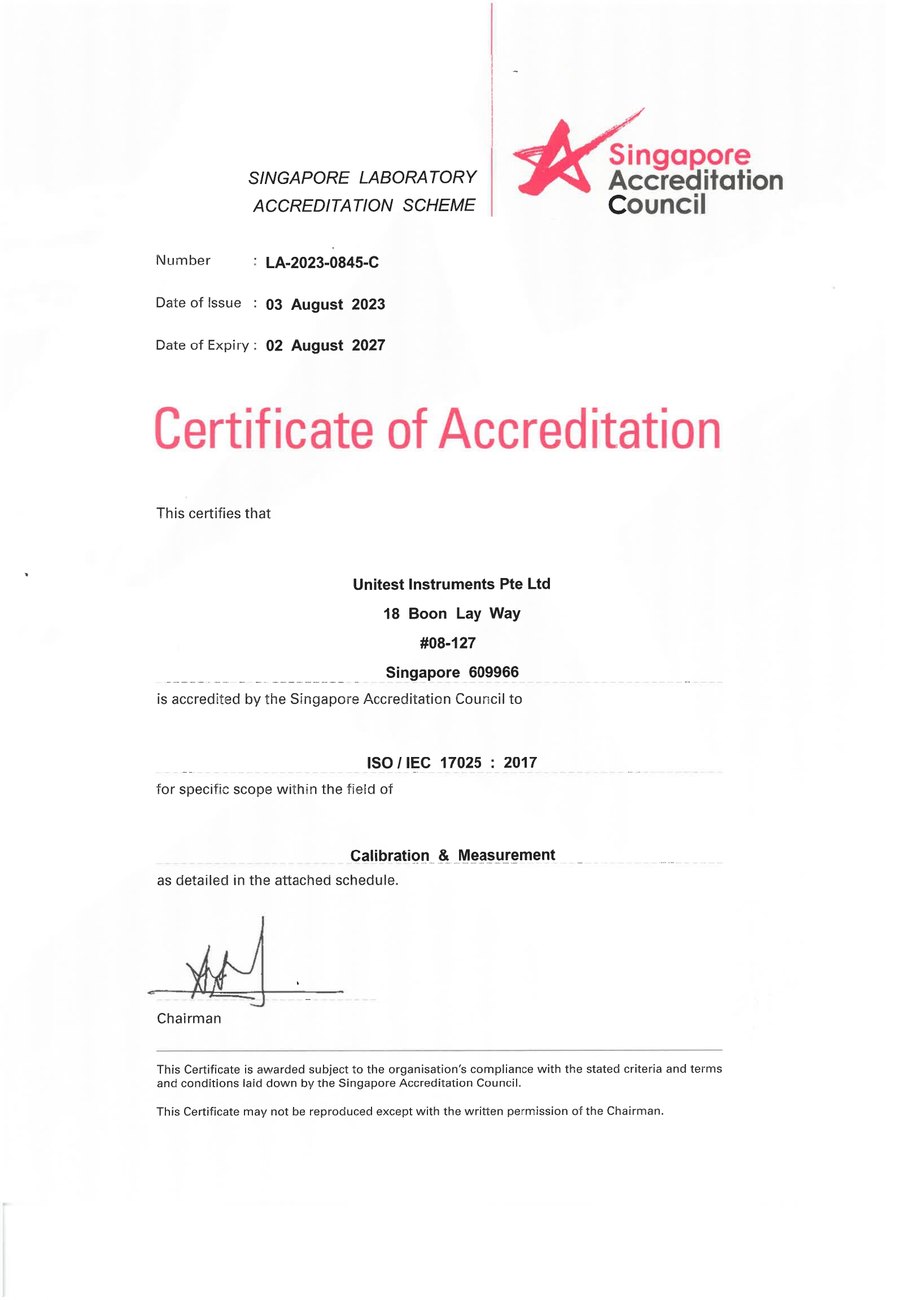
SAC-SINGLAS accredited calibration laboratory (Acc. No. LA-2023-0845-C) serving Singapore's industrial, pharmaceutical, and manufacturing sectors. All content reflects our ISO/IEC 17025 accredited scope and is reviewed by our technical calibration team.
Need humidity and water activity instrument calibration in Singapore?
Unitest Instruments is SAC-SINGLAS accredited (Acc. No. LA-2023-0845-C) to ISO/IEC 17025. Same-week turnaround, certificates accepted by ISO 9001 auditors, SFA, and HSA GMP inspectors.