
Key Takeaways
- Fluke (435-II, 1760) is purpose-built for field power quality work: rugged, battery-powered, and CAT IV safety rated for live distribution panels.
- Vitrek (PA900, PA910) is a precision bench instrument with measurement accuracy down to ±0.04%. Suited to R&D, efficiency testing, and compliance labs.
- Vitrek supports simultaneous multi-channel waveform capture and wider bandwidth harmonic analysis, critical for motor drive and inverter characterisation.
- Both brands require annual SAC-SINGLAS calibration to maintain traceability for ISO 9001 and regulatory audits in Singapore.
- Unitest Instruments sells and provides ISO/IEC 17025 calibration services for both brands from our Singapore laboratory.
Why This Comparison Matters for Singapore Buyers
Singapore's industrial base (semiconductor fabs, pharmaceutical manufacturers, data centres, and commercial property managers), relies on power quality measurement for two distinct purposes. The first is field diagnostics: finding the source of nuisance tripping, voltage sags, or harmonic pollution on a live building or plant electrical system. The second is laboratory compliance: characterising the efficiency of a motor drive or power supply to meet NEA energy label requirements, IEC standards, or a customer's product specification.
These two jobs require different instruments. Buying a bench analyzer for field work is impractical; buying a field analyzer for compliance testing leaves you with an uncertainty budget that auditors will question. The Fluke versus Vitrek decision is not really about brand loyalty. It is about matching the right tool to the right job.
As an authorised distributor and SAC-SINGLAS accredited calibration laboratory, Unitest Instruments works with both brands across these use cases. The observations in this article reflect real-world procurement decisions made by Singapore industrial buyers, not manufacturer marketing material.
It is also worth being clear that this is genuinely a two-instrument decision for many organisations, not a single either/or purchase. A facilities engineering team responsible for both plant-wide power quality troubleshooting and periodic energy-efficiency reporting to management frequently ends up owning both a Fluke-class field instrument and access to Vitrek-class bench measurement (either owned directly or contracted through a laboratory), because the two jobs genuinely require different tools and neither instrument does the other's job well. Framing the purchase decision as "which one instrument should we buy" when the underlying need spans both field and lab work is a common procurement mistake this article is written specifically to help avoid.
Fluke Power Analyzers: Field-First Design
Fluke's power quality product line is anchored by the 435-II (three-phase power quality and energy analyzer) and the 1760 (three-phase power quality recorder). Both instruments are built around an assumption: you will carry them into a switch room, clip on flexible current probes, and leave them recording for hours or days on an energised system.
Strengths of the Fluke Range
The 435-II is CAT IV 600 V / CAT III 1000 V rated. One of the highest safety categories available for portable instruments. Its battery-powered operation means it can run independently of the system under test, which matters when you are logging power on a critical UPS or generator feed. The instrument captures 50-cycle waveforms, voltage and current RMS, power factor, harmonics to the 50th order, and supports EN 50160 power quality standard compliance checking out of the box.
For a facility engineer or electrical contractor doing power quality surveys across multiple sites in Singapore, the Fluke ecosystem has a further practical advantage: the probes, leads, and cases are standardised across the range, spare parts are locally available, and the software (Energy Analyze Plus) is familiar to most electrical engineers in the region.
Limitations to Know Upfront
Fluke's field instruments are not designed for high-accuracy laboratory work. The 435-II has a basic power accuracy of ±0.1% of reading under typical conditions, which is perfectly acceptable for site surveys but is not tight enough for product compliance testing where the uncertainty budget must be calculated and documented. The instrument also lacks the multi-channel simultaneous capture that bench instruments provide for complex converter characterisation work.
How a Power Analyzer Actually Calculates Power, and Why This Matters for Both Brands
Understanding the underlying measurement principle helps explain why accuracy specifications differ so much between a field instrument and a precision bench analyzer. Both types of instrument sample instantaneous voltage and current waveforms at high speed, then calculate real (active) power as the time-averaged product of instantaneous voltage and instantaneous current, which correctly captures power delivered under non-sinusoidal, distorted waveform conditions, unlike a simple RMS-voltage-times-RMS-current calculation that only holds true for a linear resistive load on a perfect sine wave. This sampling-and-multiplication approach is why sample rate, analogue-to-digital converter resolution, and channel-to-channel timing synchronisation all directly determine measurement accuracy, not just the instrument's stated headline specification.
The distinction between apparent power (simple RMS voltage times RMS current), real power (the time-averaged instantaneous product), and reactive power (the component that does no net work but still loads the electrical system) becomes especially important on modern non-linear loads: variable-speed drives, LED lighting drivers, and switch-mode power supplies all draw current in a distorted, non-sinusoidal shape that a basic instrument can under- or over-report depending on how faithfully it samples and reconstructs the actual waveform. This is precisely the regime where Vitrek's higher sample rate and wider bandwidth genuinely earn their accuracy advantage, and where a field instrument's coarser sampling can introduce real, non-trivial error on exactly the kind of non-linear load that Singapore's growing base of variable-speed drives and switching power supplies represents.
Current Probe Selection: Often a Bigger Error Source Than the Analyzer Itself
A detail frequently overlooked when comparing power analyzer brands is that the current probe (whether a clamp-on current transformer, a flexible Rogowski coil, or a shunt-based current sensor) contributes its own, sometimes substantial, measurement uncertainty on top of the analyzer's own accuracy specification. A Fluke 435-II paired with an inexpensive or poorly calibrated flexible current probe can easily produce worse overall measurement accuracy than the instrument's own datasheet specification implies, because the datasheet figure typically describes the analyzer's internal accuracy assuming an ideal, perfectly accurate input signal, not the accuracy of the complete measurement chain including the probe.
Rogowski coil probes, commonly used for their flexibility around large or awkwardly shaped conductors, have their own frequency response characteristics and phase shift behaviour that must be accounted for, particularly at higher harmonic frequencies where a probe's phase error can introduce a genuine power measurement error even when the underlying voltage and current amplitudes are measured correctly. For any power measurement where the reported accuracy genuinely matters, whether for field diagnostics informing a costly remediation decision or for compliance testing feeding a formal test report, the current probe's own calibration status and specification deserve as much scrutiny as the analyzer's, and both should be calibrated together as a system where practical rather than treated as independent, separately-accurate components.
Vitrek Power Analyzers: Precision Bench Instruments
Vitrek's PA900 series is the primary reference for this comparison. The PA900 is a modular power analyzer (up to 14 channels of simultaneous voltage and current measurement), with a stated power accuracy of ±0.04% of reading. It is designed for engineering laboratories: motor efficiency mapping, inverter loss characterisation, standby power measurement per IEC 62301, and transformer no-load and load-loss testing.
Strengths of the Vitrek Range
The PA900's primary advantage is measurement depth. Its synchronous multi-channel architecture means all channels sample at exactly the same instant, which is essential when you are computing efficiency across the input and output of a variable speed drive simultaneously. A mismatch of even a few microseconds between channels introduces a phase error that compounds at low power factors. Exactly the regime where accuracy matters most.
Vitrek instruments also offer wide measurement bandwidth (typically to 2 MHz for voltage and to 500 kHz for current), which captures high-frequency switching noise that conventional power analyzers miss. For power electronics engineers characterising GaN or SiC switching converters, this bandwidth is not optional.
The PA900's channel-to-channel synchronisation, mentioned above as a strength, deserves a slightly deeper explanation because it is genuinely the feature that separates a precision multi-channel bench analyzer from a collection of independent single-channel meters. When measuring the efficiency of a three-phase motor drive, for example, the input power (measured across three AC phases) and the output power (measured across the motor's own phases, which may run at a different frequency entirely if the drive is a variable-frequency type) must be captured at precisely the same instants for the resulting efficiency calculation to be meaningful. Any timing skew between channels introduces a phase-dependent error into each individual power measurement, and because efficiency is calculated as a ratio of two already-imperfect measurements, timing errors on both sides of the ratio compound rather than cancel. This is a genuinely difficult engineering problem to solve well, and it is a large part of why a precision multi-channel bench analyzer commands a meaningfully higher price than an equivalent number of independent single-channel meters would suggest.
Limitations to Know Upfront
The PA900 is a mains-powered bench instrument. It weighs approximately 4 kg, requires a stable work surface, and is not rated for use on live distribution panels in the field. In Singapore's humid, high-ambient-temperature industrial environments, a bench instrument taken to a machine room is a logistical inconvenience at best and a reliability risk at worst. Vitrek instruments are also higher in purchase cost, and local support depth (calibration turnaround, spare parts, application expertise) is more limited than Fluke's for field models. Making a relationship with an accredited local calibration lab like Unitest particularly important.
Feature-by-Feature Comparison
The table below summarises the key specification and use-case differences between the Fluke 435-II (the most common field power quality analyzer in Singapore) and the Vitrek PA900 (the benchmark bench precision analyzer). Exact specifications should be verified against current datasheet revisions before procurement.
| Feature | Fluke 435-II | Vitrek PA900 |
|---|---|---|
| Primary use case | Field power quality survey, site diagnostics | Lab efficiency testing, product compliance, R&D |
| Basic power accuracy | ±0.1% of reading (typical) | ±0.04% of reading (typical) |
| Voltage input | Up to 1000 V CAT III / 600 V CAT IV | Up to 1000 V (lab-grade input, not CAT IV) |
| Current channels | 3 (via flexible current probes) | Up to 14 simultaneous (modular) |
| Harmonic analysis | To 50th harmonic | To higher orders; wider bandwidth |
| Measurement bandwidth | ~10 kHz | Up to 2 MHz (voltage), 500 kHz (current) |
| Battery powered | Yes. Up to 7 hours | No. Mains powered only |
| Safety category | CAT IV 600 V / CAT III 1000 V | Lab use. Not rated for live panel work |
| Portability | High. Carry case, rugged housing | Low. Bench instrument, ~4 kg |
| EN 50160 compliance check | Built-in | Not primary function |
| Suitable for IEC 62301 standby power testing | Marginal. Accuracy insufficient for tight budgets | Yes. Designed for this standard |
| Typical calibration interval | 12 months | 12 months |
| Calibration available at Unitest | Yes. SAC-SINGLAS accredited | Yes. SAC-SINGLAS accredited |
| Relative purchase cost | Mid-range | Higher (precision instrument) |
Need your Fluke or Vitrek power analyzer calibrated in Singapore?
Unitest Instruments provides ISO/IEC 17025 traceable calibration for both brands. Certificates accepted by ISO 9001 auditors and regulatory bodies across Singapore and the region.
Where Each Brand Wins: Clear Recommendations
Choose Fluke when:
- You are conducting power quality surveys on energised distribution panels, switchboards, or building main incoming supplies.
- You need to log voltage sags, swells, flicker, or harmonics over multiple days without mains power to the instrument.
- Your team works across multiple sites and needs a rugged, portable instrument that can withstand daily field use.
- You need EN 50160 compliance checking built in. Useful for facility managers dealing with power supply quality disputes.
- Local support, spare probes, and fast turnaround on repairs are important operational requirements.
Choose Vitrek when:
- You are characterising the efficiency of a motor, drive, transformer, or power supply in a laboratory setting.
- Your work requires documented measurement uncertainty at ±0.1% or better, for example, NEA energy labelling or IEC 62301 standby power compliance.
- You need simultaneous multi-channel power measurement across the input and output stages of a converter system.
- Your application involves high-frequency switching waveforms (GaN/SiC converters) where a 10 kHz instrument bandwidth is insufficient.
- You are running a product development or production test station where the instrument stays in one location.
Calibration: What Singapore Buyers Need to Know
Regardless of which brand you choose, annual calibration by a SAC-SINGLAS accredited laboratory is the baseline requirement for any quality management system in Singapore. This is not a manufacturer recommendation to ignore. It is the condition under which the accuracy specifications in the datasheet remain valid. An uncalibrated power analyzer may still produce readings, but there is no documented basis for trusting those readings to the stated specification.
Understanding what a calibration certificate actually documents is important for procurement managers and quality engineers. Our article on how to read a calibration certificate explains what each section means and what to look for when a certificate arrives from the lab. For those involved in compliance audits, the distinction between accredited and non-accredited calibration is also worth understanding. Not all calibration certificates carry the same regulatory weight in Singapore.
Unitest Instruments calibrates both Fluke and Vitrek power analyzers at our SAC-SINGLAS accredited laboratory (Acc. No. LA-2023-0845-C). Our calibration certificates are issued with full measurement uncertainty statements traceable to the Singapore National Metrology Centre (NMC), and are accepted by ISO 9001 certification bodies and regulatory auditors in Singapore and across the APAC region.
A practical point specific to power analyzer calibration is that a complete calibration should verify accuracy across the instrument's voltage, current, and power (and, ideally, power factor and harmonic) ranges rather than a single reference point, precisely because these instruments are used across a genuinely wide range of load conditions in practice. A calibration certificate that only confirms accuracy at one voltage and one current level provides limited assurance for a facility that will use the instrument across a range of loads from lightly loaded standby conditions to full-load motor testing. When requesting a quotation, specifying the actual voltage, current, and power factor ranges relevant to your application, rather than accepting a generic "standard calibration" scope, ensures the resulting certificate actually covers the conditions the instrument will be used under.
Total Cost of Ownership in Singapore Context
Purchase price is only part of the procurement equation. For power quality instruments used in Singapore's industrial sector, the total cost of ownership includes calibration fees (typically every 12 months), probe and accessory replacement, software licence renewals, and the cost of instrument downtime if calibration turnaround is slow.
Fluke instruments have an advantage here for field-heavy operations: the ecosystem is mature, locally supported, and calibration turnaround at accredited labs like Unitest is well-established. For Vitrek instruments, which serve a smaller user base in Singapore, the key is ensuring your calibration laboratory has the reference standards and technical competence to calibrate to the instrument's tight specifications. Not all accredited labs are equipped for ±0.04% accuracy work.
Budget approximately S$300–600 per calibration cycle for a single-channel field power quality instrument, and S$600–1,200 or more for a multi-channel precision bench analyzer, depending on the number of channels and the uncertainty level required in the certificate. These are indicative ranges; contact Unitest for a specific quote for your instrument model.
Frequently Asked Questions
Fluke power analyzers (such as the 435-II and 1760) are engineered for field use. Rugged, portable, and optimised for power quality troubleshooting on energised systems. Vitrek power analyzers (such as the PA900) are precision bench instruments designed for R&D, compliance testing, and high-accuracy efficiency measurement in a laboratory or production environment. The two brands serve genuinely different primary use cases.
Vitrek PA-series analyzers typically achieve power accuracy of ±0.04% to ±0.1% of reading, which is significantly better than Fluke's field-grade accuracy of approximately ±0.1% to ±0.5% depending on the model and measurement condition. For laboratory efficiency testing, motor drive characterisation, or product compliance (e.g. IEC 62301 standby power), Vitrek's precision is the better choice. For field diagnostics where a few tenths of a percent difference is unimportant, Fluke is more than adequate.
Vitrek PA-series instruments are bench-top units without battery operation, MIL-grade drop resistance, or an IP-rated enclosure. They can be transported between locations, but they are not designed for daily field use on construction sites, switch rooms, or energised distribution panels. For that kind of work, a Fluke 435-II or Fluke 1760 is the correct tool.
Yes. Unitest Instruments is an authorised distributor and SAC-SINGLAS accredited calibration laboratory (Acc. No. LA-2023-0845-C) that supports both brands. We can supply, calibrate, and issue ISO/IEC 17025 traceable calibration certificates for Fluke and Vitrek power analyzers from our Singapore laboratory.
Most manufacturers recommend annual calibration under normal use conditions. High-accuracy bench instruments like the Vitrek PA900 are often calibrated every 12 months due to the precision required for compliance testing. Field instruments like the Fluke 435-II may be calibrated annually or after any significant mechanical shock. Your ISO 9001 or quality management system requirements may specify a shorter interval.
Yes. SAC-SINGLAS accreditation (the Singapore Accreditation Council's National Laboratory Accreditation Scheme) is the Singapore equivalent of UKAS or NATA accreditation. Calibration certificates issued by SAC-SINGLAS accredited laboratories carry the MRA mark and are accepted by ISO 9001, ISO 14001, and regulatory auditors in Singapore and most international jurisdictions.
Harmonic analysis measures the individual frequency components of an AC waveform beyond the fundamental 50 Hz (or 60 Hz) supply. Variable speed drives, UPS systems, LED lighting, and switching power supplies generate harmonics that cause transformer heating, neutral conductor overloads, and equipment malfunction. Both Fluke and Vitrek can measure harmonics, but they differ in bandwidth and number of channels. Vitrek captures harmonics to higher orders and across more simultaneous channels, which matters for complex motor or power electronics testing.
For product compliance testing (such as NEA energy efficiency label requirements or IEC 62301 standby power measurement), a high-accuracy bench instrument like the Vitrek PA900 is the correct choice. Its low uncertainty (±0.04% of reading) and stable temperature-compensated measurement meet the demanding uncertainty budgets required by accredited test reports. A Fluke field analyzer, while excellent for site diagnostics, does not provide the accuracy depth needed for formal product certification testing.
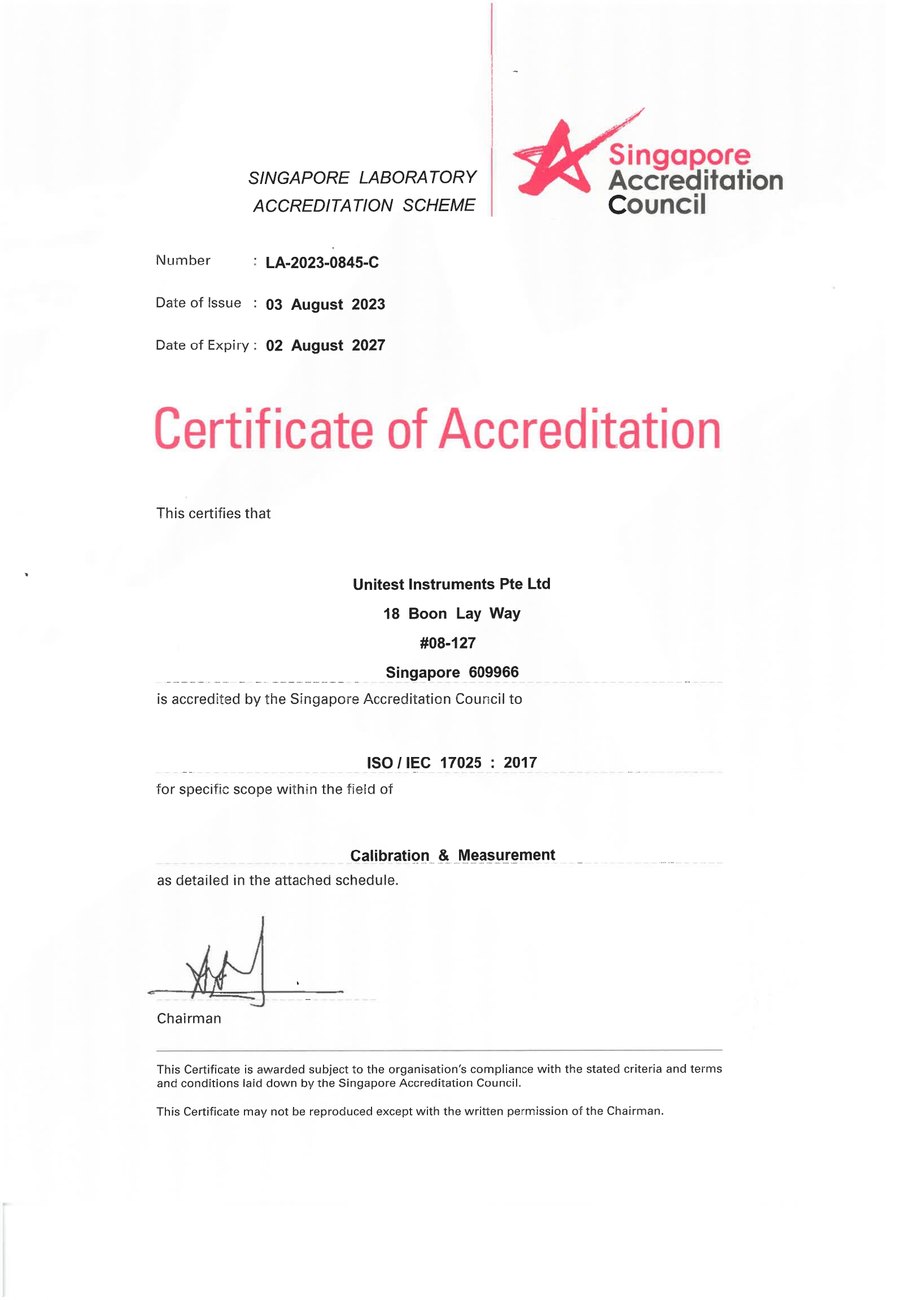
SAC-SINGLAS accredited calibration laboratory (Acc. No. LA-2023-0845-C) serving Singapore's industrial, pharmaceutical, and manufacturing sectors. All content reflects our ISO/IEC 17025 accredited scope and is reviewed by our technical calibration team.
Need power analyzer calibration in Singapore?
Unitest Instruments is SAC-SINGLAS accredited (Acc. No. LA-2023-0845-C) to ISO/IEC 17025. Same-week turnaround, certificates accepted by ISO 9001 auditors.