
Key Takeaways
- Rotronic HygroPalm typically achieves ±1.5% RH accuracy; Comark models typically specify ±2–3% RH. A meaningful gap for regulated industries.
- The HygroPalm's modular HC2 probe system lets one display unit handle room, surface, duct, and high-temperature measurements; Comark meters use dedicated fixed or plug-in probes.
- Comark meters cost significantly less upfront and are specifically designed for the physical demands of food-factory and cold-chain environments.
- Neither brand's out-of-box factory certificate qualifies as an accredited calibration. You need a SAC-SINGLAS ISO/IEC 17025 certificate for GMP, ISO 9001, or SFA audit evidence.
- Unitest Instruments sells and provides SAC-SINGLAS accredited calibration for both Rotronic and Comark instruments, with same-week turnaround available.
Why This Comparison Matters in Singapore
Humidity is one of the most commonly measured and most commonly mismanaged parameters in Singapore's manufacturing, pharmaceutical, food, and electronics sectors. The tropical climate (year-round relative humidity averaging 75–85% outdoors), puts enormous pressure on climate-controlled facilities. A humidity excursion in a pharmaceutical cleanroom can invalidate a product batch. In a food cold store, a misfiring sensor can cause a HACCP non-conformance. In an electronics assembly area, unchecked humidity drives electrostatic discharge events and corrosion failures.
Rotronic and Comark are both well-regarded in the Singapore market. Rotronic (now part of the Sensirion ecosystem) has long been the reference-grade choice for laboratories and pharmaceutical facilities. Comark, a UK-based manufacturer, has built a strong reputation in the food-safety and catering industries worldwide. The two brands rarely compete directly (they are designed for different use cases), but procurement teams regularly ask us to compare them. This article gives you an honest answer, without a sales agenda.
Rotronic HygroPalm: Strengths and Limitations
The HygroPalm series centres on the HP23 display unit paired with interchangeable HC2 probes. The HC2 sensor uses Rotronic's proprietary Hygromer IN-1 capacitive film element. A sensor technology that has been refined over decades and is widely accepted in pharmaceutical validation and cleanroom qualification work. The sensor has a specified accuracy of ±1.5% RH (10–90% RH) and ±0.3°C, with some probe variants achieving ±0.8% RH after individual adjustment.
The key technical differentiator is the probe memory chip. Every HC2 probe carries a chip that stores its individual calibration coefficients. When you connect a probe to any compatible HygroPalm display unit, the reading is automatically corrected using that probe's stored data. This means a single display unit can serve across multiple measurement locations, each with its own dedicated probe. Without any manual reconfiguration or risk of applying the wrong calibration to the wrong probe.
The HP23 also supports data logging with timestamps, PC connectivity via HW4 software, and automatic calculation of dew point, wet bulb temperature, vapour pressure, and mixing ratio. Parameters required in pharmaceutical drying, HVAC commissioning, and industrial process work.
Limitations to be honest about: The HygroPalm system is expensive. Both the display unit and each HC2 probe carry a significant price premium over comparable Comark instruments. The Hygromer sensor, while stable, can be damaged by liquid water contact and by aggressive chemicals; it requires periodic recalibration (typically annually) and probe replacement over time. The system is also more complex to operate, which can be a disadvantage in fast-paced food production environments where operators need a single-button reading.
Comark Humidity Meters: Strengths and Limitations
Comark's humidity measurement range spans several models, including instruments in their RF and RH series. These are handheld instruments designed with the food-safety professional in mind: rubberised housings, simple interfaces, and resistance to the knocks and moisture exposure common in food processing, commercial kitchens, and cold-chain environments.
Comark humidity meters typically use capacitive RH sensors with specified accuracy in the ±2–3% RH range depending on the model and measurement range. Temperature accuracy is typically ±0.5°C. For most food safety applications (monitoring cold stores, dry goods warehouses, processing rooms, and restaurant storage areas), this accuracy is entirely appropriate. The critical HACCP limits for most food-storage humidity parameters are set well away from the actual setpoint, providing sufficient guard band even with a ±2–3% RH instrument.
Comark meters are also straightforward to calibrate and service. Their probe designs are generally less sophisticated than the HygroPalm HC2 ecosystem, but this also means lower replacement costs and a more straightforward calibration process.
Limitations to be honest about: Comark meters are not well-suited for applications requiring better than ±2% RH accuracy, extended data logging to validated software, or the kind of traceable measurement uncertainty documentation demanded by pharmaceutical GMP audits and ISO/IEC 17025 laboratory quality systems. The fixed or plug-in probe designs also limit application flexibility compared to the Rotronic ecosystem.
Need your Rotronic or Comark humidity meter calibrated in Singapore?
Unitest Instruments holds SAC-SINGLAS accreditation (LA-2023-0845-C) for humidity calibration. Our certificates are accepted by ISO 9001, GMP, and SFA auditors. Same-week turnaround available.
Head-to-Head Comparison Table
The table below compares the two platforms across the parameters that matter most to Singapore procurement teams. Note that specifications vary across model variants within each brand. The values below represent the mainstream handheld instruments in each range.
| Feature | Rotronic HygroPalm (HP23 + HC2) | Comark Handheld Humidity (RF/RH Series) |
|---|---|---|
| RH Accuracy | ±1.5% RH (typical); ±0.8% RH (adjusted probes) | ±2–3% RH depending on model and range |
| Temperature Accuracy | ±0.3°C | ±0.5°C (typical) |
| Measurement Range (RH) | 0–100% RH | 0–100% RH |
| Probe System | Interchangeable HC2 probes (room, duct, surface, high-temp, needle); calibration stored in probe chip | Fixed or plug-in probes; dedicated models per application |
| Data Logging | Yes. Onboard logging with timestamp; HW4 PC software export | Selected models include basic logging; varies by model |
| Derived Parameters | Dew point, wet bulb, vapour pressure, enthalpy, mixing ratio | RH and temperature; dew point on some models |
| Housing / Ruggedness | Durable but instrument-grade; not designed for food-factory drops | Rubberised boot, splash-resistant; food-safety environment rated |
| Primary Applications | Pharmaceutical, cleanroom, laboratory, HVAC commissioning, industrial process | Food safety, cold chain, HVAC, agriculture, general industrial |
| Typical Singapore Market Price | Higher (display unit + probe investment; probe replacement over time) | Lower upfront cost; affordable probe replacements |
| Calibration by Unitest | Yes. SAC-SINGLAS accredited | Yes. SAC-SINGLAS accredited |
| Suited for GMP / Pharma Audit | Yes. Widely used in pharmaceutical qualification | Only with accredited calibration and appropriate uncertainty; accuracy class may limit use |
| Suited for HACCP / Food Safety | Yes, but over-specified for most food-safety requirements | Yes. Purpose-designed for food-safety environments |
Which Should You Choose? A Use-Case Guide
Choose Rotronic HygroPalm if:
- Your quality system (GMP, ISO 9001, ISO 13485, or cleanroom qualification) demands documented measurement uncertainty below ±2% RH.
- You need one instrument to cover multiple probe types, for example, combining a standard room probe with a duct probe for AHU commissioning and a surface probe for wall condensation checks.
- You produce calibration validation documentation for pharmaceutical, medical device, or regulated chemical manufacturing.
- You require dew point, wet bulb, or derived psychrometric parameters as part of your process monitoring.
- You operate in a Singapore cleanroom or controlled environment where humidity excursions carry significant batch-failure risk.
Choose Comark if:
- Your primary application is food safety monitoring under HACCP, SFA, or BizSAFE compliance requirements.
- You need a simple, rugged instrument that non-specialist operators can use without training.
- Your measurement tolerance allows ±2–3% RH, which covers the vast majority of storage, cold-chain, and process-area monitoring tasks.
- Budget is a constraint and you need to equip multiple locations or inspectors cost-effectively.
- You operate in wet, washdown, or physically demanding environments where instrument durability matters more than laboratory-grade precision.
Calibration Requirements for Both Brands
The calibration requirements for Rotronic and Comark humidity instruments are governed by the same underlying principles (traceable measurement, documented uncertainty, and a defined calibration interval), regardless of which brand you own. Understanding what those requirements mean in practice will help you budget correctly and avoid compliance gaps.
For Rotronic HygroPalm instruments, calibration typically involves the complete probe assembly (not just the display unit), because the sensor is located in the probe. Unitest Instruments calibrates the probe across multiple RH points inside a traceable humidity reference chamber, compares the readings against a transfer standard traceable to Singapore's National Metrology Centre (NMC), and issues a certificate with expanded uncertainty at k=2. If a probe's readings fall outside its specification during calibration, we can either adjust the probe's onboard calibration coefficients (where the model supports this) or document the as-found deviation for your corrective action records.
For Comark humidity instruments, the process is similar: the instrument is placed in our humidity reference chamber alongside our accredited transfer standards, readings are compared at multiple RH setpoints, and a traceable certificate is issued. The calibration certificate for either brand serves as documentary evidence that the instrument's readings were verified against a national standard on a specific date, which is what your ISO 9001 or HACCP auditor needs to see.
Both brands are generally recommended for annual calibration under normal conditions. Pharmaceutical and GMP environments should consider 6-monthly intervals. If an instrument is dropped, exposed to condensation, or shows unusual readings, it should be recalibrated immediately regardless of when it was last serviced. For a full discussion of how to determine the right interval for your system, see our article on calibration intervals and how often instruments should be calibrated.
Singapore Procurement Context
Singapore's regulatory and compliance landscape creates specific requirements that should inform your instrument selection. The Singapore Food Agency (SFA) expects food businesses to maintain temperature and humidity records that demonstrate HACCP plan adherence. The Health Sciences Authority (HSA) applies GMP standards to pharmaceutical manufacturers that align closely with EU GMP Annex 15 and PIC/S guidelines, which require calibrated instruments with traceable certificates. Singapore's ISO 9001-certified manufacturers face surveillance audits where calibration records are routinely reviewed.
In all these contexts, having a SAC-SINGLAS accredited calibration certificate is the cleanest way to satisfy auditors. SAC-SINGLAS is Singapore's national accreditation body for testing and calibration laboratories, and its certificates are recognised under the ILAC Mutual Recognition Arrangement (MRA). Meaning they are also accepted by overseas auditors and regulatory bodies. If you are exporting products to markets that require traceability documentation, an SAC-SINGLAS certificate from Unitest Instruments will be accepted without question.
On price: both Rotronic and Comark instruments are available through Unitest Instruments as an authorised distributor. We can also advise on model selection before purchase, so you are not over-specifying (and overpaying) for your application, or under-specifying and finding out during an audit that your instrument's accuracy class was insufficient.
Sensor Handling and Care: Protecting Your Investment Between Calibrations
A capacitive humidity sensor is a delicate component, and how it is handled between calibration visits has more influence on measurement reliability than most facilities realise. Both the Rotronic Hygromer film and the sensing elements used in Comark instruments are susceptible to contamination and drift if exposed to conditions outside their intended operating envelope, and understanding the failure modes helps extend the useful life of either instrument.
Liquid water contact is the most damaging exposure for either brand's sensor. A probe accidentally immersed, or exposed to condensation dripping directly onto the sensing element, can shift its calibration permanently or, in severe cases, destroy the sensor outright. Chemical vapours are a second concern, particularly in industrial and food-processing environments where cleaning agents, solvents, or ammonia (common in cold-storage refrigeration systems) are present; these can contaminate the sensing film and cause a slow, hard-to-detect drift rather than an obvious failure. Storage matters too: leaving a probe in a sealed, unventilated case in a humid Singapore storeroom for extended periods between uses can itself cause the sensor to drift toward whatever humidity level it is stored at, an effect sometimes called sensor "memory."
Best practice for either brand is to store probes in their protective caps or cases when not in use, avoid direct contact with liquids or aerosol chemicals, and, for instruments used in variable environments (moving between an air-conditioned office and a humid production floor, for example), allow a short stabilisation period before taking a reading that will inform a decision. None of this replaces periodic calibration, but it materially reduces the chance of a nasty surprise, an instrument that has drifted well outside tolerance between scheduled calibration visits, being discovered only when an auditor questions a reading.
Verifying a Humidity Instrument in the Field Between Calibrations
Annual or six-monthly calibration establishes a documented baseline, but for facilities running humidity-sensitive processes continuously, a simple interim field check between full calibrations catches gross drift early, before it affects product quality or triggers a compliance finding.
The most widely used field-check method is a saturated salt solution reference. A small sealed chamber containing a saturated salt solution (sodium chloride produces a stable 75.3% RH at 25°C; potassium chloride produces approximately 85% RH) generates a known, stable humidity level once equilibrium is reached, typically after several hours. Placing the probe of either a Rotronic HygroPalm or a Comark meter into this chamber and comparing the displayed reading against the known reference value gives a quick, low-cost sanity check that the instrument has not drifted significantly since its last accredited calibration. This is a useful operational discipline, not a substitute for accredited calibration itself, since the salt solution's accuracy and the check's documentation rigour do not meet the traceability standard an auditor requires, but it is a genuinely useful early-warning tool that costs very little to implement and can catch a failing sensor weeks or months before its next scheduled calibration date.
Building a Complete Instrument Kit: What Else to Budget For
Procurement teams frequently price a single display unit and probe, then discover mid-project that a complete, workable kit needs several additional items that were not on the original quotation. Planning for these upfront avoids delays once the instrument is already in use.
For Rotronic HygroPalm deployments covering more than one measurement type, budget for the specific HC2 probe variants your applications require from the outset, room, duct, surface, and needle probes are not interchangeable in function even though they connect to the same display unit, and purchasing the wrong probe type for a duct-mounted AHU commissioning task versus a room-air spot check is a common and avoidable procurement error. For Comark deployments across multiple sites (a common pattern for food-safety compliance teams checking several cold stores), budgeting for one calibrated instrument per site, rather than a single shared unit rotated between locations, avoids the logistical friction of coordinating instrument availability and reduces the risk of a site being caught without a working, in-date instrument during an SFA inspection.
Both brands also benefit from a documented spare-parts holding: a spare probe or sensor element sourced in advance means a facility is not left without a working instrument for the weeks it can take to source a replacement part internationally, a genuine risk given that neither brand maintains large Singapore-based spare stock for every model variant.
Frequently Asked Questions
Rotronic HygroPalm instruments typically specify ±1.5% RH accuracy (±0.3°C for temperature) using their Hygromer IN-1 sensor, which is superior for laboratory-grade and pharmaceutical applications. Comark's handheld humidity meters generally specify ±2–3% RH depending on the model, which is adequate for food-safety monitoring, HVAC checks, and general industrial use. If your process tolerance requires better than ±2% RH, the HygroPalm range is the safer choice.
Neither instrument can serve as a reference standard on its own. Both must be calibrated by an accredited laboratory (ideally one holding SAC-SINGLAS ISO/IEC 17025 accreditation), before being used as a reference in a GMP, ISO 9001, or pharmaceutical qualification context. The calibration certificate must carry a traceable measurement uncertainty statement. Unitest Instruments calibrates both Rotronic and Comark instruments under our SAC-SINGLAS accreditation (LA-2023-0845-C).
Yes. The HygroPalm system is built around a modular probe architecture. The handheld display unit accepts a wide range of interchangeable HC2 series probes including standard RH/T probes, needle probes for material moisture measurement, surface probes, duct probes for HVAC, and high-temperature variants. Each probe stores its own calibration data in an onboard chip, so the displayed reading automatically uses the correct calibration for whichever probe is attached.
Calibration cost depends on the number of calibration points and the turnaround required, not primarily on the instrument brand. For both Rotronic and Comark handheld humidity instruments, Unitest Instruments offers SAC-SINGLAS accredited calibration at competitive rates with same-week turnaround available. Contact us for a fixed-price quotation; we calibrate both brands in our accredited humidity reference chamber.
Most manufacturers recommend annual calibration under normal use conditions. However, the appropriate calibration interval depends on the criticality of the measurement, the environmental conditions the instrument is exposed to, and your quality system requirements. Pharmaceutical and medical-device environments typically require 6-monthly calibration. ISO 9001 and GMP systems require the interval to be documented and risk-justified. Our detailed article on calibration intervals provides further guidance on setting a defensible schedule for your instruments.
For food manufacturing and Food Safety Management System (FSMS/HACCP/SFA) compliance in Singapore, Comark handheld meters are a popular and cost-effective choice. They are purpose-designed for food-safety environments, robust against knocks and moisture ingress, and their accuracy class (±2–3% RH) is generally adequate for monitoring cold stores, dry goods stores, and processing areas where the regulatory trigger point is 15% RH away from the nearest critical limit. Where tighter tolerances are required (such as in controlled atmosphere storage or active pharmaceutical ingredient drying), the HygroPalm is the better instrument.
Yes. Unitest Instruments supplies, services, and calibrates both Rotronic HygroPalm and Comark handheld humidity instruments. As a SAC-SINGLAS accredited laboratory (LA-2023-0845-C) operating to ISO/IEC 17025, our calibration certificates are accepted by ISO 9001, GMP, and SFA auditors in Singapore. We can advise on which model best matches your application before purchase and calibrate it immediately after delivery.
A factory certificate confirms the instrument left the production line within specification, but it is not independently verified and rarely includes a traceable uncertainty statement. An accredited calibration certificate (issued by a SAC-SINGLAS or equivalent ISO/IEC 17025 laboratory), is independently audited, includes a measurement uncertainty value traceable to a national metrology standard, and is the type required for regulatory compliance in Singapore. Many buyers are surprised to find that the certificate shipped with a new humidity meter is a factory certificate, not an accredited one. Unitest issues fully traceable accredited certificates for both Rotronic and Comark instruments.
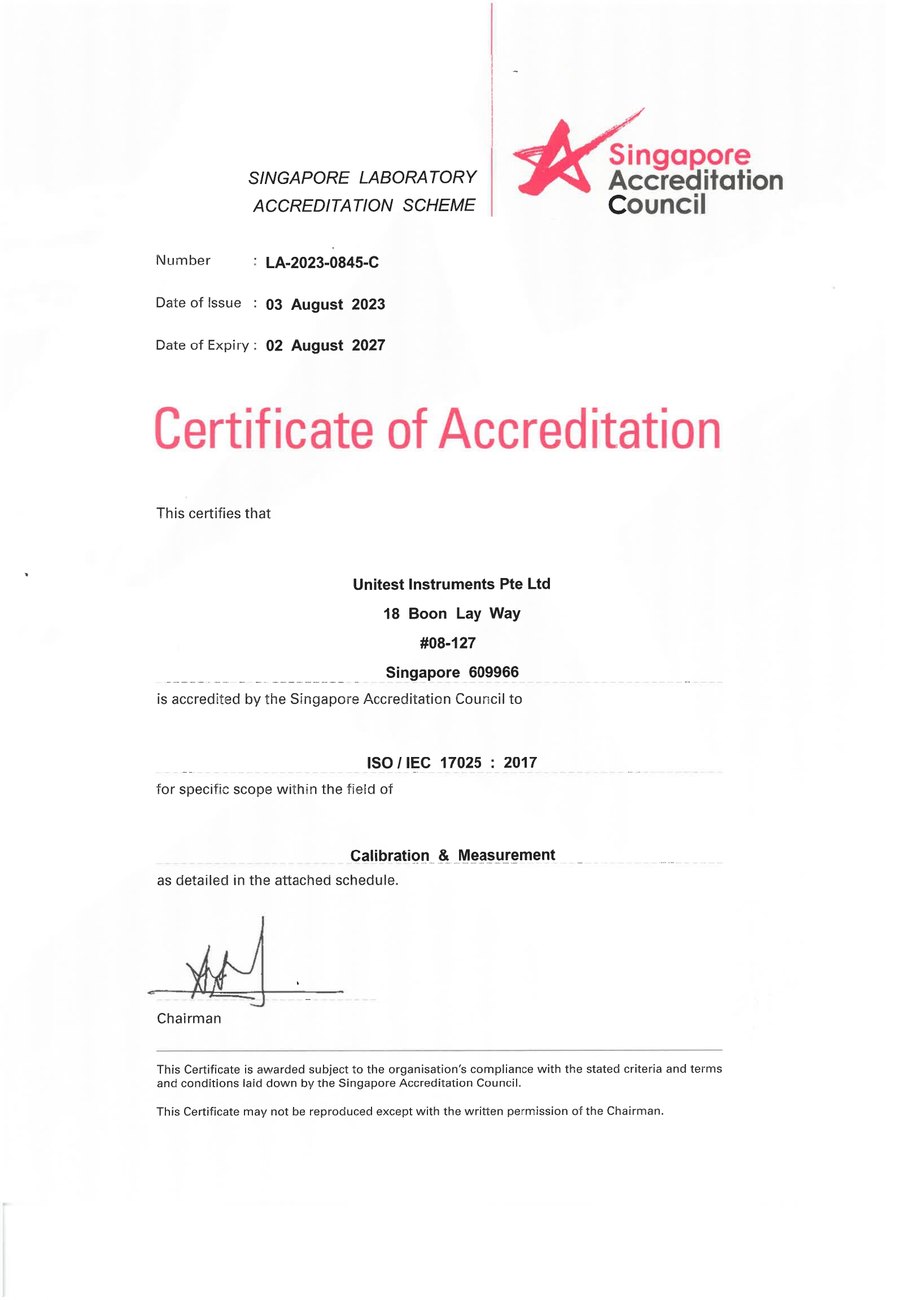
SAC-SINGLAS accredited calibration laboratory (Acc. No. LA-2023-0845-C) serving Singapore's industrial, pharmaceutical, and manufacturing sectors. All content reflects our ISO/IEC 17025 accredited scope and is reviewed by our technical calibration team.
Need humidity instrument calibration in Singapore?
Unitest Instruments is SAC-SINGLAS accredited (Acc. No. LA-2023-0845-C) to ISO/IEC 17025. We calibrate Rotronic HygroPalm and Comark humidity meters with same-week turnaround. Certificates accepted by ISO 9001 auditors.