
Key Takeaways
- Comark offers lower upfront cost, replaceable probes, and a proven track record in UK and Singapore food-service environments. Strong value for HACCP kitchens on a budget.
- Testo leads on data logging, Bluetooth connectivity, and probe variety. The better choice for food manufacturing, cold-chain monitoring, or multi-point HACCP programmes.
- Both brands deliver ±0.3–0.5°C factory accuracy, which meets SFA HACCP critical-limit requirements, but factory specs age; only calibration verifies your specific unit today.
- Singapore Food Agency (SFA) HACCP audits require a traceable calibration certificate, not just a brand name or a spec sheet, annual accredited calibration is non-negotiable.
- Unitest Instruments supplies and calibrates both Comark and Testo food thermometers under SAC-SINGLAS Acc. No. LA-2023-0845-C, with same-week turnaround.
Why the Brand Choice Matters Less Than You Think
When food businesses in Singapore ask us whether to buy a Comark or a Testo thermometer, they usually expect us to name a winner. The honest answer is that both brands produce instruments capable of meeting HACCP critical limits. The more important question is whether your specific thermometer, whichever brand it is, has a current calibration certificate traceable to Singapore's National Metrology Centre (NMC).
That said, brand choice is not irrelevant. Comark and Testo have genuinely different design philosophies, price points, and ecosystem strengths. Picking the wrong one for your operation means either overpaying for features you will never use, or buying a tool that lacks the capabilities your HACCP plan actually requires. This guide gives you an honest feature-by-feature breakdown so you can make a defensible procurement decision. One that holds up when your auditor asks why you chose what you chose.
As an ISO/IEC 17025 accredited laboratory that calibrates both brands regularly, we also have direct insight into how each type of instrument performs under real-world conditions in Singapore's humid, high-throughput food environments.
Brand Backgrounds: Who Makes What
Comark
Comark Instruments is a UK-founded brand with decades of focus almost exclusively on food-industry temperature measurement. Their range is deliberately narrow: handheld digital thermometers, waterproof pocket probes, and data loggers designed for cook-chill, cold-chain, and foodservice CCP monitoring. The C20, C26, and PDT 300 series are among the most widely deployed HACCP thermometers in the UK and Commonwealth markets, including Singapore. Probes are colour-coded for allergen and cross-contamination management. A practical HACCP feature often overlooked by lab-focused buyers.
Testo
Testo is a German precision instrument manufacturer with a much broader portfolio spanning HVAC, combustion analysis, air quality, and food safety. Their food thermometers (the testo 104, 105, 108, and 826 series), sit within a larger ecosystem of probes, data loggers, and the testo Smart app. Testo's advantage is depth: they manufacture needle probes, surface probes, immersion probes, infrared non-contact thermometers, and multi-channel logging units all within the same accessory ecosystem. For food manufacturers who need to monitor multiple CCPs simultaneously and generate automated digital records, Testo's integration story is compelling.
Head-to-Head Feature Comparison
The table below compares the two brands across the features that matter most for HACCP compliance in Singapore food operations. We have used representative flagship models (the Comark C26 and Testo testo 104-BT), but the patterns hold across each brand's range.
| Feature | Comark (C26 / PDT 300) | Testo (104-BT / 108) |
|---|---|---|
| Measurement range | −40°C to +200°C (probe-dependent) | −50°C to +300°C (probe-dependent) |
| Accuracy (factory spec) | ±0.4°C at food-safety range | ±0.3°C at food-safety range |
| Resolution | 0.1°C | 0.1°C |
| Response time | ~5 seconds (penetration probe) | ~4 seconds (penetration probe) |
| IP rating (body) | IP67 (waterproof) | IP67 (waterproof) |
| Probe types | Penetration, surface; colour-coded range | Penetration, surface, needle, immersion, air, infrared; broad ecosystem |
| Data logging | Limited (PDT 300 via PC); not standard | Yes. Bluetooth to testo Smart app; stores up to 10,000 readings |
| Connectivity | USB (select models only) | Bluetooth 4.0 (104-BT and above) |
| Replaceable probes | Yes. Quick-connect bayonet; low cost | Yes. Mini plug; broader but pricier range |
| HACCP colour coding | Yes. Purpose-built colour-coded probe system | Partial. Some probe types available in colour variants |
| Battery life | ~1,500 hours (AAA) | ~400 hours with Bluetooth on (AAA) |
| Approximate unit price (SGD) | S$120–S$250 | S$200–S$450 |
| Calibration cost (Unitest, per unit) | S$80–S$120 (3 points, traceable) | S$80–S$120 (3 points, traceable) |
| Best for | Foodservice kitchens, caterers, central kitchens, cook-chill | Food manufacturing, cold-chain logistics, multi-CCP monitoring, QA labs |
Where Comark Wins: Ruggedness, Simplicity, and Total Cost
For the majority of Singapore food-service businesses (central kitchens, hotels, hawker central operators, caterers, and quick-service restaurants), Comark represents the better value proposition. The instruments are built to be used hard, cleaned frequently, and replaced affordably when they eventually fail. Probes are the consumable part of any food thermometer; Comark's bayonet-connect probes are among the most field-replaceable on the market, meaning a damaged probe does not mean a discarded meter body.
The colour-coded probe system is a genuine HACCP feature, not a marketing detail. Singapore Food Agency inspectors and BizSAFE/HACCP auditors look for allergen and cross-contamination controls at CCPs. A kitchen with dedicated red probes for raw meat, blue for seafood, yellow for poultry, and green for ready-to-eat foods satisfies this requirement visually and procedurally, without any additional documentation overhead.
Battery life is another practical consideration in a busy kitchen environment. Comark's ~1,500-hour runtime on standard AAA cells means fewer battery changes and lower risk of a flat thermometer at a critical monitoring point. This sounds trivial, but in a HACCP programme, a thermometer that cannot take a reading at a CCP is a nonconformance.
Calibrate Your Comark or Testo Food Thermometer in Singapore
Unitest Instruments calibrates both brands under Acc. No. LA-2023-0845-C. Same-week turnaround, certificates accepted by SFA HACCP auditors and ISO 9001 bodies.
Where Testo Wins: Data, Connectivity, and Probe Depth
Testo's food thermometer range is the stronger choice when your HACCP programme requires digital records, multiple simultaneous measurement channels, or specialist probe types that go beyond a standard penetration probe. Food manufacturers, cold-chain operators, and central kitchens implementing digital FSMS (Food Safety Management Systems) will find Testo's ecosystem investment justifiable.
The testo Smart app integration is genuinely useful for operations that have moved away from paper HACCP records. The app logs readings with timestamps, flags out-of-limit values, and can export reports in formats that satisfy MOM and SFA digital record requirements. For a food-production manager overseeing multiple CCPs across a single shift, the ability to see all readings on a tablet in real time (rather than collecting paper logs from each station), is a meaningful operational gain.
Testo also leads on extended temperature range and probe variety. If your operation includes blast chilling (down to −40°C), high-temperature oil monitoring (up to +200°C), or non-contact surface screening at a goods-in CCP, Testo's probe catalogue covers these applications within a single meter body and accessory ecosystem. Comark covers the core food-safety range excellently but does not offer the same breadth of specialist probes.
The trade-off is cost and complexity. Testo meters are typically 30–80% more expensive than equivalent Comark units, and the Bluetooth functionality draws down battery life significantly. In a large food-manufacturing plant with a dedicated QA team, this is an acceptable trade-off. In a smaller kitchen where staff turnover is high and instruments get rough handling, the Comark's simplicity and lower replacement cost often wins.
The HACCP Calibration Requirement: What Both Brands Share
Whatever thermometer you select, the single most important HACCP compliance step happens after purchase: calibration. Singapore's HACCP framework, aligned with the Codex Alimentarius standard, requires that measuring equipment at critical control points be calibrated at defined intervals and that calibration records be maintained. For food thermometers, this means an annual calibration at minimum. More frequently if the probe is used intensively or has been subjected to shock.
The calibration certificate must demonstrate traceability to a recognised national standard. In Singapore, this means traceability to the National Metrology Centre (NMC) through a SAC-SINGLAS accredited laboratory. A certificate from a non-accredited service provider (or a self-performed ice-water verification), will not satisfy an SFA HACCP audit or an ISO 9001 third-party inspection.
Understanding what a calibration certificate actually contains is important for anyone managing a HACCP programme. Our article on what a calibration certificate contains and how to read it walks through each field in detail, including how to interpret the measurement uncertainty figure that auditors assess. It is also worth understanding the difference between accredited versus non-accredited calibration. The distinction matters significantly when a food safety auditor reviews your instrument records.
Unitest Instruments calibrates both Comark and Testo food thermometers under our SAC-SINGLAS accreditation (Acc. No. LA-2023-0845-C). We test across multiple points relevant to HACCP critical limits (typically 0°C, 70°C, and 100°C as a minimum, with additional points on request), and issue certificates with full measurement uncertainty statements that satisfy the most stringent audit requirements.
Singapore Procurement Context: What to Consider
For Singapore-based food businesses, there are several procurement considerations beyond the pure technical comparison.
Local service and warranty. Both Comark and Testo have authorised distributors in Singapore, but response times for warranty repairs vary. Unitest Instruments carries stock of both brands and can advise on current lead times. Particularly relevant given the ongoing disruption to global instrument supply chains.
SFA licensing alignment. If your business operates under an SFA Food Shop Licence or a Central Kitchen Licence, your FSMS documentation must specify the make, model, and calibration schedule of temperature measurement instruments at each CCP. Buying from a supplier who can also provide the initial calibration certificate simplifies this documentation significantly. You have a single traceable record from instrument delivery through first calibration to ongoing service.
Multi-site operations. Food businesses operating across multiple outlets should consider whether they want to standardise on one brand. Mixed fleets create administrative complexity: different probe connector types, different calibration fixture requirements, and different app ecosystems. For most multi-site operators, standardising on one brand and negotiating a scheduled calibration programme across all units is more efficient than buying on a unit-by-unit basis.
Total cost of ownership. The unit price of a thermometer is only part of the story. Factor in probe replacement cost (Comark probes are generally cheaper), calibration cost (similar for both brands at Unitest), battery consumption (Comark wins on Bluetooth-off models), and the cost of a HACCP nonconformance caused by instrument failure. A S$50 difference in unit price is irrelevant if a failed thermometer causes a missed CCP measurement and triggers an SFA investigation.
Our Recommendation by Use Case
After calibrating hundreds of food thermometers across Singapore's food industry, here is our honest use-case guidance:
- Hotel or restaurant kitchen (single site, <20 staff): Comark C26 with colour-coded probe set. Simple, tough, affordable, HACCP colour coding built in. Get it calibrated annually.
- Catering company or events caterer: Comark PDT 300 series. The ruggedised body handles transport and repeated deployment well, and replaceable probes keep lifecycle costs low.
- Central kitchen or food manufacturer: Testo 104-BT or Testo 108 with multi-probe kit. The Bluetooth logging and testo Smart app will pay for themselves in audit documentation time saved.
- Cold-chain logistics or blast-chilling operation: Testo. The extended low-temperature range and surface probe options cover blast-chiller verification that Comark cannot match.
- FSMS consultant equipping multiple client sites: Comark for most sites; Testo where a client specifically requires digital logging. Negotiate a calibration schedule with Unitest to cover the whole fleet at a fixed annual cost.
Probe Hygiene and Cross-Contamination Control Between Uses
A food thermometer probe touches raw meat, cooked product, and everything in between over the course of a single shift, and how it is cleaned and sanitised between uses is as much a food safety consideration as the accuracy of the reading itself, a point that sits alongside but separate from the brand comparison above.
Both Comark and Testo probes are designed for wipe-down or alcohol-swab sanitising between uses rather than full immersion cleaning of the meter body, and neither brand's standard probes are dishwasher-safe, a detail that is easy to overlook in a busy kitchen and can shorten probe life significantly if ignored. Comark's colour-coded probe system, discussed above as a HACCP feature, does double duty here: assigning a dedicated probe colour to raw protein categories physically prevents a probe used on raw chicken from being reached for immediately after, without cross-contamination control relying entirely on staff memory and discipline under service pressure. For operations without a colour-coded system (more common on Testo deployments, where colour variants are more limited), a documented cleaning-between-uses procedure, alcohol swab or approved food-contact sanitiser wipe after every reading, becomes a more explicit training requirement rather than something the equipment itself partially enforces through its physical design.
Verifying Your Thermometer Between Formal Calibrations
Annual accredited calibration establishes a documented, traceable baseline, but for a thermometer in daily service at multiple CCPs, a simple interim verification check between formal calibrations catches a genuinely failing probe early, before it produces a run of incorrect readings that only surface when the annual calibration finally happens.
The standard low-cost method is an ice-point check: a slurry of finely crushed ice and water, stirred and allowed to stabilise for a minute or two, produces a known reference of very close to 0°C, and a probe reading meaningfully outside a tight tolerance of that value (typically within about ±0.5°C for a well-functioning food thermometer) indicates the instrument needs attention before its next scheduled calibration, not after. As already noted above, this ice-point check is a useful operational discipline that catches gross drift or probe failure quickly, but it is explicitly not a substitute for the SFA-required accredited calibration, since it checks only one point, carries no formal measurement uncertainty, and produces no certificate an auditor can rely on. Building a simple daily or weekly ice-point check into kitchen opening procedures, logged on a basic checklist alongside the annual calibration certificate, gives a food business genuine day-to-day confidence in its thermometers without adding meaningful cost or time to a busy service.
Replacing a Damaged Probe Without Losing Your Calibration Traceability
Probes are the consumable, wear-prone part of any food thermometer, and both Comark's bayonet-connect and Testo's mini-plug systems are designed around the assumption that probes will be replaced more often than the meter body itself. What is easy to overlook is that swapping a probe changes the measuring system, and the calibration certificate issued for the original probe-and-meter combination technically no longer applies once a different probe is fitted, even though the meter body itself is unchanged.
For HACCP documentation purposes, this means a replaced probe should be treated as triggering a fresh calibration requirement, not simply logged as a routine consumable swap under the existing certificate's validity period. In practice, many Singapore food operations manage this by keeping a small stock of pre-calibrated spare probes on hand (calibrated together with the meter body they will eventually be paired with, or individually characterised if the meter and probe are calibrated as separable units), so a probe failure during service does not leave a CCP monitoring point without a traceable instrument until the next scheduled calibration visit. Discussing this replacement workflow with your calibration provider in advance, rather than discovering the traceability gap during an SFA audit, is a small planning step that avoids a genuinely awkward conversation with an inspector.
Frequently Asked Questions
Both brands are accepted under Singapore Food Agency (SFA) HACCP schemes provided the thermometer is calibrated to a traceable standard. Comark is generally preferred for high-volume cook-chill and catering operations where ruggedness and low cost-of-ownership matter most. Testo is the stronger choice when multi-channel data logging, Bluetooth connectivity, or a wide range of probe types is required. The most important factor is not the brand itself but that your thermometer holds a current, traceable calibration certificate. Ideally from a SAC-SINGLAS accredited laboratory.
Singapore Food Agency guidelines and the Codex Alimentarius HACCP framework typically require food thermometers to be accurate to within ±0.5°C at critical control points such as cook temperatures (≥75°C) and cold-chain storage (≤5°C). Most professional Comark and Testo models are specified to ±0.3–0.5°C from the factory, but accuracy drifts over time and with physical shock. Annual calibration by an accredited laboratory verifies that the thermometer still meets its specification and provides a measurement uncertainty value that auditors can assess.
Yes. Both brands recommend calibration at least annually under normal food-service use, and more frequently if the probe is dropped, exposed to extreme temperatures, or used in high-throughput environments. For HACCP audit purposes, the calibration certificate must show traceability to a national metrology standard. In Singapore, this means traceability to the National Metrology Centre (NMC) via a SAC-SINGLAS accredited laboratory. Unitest Instruments calibrates both Comark and Testo food thermometers under Acc. No. LA-2023-0845-C.
An ice-water check (0°C reference) is a useful daily verification step, but it is not a substitute for accredited calibration. It only checks one temperature point, gives no measurement uncertainty figure, does not generate a traceable certificate, and will not satisfy ISO 9001 or HACCP third-party auditors. Professional calibration covers multiple points across the working range, documents expanded uncertainty, and provides a certificate that auditors accept.
A manufacturer's specification sheet states the design accuracy of the instrument model under ideal laboratory conditions. A calibration certificate, issued after actual testing of your specific unit, shows how that particular thermometer performs on the day it was calibrated, including any bias corrections and the measurement uncertainty at each test point. HACCP and ISO 9001 auditors require the calibration certificate, not just the spec sheet. See our article on calibration certificates explained for a full breakdown.
Testo's testo 104-BT and similar Bluetooth-enabled models can stream readings to the Testo Smart app, significantly reducing manual entry errors and creating an automatic digital trail. However, the logged data must still be reviewed, corrective actions recorded for out-of-limit readings, and the system itself (including the app and calibration status of the probe) must be documented in your HACCP plan. Digital logging is an efficiency gain, not an exemption from HACCP record-keeping requirements.
Calibration costs vary depending on the number of test points, the temperature range, and turnaround time. For a standard food thermometer calibrated at three points (0°C, 70°C, 100°C), fees typically range from S$60–S$150 per unit at an accredited laboratory. Unitest Instruments offers competitive pricing with same-week turnaround and SAC-SINGLAS accredited certificates. Contact us for a firm quotation.
Unitest Instruments supplies and calibrates both Comark and Testo food thermometers in Singapore. Purchasing your instrument through Unitest means we can pair the unit with an initial accredited calibration certificate before it goes into service. The cleanest way to start your HACCP audit trail with full traceability from day one. Contact our team to check current stock and pricing.
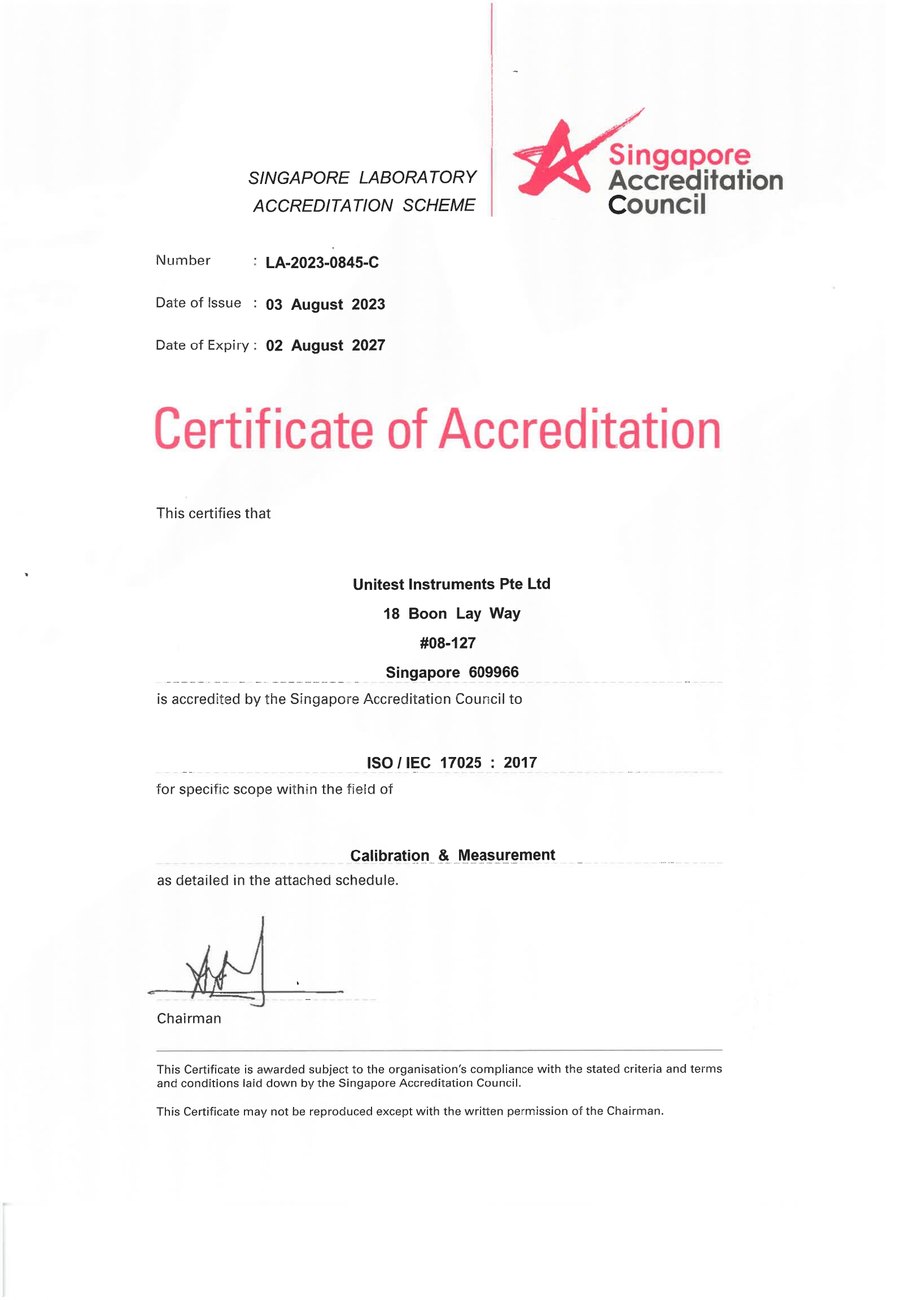
SAC-SINGLAS accredited calibration laboratory (Acc. No. LA-2023-0845-C) serving Singapore's industrial, pharmaceutical, and manufacturing sectors. All content reflects our ISO/IEC 17025 accredited scope and is reviewed by our technical calibration team.
Need food thermometer calibration in Singapore?
Unitest Instruments is SAC-SINGLAS accredited (Acc. No. LA-2023-0845-C) to ISO/IEC 17025. Same-week turnaround, certificates accepted by SFA HACCP auditors and ISO 9001 bodies.