
Key Takeaways
- Both Rotronic and Vaisala use capacitive thin-film polymer sensors. Accuracy differences in real-world use are minimal when both are regularly calibrated.
- Vaisala's HUMICAP auto-recovery feature (chemical contamination purge by brief heating) is a genuine advantage in environments with solvent or process chemical exposure.
- Rotronic's interchangeable Hygromer probe head model lets you swap sensors without replacing the transmitter body, significantly reducing calibration costs at scale.
- Neither brand is "GMP-preferred". Regulatory acceptance depends on your IQ/OQ/PQ documentation and a valid ISO/IEC 17025 calibration certificate, not the brand.
- Unitest Instruments is SAC-SINGLAS accredited to calibrate both brands; calibration certificates are traceable to Singapore's NMC and accepted by HSA and ISO 9001 auditors.
Why Humidity Measurement Matters in Pharma and Cleanrooms
Relative humidity (RH) is a critical parameter in pharmaceutical manufacturing, medical device production, semiconductor cleanrooms, and food processing environments. In a GMP-regulated drug manufacturing facility, uncontrolled humidity can affect tablet hardness, capsule integrity, active ingredient stability, and microbial growth rates. In an ISO 14644-classified cleanroom, humidity control is part of the environmental monitoring programme that demonstrates ongoing compliance.
Singapore's tropical climate (with outdoor RH consistently in the 70–90% range), makes HVAC humidity control especially demanding. Infiltration events, coil failures, and door cycling can spike RH rapidly. Your humidity probes need to respond quickly, hold calibration well between service intervals, and generate certificates that satisfy both internal quality systems and external regulatory bodies including the Health Sciences Authority (HSA).
This regional context is worth taking seriously rather than treating as background colour, because a probe specified and validated for a temperate-climate facility does not automatically perform the same way once installed in Singapore. A humidity control system in a European facility might rarely see the HVAC plant working to pull RH down from an 85% outdoor condition; here, that is the everyday baseline the system is fighting against, which means probes spend more of their operating life closer to the upper end of their measurement range, exactly where capacitive sensor non-linearity and long-term drift tend to be most pronounced. Facilities specifying humidity monitoring for Singapore operations should ask both brands' local distributors for performance data specific to sustained high-humidity operation, not just the general specification sheet written for a global market.
Rotronic (Swiss, now part of Xylem) and Vaisala (Finnish) are the two names most frequently specified in Singapore pharmaceutical and cleanroom tenders. Both are well-established, technically credible, and globally supported. This article gives you an honest comparison. Not a sales pitch for either brand.
Sensor Technology: Hygromer vs HUMICAP
At the core of any humidity probe is its sensing element. Both Rotronic and Vaisala use capacitive thin-film polymer sensors. The dominant technology in industrial metrology. The sensor absorbs or releases water vapour in proportion to ambient RH, changing its electrical capacitance, which the instrument converts to an RH reading.
Rotronic Hygromer IN-1
Rotronic's proprietary Hygromer IN-1 polymer is manufactured in-house in Switzerland and has decades of field history. Its key characteristic is long-term drift stability. The sensor is designed to maintain its calibration curve over extended intervals, which Rotronic claims reduces the frequency of recalibration needed in stable environments. The probe head is physically separable from the transmitter body, meaning you can send the head for calibration (or swap it for a pre-calibrated spare) without removing or reconfiguring the transmitter installed in your ductwork or cleanroom wall.
Vaisala HUMICAP 180R
Vaisala's HUMICAP 180R is a second-generation capacitive sensor that adds one important feature absent in the standard Rotronic offering: chemical purge auto-recovery. When the probe detects performance drift consistent with chemical contamination (common in environments with cleaning agents, solvents, or process gases), it briefly heats the sensor to 160°C to burn off contaminants and restore baseline performance. This happens automatically and is logged. In pharmaceutical manufacturing areas where IPA, hydrogen peroxide vapour (VHP), or other agents are used for decontamination, this is a meaningful real-world advantage. For a technology-level comparison of the underlying sensing methods, see capacitive hygrometer vs chilled mirror humidity sensors.
The HUMICAP sensor is also available in a warmed sensor variant (HMW) that prevents condensation in high-humidity environments. Useful for autoclave rooms, lyophilisation areas, or Singapore loading bays where probes may see near-saturation conditions.
What Actually Degrades a Capacitive Humidity Sensor Over Time
Understanding why a capacitive polymer sensor drifts helps explain why the differences between Rotronic and Vaisala's approaches matter beyond a spec sheet comparison. The polymer film at the heart of both sensor designs absorbs water vapour reversibly under normal conditions, but its absorption characteristics slowly change with prolonged exposure to certain conditions. Chronic exposure to very high humidity (above 90% RH) for extended periods can cause the polymer to swell in ways that do not fully reverse, gradually shifting the sensor's calibration curve. Exposure to airborne chemical contaminants, cleaning solvents, ammonia from certain manufacturing processes, or condensable organic vapours, can coat the sensor surface or chemically interact with the polymer, producing a drift that specifically manifests as an erroneously low RH reading, since the contamination layer partially blocks water vapour from reaching the active sensing surface.
This is the precise failure mode Vaisala's HUMICAP auto-recovery is designed to address, and it explains why the feature is not simply a nice-to-have in environments with regular chemical decontamination cycles. A contaminated sensor reading artificially low humidity in a pharmaceutical manufacturing area is a genuine risk, because operators may believe the environment is drier than it actually is and fail to intervene on a genuine humidity excursion that the sensor is under-reporting. Rotronic's approach relies instead on physically swapping the probe head before contamination becomes severe enough to matter, which requires either a proactive replacement schedule or drift monitoring sensitive enough to catch the problem before it affects process decisions.
How Humidity Probes Are Actually Calibrated
Understanding the calibration method itself helps explain what a certificate for either brand is actually verifying. Accredited humidity calibration typically uses one of two reference methods: a two-pressure or divided-flow humidity generator that produces a precisely controlled, known RH environment by mixing dry and saturated air streams in a calculated ratio, or comparison against a chilled mirror hygrometer, which determines humidity by directly measuring the dew point temperature at which condensation first forms on a precisely cooled mirror, a fundamentally different and highly accurate physical measurement principle that serves as the primary reference standard against which working capacitive probes are ultimately checked.
A typical accredited calibration exposes the probe under test to several fixed RH points, commonly around 11%, 33%, 75%, and sometimes higher points such as 85% or 93% RH, generated using either method, and records the probe's reading against the reference value at each point once conditions have stabilised, which for humidity measurements can take considerably longer than temperature or pressure calibration because humidity equilibrium is a slower physical process than thermal or pressure equilibrium. The resulting certificate states the error at each calibration point along with the associated measurement uncertainty, calculated according to the same GUM framework used across all accredited calibration disciplines. Because both Rotronic and Vaisala probes ultimately rely on the same underlying calibration reference infrastructure regardless of brand, the accreditation and competence of the calibrating laboratory, not the sensor brand, is what determines how defensible the resulting certificate is.
Head-to-Head Comparison: Key Specifications
The table below compares the two brands' flagship pharmaceutical/cleanroom probe series (Rotronic HC2 and Vaisala HMP110/HMP7), on the criteria that matter most for Singapore procurement decisions.
| Feature / Criterion | Rotronic HC2 Series | Vaisala HMP110 / HMP7 Series |
|---|---|---|
| Sensor technology | Hygromer IN-1 capacitive polymer | HUMICAP 180R capacitive polymer |
| RH accuracy (typical) | ±0.8% RH at 23°C (±1.5% RH at extremes) | ±1.0% RH at 20°C (±1.5% RH at extremes) |
| Temperature accuracy (typical) | ±0.1°C at 23°C | ±0.2°C at 20°C |
| Operating RH range | 0–100% RH (non-condensing) | 0–100% RH (non-condensing) |
| Chemical contamination recovery | Manual cleaning / sensor swap required | Auto-recovery (heating purge, HUMICAP 180R) |
| Probe head interchangeability | Yes. Field-swappable without transmitter recalibration | Partial. Module replaceable but body recalibration recommended |
| Output options | 4–20 mA, RS-485 Modbus, digital HW4 network | 4–20 mA, RS-485 Modbus, HART, digital |
| BMS/SCADA integration | Good. Widely supported, HW4 proprietary software | Excellent. Broad ecosystem, HVAC-native protocols |
| Calibration approach | Send probe head only; swap strategy minimises downtime | Send full probe; auto-recovery extends intervals in some environments |
| Typical Singapore list price (probe + transmitter) | SGD 600–1,200 (indicative) | SGD 800–1,600 (indicative) |
| Country of manufacture | Switzerland (now Xylem group) | Finland |
| Regulatory documentation | Good. IQ/OQ packs available | Excellent. Extensive pharma regulatory support library |
| Singapore distributor support | Available via local authorised distributors | Available via Vaisala Singapore and authorised distributors |
Note: Prices are indicative as of 2024 and will vary by configuration, volume, and distributor. Always request a formal quotation for procurement purposes.
Need your Rotronic or Vaisala humidity probes calibrated in Singapore?
Unitest Instruments calibrates all major humidity probe brands with SAC-SINGLAS accredited certificates traceable to Singapore's NMC. Certificates accepted by HSA, ISO 9001 auditors, and GMP inspectors.
Which Brand Wins for Each Use Case?
Rather than a single "winner," the honest answer is that each brand has specific scenarios where it delivers better value. Here is our recommendation by application type.
Large Pharmaceutical Manufacturing Facility (GMP-regulated)
Recommended: Vaisala, particularly for production areas with cleaning-in-place (CIP) cycles, VHP bio-decontamination, or regular chemical exposure. The auto-recovery feature reduces the risk of a contaminated probe generating false low-humidity readings. A patient safety issue in a fill-finish or tablet compression area. Vaisala's extensive IQ/OQ/PQ documentation library also reduces validation effort during facility qualification, which is a real cost saving when you are qualifying dozens of monitoring points.
Multi-Point Cleanroom Monitoring (ISO 14644)
Recommended: Rotronic for facilities monitoring 20+ points across semiconductor, medical device, or electronics cleanrooms. The probe-head swap strategy means you can rotate pre-calibrated heads through your monitoring network without taking your transmitter fleet out of service. This is particularly cost-effective in Singapore, where calibration turnaround time affects production scheduling. As explained in our article on how often to calibrate your instruments, minimising monitoring gaps during calibration events is a key operational consideration.
Cold Chain and Controlled Temperature Warehousing
Recommended: Either. Both brands perform well in the 2–25°C, 20–80% RH ranges typical of pharmaceutical cold chain storage. Choose based on your existing logger ecosystem and whether your third-party logistics provider has a preference for calibration certificate format.
R&D Laboratory or Stability Chamber
Recommended: Rotronic HC2-A for precision lab work, where its ±0.8% RH accuracy specification and high-resolution digital output are valuable. The HW4 software ecosystem integrates well with datalogger setups common in stability testing. That said, Vaisala's HMP7 probe with its high-accuracy option is a strong competitor here.
Calibration: What You Actually Need to Know
In Singapore's regulatory environment, the calibration certificate matters more than the brand on the probe. Whether you use Rotronic or Vaisala, your QMS requires that each monitoring instrument carries a valid calibration certificate that demonstrates traceability to a national metrology body. For Singapore, that means traceability to the National Metrology Centre (NMC) at A*STAR.
As our article on accredited vs non-accredited calibration explains, only certificates issued by SAC-SINGLAS accredited laboratories carry the regulatory weight needed for GMP and ISO 9001 audits. Manufacturer's factory calibration certificates, while useful for incoming inspection, do not satisfy this requirement on their own.
Unitest Instruments calibrates both Rotronic and Vaisala humidity probes under our SAC-SINGLAS accreditation (Acc. No. LA-2023-0845-C). Our calibration scope covers temperature and humidity measurement, and all certificates include measurement uncertainty statements in line with ISO/IEC 17025 requirements. We offer same-week turnaround for standard instruments and can accommodate urgent calibration requests for production-critical probes.
Total Cost of Ownership: The Honest Picture
Purchase price is rarely the dominant cost factor in a humidity monitoring programme that runs for 5–10 years. When you account for calibration costs, sensor replacement, downtime during calibration events, and software/integration costs, the picture becomes more nuanced.
Rotronic's probe-head swap model is genuinely cost-effective at scale. If you maintain a small pool of pre-calibrated spare heads, you can replace an in-service head in minutes and return the removed head to the laboratory for calibration. This eliminates monitoring gaps and, if you negotiate a volume calibration agreement with your accredited lab, can reduce per-instrument calibration cost significantly.
Vaisala's auto-recovery feature can extend effective calibration intervals in chemically challenging environments, but this benefit needs to be validated within your QMS rather than assumed. In clean, controlled environments, both brands drift at similar rates and the auto-recovery advantage is minimal.
Software ecosystem lock-in is worth considering. Rotronic's HW4 software is proprietary; Vaisala offers broader integration with third-party BAS/SCADA platforms. If your facility is already committed to a specific BMS infrastructure, check integration compatibility before specifying either brand.
Validation Documentation: What Your QA Team Will Actually Ask For
Beyond the calibration certificate itself, a GMP-regulated facility qualifying a new humidity monitoring instrument will typically require a defined installation qualification (IQ) and operational qualification (OQ) package, and this is an area where Vaisala's documentation ecosystem has historically had a practical edge for larger pharmaceutical deployments. Vaisala's IQ/OQ documentation, developed specifically around GMP Annex 1 and 21 CFR Part 11 expectations, tends to arrive pre-structured in a format validation engineers can adapt quickly, which measurably reduces the internal engineering effort needed to qualify each instrument, a real and recurring cost across a facility deploying dozens or hundreds of monitoring points.
Rotronic's documentation is entirely adequate and widely accepted by Singapore regulators and auditors, but facilities sometimes report needing to do more of the qualification-package assembly work themselves, adapting Rotronic's standard technical documentation into their own IQ/OQ template rather than working from a ready-made regulatory package. Neither approach is a compliance risk in itself. What matters is confirming with your quality assurance team, before procurement, which documentation format your validation process expects, since retrofitting missing qualification paperwork after installation is a genuinely avoidable cost.
Data Logging and Continuous Monitoring Considerations
For facilities running continuous environmental monitoring rather than periodic spot-checks, the way each brand's ecosystem handles data logging, alarming, and audit-trail integrity under 21 CFR Part 11 becomes a genuinely material selection factor, separate from the sensor's raw measurement accuracy. Both Rotronic's HW4 platform and Vaisala's monitoring ecosystem support continuous logging with configurable alarm thresholds and electronic audit trails, but the depth of native integration with third-party building management and SCADA systems differs, as reflected in the comparison table above. A facility already standardised on a particular BMS platform should validate actual integration compatibility (not just a vendor's stated "supports Modbus" claim) before committing to either ecosystem at scale, since integration friction discovered after a large multi-point rollout is a considerably more expensive problem to fix than one caught during a pilot installation of a handful of points.
Frequently Asked Questions
Both brands offer high-accuracy probes suitable for pharmaceutical and cleanroom use. Vaisala's HMP series typically specifies ±1.0% RH accuracy (±1.5% RH at extremes), while Rotronic's HC2 series specifies ±0.8% RH at 23°C. In practice, both perform comparably when regularly calibrated by an accredited laboratory. The sensor most recently calibrated by a SAC-SINGLAS or ISO/IEC 17025 accredited lab is the one you should trust most, regardless of brand.
Neither brand mandates a fixed interval. Calibration frequency should be risk-based, following your facility's validation protocol and applicable guidelines (GMP Annex 1, PICS, or ISO 14644). In Singapore pharmaceutical environments, annual calibration is common for monitoring instruments, with more frequent checks (quarterly or semi-annual) for critical process areas. Unitest recommends calibrating both brands on the same schedule as your other critical measurement instruments.
Yes. Unitest Instruments is SAC-SINGLAS accredited (Acc. No. LA-2023-0845-C) to ISO/IEC 17025 and calibrates humidity probes across all major brands, including Rotronic and Vaisala. Calibration certificates are traceable to Singapore's National Metrology Centre (NMC) and are accepted by GMP auditors, ISO 9001 auditors, and HSA inspectors.
Both Rotronic and Vaisala are widely accepted in GMP-regulated pharmaceutical facilities globally, including in Singapore. Vaisala has a slight edge in large multinational pharma installations due to its HVAC integration ecosystem and extensive regulatory documentation. Rotronic is preferred by many smaller to mid-size facilities for its excellent sensor-swap model and competitive total cost of ownership. The deciding factor is usually your existing BMS/SCADA infrastructure and whether your validation team has already qualified one brand.
Both are capacitive thin-film polymer humidity sensors. The dominant technology in industrial and pharmaceutical applications. Rotronic's proprietary Hygromer IN-1 polymer is optimised for stable long-term drift performance. Vaisala's HUMICAP 180R adds a built-in auto-recovery feature that burns off chemical contaminants by briefly heating the sensor to 160°C. In cleanroom and pharma environments with chemical vapour exposure from VHP or IPA decontamination, the Vaisala auto-recovery feature can extend calibration intervals, which is a genuine differentiator.
Yes. There is no HSA or MOM prohibition on either brand. Regulatory acceptance depends on your instrument qualification process (IQ/OQ/PQ), not on brand approval. What matters is that the probe carries a valid SAC-SINGLAS or equivalent ISO/IEC 17025 calibration certificate with traceability to a national metrology body, a defined calibration interval within your quality management system, and documented performance within your facility's acceptance criteria.
Start with your regulatory framework (GMP vs ISO 14644 vs both), your RH range and accuracy requirements, and your existing data acquisition or BMS system. If you need duct or vent mounting with HVAC integration, Vaisala's range is broad and well-documented. If you need frequent sensor replacements in multiple locations, Rotronic's interchangeable probe head model reduces calibration costs. Unitest can assist with selection advice based on your application; contact us for a free consultation.
Calibration cost depends on the number of calibration points, the RH range covered, and whether combined temperature and humidity calibration is required. For a standard 3-point humidity calibration (typically 20%, 50%, 80% RH) with a SAC-SINGLAS accredited certificate traceable to NMC Singapore, you should budget in the range of SGD 80–200 per probe depending on turnaround requirements. Contact Unitest Instruments for an accurate quote based on your instrument model and volume.
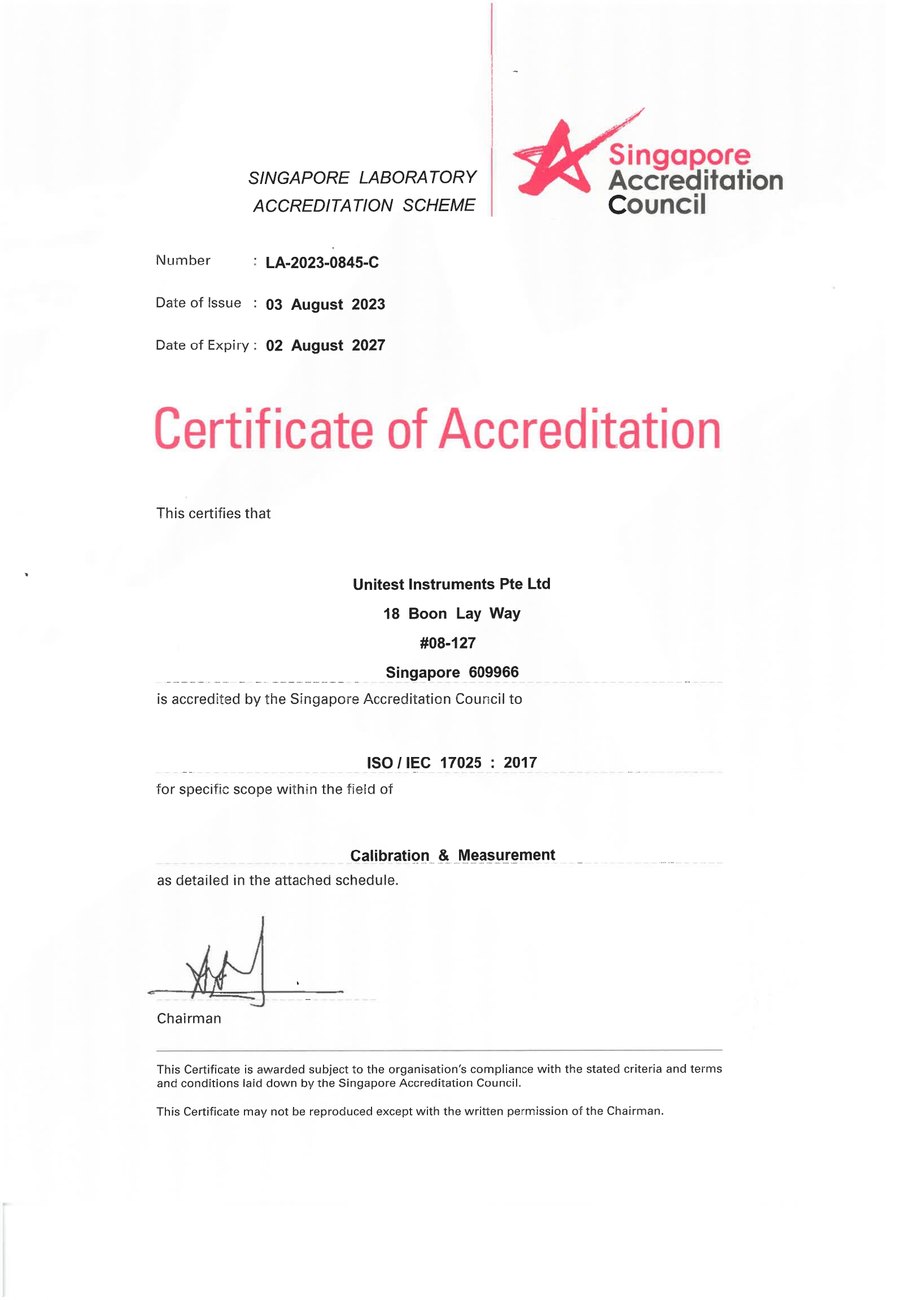
SAC-SINGLAS accredited calibration laboratory (Acc. No. LA-2023-0845-C) serving Singapore's industrial, pharmaceutical, and manufacturing sectors. All content reflects our ISO/IEC 17025 accredited scope and is reviewed by our technical calibration team.
Need humidity probe calibration in Singapore?
Unitest Instruments is SAC-SINGLAS accredited (Acc. No. LA-2023-0845-C) to ISO/IEC 17025. Same-week turnaround, certificates accepted by ISO 9001 auditors and HSA.