
Key Takeaways
- Fluke wins for industrial, electrical panel, HVAC, and process applications. Higher D:S ratio, adjustable emissivity, wider temperature range.
- Comark wins for food safety, HACCP records, cold-store checks, and kitchen environments, purpose-built ergonomics and fixed 0.95 emissivity for food surfaces.
- Neither brand is inherently more accurate; accuracy is a function of correct emissivity setting, D:S ratio discipline, and regular calibration.
- Both Comark and Fluke infrared thermometers require SAC-SINGLAS accredited calibration annually (or per your QMS interval) for Singapore compliance.
- Unitest Instruments sells and calibrates both brands under ISO/IEC 17025 (Acc. No. LA-2023-0845-C), with certificates traceable to NMC Singapore.
Why This Comparison Matters for Singapore Procurement
Singapore's industrial and food-safety sectors operate under rigorous measurement standards. The Singapore Food Agency (SFA) requires traceable temperature records for food businesses, while ISO 9001 and ISO 22000 quality management systems demand that temperature instruments are calibrated at defined intervals. When procurement managers or quality officers in Singapore are choosing between Comark and Fluke infrared thermometers, the decision is not merely about price. It determines which regulatory frameworks your records will satisfy and how easily your calibration provider can service the instrument.
Fluke Electronics, an American brand now under Fortive Corporation, has built its reputation in the industrial test-and-measurement market. Its infrared thermometers are standard equipment in electrical maintenance departments, HVAC servicing teams, and process engineering environments. Comark Instruments, a UK-origin brand, carved its niche in food temperature measurement, designing instruments explicitly for HACCP compliance, cold-chain auditing, and commercial catering environments.
Understanding these different design philosophies is the starting point for a sound procurement decision. This guide compares both brands across the dimensions that matter in Singapore's commercial and industrial context: accuracy, D:S ratio, emissivity control, build quality, temperature range, price, and post-purchase calibration serviceability.
Brand Profiles: Who Makes These Instruments and For Whom?
Fluke. The Industrial Standard
Fluke infrared thermometers are engineered for professional maintenance and industrial applications. The product line spans from affordable entry-level models like the Fluke 59 Max+ (range -30°C to 500°C, 8:1 D:S) through to high-performance instruments like the Fluke 572-2 (range -30°C to 1000°C, 60:1 D:S) used in furnace monitoring, molten metal processes, and precision electrical inspections. Key characteristics of Fluke IR thermometers include adjustable emissivity (typically 0.10 to 1.00), laser sighting (single or dual), and rugged housings rated IP54 or higher on many models. Fluke instruments are generally designed to be used one-handed at distance, which matters when inspecting live electrical panels or scanning large industrial surfaces.
Comark. The Food Safety Specialist
Comark infrared thermometers are built around the food industry's specific measurement needs. Models such as the Comark IRT200 and the Comark KM28 are designed with HACCP in mind. Bright colour-coded housings for easy station identification, fixed emissivity of 0.95 (appropriate for most food surfaces), simple one-button operation, and IP ratings suited to kitchen splash environments. Comark's temperature range for most IR models tops out at 250°C to 350°C, which is more than adequate for cooking, refrigeration, and incoming goods inspection but insufficient for industrial process work. The design philosophy prioritises ease of daily use by food-handling staff rather than the fine-grained configurability needed by engineers.
Understanding D:S Ratio: The Spec That Actually Determines Real-World Accuracy
The distance-to-spot (D:S) ratio is the specification procurement teams overlook most often, and it is arguably more consequential day-to-day than the headline accuracy figure printed on the box. It describes how large the measured area (the "spot") becomes as the instrument is held further from the target. A D:S ratio of 12:1, as on the Fluke 62 Max+, means that at 12 units of distance, the instrument is averaging the temperature over a spot 1 unit in diameter. At 1.2 metres from the target, the spot is 10 cm across; at 3.6 metres, the spot has grown to 30 cm.
This matters enormously in practice. If the target of interest, a small electrical terminal, a single food probe point, a localised hot spot on a bearing, is smaller than the instrument's spot size at the distance it is being used, the reading is not measuring that target at all. It is averaging the target together with whatever surrounds it, which can produce a reading that looks plausible but is quietly wrong. A Comark IRT200 with a 6:1 ratio needs to be held roughly twice as close as a 12:1 Fluke to achieve the same spot size, which is a real, physical constraint on how it can be used, not a minor inconvenience. For food safety spot-checks on a plated meal or a probe point in a stockpot, this closer working distance is rarely a problem. For scanning an electrical panel from a safe distance, or checking a hot surface that cannot be approached closely, it very much is, and this is the underlying reason Fluke's higher D:S ratio models command a premium in industrial applications rather than it being simply a marketing number.
Why Emissivity Errors Produce Wildly Wrong Readings
Emissivity describes how efficiently a surface radiates infrared energy relative to a theoretical perfect radiator (a "blackbody," with emissivity of exactly 1.00). An infrared thermometer does not measure temperature directly; it measures infrared radiation and calculates a temperature from it using the emissivity setting as part of that calculation. When the emissivity setting matches the actual surface, the calculated temperature is accurate. When it does not, the error can be severe, not a small percentage but potentially hundreds of degrees on reflective surfaces.
Polished or oxidised metals are the classic failure case. Bare polished aluminium has an emissivity as low as 0.05, meaning it reflects the vast majority of the infrared energy an instrument detects rather than emitting its own. Pointing an infrared thermometer set to 0.95 (a typical food-surface default) at polished aluminium can produce a reading dramatically lower than the metal's true temperature, because the instrument is largely detecting reflected ambient infrared radiation rather than the metal's own emission. This is precisely why Fluke's adjustable emissivity is not a luxury feature for industrial users: without the ability to correct for a target's actual emissivity, an infrared thermometer used on metallic or reflective surfaces is close to useless for anything beyond relative comparison. Comark's fixed 0.95 setting is not a design shortcoming; it is a deliberate simplification that works because food surfaces (skin, most cooked and raw food products, plastics, and painted surfaces) genuinely do sit in the 0.90 to 0.98 emissivity range where the fixed setting introduces negligible error.
Head-to-Head Feature Comparison
The table below compares representative models from each brand. The Fluke 62 Max+ (a popular mid-range industrial model) and the Comark IRT200 (a widely used food-safety IR thermometer), across the key specification dimensions.
| Feature | Fluke 62 Max+ | Comark IRT200 | Winner |
|---|---|---|---|
| Temperature Range | -30°C to 500°C | -35°C to 365°C | Fluke (higher ceiling) |
| Accuracy | ±1.5°C or ±1.5% (whichever greater) | ±2°C or ±2% (whichever greater) | Fluke (tighter spec) |
| D:S Ratio | 12:1 | 6:1 | Fluke (measures smaller/more distant targets) |
| Emissivity | Adjustable 0.10–1.00 | Fixed 0.95 | Fluke for industrial; Comark fine for food |
| IP Rating | IP54 | IP42 | Fluke (more robust sealing) |
| Drop Rating | 3 m drop proof | 1 m drop proof | Fluke |
| Response Time | 500 ms | 500 ms | Equal |
| Data Logging | No (basic model) | No (basic model) | Equal |
| HACCP Colour Coding | Not available | Available on selected models | Comark (food-safety workflow) |
| Typical Singapore Price | S$150–S$220 | S$100–S$160 | Comark (lower entry cost) |
| Calibration Serviceability | Both calibrated by Unitest (SAC-SINGLAS) | Both calibrated by Unitest (SAC-SINGLAS) | Equal |
Need calibration for your Comark or Fluke infrared thermometer?
Unitest Instruments calibrates both brands under ISO/IEC 17025 (Acc. No. LA-2023-0845-C). Certificates accepted by SFA, ISO 9001, and HACCP auditors. Same-week turnaround available.
Where Each Brand Wins: Use-Case Recommendations
Choose Fluke When...
Fluke is the right infrared thermometer when your applications span electrical panel inspection, motor and bearing diagnostics, HVAC system surveys, boiler and pipe surface monitoring, or any environment where you need to measure metallic surfaces, small targets, or objects at distance. The adjustable emissivity is non-negotiable for accurate readings on shiny metals. Without it, a reading on polished aluminium can be 200°C off the true surface temperature. Fluke's rugged housing and higher drop rating also matter in industrial environments where tools are regularly knocked off surfaces or used in wet conditions.
Facilities managers, building services engineers, and electrical maintenance contractors in Singapore typically standardise on Fluke for exactly these reasons. The brand's calibration ecosystem is mature, and Unitest Instruments holds the instruments in our SAC-SINGLAS accredited scope for straightforward, compliant calibration support.
Choose Comark When...
Comark makes more sense for food businesses: restaurant chains, central kitchens, food manufacturers, cold-store operators, and any operation running a HACCP plan or preparing for SFA audit. The fixed 0.95 emissivity is not a limitation here. It is appropriate for the majority of food surfaces, and removing the need for staff to adjust settings reduces human error in daily monitoring. The HACCP colour-coding system available on Comark models means red thermometers stay in the raw meat station and blue thermometers stay in the seafood section, matching the physical cross-contamination controls your HACCP plan requires.
Comark's lower price point also makes it economical to equip multiple stations in a large kitchen or across multiple cold rooms, which is a real procurement advantage for food-service operators. The trade-off (lower D:S ratio and no emissivity adjustment), simply does not matter in these applications.
The Calibration Imperative: Why Brand Choice Does Not End the Story
Neither Comark nor Fluke infrared thermometers are self-certifying. Both drift over time due to detector ageing, mechanical shock, and environmental exposure. For Singapore businesses operating under ISO 9001, ISO 22000, or HACCP requirements, the instrument's calibration certificate is what regulators and auditors are examining, not the brand badge.
As we explain in our guide on what a calibration certificate contains and what it proves, a valid calibration certificate documents the instrument's actual error at the time of calibration, the measurement uncertainty, the reference standard used, and the traceability chain back to national standards. Without this document, even a brand-new Fluke or Comark provides no defensible compliance record. A calibration certificate from an accredited laboratory (such as Unitest Instruments' SAC-SINGLAS certificate (Acc. No. LA-2023-0845-C)), is the only form of calibration evidence accepted by SFA food safety auditors and ISO certification bodies in Singapore.
It is also worth understanding the distinction between accredited and non-accredited calibration. Our article on accredited vs non-accredited calibration covers this in detail, but the short version is: non-accredited calibration may use unverified reference standards and does not carry the legal and technical defensibility that SAC-SINGLAS accreditation provides. For any instrument used in a regulatory context, accredited calibration is not optional.
How Accredited Calibration of an Infrared Thermometer Actually Works
Calibrating an infrared thermometer is technically different from calibrating a contact thermometer, and understanding the difference is useful when comparing quotations or evaluating whether a provider's calibration procedure is rigorous. The standard reference used is a blackbody source, a calibrated cavity or flat-plate device engineered to have a known, stable emissivity (typically 0.95 to 1.00) and a precisely controlled, traceable surface temperature. The infrared thermometer under test is positioned at a defined distance from the blackbody source, matching or accounting for its D:S ratio, and its reading is compared against the blackbody's own reference temperature, itself traceable to Singapore's National Metrology Centre through the reference thermometer embedded in or monitoring the blackbody source.
This comparison is typically performed at multiple temperature points spanning the instrument's specified operating range and, for instruments used across variable distances, sometimes at more than one distance to verify the D:S ratio behaviour holds as specified. The laboratory environment itself is controlled, since ambient temperature and reflected radiation from surrounding surfaces can influence the blackbody's effective temperature at the target and introduce error into the very comparison being made. A calibration performed casually, without a genuine blackbody reference and environmental control, cannot produce a defensible uncertainty figure, which is one more reason the accreditation status of the provider (not just the brand of instrument being calibrated) determines whether the resulting certificate holds up under audit.
Ambient Temperature and Instrument Self-Heating: A Practical Field Consideration
An infrared thermometer's own internal temperature affects its reading accuracy, a fact rarely mentioned outside the manufacturer's fine print. Most infrared thermometers specify an operating temperature range (commonly 0°C to 50°C ambient) within which their stated accuracy applies, and moving an instrument rapidly between environments, for example carrying a thermometer from an air-conditioned office directly into a hot kitchen or an outdoor loading bay in Singapore's climate, can cause a temporary reading error until the instrument's internal sensor thermally stabilises to the new ambient condition. Manufacturers typically recommend allowing several minutes of acclimatisation before relying on readings after such a transition.
This is a genuinely practical issue for Singapore operations moving between climate-controlled and non-climate-controlled zones multiple times per shift, which describes a large share of both food-service and industrial maintenance work in this market. Building a short acclimatisation pause into a standard operating procedure, rather than trusting the first reading taken immediately after a large ambient temperature change, is a low-cost practice that measurably improves the reliability of field readings, independent of which brand of instrument is in use.
Recommended Calibration Intervals
For food-safety applications using Comark thermometers, a 12-month calibration interval is standard, with additional verification checks recommended after any physical shock or if a reading seems inconsistent with adjacent probe measurements. For Fluke instruments in industrial use, 12 months is likewise typical, though instruments used daily in high-vibration or high-temperature environments may benefit from 6-monthly checks. Your quality management system should document the calibration interval and the rationale. Both the interval and the justification are subject to auditor review.
Singapore Procurement Context: What Buyers Need to Know
When procuring infrared thermometers for a Singapore business, several practical factors bear on the Comark vs Fluke decision beyond raw specifications. First, consider your calibration provider's scope: your SAC-SINGLAS accredited calibration laboratory must hold the relevant measurement parameter (temperature) and range in their accredited scope. Unitest Instruments calibrates both Comark and Fluke IR thermometers and can issue certificates accepted by all major Singapore auditing bodies.
Second, consider the total cost of ownership rather than just the purchase price. A Comark IRT200 at S$130 plus annual calibration at S$80–120 has a three-year total cost of approximately S$370–490. A Fluke 62 Max+ at S$190 with the same calibration cost runs to approximately S$430–550 over three years. The difference is modest, and if the Fluke's higher accuracy specification prevents a single non-conformance in a quality audit, the cost difference is easily recovered.
Third, spare parts and replacement availability matter for long-term procurement planning. Both Fluke and Comark have established distribution in Singapore. Unitest Instruments supplies both brands and can advise on availability and lead times for specific models.
Frequently Asked Questions
Both brands offer ±1°C to ±2°C accuracy in their standard ranges, but Fluke's industrial models achieve tighter specifications, for example the Fluke 572-2 is rated ±1°C or ±1% of reading. Comark food-safety models like the IRT200 are rated ±2°C or ±2%, which is adequate for HACCP applications in the 0–100°C food temperature band. Neither brand is universally more accurate; accuracy in practice depends on correct emissivity setting, D:S ratio discipline, and regular SAC-SINGLAS accredited calibration. An instrument that has drifted and is uncalibrated is unreliable regardless of the brand name on the housing.
Comark targets food-service and light commercial use with HACCP-compliant designs, colour-coded housings, and fixed emissivity suited to food surfaces. Fluke targets industrial, electrical, and HVAC applications, offering higher temperature ceilings (up to 1000°C+), adjustable emissivity, higher D:S ratios, and rugged IP ratings. If your measurement task is food safety or cold storage, Comark is the more purpose-built choice. For electrical panels, motors, or process equipment, Fluke is the stronger option. Many Singapore businesses maintain both: Fluke for engineering, Comark for food-safety compliance.
Yes, if your infrared thermometer readings feed into quality, compliance, or HACCP records. Singapore's SFA and ISO 9001/ISO 22000 auditors expect temperature instruments to be calibrated at defined intervals. Typically 12 months for non-contact thermometers in commercial use. Unitest Instruments provides SAC-SINGLAS accredited calibration (Acc. No. LA-2023-0845-C) for both Comark and Fluke infrared thermometers, with certificates traceable to Singapore's National Metrology Centre and accepted by all major auditing bodies in Singapore.
The D:S ratio describes how large the measurement spot is relative to the distance from the thermometer. A 12:1 D:S ratio means that at 1.2 metres distance, the instrument averages temperature over a 10 cm diameter spot. A higher ratio lets you measure small or distant targets accurately without the surrounding area contaminating the reading. Fluke industrial models typically offer 12:1 to 60:1 ratios; most Comark food-safety models operate at 6:1 to 12:1. For food surface checks from close range (within 30–50 cm), 6:1 is adequate. For electrical panel inspection or equipment scanning from a safe working distance, a 12:1 or higher ratio is essential for reliable readings.
Comark IR thermometers are designed primarily for food-service and light-commercial environments. While some models reach 350°C, they lack the adjustable emissivity, high D:S ratios, and wide temperature ranges needed for industrial applications. On shiny metallic surfaces (motors, bus bars, pipe flanges), a fixed-emissivity instrument will produce large systematic errors. For industrial maintenance work, a Fluke or comparable adjustable-emissivity instrument is the technically correct choice. Comark remains the practical and economical tool for cold-store, incoming goods inspection, and cooking line temperature audits.
Yes. Unitest Instruments supplies and provides SAC-SINGLAS accredited calibration services for both Comark and Fluke infrared thermometers. Our calibration certificates are issued under ISO/IEC 17025 (Acc. No. LA-2023-0845-C) and are traceable to Singapore's National Metrology Centre, making them accepted by ISO 9001, ISO 22000, and HACCP auditors. Contact our team via the link below for pricing on supply, calibration, or both.
The standard recommendation is every 12 months for general commercial use, or more frequently if the instrument experiences drops, extreme temperatures, or heavy daily use. High-risk applications such as pharmaceutical cold-chain or food production may require 6-monthly calibration or in-process verification checks. Calibration intervals should be documented in your quality management system alongside the rationale for the chosen interval. Both are subject to auditor review under ISO 9001 and ISO 22000. See our guide on calibration intervals for a structured approach to setting and documenting intervals.
Emissivity ranges from 0 to 1 and describes how effectively a surface radiates thermal energy. Most food products, skin, painted surfaces, and non-metallic materials have emissivity of 0.90–0.98, making a fixed setting of 0.95 (as used in Comark food models) appropriate. Shiny metals, polished aluminium, and bare steel have much lower emissivity (0.05–0.35). Without adjusting the emissivity setting on a Fluke or similar industrial instrument, readings on these surfaces can be dramatically incorrect, showing temperatures 100°C or more below the true value. Always verify emissivity against material reference tables before recording readings on any non-standard surface, and note the setting used in your measurement records.
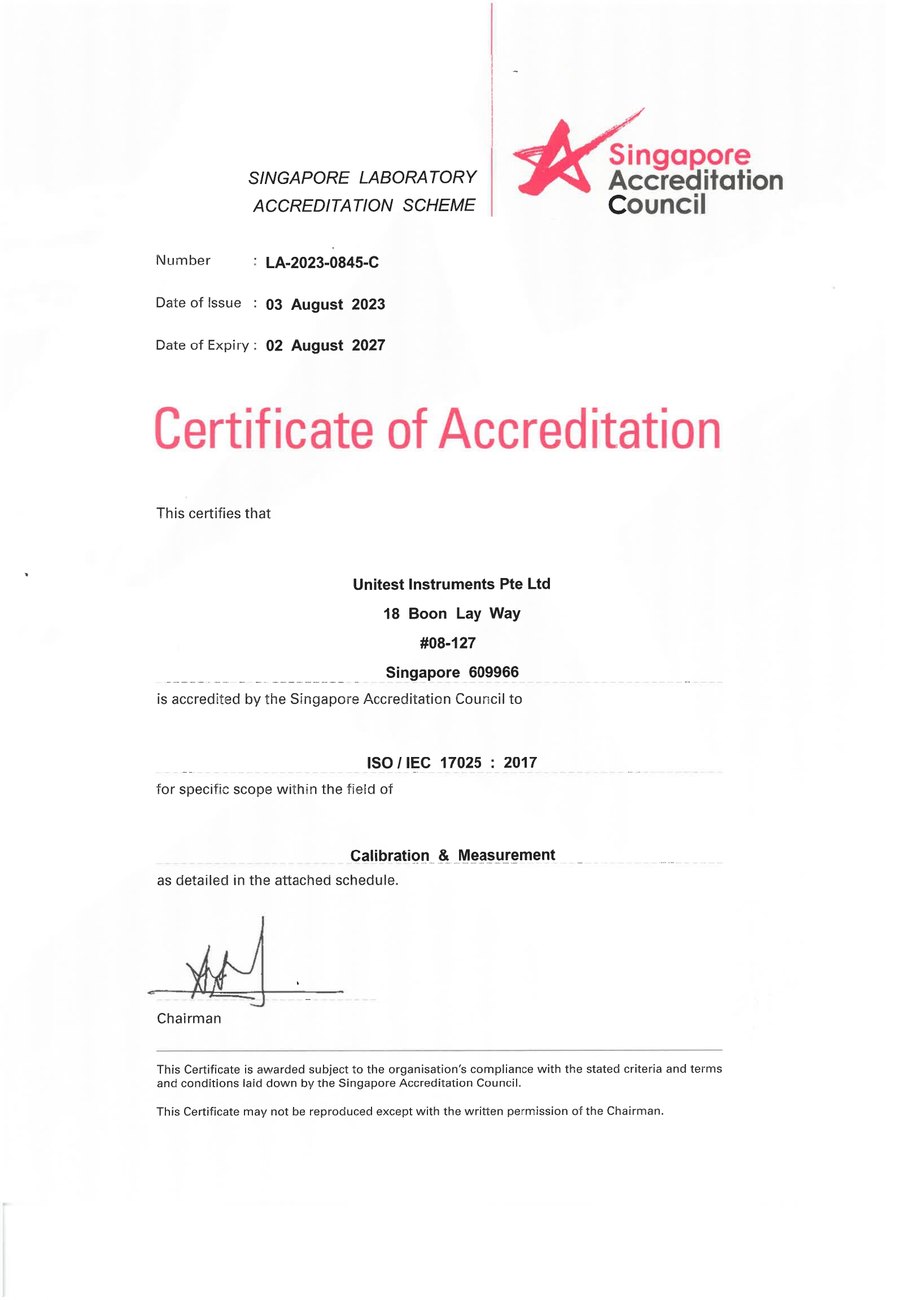
SAC-SINGLAS accredited calibration laboratory (Acc. No. LA-2023-0845-C) serving Singapore's industrial, pharmaceutical, and manufacturing sectors. All content reflects our ISO/IEC 17025 accredited scope and is reviewed by our technical calibration team.
Need infrared thermometer calibration in Singapore?
Unitest Instruments is SAC-SINGLAS accredited (Acc. No. LA-2023-0845-C) to ISO/IEC 17025. Same-week turnaround, certificates accepted by ISO 9001 and HACCP auditors.