
Key Takeaways
- A process calibrator can both source and measure process signals; a multimeter can only measure. It cannot source a 4–20 mA signal or simulate a thermocouple output.
- Using a multimeter for transmitter calibration will fail an ISO 9001 or GMP audit because it is not fit-for-purpose for that task.
- Process calibrators typically achieve 0.01–0.025% accuracy; most quality multimeters reach 0.025–0.1%. The difference matters for the 4:1 test uncertainty ratio required by best practice.
- Both instruments must be on your calibration schedule and hold their own SAC-SINGLAS traceable calibration certificates.
- Unitest sells and calibrates both. Fluke, Beamex, Yokogawa, and WIKA instruments are within our accredited scope.
Why This Comparison Matters
Walk into any instrumentation store or distributor in Singapore and you will find both process calibrators and digital multimeters on the same shelf, often from the same brand. Fluke, the market leader in both categories, makes the 87V multimeter and the 754 Documenting Process Calibrator. Two products that look superficially similar but serve fundamentally different purposes. Buying the wrong one, or assuming one can substitute for the other, is a procurement mistake that shows up during calibration audits or, worse, during an instrument failure on a production line.
The distinction matters especially in Singapore, where manufacturing, pharmaceutical, water treatment, and petrochemical plants are subject to ISO 9001, GMP (Good Manufacturing Practice), and in some cases MAS-regulated or HSA-regulated processes that require documented, traceable calibration records. Getting the tooling right is not a technical nicety, it is a compliance requirement.
What a Digital Multimeter Actually Does
A digital multimeter (DMM) is a general-purpose electrical measurement instrument. It measures voltage (AC and DC), current, resistance, continuity, capacitance, and in some models, frequency and temperature via a probe. Quality professional-grade DMMs like the Fluke 87V or Hioki DT4282 achieve measurement accuracies in the range of 0.025–0.1% of reading for DC voltage, highly capable for electrical work.
What a DMM does not do: it cannot output or source a 4–20 mA loop current, generate a thermocouple millivolt signal, simulate an RTD resistance value at a given temperature, or drive a pressure reference. It is a passive measurement device in the context of process signals. This is the hard boundary that makes it unsuitable for calibrating transmitters.
Where multimeters genuinely excel is in panel wiring verification, motor and drive electrical checks, fault-finding on junction boxes, continuity checks during installation, and any task where you need to quickly measure a voltage or current at a terminal. Their ruggedness, CAT III/IV safety ratings, and relatively low cost make them the right tool for high-voltage industrial environments where a precision calibrator would be at risk of damage.
What a Process Calibrator Actually Does
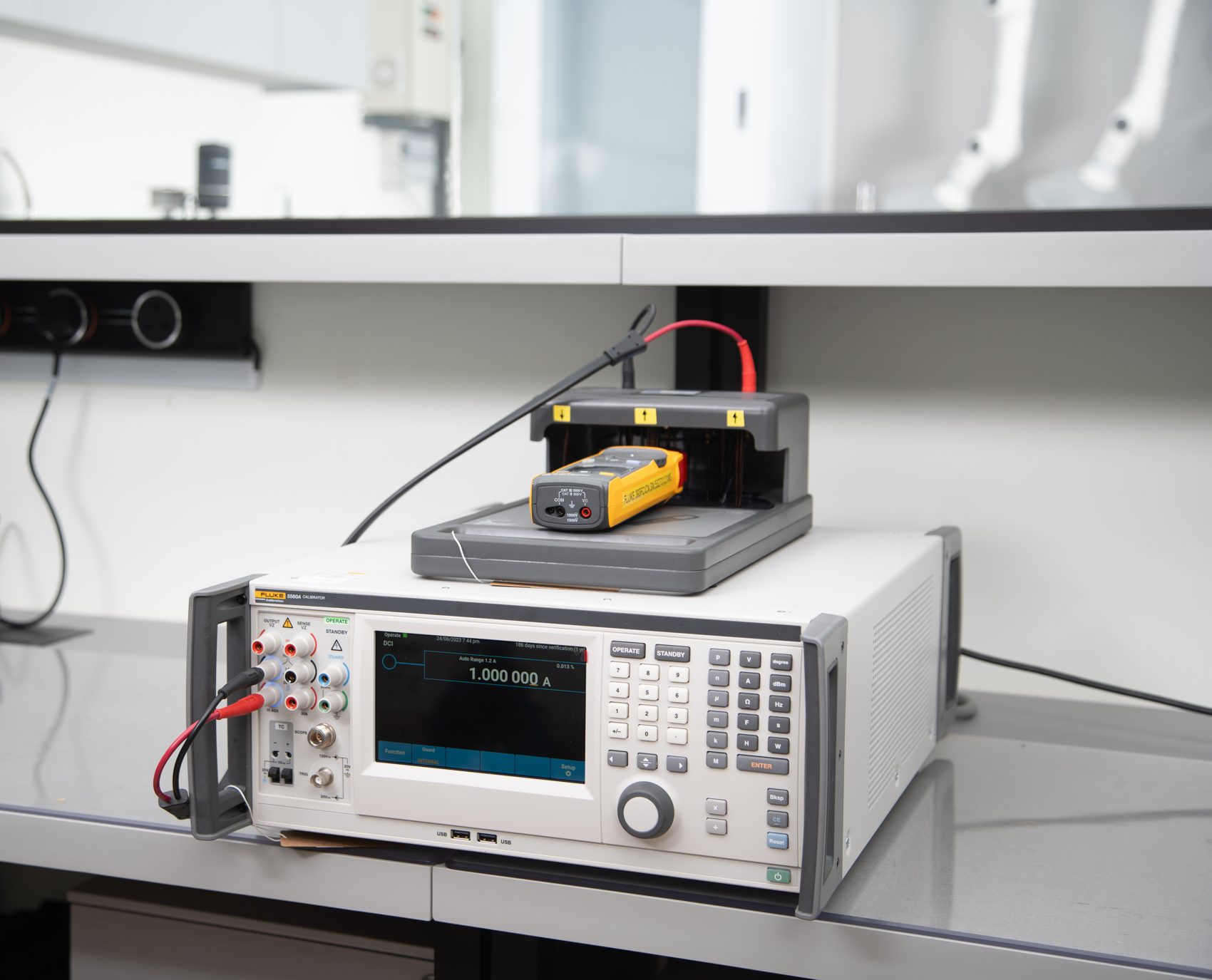
A process calibrator is a bidirectional instrument: it can both source (simulate) and measure process signals. This sourcing capability is the defining feature that separates it from a multimeter. A process calibrator can inject a known 4–20 mA signal into a loop to check how a controller reads it, or sink loop current and display the mA value as the transmitter generates it. All with accuracies in the 0.01–0.025% range.
High-end process calibrators like the Beamex MC6 and the Fluke 754 Documenting Process Calibrator go further: they store calibration data on-board, generate calibration certificates directly, and communicate with HART and Profibus devices for automated calibration of smart transmitters. This documentation capability is what makes them the instrument of choice in GMP and ISO 9001 environments where audit trails are mandatory.
The trade-off is cost and sensitivity. A quality process calibrator costs between S$3,000 and S$18,000 depending on capability. They are also more sensitive to physical shock and electrical overvoltage than a rugged field multimeter. Teams that use process calibrators in harsh conditions often discover this the hard way.
Head-to-Head Comparison: Feature by Feature
The table below compares the two instrument categories across the features that matter most in Singapore's industrial procurement context. Note that specific models vary. These are representative characteristics of professional-grade instruments in each category.
| Feature | Process Calibrator (e.g. Fluke 754, Beamex MC6) |
Digital Multimeter (e.g. Fluke 87V, Hioki DT4282) |
|---|---|---|
| Primary purpose | Source and measure process signals for instrument calibration | Measure general electrical parameters for troubleshooting |
| 4–20 mA source (output) | Yes. Can generate a known mA signal to drive a loop | No. Passive measurement only |
| 4–20 mA measure (input) | Yes, with high accuracy (typically ±0.01–0.02% of reading) | Yes, but lower accuracy (typically ±0.1–0.2% of reading) |
| Thermocouple simulation | Yes. Sources millivolt signals matching TC types J, K, T, E, N, R, S, B | No |
| RTD simulation | Yes. Simulates Pt100, Pt1000, Ni120 resistance values | No |
| Pressure measurement | Yes (with external module on models like Beamex MC6) | No |
| DC voltage accuracy | ±0.01–0.025% of reading (reference class) | ±0.025–0.1% of reading (professional grade) |
| HART / smart device communication | Yes (on documenting models. Fluke 754, Beamex MC6) | No |
| On-board calibration records | Yes. Stores as-found / as-left data, generates certificate | No |
| CAT safety rating | Typically CAT II (not suitable for high-voltage panel work) | CAT III / CAT IV (safe for distribution panels, motors) |
| Typical price range (SGD) | S$3,000 – S$18,000 | S$80 – S$1,500 |
| Suitable for transmitter calibration | Yes. Fit for purpose | No. Not fit for purpose |
| Suitable for wiring / electrical checks | Limited. Not rated for high-voltage environments | Yes. Ideal |
| Calibration required | Yes. Must hold SAC-SINGLAS traceable certificate | Yes. Must hold SAC-SINGLAS traceable certificate |
Need your process calibrators or multimeters calibrated in Singapore?
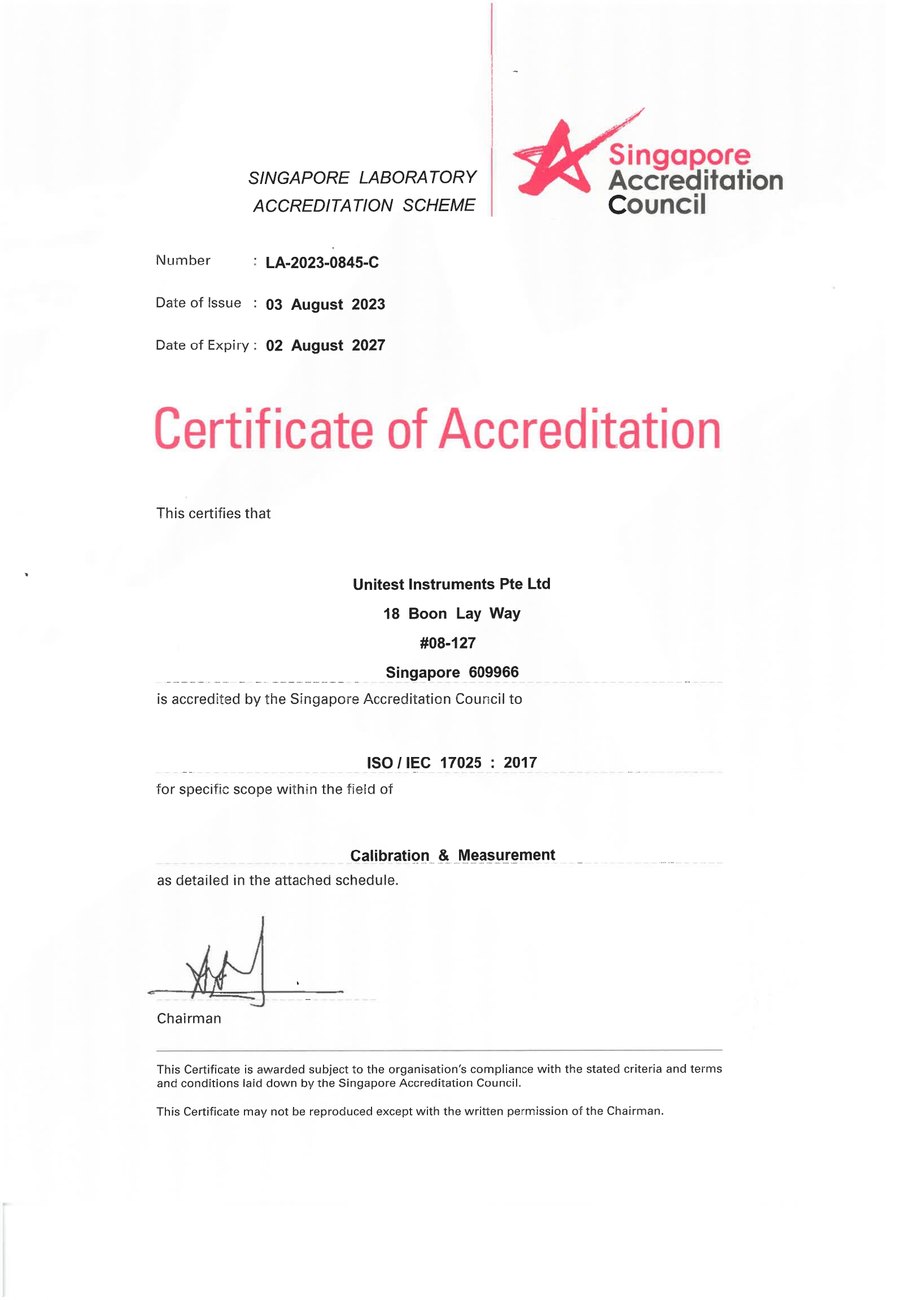
Unitest Instruments holds SAC-SINGLAS accreditation (Acc. No. LA-2023-0845-C). We calibrate Fluke, Beamex, Yokogawa, and WIKA instruments. Certificates accepted by ISO 9001 and GMP auditors. Same-week turnaround available.
Brand Comparison: Fluke vs Beamex for Process Calibration
In Singapore's process industries, two brands dominate the process calibrator market: Fluke and Beamex. Both are excellent; neither is universally the right choice. Here is an honest assessment for procurement teams.
Fluke 754 Documenting Process Calibrator
The Fluke 754 is the most widely used process calibrator in Singapore's manufacturing and utilities sectors. Its strengths are durability, brand familiarity, and the breadth of its calibration software ecosystem (Fluke DPCTrack2). It handles 4–20 mA sourcing and measuring, thermocouple and RTD simulation, frequency, and HART communication in a single unit. Battery life is excellent for field work. The 754 is a strong choice for teams that want a field-ready, rugged instrument with a broad supplier network in Singapore.
The trade-off: the Fluke 754 is not a pressure calibrator on its own. Pressure calibration requires a separate Fluke 700 pressure module and pump. If your work involves pressure transmitters heavily, this modular approach adds cost and complexity compared to integrated solutions.
Beamex MC6 Advanced Field Calibrator
The Beamex MC6 is the preferred instrument in pharmaceutical GMP environments and for sites that run Beamex's CMX calibration management software. Its key advantage is seamless two-way integration with CMX: calibration procedures download from the database, results upload automatically, and certificates are generated without manual data entry. Reducing transcription errors to near zero. For GMP sites where audit trails are tightly scrutinised, this workflow is a significant advantage.
The MC6 also integrates pressure modules internally more elegantly than the Fluke ecosystem. However, it is more expensive than the Fluke 754 at equivalent capability, and its software ecosystem requires a CMX licence investment. For smaller operations or sites without a formal calibration management system, the MC6's workflow advantages are largely unused.
Which Brand Wins Per Use Case?
| Use Case | Recommended Instrument | Reason |
|---|---|---|
| General process plant. Singapore manufacturing | Fluke 754 | Rugged, widely serviced, strong local support network |
| GMP pharmaceutical or medical device | Beamex MC6 + CMX | Integrated audit trail, paperless workflow, HSA/FDA-aligned |
| Heavy pressure transmitter work | Beamex MC6 (integrated module) | Pressure module integrates more cleanly than Fluke modular approach |
| Wiring, panel, motor electrical checks | Fluke 87V (multimeter) | CAT III/IV rated, rugged, purpose-built for electrical environments |
| Budget-conscious operation, light loop checks | Fluke 725 (entry process calibrator) | Lower cost, covers core 4–20 mA and TC tasks without HART |
Unitest Instruments sells instruments from both Fluke and Beamex and can calibrate both within our accredited scope. We recommend speaking to our technical team before purchasing. The right instrument depends on your specific process signals, calibration volume, and software environment.
Calibration Intervals and Compliance in Singapore
Owning the right instrument is only half the answer. Both your process calibrator and your multimeters must be calibrated at defined intervals and hold current traceable certificates to satisfy ISO 9001, GMP, or any other quality management system audit. This is a requirement under ISO 9001:2015 Clause 7.1.5 and is reinforced by the calibration requirements documented in our guide to ISO/IEC 17025 calibration requirements.
Industry practice in Singapore is to calibrate process calibrators annually for instruments in regular active use. Multimeters in high-use environments are often calibrated on the same 12-month cycle. If your instruments are used infrequently or stored in stable conditions, some organisations extend intervals to 24 months, but this must be supported by documented evidence of stability (e.g. as-found data showing the instrument remains within tolerance at each calibration). Simply choosing a longer interval without evidence is an audit risk.
The calibration certificate you receive must trace back to national standards. In Singapore, this means traceability to the National Metrology Centre (NMC). Unitest Instruments' SAC-SINGLAS accreditation (Acc. No. LA-2023-0845-C) provides exactly this chain of traceability. For more on what a calibration certificate should contain, see our plain-English guide to calibration certificates.
What to Tell Your Procurement Team
Procurement managers in Singapore often face pressure to consolidate tool purchases and reduce spend. The question of "can we just buy multimeters and skip the process calibrators?" comes up more often than instrument technicians would like. The honest answer is: no, and here is the business case to make that case clearly.
A process calibrator is the minimum instrument required to verify that a 4–20 mA transmitter is reading correctly across its full range. Without one, you cannot produce a valid calibration record for that transmitter. Without a calibration record, your transmitter is an uncalibrated device in the eyes of an ISO 9001 auditor, which places your entire measurement system in doubt. The downstream risk (failed audit, product recall, regulatory action) vastly exceeds the S$3,000–5,000 cost of an entry-level process calibrator.
Multimeters, on the other hand, are not a compliance risk if selected correctly. Any CAT III-rated professional multimeter from a recognised brand (Fluke, Hioki, Metrel), calibrated annually with a traceable certificate, will satisfy auditors for general electrical measurement tasks. Spending S$1,200 on a Fluke 87V when a S$350 Fluke 117 would serve the purpose is over-spec; spending S$80 on an uncalibrated no-name multimeter when a quality record is attached to the measurement is an audit problem.
The procurement summary: budget for at least one process calibrator per instrument technician team doing loop and transmitter work, plus one professional multimeter per technician for general electrical tasks. Both must be included in your calibration asset register. Unitest can help you identify the right specification for your process signals and calibration volume. Contact our technical team for a no-obligation consultation.
Sequencing a Loop Verification Round: Where Each Instrument Fits
A well-run instrument technician team in a Singapore plant does not choose between a process calibrator and a multimeter, they use both in a deliberate sequence during a single loop verification round, and understanding that sequence clarifies why both tools remain in the kit rather than one substituting for the other. The round typically starts with the multimeter: before touching the transmitter or its loop, the technician verifies supply voltage at the transmitter terminals, checks continuity of the field wiring back to the marshalling cabinet, and confirms there is no unexpected voltage present that could damage the more sensitive process calibrator when it is connected. This wiring and safety check is exactly the CAT III/IV-rated, rugged use case the multimeter is built for, and skipping it to save time is how a process calibrator ends up connected to a live, unexpectedly high-voltage circuit.
Only once the wiring is confirmed safe does the process calibrator come out, sourcing a known mA signal into the transmitter's input (for a controller-side check) or measuring the transmitter's actual output against its 4–20 mA specification across several points spanning the range, recording as-found and as-left data as it goes. The multimeter could technically measure that same 4–20 mA output, but at roughly ten times the uncertainty of the process calibrator and with no ability to source a known signal to check the receiving PLC or DCS input card independently, it cannot complete the other half of the verification. Teams that understand this sequence budget their round time accordingly: multimeter checks are fast (seconds per point), process calibrator checks are slower and more deliberate (minutes per transmitter, longer for HART trim work), and scheduling a realistic day's round depends on knowing which tool does which job.
Misuse Patterns Worth Training Technicians Out Of
Two specific misuse patterns account for a disproportionate share of the instrument damage and bad-data incidents we hear about from Singapore plant clients. The first is using a multimeter's current range to attempt a rough transmitter output check "just to see if it's roughly right" and then treating that reading as if it were a formal calibration result, entering it into a maintenance record as though the loop had been verified. Because a multimeter's current measurement accuracy is typically five to ten times worse than a process calibrator's, and because it cannot source a signal to independently confirm the receiving instrument, this shortcut produces a record that looks like a calibration but would not survive scrutiny in an ISO 9001 or GMP audit, and worse, gives the team false confidence that the loop has actually been verified when only half the check was ever possible.
The second pattern, less common but more costly, is connecting a process calibrator (rated CAT II in most cases) directly across a distribution panel or motor control centre bus expecting it to behave like a rugged CAT III/IV multimeter, an assumption that has damaged more than one expensive documenting calibrator in Singapore plants over the years. The fix for both patterns is the same: a short, specific induction point in new technician training that states plainly which instrument is rated for which environment and which tool produces a record an auditor will actually accept, rather than assuming technicians will infer the boundary correctly from general electrical experience alone.
Frequently Asked Questions
A process calibrator is a purpose-built instrument that can both simulate and measure process signals (4–20 mA loops, RTDs, thermocouples, and pressure), at high accuracy (typically 0.01–0.025% of reading). A multimeter measures electrical parameters (voltage, current, resistance) across a broad range but cannot source loop current or simulate sensor outputs. For calibrating transmitters and field instruments, you need a process calibrator; for general electrical troubleshooting, a quality multimeter suffices.
No, not for calibration work. A multimeter cannot source a 4–20 mA signal, simulate a thermocouple millivolt output, or generate RTD resistance values. These sourcing capabilities are essential for verifying that a transmitter or controller responds correctly across its full range. Using a multimeter for instrument calibration on a process plant typically fails an ISO 9001 or GMP audit because the tool is not fit-for-purpose for that task.
Unitest Instruments sells and calibrates instruments from leading brands including Fluke, Beamex, Yokogawa, and WIKA, among others. As an SAC-SINGLAS accredited laboratory (Acc. No. LA-2023-0845-C), we provide traceable calibration certificates for both process calibrators and multimeters that are accepted by ISO 9001 and GMP auditors in Singapore.
ISO 9001 does not specify a fixed accuracy ratio, but industry best practice (and the requirement implied by ISO/IEC 17025), is a 4:1 test uncertainty ratio (TUR). This means your calibration reference must be at least four times more accurate than the instrument under test. For a typical ±0.1% transmitter, your reference calibrator should achieve at least ±0.025% of reading. High-end process calibrators from Fluke (754/753) and Beamex (MC6) meet this threshold; most general-purpose multimeters do not.
Yes. Both are measuring instruments and must be included in your equipment calibration schedule. The calibration interval depends on usage, environmental conditions, and manufacturer recommendations. Typically 6 to 12 months for instruments in active industrial use. Unitest Instruments can calibrate both types under our SAC-SINGLAS accredited scope, providing traceable certificates for each.
A 4–20 mA current loop is the dominant signal standard in process industries. Field transmitters (pressure, flow, temperature, level) send a 4 mA signal at 0% of range and 20 mA at 100% of range. To verify a transmitter is reading correctly, you must source a known mA signal and check the transmitter's output. Or sink the loop current and measure the reading in the control system. A process calibrator can do both. A standard multimeter can only measure the mA flowing through the loop passively; it cannot source the reference signal needed to drive the calibration check.
No. The Fluke 87V is a professional-grade digital multimeter. Excellent for electrical troubleshooting, continuity checks, and measuring AC/DC voltage, resistance, and current. It does not source 4–20 mA signals, simulate thermocouple or RTD outputs, or perform as a process calibrator. For process calibration tasks, Fluke offers dedicated products such as the Fluke 725, 753, and 754 series.
Some advanced process calibrators (e.g. Beamex MC6, Fluke 754) include voltage and resistance measurement functions, so they can handle light electrical measurement tasks. However, they are heavier, more expensive, and typically more sensitive to rough handling than a dedicated multimeter. The practical answer for most Singapore plants is: one process calibrator per instrument technician for loop and transmitter work, plus one robust multimeter for panel, wiring, and motor electrical checks. Both instruments need their own calibration certificates.
SAC-SINGLAS accredited calibration laboratory (Acc. No. LA-2023-0845-C) serving Singapore's industrial, pharmaceutical, and manufacturing sectors. All content reflects our ISO/IEC 17025 accredited scope and is reviewed by our technical calibration team.
Need process calibrator or multimeter calibration in Singapore?
Unitest Instruments is SAC-SINGLAS accredited (Acc. No. LA-2023-0845-C) to ISO/IEC 17025. Same-week turnaround, certificates accepted by ISO 9001 auditors.