
Key Takeaways
- Dry block calibrators are for contact sensors only (thermocouples, RTDs, thermistors). They cannot calibrate IR thermometers without specialist accessories.
- Infrared calibrators (blackbody sources) are the only correct tool for IR thermometers and thermal cameras; using a dry block will produce inaccurate results.
- Dry blocks typically achieve ±0.1 °C to ±0.5 °C uncertainty; portable blackbody sources range from ±0.5 °C to ±2 °C depending on emissivity and temperature range.
- Emissivity mismatch is the single largest source of error in IR thermometer calibration. Always match thermometer and calibrator emissivity settings.
- Unitest Instruments supplies and provides SAC-SINGLAS accredited calibration for both instrument types. Certificates are accepted by ISO 9001 and GMP auditors in Singapore.
What Each Instrument Actually Does
The Dry Block Calibrator
A dry block calibrator (sometimes called a dry-well calibrator), consists of a precision-heated (or cooled) metal block with machined holes or a sleeve insert. When a thermocouple, RTD, or thermistor probe is inserted into these holes, the block conducts heat uniformly around the sensor, creating a stable reference temperature environment. The "dry" in the name simply distinguishes it from liquid bath calibrators, which immerse the sensor in oil or water; the dry block achieves similar stability without the mess, spill risk, or cleaning overhead.
Modern portable dry blocks cover temperature ranges from about −40 °C to +1200 °C depending on the model. They are widely used in Singapore's pharmaceutical, food manufacturing, oil and gas, and industrial process sectors. Anywhere a thermocouple or RTD needs a traceable calibration certificate before it goes into service. The instrument's internal reference sensor (usually a precision platinum RTD) continuously monitors the block temperature, and a PID controller maintains it within the specified stability window.
The Infrared (Blackbody) Calibrator
An infrared calibrator provides a surface or cavity at a known, stable temperature that emits thermal radiation according to Planck's law. Because its emissivity is precisely characterised and documented on its calibration certificate, you can point any IR thermometer at the source and compare the thermometer's reading to the true temperature. These sources range from handheld portable blackbodies (suited for field checks of fever screening cameras or food-safety IR guns) to large laboratory cavity sources achieving emissivity of 0.999 for the most demanding metrological work.
The key physics: infrared thermometers do not measure temperature directly. They measure emitted radiation and compute temperature from it. A dry block's metal surface has variable, uncertified emissivity and does not present a uniform radiation field at the instrument's working distance. Pointing an IR thermometer at a dry block insert and calling it "calibration" is technically wrong, and no ISO/IEC 17025 accredited laboratory would issue a certificate on that basis.
Head-to-Head Comparison Table
The table below compares the two instrument types across the criteria that matter most for Singapore procurement decisions. Accuracy, sensor compatibility, portability, cost, and regulatory acceptance.
| Feature | Dry Block Calibrator | Infrared (Blackbody) Calibrator |
|---|---|---|
| Sensor types supported | Thermocouples (J, K, T, E, N, R, S, B), RTDs (Pt100, Pt1000), thermistors, bimetallic probes | IR thermometers, thermal cameras, pyrometers, non-contact thermometers only |
| Operating principle | Conductive heat transfer via metal insert; sensor physically inserted into heated/cooled block | Thermal radiation (blackbody emission); sensor measures radiated energy at working distance |
| Typical temperature range | −40 °C to +1200 °C (model-dependent; field units usually −25 °C to +700 °C) | −15 °C to +1000 °C (portable units typically 35 °C to 500 °C; lab cavities wider) |
| Typical uncertainty | ±0.1 °C to ±0.5 °C (at calibrated set points, with reference probe) | ±0.5 °C to ±2 °C (emissivity-corrected; better in lab cavity sources) |
| Emissivity dependency | None. Contact measurement is emissivity-independent | Critical. Emissivity mismatch between source and thermometer is leading error source |
| Portability | Good. Most field units weigh 2–5 kg; battery-operable models available | Moderate. Compact portable blackbodies available; cavity sources are bench-top or rack-mounted |
| Warm-up / stabilisation time | 5–20 minutes depending on setpoint and model | 10–30 minutes depending on setpoint; cavity sources may take longer |
| Typical purchase price (SGD) | S$2,000–S$18,000 depending on range and accuracy specification | S$3,500–S$25,000+ (portable blackbodies lower; large cavity sources higher) |
| Calibration certificate accepted by | ISO 9001, ISO/IEC 17025, GMP, BizSAFE, MOM-regulated equipment audits | ISO 9001, ISO/IEC 17025, MOH fever screening compliance, food safety (AVS/SFA) |
| Cross-calibration capability | Can use a reference probe alongside the sensor under test (comparison calibration) | No simultaneous contact reference possible; relies entirely on source traceability |
| Maintenance requirements | Insert cleaning, reference probe verification, annual factory or lab recalibration | Cavity surface care (avoid scratches/contamination), annual recalibration with emissivity verification |
Which Wins for Each Use Case?
Manufacturing and Process Industries
If your plant relies on thermocouples or RTDs wired into PLCs, ovens, reactors, or HVAC control loops, a dry block calibrator is the clear winner. It lets a technician pull a sensor, insert it into the block in the field, read the error at multiple setpoints, and issue a calibration record. All without sending the sensor to an external lab. For Singapore's electronics, semiconductor, pharmaceutical, and food manufacturing sectors, where temperature measurement underpins GMP compliance and product release decisions, the dry block is the workhorse instrument.
The trade-off is that dry blocks require selecting the right insert size for each sensor diameter. Loose-fitting inserts introduce radial temperature gradients that inflate measurement uncertainty. Always order the correct insert for your sensor OD, and verify the axial uniformity specification in the datasheet, it should be ±0.1 °C or better across the insert depth for laboratory-grade work.
Fever Screening, Food Safety, and Non-Contact Monitoring
Singapore's MOH guidelines for fever screening at workplace and public locations require IR thermometers to be verified against a traceable source. This is where infrared calibrators are mandatory. A portable blackbody source set to 37.0 °C or 42.0 °C (the common verification points for clinical IR thermometers) gives you a traceable reference that matches the measurement physics of the instrument you are checking.
Food safety applications (blast chillers, cold stores, cooking line verification), increasingly use IR thermometers for speed and hygiene. If your HACCP plan requires documented temperature verification of your IR gun, only an infrared calibrator source (or an external SAC-SINGLAS accredited lab calibration) will satisfy an SFA or BRC auditor.
Thermal Cameras and Radiometric Imagers
Industrial thermal cameras used for predictive maintenance, electrical panel inspections, and building diagnostics need periodic verification against a blackbody source at known temperatures. Dry blocks cannot do this. The camera measures a two-dimensional radiation field, not a single point probe insertion. A flat-plate or cavity blackbody source large enough to fill the camera's field of view at the working distance is the only correct reference. If your business uses thermal cameras for condition monitoring reports, keep this instrument type and its recalibration on your quality schedule.
Need calibration for a dry block or infrared calibrator in Singapore?
Unitest Instruments issues traceable calibration certificates accepted by ISO 9001, GMP, and BCA auditors, same-week turnaround for most instruments.
Understanding Measurement Uncertainty for Each Type
Measurement uncertainty is the quantified expression of doubt about a calibration result. It is what separates a meaningful certificate from a piece of paper. For a deeper treatment of this concept, see our article on how measurement uncertainty is calculated and what it means on your calibration certificate.
For dry block calibrators, the main uncertainty contributors are: the reference probe uncertainty (typically the largest term), insert radial and axial temperature gradients, display resolution, and repeatability over multiple calibration runs. A well-characterised dry block with a traceable reference probe can achieve combined expanded uncertainties (k=2) as low as ±0.2 °C to ±0.5 °C. Sufficient for most industrial thermocouple and RTD applications.
For infrared calibrators, the uncertainty budget is more complex. Emissivity uncertainty (the difference between the calibrator's rated cavity emissivity and its actual value), is often the dominant term, compounded by distance-to-target ratio, ambient radiation reflected into the cavity, and the IR thermometer's own noise floor. Even high-quality portable blackbodies used carefully will rarely achieve better than ±1 °C expanded uncertainty for the complete measurement chain. This is why IR thermometers carry wider process tolerances than contact sensors in GMP and QMS documentation.
Calibration Traceability and Singapore Compliance
Whether you own a dry block or a blackbody source, the instrument itself needs periodic recalibration by an accredited laboratory to maintain the traceability chain. As our article on calibration traceability explains, every measurement in your quality system must be traceable through an unbroken chain of comparisons back to national or international standards, in Singapore's case, the National Metrology Centre (NMC) at A*STAR.
Unitest Instruments is accredited by SAC-SINGLAS (Acc. No. LA-2023-0845-C) under ISO/IEC 17025 for temperature calibration. When you send a dry block calibrator or a portable blackbody source to our laboratory, we issue a certificate that: (1) documents the instrument's actual performance at multiple setpoints, (2) states the expanded measurement uncertainty at k=2, (3) references our accreditation scope traceable to NMC Singapore, and (4) is accepted without qualification by ISO 9001 lead auditors, GMP inspectors, and BizSAFE Level Star assessors across Singapore's industrial sector.
Honest Trade-offs and What to Avoid
Do Not Buy a Dry Block to Calibrate IR Thermometers
This is the most common and most costly mistake we see in Singapore procurement. A dry block is cheaper and more familiar than a blackbody source, so buyers sometimes assume it covers all temperature calibration needs. It does not. The metal insert surface is not a characterised radiometric source; its effective emissivity is highly variable and not certified. Any comparison between an IR thermometer reading and a dry block's setpoint temperature is physically meaningless as a calibration act. If your quality system or regulatory obligation requires IR thermometer calibration, you need either a blackbody source or an external accredited lab calibration, there is no shortcut.
Consider Sending to an External Lab if Volume is Low
If you calibrate fewer than 10–15 contact sensors per year, the economics of owning a dry block calibrator may not stack up when you factor in the instrument's own annual recalibration cost (typically S$300–S$800 at an accredited lab), insert maintenance, and technician training. For low-volume users, sending sensors directly to Unitest for individual traceable calibration is often more cost-effective and gives you the same certificate outcome without capital outlay. For higher volumes (or where on-site speed is critical), in-house dry block capability becomes attractive.
Emissivity is Non-Negotiable for IR Work
If you do purchase an infrared calibrator, invest in understanding and documenting your emissivity settings from day one. The blackbody source's calibration certificate will state the effective emissivity of the cavity at the calibration setpoints. Set your IR thermometer to the same emissivity value before comparing readings. A 0.05 emissivity mismatch at 100 °C can introduce errors of 0.5 °C to 2 °C. Enough to shift a borderline-compliant process into non-compliance. Document the emissivity setting used in every calibration record.
Dual-Block and Multi-Fixed-Point Options for High-Volume Sensor Calibration
For laboratories and facilities calibrating a high volume of thermocouples and RTDs (common in Singapore's semiconductor and pharmaceutical manufacturing sectors, where hundreds of process sensors may be in service), a standard single-insert dry block quickly becomes a throughput bottleneck, and it is worth knowing what higher-capacity options exist before defaulting to buying multiple standard units.
Dual-block dry calibrators, offering two independently controlled wells at different temperatures simultaneously, let a technician calibrate a sensor's low and high setpoints in parallel rather than waiting for the block to ramp between temperatures sequentially, a genuinely significant time saving on a busy calibration bench handling dozens of sensors a day. Multi-fixed-point dry blocks, a step up in both capability and cost, use phase-change reference cells (the melting or freezing point of pure metals like zinc, tin, or indium) to provide extremely stable, highly accurate reference temperatures at fixed points, an approach reserved for the highest-accuracy metrology work rather than routine industrial sensor calibration, and generally beyond what most Singapore facilities need outside a dedicated standards laboratory. For most industrial and pharmaceutical users, a well-specified dual-block unit strikes the right balance between throughput and capital cost, and is worth the incremental spend over a single-well unit once sensor volume exceeds roughly 20-30 calibrations a month.
Selecting the Right Blackbody Calibrator for Your Application
Not all infrared calibrators are built for the same job, and matching the blackbody source's specification to your actual application avoids both underspecifying (a source that cannot properly verify your instrument's full range) and overspending on laboratory-grade capability a routine field application does not need.
For fever screening and clinical IR thermometer verification under MOH guidance, a compact portable blackbody covering roughly 30-45°C with high emissivity accuracy at that narrow range is sufficient and considerably more affordable than a full-range laboratory source. For food safety and HACCP verification of handheld IR guns used across chilled, ambient, and hot-holding checks, a wider-range portable source (typically covering -20°C to 100°C or beyond) better matches the actual spread of temperatures being verified in daily use. For industrial thermal camera verification (electrical panel inspection, building diagnostics), a flat-plate or extended-area source large enough to fill the camera's field of view at realistic working distances is essential. A small point-source blackbody, adequate for a spot-reading IR thermometer, cannot properly fill a thermal camera's frame and will produce a misleading verification result. Discussing your specific instrument fleet and its typical working distances with your calibration provider before purchasing a blackbody source avoids buying a unit that technically works but is poorly matched to how the instrument is actually used in the field.
Combining Both Instrument Types in a Single Quality Programme
Many Singapore facilities, particularly in food manufacturing, pharmaceutical production, and semiconductor fabrication, genuinely need both instrument types as part of a complete temperature measurement quality programme, rather than facing a strict either/or purchasing decision, and it is worth planning for this from the outset rather than acquiring each instrument reactively as a separate need arises.
A typical mature programme uses a dry block calibrator to maintain the accuracy of the contact sensors embedded throughout the process (oven thermocouples, cold-store RTDs, reactor probes) while a separate blackbody source supports the growing use of non-contact IR thermometers for spot checks, fever screening compliance, and food-handling verification where physical contact with the product is undesirable or impractical. Budgeting for both instrument types together, along with their respective annual accredited recalibration costs, gives a more accurate total cost of ownership picture for a facility's temperature measurement capability than evaluating either purchase in isolation, and avoids the common scenario where a facility owns a well-maintained dry block programme but has no defensible answer when an auditor asks how the IR thermometers used daily on the production floor are being verified.
Frequently Asked Questions
A dry block calibrator uses a heated or cooled metal insert to create a stable, uniform temperature zone that physically contacts the sensor under test. An infrared (IR) calibrator generates a blackbody radiation source at a known temperature, allowing non-contact calibration of IR thermometers and thermal cameras. Dry blocks are for contact sensors (thermocouples, RTDs, thermistors); IR calibrators are designed exclusively for non-contact, radiation-based instruments. The two instrument types are not interchangeable.
High-quality dry block calibrators typically achieve uncertainties of ±0.1 °C to ±0.5 °C in their stable insert zone, making them the more accurate option for contact sensor calibration. Infrared calibrators (blackbody sources) used in laboratory settings can achieve emissivity-corrected uncertainties of ±0.5 °C to ±2 °C depending on the temperature range and emissivity setting. For the highest accuracy contact calibration, a dry block (or liquid bath) is generally preferred; for IR thermometer work, a traceable blackbody source is the correct and only valid tool.
Not directly, and not in any way that produces a valid traceable calibration. Dry block calibrators are designed for immersion-type sensors. Some manufacturers offer optional flat-plate accessories that approximate a blackbody surface, but these rarely match the emissivity control and temperature uniformity of a dedicated IR calibrator. For traceable calibration of an IR thermometer accepted by ISO 9001 or ISO/IEC 17025 auditors, you need a proper blackbody or infrared calibrator source, or you should send the IR thermometer to an accredited laboratory such as Unitest.
Most portable dry block calibrators take between 5 and 20 minutes to reach setpoint stability, depending on the temperature range and model. High-temperature setpoints (above 300 °C) typically require longer warm-up times. Look for models that specify axial uniformity of ±0.05 °C or better across the insert depth. This ensures the sensor is measuring a truly stable zone rather than a gradient, which is especially important when calibrating sensors with active tips positioned at different insertion depths.
Most blackbody calibrators are designed with a cavity emissivity of 0.95 to 0.999. When calibrating an IR thermometer, set the thermometer's emissivity to match the calibrator's rated emissivity (documented on the calibration certificate). Mismatched emissivity settings are the single most common source of error in IR thermometer calibration. If your IR thermometer has a fixed emissivity of 0.95, choose a blackbody with a cavity emissivity of at least 0.95. Always record the emissivity value used in your calibration records.
Yes. Portable dry block calibrators are battery-operable or use standard 220 V mains supply, and most are rated for ambient temperatures between 5 °C and 50 °C, covering Singapore's typical indoor and outdoor industrial environments. High humidity (80–95% RH common in Singapore) can affect stabilisation time slightly but generally does not degrade measurement performance for well-sealed units. Allow the calibrator to acclimatise for at least 15 minutes before use if brought from an air-conditioned vehicle into a warm plant environment.
Yes. Unitest Instruments supplies both dry block calibrators and infrared (blackbody) calibration sources, and our SAC-SINGLAS accredited laboratory (Acc. No. LA-2023-0845-C) can issue traceable calibration certificates for both instrument types. We can also advise on model selection based on your sensor types, accuracy requirements, and Singapore regulatory context (ISO 9001, GMP, BizSAFE). Contact our technical team for a no-obligation recommendation.
The calibration interval depends on usage frequency, operating environment, and the accuracy demands of your quality system. A common starting interval is 12 months for laboratory-grade instruments used daily. Singapore GMP environments often require 6-month intervals. Infrared calibrators should be recalibrated at similar intervals, with particular attention to the emissivity cavity condition. Scratches or contamination can alter the effective emissivity and invalidate all downstream calibrations performed using that source. For a full methodology on setting evidence-based intervals, see our article on how often you should calibrate your instruments.
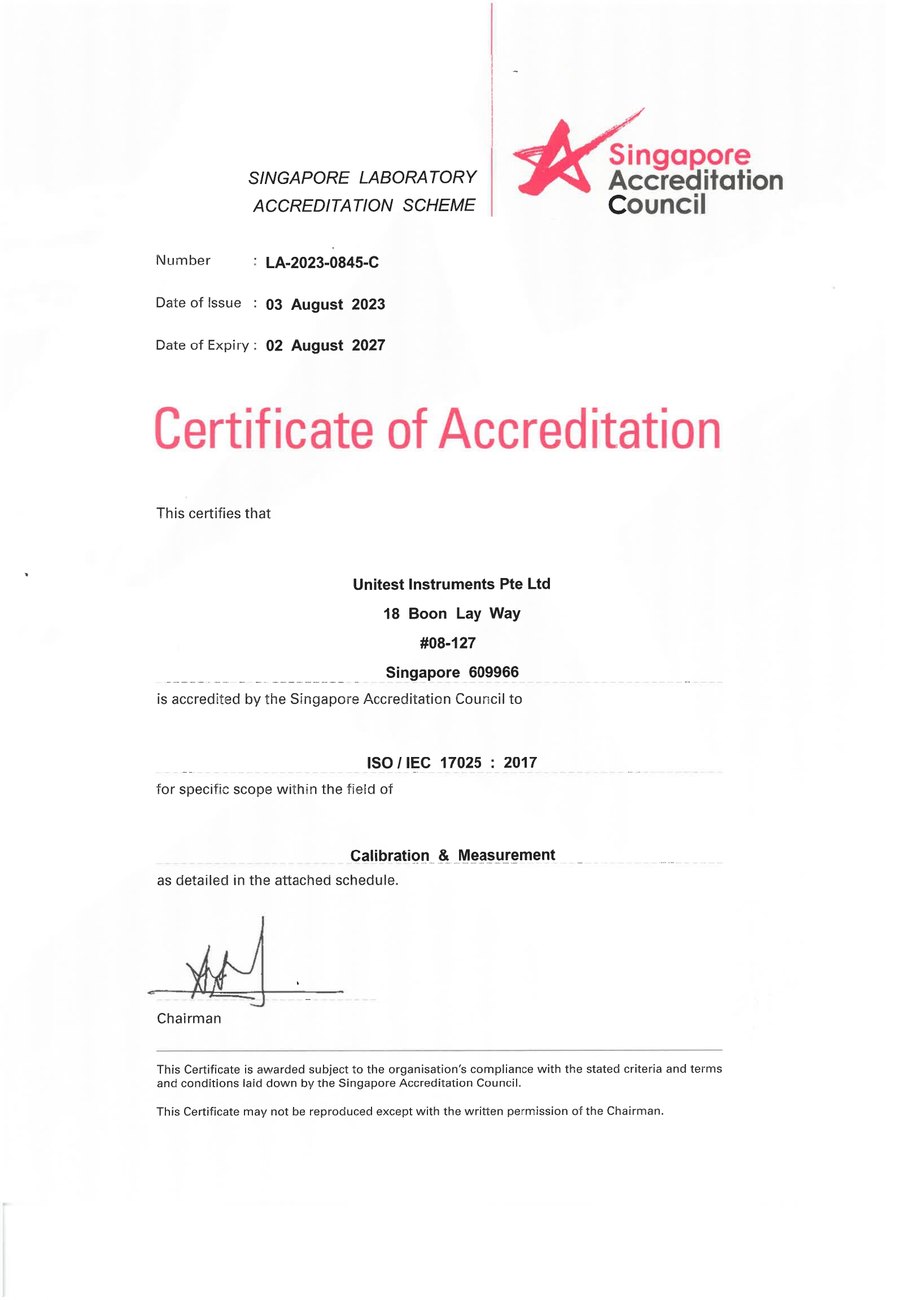
SAC-SINGLAS accredited calibration laboratory (Acc. No. LA-2023-0845-C) serving Singapore's industrial, pharmaceutical, and manufacturing sectors. All content reflects our ISO/IEC 17025 accredited scope and is reviewed by our technical calibration team.
Need temperature calibration in Singapore?
Unitest Instruments is SAC-SINGLAS accredited (Acc. No. LA-2023-0845-C) to ISO/IEC 17025. Same-week turnaround, certificates accepted by ISO 9001 auditors.