
Key Takeaways
- Internal resistance is the primary indicator of UPS battery health. A rise of 25% above baseline signals significant capacity degradation.
- Open-circuit voltage alone (from a multimeter) does not predict battery condition; dedicated analyzers measure impedance and conductance.
- Singapore's tropical climate accelerates battery degradation. Quarterly testing is recommended over semi-annual schedules.
- Battery analyzers require periodic calibration to maintain accuracy; SAC-SINGLAS accredited certificates are accepted by ISO 9001 and BCA Green Mark auditors.
- The Fluke BT521, Amprobe BAT-500, Fluke 500 Series, Megger BITE3, and Fluke BT510 cover the full range of UPS and battery-bank applications from small server-room UPS to large data-centre string systems.
Who Needs a Battery Analyzer, and Why Now?
Uninterruptible power supplies are only as reliable as the batteries inside them. A UPS that reports "100% battery" can fail to deliver rated backup time if its battery cells have degraded, and in Singapore's 24/7 industrial and commercial environment, that failure can mean lost production, corrupted data, or a failed fire-suppression system.
Battery analyzers are essential for three groups. Facilities managers responsible for critical infrastructure (hospitals, data centres, manufacturing plants) use them to verify that UPS systems will deliver rated backup time during SP PowerGrid outages. Electrical contractors and MOM-licensed electricians use them during commissioning and annual inspections mandated under the Electricity Act. Battery service companies use them to justify preventive replacements before warranty claims or emergency callouts arise.
The case for proactive testing has grown stronger in Singapore over the last decade. The Energy Market Authority's (EMA) reliability data shows that even with Singapore's highly reliable grid (SAIDI consistently below 1 minute per year), internal facility events (switchgear faults, maintenance errors, cable faults), remain the primary cause of power disruptions to critical loads. A UPS with degraded batteries provides zero protection against these events.
What to Look for in a Battery Analyzer
Internal Resistance Measurement Range and Resolution
This is the specification that separates a capable battery analyzer from a basic continuity tester. For 12V VRLA/AGM blocks (the most common UPS battery in Singapore), look for a measurement range of 0 to at least 100 mΩ with a resolution of 0.01 mΩ. For large 2V cells used in data-centre battery strings (200Ah and above), you need resolution down to 0.001 mΩ. Models with automatic ranging handle mixed battery banks more conveniently.
Voltage Range and String Testing Capability
Small office UPS systems use 12V or 24V battery modules. Data centre UPS systems commonly use 480V or 240V battery strings made up of 2V cells in series. If you manage both types, choose an analyzer with a wide voltage input range. The Fluke BT521 covers 2V to 120V per cell and handles multi-cell string measurements efficiently. Confirm whether the analyzer measures individual cells within a string or only the overall string voltage.
Temperature Compensation
Singapore's ambient temperatures (typically 28°C to 35°C in plant rooms), significantly affect internal resistance readings. A 10°C rise above the standard 25°C reference temperature can lower resistance readings by 3–5%, making a degraded battery appear healthier than it is. Analyzers with built-in temperature compensation probes or automatic correction algorithms are strongly preferred for Singapore conditions.
Data Logging and Trending Software
A single internal resistance reading tells you where a battery is today. Trending over multiple readings tells you how fast it is degrading, and when to replace it before failure. Analyzers that store time-stamped readings and connect to PC software (via USB or Bluetooth) allow you to build a maintenance history that satisfies ISO 9001 QMS documentation requirements and supports IEC 62040-3 UPS performance records.
Safety Ratings for Singapore's Industrial Environments
Look for CAT III or CAT IV safety ratings for work in switchroom and generator environments. IP54 or better ingress protection is valuable in Singapore's humid plant rooms. Instruments carried into data centre battery rooms should also meet relevant ATEX or IECEx classifications if the battery room is classified as a hazardous area, though this is rare in modern VRLA/AGM installations.
Top Battery Analyzers for UPS and Battery-Bank Maintenance
All models below are available through Unitest Instruments or its distribution partners. Prices shown are indicative Singapore market ranges (excluding GST) and are subject to change.
| Model | Key Specification | Battery Types | Price Range (SGD) | Best For |
|---|---|---|---|---|
| Fluke BT521 | Internal resistance 0.001–3000 mΩ; voltage 2–120V; USB data logging | VRLA, AGM, Gel, Flooded LA | S$2,800–3,400 | Data centres, large UPS strings, critical infrastructure |
| Fluke BT510 | Internal resistance 0.01–999.9 mΩ; voltage 1.5–16V per cell; Bluetooth | VRLA, AGM, Gel | S$1,800–2,200 | Server-room UPS, medium battery banks, field service |
| Amprobe BAT-500 | Internal resistance 0–100 mΩ; voltage 6–12V; conductance + resistance dual-mode | VRLA, AGM, standard lead-acid | S$680–880 | Small-to-medium UPS, budget-conscious field maintenance |
| Megger BITE3 | Resistance 0.01–320 mΩ; voltage 1–16V/cell; onboard storage 3,000 records; GPS tagging | VRLA, AGM, Gel, Nickel-Cadmium | S$3,200–4,000 | Telecoms, utilities, multi-site battery management programmes |
| Fluke 500 Series (BT500) | Conductance + resistance; voltage 1.5–18V; thermal imaging add-on compatible | VRLA, AGM, Gel, Li-ion (select modes) | S$1,200–1,600 | Mixed-chemistry battery banks; facilities with newer Li-ion UPS |
All Fluke and Amprobe instruments are distributed by Unitest Instruments in Singapore. You can browse available models and request a quotation at unitestshop.com.
Calibrate Your Battery Analyzer Before Field Use
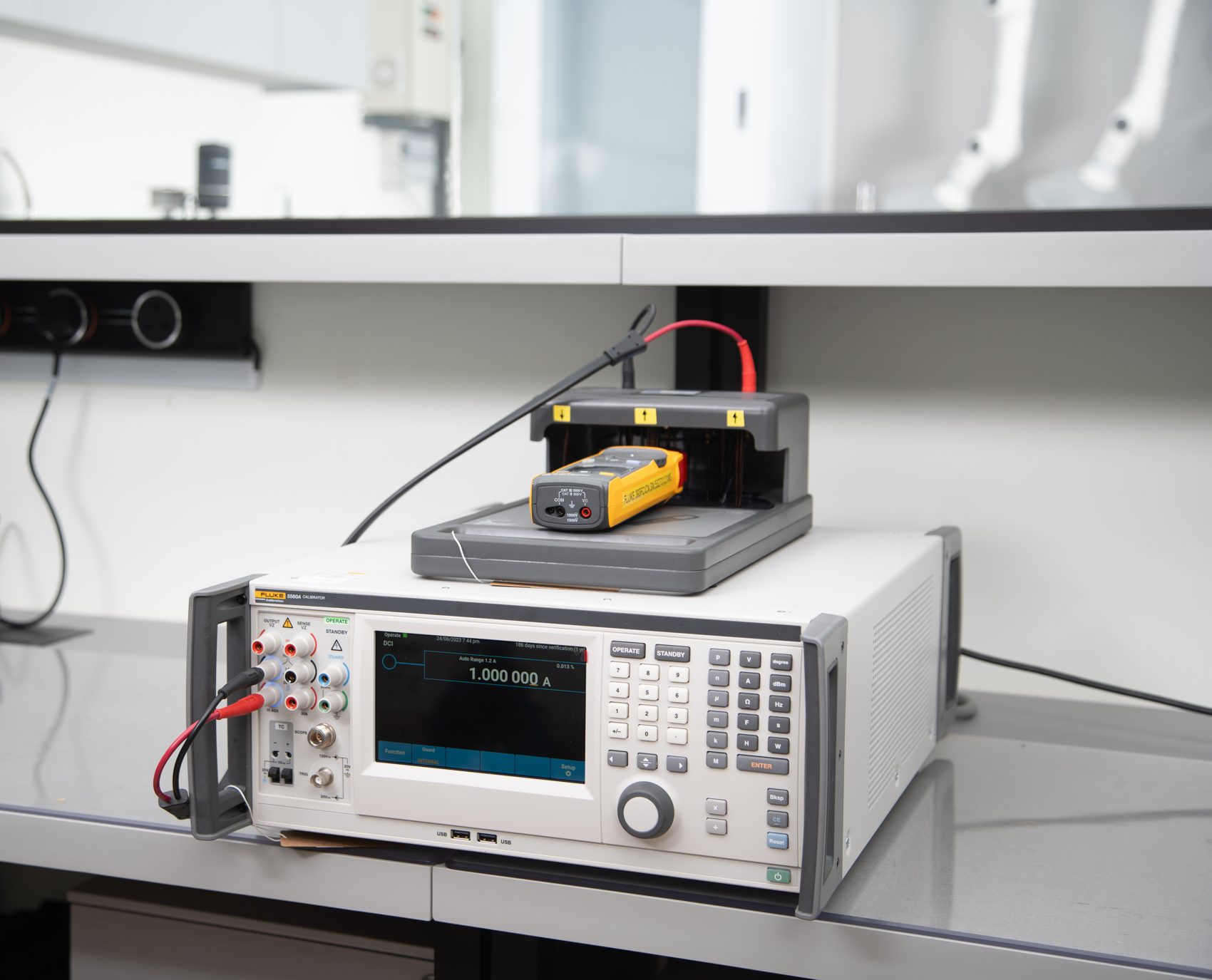
A new battery analyzer must be calibrated before it becomes the reference instrument for your maintenance programme. Unitest Instruments provides SAC-SINGLAS accredited calibration for battery test equipment with same-week turnaround and certificates traceable to Singapore's NMC.
Model Deep-Dives: Choosing the Right Analyzer for Your Application
Fluke BT521. The Professional's Choice for Data Centres
The BT521 is the most capable battery analyzer in Fluke's range and is the benchmark instrument for large UPS and battery-string maintenance in Singapore's Tier III and Tier IV data centres. Its 0.001 mΩ resolution makes it accurate enough for the large 2V cells used in 480V data-centre battery strings, where absolute resistance values are very low and small changes carry significant diagnostic weight.
The BT521 connects to Fluke's BatteryMD or PowerLog software via USB, allowing you to build trend charts that satisfy IEC 62040-3 battery test documentation requirements. The large colour display is readable in dimly lit battery rooms, and the instrument's CAT III 600V safety rating covers generator room work. For organisations managing multiple sites, the BT521's ability to export standardised CSV records simplifies consolidation into a central asset management system.
Shop the Fluke BT521 at unitestshop.com.
Amprobe BAT-500. Best Value for Standard UPS Maintenance
The BAT-500 covers the most common scenario in Singapore: maintaining 12V VRLA or AGM battery strings in office server rooms, retail UPS systems, and light-industrial backup power. Its dual conductance/resistance measurement gives both a quick conductance screen (fast, for large numbers of batteries) and a more precise resistance reading for trend analysis.
At under S$900, the BAT-500 is the logical entry point for electrical contractors and smaller facilities teams who need a reliable, calibratable battery analyzer without the investment of a full Fluke professional instrument. The instrument stores up to 500 test records internally and transfers data via USB. Amprobe is a Fluke company, so calibration support and spare parts are well established in Singapore.
View the Amprobe BAT-500 and related accessories at unitestshop.com.
Megger BITE3. Preferred for Telecoms and Utilities
The BITE3 (Battery Impedance Test Equipment, 3rd generation) is the instrument of choice for Singapore's telecoms operators and utilities, where nickel-cadmium batteries in addition to lead-acid types are still common in legacy installations. Its onboard GPS tagging feature is useful for multi-site battery management programmes where physical battery location matters for traceability. A requirement under some MAS-regulated financial institution operational resilience frameworks.
The BITE3's 3,000-record internal storage and dedicated Megger BATTView software provide a complete battery management ecosystem. Its automatic string configuration detection saves significant setup time when testing large strings. Megger instruments are calibrated and serviced through Unitest Instruments' accredited laboratory.
When to Consider the Fluke 500 Series for Lithium-Ion UPS
Singapore's data centre and commercial building market is gradually adopting lithium-ion UPS systems for their higher energy density and longer design life. The Fluke 500 Series includes operating modes for lithium-ion chemistry. Important because applying lead-acid test parameters to a lithium battery can produce misleading results or, in some configurations, trigger BMS alerts. If your facility has or is planning to deploy Li-ion UPS, verify chemistry compatibility before purchasing any battery analyzer.
Singapore Standards and Compliance Context
Battery maintenance in Singapore sits at the intersection of several regulatory frameworks. SS 638 (Code of Practice for Emergency Lighting) mandates that battery-backed emergency lighting systems be tested and maintained with documented records. IEC 62040-1 and IEC 62040-3 cover UPS safety and performance testing respectively, with IEC 62040-3 specifying the battery capacity test procedures that determine whether a UPS can deliver rated backup time.
Organisations certified to ISO 9001 must demonstrate that all measuring instruments used in their quality processes are calibrated against traceable standards. A battery analyzer used to make pass/fail decisions about UPS battery banks is a measuring instrument within scope. It must have a valid calibration certificate from an accredited laboratory. As described in our article on accredited vs non-accredited calibration, only SAC-SINGLAS accredited certificates provide the independent third-party assurance that ISO 9001 auditors require.
For data centres, SS 564 (Singapore Standard for Green Data Centres) and the TIA-942 standard both require documented preventive maintenance programmes for power infrastructure including UPS battery systems. The BCA's Green Mark scheme for commercial buildings similarly awards credits for documented M&E maintenance programmes. Battery analyzer test records, with the instrument's calibration certificate attached, are the primary evidence for these audits.
Understanding what a calibration certificate contains and how to read it is important for facilities teams who need to present calibration evidence to auditors. A valid SAC-SINGLAS certificate will state the instrument's measured values, the reference standards used, and the measurement uncertainty. Giving auditors the traceability chain they require.
How to Build a Battery Maintenance Programme Around Your Analyzer
Step 1. Baseline at Commissioning
Measure and record the internal resistance of every battery cell or block when the system is new and fully charged. This baseline is the reference against which all future readings are compared. Store the data in your CMMS or asset management system alongside the battery manufacturer's specifications and the UPS system details.
Step 2. Quarterly Impedance Testing
In Singapore's climate, quarterly testing is the recommended frequency. Take readings under consistent conditions: same time of day, same ambient temperature where possible, batteries at rest for at least one hour after the last charge cycle. Temperature-compensate all readings to 25°C. Flag any cell whose resistance has increased more than 25% above baseline for close monitoring, and schedule replacement for any cell above 50% above baseline.
Step 3. Annual Capacity Discharge Test
Impedance testing predicts capacity but does not measure it directly. An annual capacity discharge test (discharging the battery at the rated current and measuring actual runtime), confirms that the UPS will deliver its rated backup time. This test requires a battery load bank and is typically performed by a specialist contractor. The battery analyzer data provides the trend context that makes the discharge test findings meaningful.
Step 4. Calibrate Your Analyzer Annually
An uncalibrated battery analyzer produces unreliable trend data. If your instrument's voltage or resistance measurement has drifted, your baseline comparison is invalid. Annual calibration by a SAC-SINGLAS accredited laboratory (such as Unitest Instruments, Acc. No. LA-2023-0845-C) ensures your readings remain accurate and your maintenance records remain defensible. Most ISO 9001 QMS documentation systems require the calibration interval to be defined in the instrument's calibration record. Typically 12 months for battery analyzers used in regular field service.
Reading the Trend Curve: When to Monitor and When to Replace
A single internal resistance reading has limited diagnostic value on its own, batteries vary meaningfully in their as-manufactured baseline even within the same production batch, which is why the trend curve relative to each individual cell's own baseline matters more than comparing absolute resistance values across cells. In practice, a cell whose resistance rises steadily but slowly (a few percent per quarter) over eighteen to twenty-four months is behaving as lead-acid chemistry normally ages, and continued quarterly monitoring rather than immediate replacement is the appropriate response. What should trigger closer attention is the shape of the curve, not just the magnitude: a cell that has been stable for a year and then shows a sudden jump between two consecutive quarterly readings is a materially different signal than one on a smooth, predictable rise, since a sudden jump often indicates an internal fault (a partial plate short, sulfation acceleration, or grid corrosion reaching a critical point) that can progress to outright failure faster than the next scheduled test would catch.
Facilities managing large battery strings in Singapore's data centres should also watch for the "weakest link" pattern common in series-connected strings: a single degraded cell in an otherwise healthy string can force the remaining healthy cells to compensate during a discharge event, accelerating their own wear and eventually producing a cascading pattern of failures that, if you are only reviewing string-level voltage rather than individual cell resistance, remains invisible until the string itself fails a capacity test. This is the practical argument for cell-level (not just string-level) impedance testing on any battery bank supporting genuinely critical load, even though it takes longer per test round than a single string-voltage check.
Field Testing Mistakes That Silently Skew Your Data
Beyond instrument calibration, several testing technique errors are common enough in Singapore facility teams to be worth calling out explicitly, because they produce readings that look plausible but quietly undermine the trend data your replacement decisions depend on. The most frequent is testing batteries at inconsistent points in the charge cycle: a battery tested immediately after a charge or discharge event will show a temporarily different impedance reading than one tested at rest, and mixing "just charged" and "at rest" readings into the same trend series introduces noise that can mask a genuine gradual degradation trend or, worse, create a false alarm that looks like sudden failure. Establishing a fixed rest period (commonly one hour minimum after the last charge or discharge activity) before every test round, and recording that rest period was observed, removes this variable from your data entirely.
A second common error is inconsistent probe contact on battery terminals, corrosion, oxidation, or a loose connection between the test probe and the terminal introduces contact resistance that adds directly to the measured value, and because this error is random rather than systematic (it depends on how carefully each individual test was performed, not on the battery's true condition), it is one of the hardest sources of bad data to detect after the fact from the numbers alone. Cleaning terminals before testing and applying firm, consistent probe pressure resolves most of this, and technicians should be trained to distrust and immediately retest any single reading that jumps sharply out of line with a cell's established trend, since a genuine sudden battery fault and a bad probe contact produce very similar-looking single-point anomalies, and only a clean retest tells you which one you are actually looking at.
Frequently Asked Questions
Internal resistance measurement accuracy is the single most important specification. A UPS battery's state of health correlates closely with its internal resistance, as resistance rises, capacity drops. Look for analyzers with a resolution of 0.01 mΩ or better and a measurement range that covers the battery chemistry you use (typically 12V VRLA/AGM blocks in Singapore facilities). Voltage measurement accuracy and the ability to test under load are also critical for assessing real-world capacity.
No. A standard multimeter only measures open-circuit voltage, which tells you almost nothing about a battery's actual condition. A battery can show a healthy open-circuit voltage (e.g. 12.8V) while having severely degraded capacity due to sulphation or internal cell failure. A dedicated battery analyzer measures internal resistance, conductance, and load voltage. The three parameters that reliably predict remaining service life.
Singapore's SS 638 (Code of Practice for Emergency Lighting) and IEC 62133 guidance, along with best practice from UPS manufacturers, recommend baseline testing at commissioning, then quarterly checks of internal resistance, and a full discharge capacity test annually. In high-humidity environments like Singapore (which accelerates corrosion and self-discharge), quarterly internal resistance testing is strongly recommended rather than the semi-annual schedule sometimes used in temperate climates.
Both are impedance-based methods that estimate battery health without a full discharge. Conductance testing (pioneered by Midtronics/Fluke) applies a small AC signal and measures the battery's conductance (inverse of resistance). Internal resistance testing applies a known current pulse and measures the voltage drop. Conductance is faster and better for screening large battery strings; internal resistance measurement is more precise for trend analysis. Most modern analyzers combine both methods.
Yes. Battery analyzers use precision voltage, current, and impedance measurement circuits that drift over time and with temperature cycling. For facilities covered under ISO 9001, Singapore's BCA Green Mark, or those supplying calibration evidence to clients or auditors, analyzers must be calibrated against traceable standards. Unitest Instruments provides SAC-SINGLAS accredited calibration (Acc. No. LA-2023-0845-C) for battery test instruments, with certificates accepted by ISO 9001 and SS 538 auditors.
The analyzers in this guide cover the battery chemistries most common in Singapore UPS and battery-bank applications: VRLA (Valve-Regulated Lead-Acid), AGM (Absorbed Glass Mat), gel-cell, flooded lead-acid, and lithium-ion (Li-ion and LiFePO4) on select models. The Fluke BT521 and Amprobe BAT-500 handle all lead-acid UPS types; for lithium UPS systems increasingly found in data centres, confirm your model supports lithium chemistry before purchase.
Key references include SS 638 (Code of Practice for the Design and Installation of Emergency Lighting Systems), IEC 62040-1 (UPS safety), IEC 62040-3 (UPS performance testing), and SP PowerGrid technical requirements for generator and UPS installations in critical facilities. Data centres following TIA-942 or SS 564 (Singapore Standard for Green Data Centres) also mandate documented battery health records. Always verify current editions with the Singapore Standards Council.
Establish a baseline reading at commissioning when the battery is new and fully charged. Flag any battery whose internal resistance has increased by more than 25% above baseline, this indicates significant capacity loss. A rise of 50% or more typically means the battery should be replaced before the next annual cycle. Temperature affects readings significantly: correct measurements to 25°C using your analyzer's built-in temperature compensation, or apply the standard 0.5% per °C correction manually. Always compare readings taken under the same conditions for valid trend analysis.
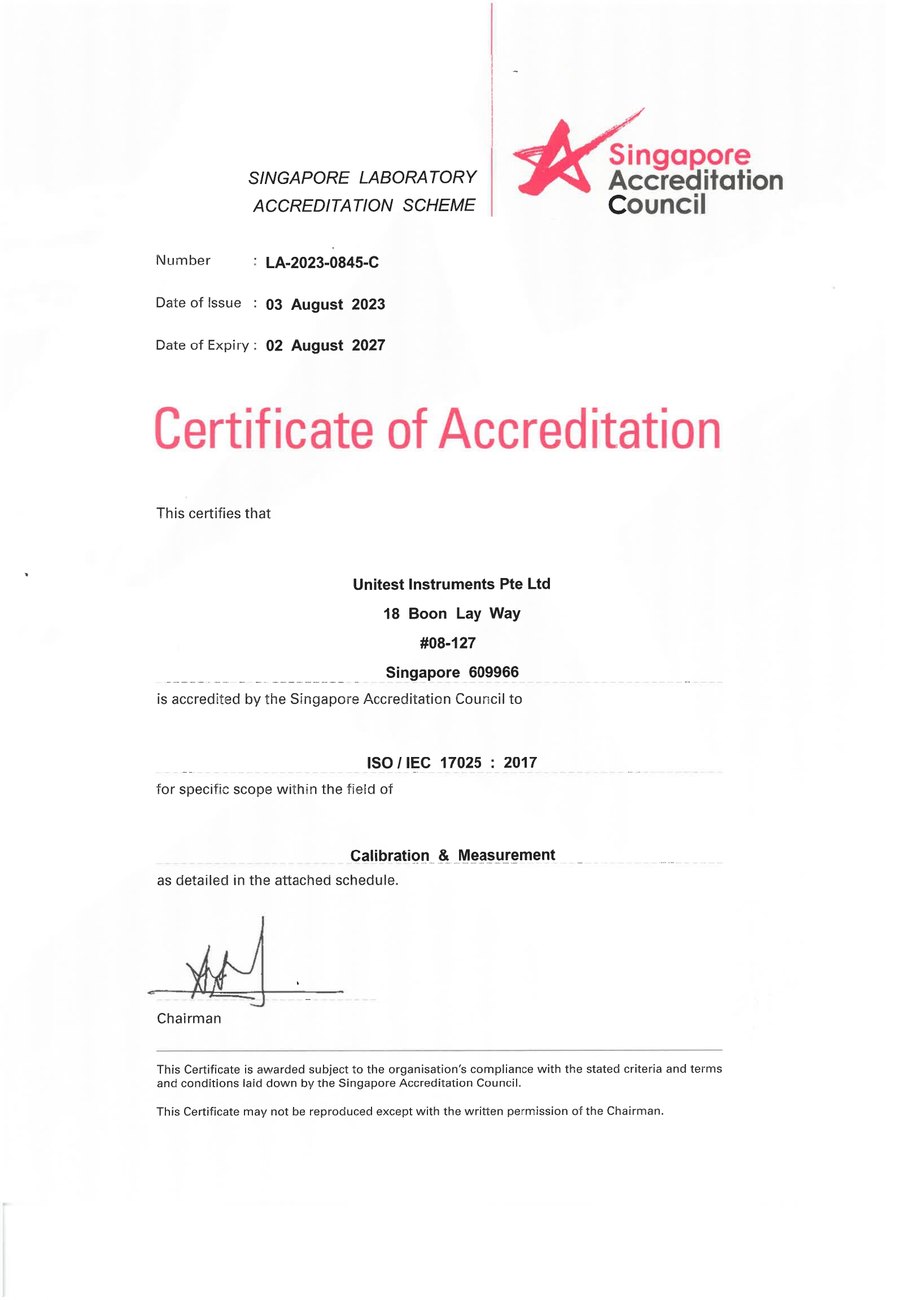
SAC-SINGLAS accredited calibration laboratory (Acc. No. LA-2023-0845-C) serving Singapore's industrial, pharmaceutical, and manufacturing sectors. All content reflects our ISO/IEC 17025 accredited scope and is reviewed by our technical calibration team.
Need battery analyzer calibration in Singapore?
Unitest Instruments is SAC-SINGLAS accredited (Acc. No. LA-2023-0845-C) to ISO/IEC 17025. Same-week turnaround, certificates accepted by ISO 9001 auditors.