
Key Takeaways
- Calibration tests your moisture analyzer against NMC-traceable reference standards and documents deviation and measurement uncertainty at each test point.
- SAC-SINGLAS accredited calibration (ISO/IEC 17025, Acc. No. LA-2023-0845-C) is the standard required by ISO 9001 auditors, HSA GMP, and Singapore Food Agency regulations.
- Trace moisture instruments (ppm-range) require certified reference gas mixtures; relative humidity instruments use humidity generators or saturated salt solutions.
- Most industrial moisture analyzers should be calibrated every 12 months; pharmaceutical GMP instruments typically every 6 months.
- A valid calibration certificate must include expanded measurement uncertainty (k=2), traceability statement, and environmental conditions during calibration.
What Happens During Moisture Analyzer Calibration?
When you send a moisture analyzer for calibration at an ISO/IEC 17025 accredited laboratory, the process follows a structured sequence designed to produce a reliable, defensible measurement result. The technician first inspects the instrument for physical condition and checks that it powers on and reaches stable operating conditions. Environmental parameters in the calibration area (temperature, relative humidity, and barometric pressure), are recorded, because moisture measurement is highly sensitive to ambient conditions.
The instrument is then presented with known moisture concentrations. Either as certified reference gas mixtures (for trace moisture in the ppm range), or as controlled humidity environments generated by a two-pressure or two-temperature humidity generator, or saturated salt solutions (for relative humidity instruments). At each reference point, the instrument's indicated value is recorded alongside the reference value. The difference between the two is the error, and the calibration certificate will report this at every test point.
The final step is the calculation of expanded measurement uncertainty. A figure that accounts for the uncertainty in the reference standard itself, the instrument's repeatability during the calibration run, the resolution of the instrument's display, and the drift in environmental conditions. This uncertainty figure, expressed at the 95% confidence level (coverage factor k=2), is what distinguishes an ISO/IEC 17025 accredited certificate from a simple "calibration check." Without it, you cannot determine whether your instrument is genuinely fit for purpose within your required measurement tolerance.
Reference Standards Used for Moisture Calibration in Singapore
The choice of reference standard depends on the type of moisture analyzer being calibrated and the measurement range. In Singapore, all reference standards used by SAC-SINGLAS accredited laboratories must be traceable to the National Metrology Centre (NMC) or to a national metrology institute recognised under the BIPM Mutual Recognition Arrangement (MRA).
Trace Moisture (ppm-range) Instruments
For instruments such as electrolytic phosphorus pentoxide (P₂O₅) analyzers, chilled mirror hygrometers operating at low dew points, laser-based TDLAS (Tunable Diode Laser Absorption Spectroscopy) sensors, and capacitance-type trace moisture probes, calibration uses certified reference gas mixtures. These are prepared gravimetrically or by dynamic dilution and carry a stated moisture concentration in ppm(v) or ppm(m) with a certified uncertainty. The gas cylinders themselves are traceable to NMC Singapore or an MRA-signatory national metrology institute.
Relative Humidity Instruments
Calibration of relative humidity (RH) instruments. Including capacitive humidity sensors, psychrometers, and electronic RH transmitters used in HVAC, cleanrooms, and food storage. Uses either a two-pressure or two-temperature humidity generator, which produces a precisely controlled stream of moist air at known RH values, or saturated salt solutions in temperature-controlled enclosures. Common salt standards include lithium chloride (LiCl, ~11% RH at 25°C), magnesium chloride (MgCl₂, ~33%), sodium chloride (NaCl, ~75%), and potassium sulphate (K₂SO₄, ~97%), each with certified RH values traceable to NMC.
Loss-on-Drying (LOD) Moisture Balances
Halogen moisture analyzers and thermogravimetric LOD balances used in pharmaceutical and food QC are calibrated in two parts: the weighing mechanism is calibrated against OIML Class E2 or F1 certified weights (mass traceability), while the temperature unit is calibrated against calibrated thermometers or thermocouples traceable to NMC. Both elements must appear on the certificate for the instrument to be considered fully calibrated.
Singapore Regulatory Context: Who Requires Calibrated Moisture Analyzers?
Moisture measurement sits at the intersection of several Singapore regulatory frameworks. Understanding which applies to your operation determines both the required calibration standard and the acceptable certificate format.
Health Sciences Authority (HSA). Pharmaceutical GMP
Pharmaceutical manufacturers licensed under the HSA Medicines Act must comply with PIC/S GMP guidelines, which require that all instruments used in manufacturing and quality control be calibrated at defined intervals against standards traceable to national standards. Moisture content is a critical quality attribute for APIs, excipients, and finished dosage forms, and LOD moisture balances or Karl Fischer titrators used in release testing must be calibrated by an ISO/IEC 17025 accredited laboratory. A certificate lacking measurement uncertainty or traceability statements will not satisfy a PIC/S GMP audit.
Singapore Food Agency (SFA). Food Manufacturing
Under the Sale of Food Act and SFA's licensing conditions, food manufacturers are required to maintain equipment used for product testing in calibrated, fit-for-purpose condition. Moisture content directly affects shelf life, microbial safety, and label declarations. Making moisture analyzer calibration a food safety control, not merely a QC formality. SFA-audited facilities are expected to produce calibration records with valid, traceable certificates on demand.
Workplace Safety and Health (WSH) Act
In industrial settings where moisture in process gases (such as compressed air, nitrogen, or natural gas) is a safety parameter (for example, preventing hydrate formation in pipelines or moisture-induced corrosion in pressure systems), the WSH Act requires that measuring instruments used for safety-critical purposes be maintained in proper working order. Calibration records with stated uncertainty provide evidence of compliance.
ISO 9001 and Industry Standards
ISO 9001:2015 Clause 7.1.5 requires that monitoring and measuring resources be calibrated against measurement standards traceable to international or national measurement standards. Certification bodies conducting ISO 9001 audits in Singapore routinely verify that calibration certificates are issued by SAC-SINGLAS accredited laboratories and include measurement uncertainty. A certificate from a non-accredited provider will typically be flagged as a non-conformance.
Need Your Moisture Analyzer Calibrated in Singapore?
Unitest Instruments (Acc. No. LA-2023-0845-C) calibrates trace moisture, relative humidity, and LOD instruments with full NMC traceability. Certificates accepted by ISO 9001 auditors, HSA GMP inspectors, and SFA. Same-week turnaround available.
Accredited vs Non-Accredited Calibration: A Direct Comparison
Many facilities in Singapore receive calibration from in-house technicians, equipment distributors, or general-purpose workshops that are not SAC-SINGLAS accredited. The table below sets out the practical differences, so you can assess whether your current calibration provider meets your regulatory and quality requirements.
| Factor | SAC-SINGLAS Accredited (ISO/IEC 17025) | Non-Accredited Calibration |
|---|---|---|
| Reference standards | NMC-traceable; own references independently calibrated and documented | May use traceable standards, but traceability chain is not independently verified |
| Measurement uncertainty | Mandatory. Stated on certificate at k=2, 95% confidence | Rarely stated; no requirement to calculate or disclose |
| Certificate recognition | Internationally recognised under ILAC MRA; accepted by ISO 9001, HSA GMP, SFA auditors | Not internationally recognised; may be rejected by auditors |
| Laboratory competence | Independently assessed by SAC every 2 years; technician competence verified | Self-asserted; no third-party assessment |
| Environmental control | Calibration performed in controlled, monitored environment | Variable; on-site calibration may not control ambient moisture or temperature |
| Suitability for export documentation | Accepted by overseas regulators and customers in MRA-signatory countries | May require additional verification or rejection by overseas counterparts |
| Typical use case | Pharmaceutical, food manufacturing, semiconductor, industrial safety, ISO-certified QMS | Internal maintenance checks only; not suitable for regulatory compliance |
For a deeper analysis of when accredited calibration is legally required versus best practice, see our article Accredited vs Non-Accredited Calibration in Singapore.
Calibration Interval Recommendations for Moisture Analyzers
There is no single universal answer to "how often should I calibrate my moisture analyzer?". The correct interval depends on the instrument type, the severity of the application, and the historical drift data from previous calibrations. However, the following guidelines reflect common practice in Singapore's regulated industries and are consistent with the approach taken by ISO/IEC 17025 accredited laboratories.
General Industry (12-month interval)
Most industrial moisture analyzers (including process RH transmitters, compressed air moisture monitors, and general-purpose LOD balances), are calibrated on a 12-month cycle. This is the default interval recommended for ISO 9001-certified facilities and is consistent with the calibration recall period used by most SAC-SINGLAS accredited laboratories. If calibration results show the instrument is consistently within specification with low drift, some laboratories may recommend extending the interval to 18 months, but this decision must be documented and justified.
Pharmaceutical GMP (6-month interval)
LOD moisture balances, Karl Fischer titrators, and RH instruments used in pharmaceutical manufacturing and QC are typically calibrated every 6 months under PIC/S GMP. Some HSA-audited facilities opt for quarterly in-house verification checks (using certified weights and reference standards) between formal accredited calibrations, which is a recognised good practice that provides early warning of instrument drift without incurring the full cost of a laboratory calibration each quarter.
Trace Moisture Analyzers in Critical Process Applications (quarterly or 6-month)
Trace moisture analyzers used in semiconductor manufacturing, specialty gas production, or cryogenic applications (where moisture above a few ppm can cause catastrophic process failures), are often calibrated every 3 to 6 months. The high consequence of undetected drift justifies the shorter interval. Field verification using certified gas standards between formal calibrations is standard practice in these sectors.
For a comprehensive framework on setting and justifying calibration intervals, including how to use historical drift data to extend or shorten cycles, see our article Calibration Interval: How Often Should You Calibrate Your Instruments?
What a Proper Moisture Analyzer Calibration Certificate Must Show
A calibration certificate is only as useful as the information it contains. Many facilities in Singapore accept certificates that lack critical data, which can leave them exposed during audits or, more seriously, unaware that their instruments are out of tolerance. The following elements are mandatory on any ISO/IEC 17025 accredited calibration certificate for a moisture analyzer.
- Laboratory identification and accreditation number. The issuing laboratory's name, address, and SAC-SINGLAS accreditation number (for Unitest: LA-2023-0845-C). The accreditation mark should appear on the certificate.
- Instrument details. Make, model, serial number, and asset/tag number of the instrument calibrated.
- Calibration date and recommended recalibration date, both must be explicit. A certificate without a recalibration date leaves the interval undefined.
- Reference standards used. Identification, serial or batch number, and the calibration certificate number for each reference standard used, confirming traceability.
- Measurement results. The reference value (nominal), the instrument's indicated value, and the error (deviation) at each calibration point. For moisture analyzers, this typically means results at a minimum of three points spanning the instrument's working range.
- Expanded measurement uncertainty. Expressed as U = k·uc with the coverage factor k and confidence level stated (typically k=2, approximately 95% confidence level). This is the single most important data element for fitness-for-purpose assessment.
- Environmental conditions. Temperature, relative humidity, and (where relevant) barometric pressure in the calibration area at the time of calibration.
- Authorised signatory. Name, signature, and date of the technical signatory responsible for the certificate. Electronic signatures are acceptable if the laboratory's quality system supports them.
- Statement of conformance (if applicable). If the certificate states that the instrument "passes" or "conforms to specification," the specification and the decision rule used (including whether measurement uncertainty was taken into account) must be clearly stated, per ISO/IEC 17025:2017 Clause 7.8.6.
To understand every line of a calibration certificate and what it means for your quality system, see our detailed guide: Calibration Certificate Explained: What Every Field Means.
Buying vs Calibrating: When to Upgrade Your Moisture Analyzer
Calibration reveals whether your instrument is fit for purpose, but it also sometimes reveals that an instrument has drifted beyond the point where correction is practical, or that its fundamental measurement uncertainty is too large for your current application. If calibration results consistently show large deviations, or if your process requirements have tightened since you purchased the instrument, it may be more cost-effective to replace the unit than to continue calibrating a marginally compliant instrument.
Unitest Instruments supplies a wide range of moisture analyzers (including trace moisture analyzers, relative humidity transmitters, and halogen LOD balances), calibrated and ready for deployment in Singapore's industrial, pharmaceutical, and food manufacturing sectors. Visit unitestshop.com to browse available instruments or to source a replacement unit that matches your measurement range and application requirements. All instruments purchased through Unitest can be calibrated by our SAC-SINGLAS accredited laboratory (Acc. No. LA-2023-0845-C) before delivery, so you receive a factory-fresh, fully traceable instrument on day one.
Karl Fischer Titration: The Reference Method Behind Many Moisture Results
For solid, liquid, and some gas samples in pharmaceutical and food QC, loss-on-drying balances are a fast, convenient method, but they measure total mass loss on heating, not water specifically, and volatile compounds other than water (residual solvents, essential oils, certain preservatives) will be counted as "moisture" by an LOD balance even though they are not. Karl Fischer titration, by contrast, is a chemical method that reacts specifically with water molecules, making it the more accurate and often the regulatory reference method for products where volatile non-water compounds could otherwise distort an LOD result, active pharmaceutical ingredients with residual solvents being a common example. Karl Fischer instruments themselves require calibration, using certified water standards (typically a series of water-in-methanol or water-in-oil standards of known, certified water content) to verify the titrant's water equivalence factor, alongside periodic verification of the instrument's electrode response and end-point detection.
Facilities running both an LOD balance and a Karl Fischer titrator for the same product category benefit from periodically cross-checking the two methods against each other on a representative sample, since a persistent, unexplained divergence between the two results is often the first sign that either an LOD balance's temperature calibration has drifted or that the product formulation contains a volatile component the LOD method is misreading as moisture. This cross-check is a valuable, low-cost addition to a QC programme's ongoing method verification and is increasingly expected as good practice by PIC/S GMP auditors reviewing moisture testing methodology for finished pharmaceutical products.
Field Errors That Undermine an Otherwise Correct Calibration
A properly calibrated moisture analyzer can still produce misleading results in routine use if sample handling technique introduces error the calibration certificate has no way to capture. For LOD balances, sample size and spread across the pan matter considerably: a sample piled too thickly heats unevenly, with the surface drying while the core remains moist, producing a result that understates true moisture content and has not actually reached the stable end-point the instrument reports. Manufacturers' recommended sample mass and an even, thin spread across the pan are not arbitrary suggestions but are calibrated into the drying profile the instrument's algorithm assumes. For relative humidity probes, a very common field error is measuring immediately after moving the probe from a different humidity environment, since capacitive sensors typically need one to several minutes to equilibrate fully, and a reading taken too early will still be transitioning toward the true value rather than displaying it. Trace moisture analyzers used on process gas lines carry their own specific hazard: residual moisture trapped in sample tubing or fittings from a previous, wetter application can desorb slowly into a supposedly dry gas stream for hours or even days after a line change, a phenomenon known as memory effect, producing a persistently elevated reading that has nothing to do with the actual process gas moisture content or the analyzer's calibration status, and is instead resolved only by proper line purging and, in persistent cases, replacement of contaminated tubing.
Frequently Asked Questions
During moisture analyzer calibration, the instrument is tested against certified reference standards at multiple points across its measurement range. The technician verifies the instrument's response at known moisture concentrations (typically in ppm or % relative humidity), records deviations, applies correction factors where permitted, and documents measurement uncertainty. The calibration is traceable to the National Metrology Centre (NMC) Singapore under SAC-SINGLAS accreditation no. LA-2023-0845-C.
Accredited laboratories in Singapore use certified reference gas mixtures (for trace moisture in ppm), certified humidity generators or saturated salt solutions (for relative humidity instruments), and gravimetrically prepared standards. All reference standards carry NMC traceability, ensuring they are linked to SI units through an unbroken chain of comparisons with stated uncertainties.
The recommended calibration interval for most industrial moisture analyzers is 12 months. Pharmaceutical-grade instruments used in GMP environments (HSA-regulated or FDA-inspected facilities) typically require 6-month intervals. High-use process analyzers in humid Singapore conditions may need quarterly verification checks. Your ISO/IEC 17025 calibration certificate will include a recommended recalibration date based on your instrument's drift history and usage context.
A proper SAC-SINGLAS calibration certificate for a moisture analyzer must include: the laboratory's accreditation number (LA-2023-0845-C), the calibration date and due date, the instrument's make, model, and serial number, the measurement points tested, the reference standard used with its own traceability reference, the measured values and deviations at each point, the expanded measurement uncertainty (typically at k=2, 95% confidence), environmental conditions during calibration, and the authorised signatory's name and signature.
Yes. Under the Workplace Safety and Health (WSH) Act, employers must maintain measuring equipment used for safety-critical assessments in proper working order. HSA's Good Manufacturing Practice (GMP) guidelines require that all measuring equipment used in pharmaceutical manufacturing be calibrated at defined intervals with traceable certificates. Food manufacturers regulated under the Singapore Food Agency (SFA) must also ensure moisture measurement equipment is calibrated and fit for purpose under the Sale of Food Act.
Accredited calibration (SAC-SINGLAS under ISO/IEC 17025) provides a certificate with internationally recognised measurement uncertainty statements, full traceability to NMC Singapore, and is accepted by ISO 9001 auditors, HSA GMP inspectors, and export documentation bodies. Non-accredited calibration may use the same equipment but lacks third-party verification of the laboratory's competence. Certificates are not internationally recognised and may not satisfy regulatory or customer audit requirements.
Yes. Unitest Instruments (SAC-SINGLAS Acc. No. LA-2023-0845-C) calibrates trace moisture instruments measuring in the low-ppm range, including electrolytic, capacitance, and optical (TDLAS) type analyzers used in industrial gas, semiconductor, and petrochemical applications. Calibration uses certified reference gas standards with NMC-traceable concentrations.
Measurement uncertainty quantifies the doubt around a calibration result. It tells you the range within which the true moisture value lies with a stated probability (usually 95%). For moisture analyzers, a high uncertainty relative to your process tolerance means the calibration result cannot confirm whether your instrument is fit for purpose. An ISO/IEC 17025 accredited certificate always states expanded uncertainty, allowing engineers and auditors to make informed fitness-for-use decisions.
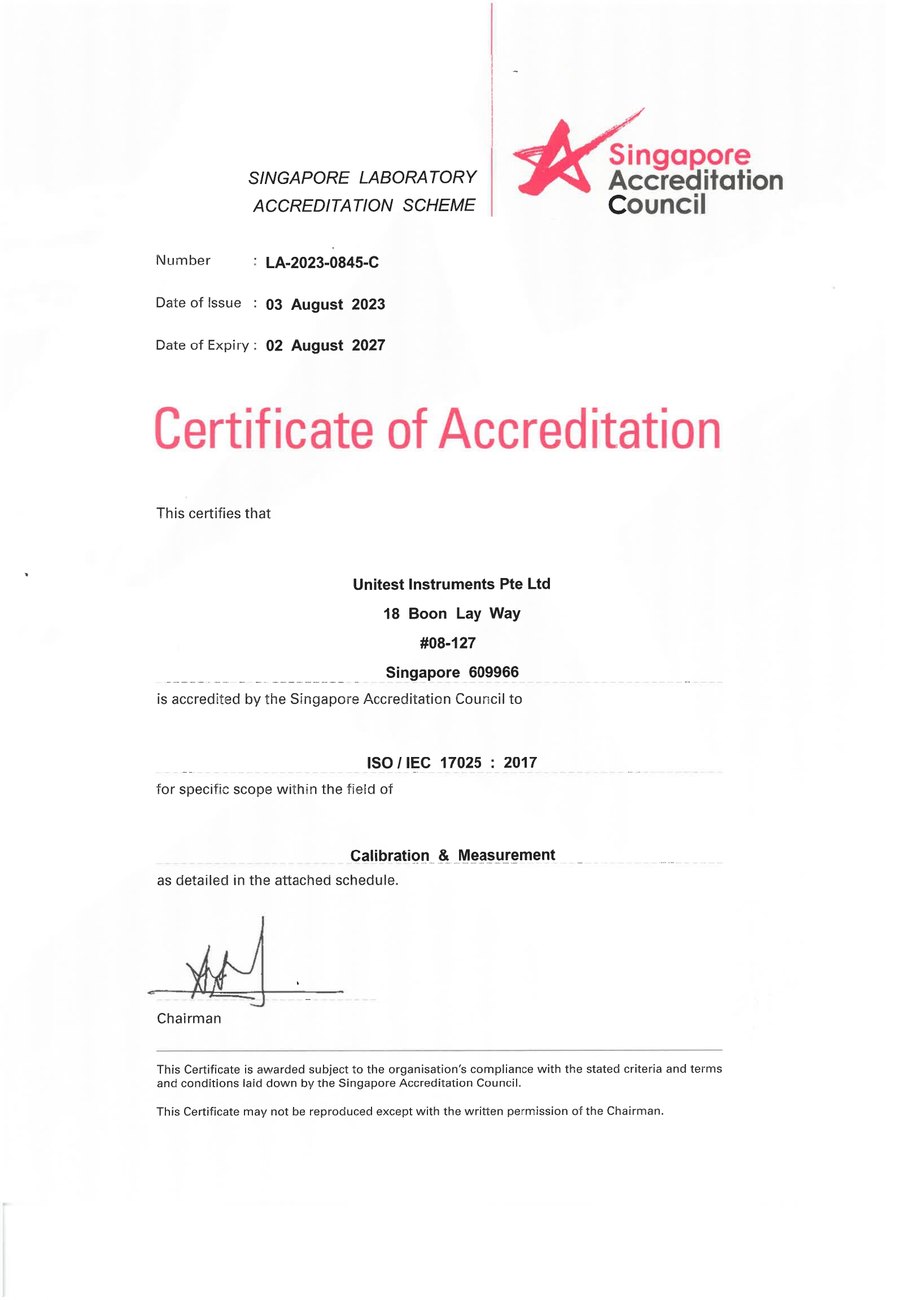
SAC-SINGLAS accredited calibration laboratory (Acc. No. LA-2023-0845-C) serving Singapore's industrial, pharmaceutical, and manufacturing sectors. All content reflects our ISO/IEC 17025 accredited scope and is reviewed by our technical calibration team.
Need moisture analyzer calibration in Singapore?
Unitest Instruments is SAC-SINGLAS accredited (Acc. No. LA-2023-0845-C) to ISO/IEC 17025. Same-week turnaround, certificates accepted by ISO 9001 auditors, HSA GMP inspectors, and SFA.