
Key Takeaways
- BCA Green Mark IAQ compliance is governed by SS 554:2016 and NEA's IAQ Guidelines for Office Premises, both must be satisfied simultaneously.
- Six parameters are mandated: CO2, PM2.5, PM10, TVOC, formaldehyde (HCHO), temperature, and relative humidity. Some tiers add CO monitoring.
- All IAQ instruments used in assessment evidence must be calibrated by a SAC-SINGLAS accredited laboratory with certificates traceable to Singapore's NMC.
- Green Mark certification is renewed every three years; a formal IAQ audit is part of the recertification process and non-compliance can result in downgrade or loss of rating.
- MOM's Workplace Safety and Health Act provides an additional enforcement layer. Poor IAQ that endangers workers can result in statutory penalties independent of BCA.
Why Indoor Air Quality Matters for BCA Green Mark
Singapore's BCA Green Mark scheme is the national green building rating system administered by the Building and Construction Authority. First launched in 2005 and significantly updated in 2021 with the Green Mark 2021 framework, it evaluates buildings across five key sections: Energy Efficiency, Whole Life Cycle GHG Emissions, Resilience, Smart Buildings, and Health and Wellbeing. Indoor Air Quality sits squarely within the Health and Wellbeing section and is not optional. It is a prerequisite for all rating tiers from Certified to Platinum.
The rationale is straightforward. Singapore's tropical climate means buildings are sealed and air-conditioned for most of the year. Without adequate ventilation management and pollutant control, occupants in commercial offices, retail malls, hospitals, schools, and mixed-use developments are exposed to elevated concentrations of CO2, volatile organic compounds from furnishings and cleaning products, fine particulate matter from outdoor ingress and indoor sources, and biological pollutants. Studies conducted in Singapore by NEA have recorded CO2 levels exceeding 1,500 ppm in poorly managed commercial spaces (well above the recommended threshold), which correlates with reduced cognitive performance, increased sick-leave rates, and occupant complaints.
For facilities managers and compliance officers, understanding exactly which parameters must be measured, what the limits are, and how to demonstrate traceability in your measurement data is the difference between a smooth Green Mark audit and a costly remediation cycle.
The Governing Standards: SS 554, NEA, and BCA Green Mark 2021
Three documents form the regulatory backbone of IAQ compliance in Singapore, and they interlock:
SS 554:2016. Code of Practice for Indoor Air Quality for Air-Conditioned Buildings is the primary technical standard. Published by Enterprise Singapore, it specifies acceptable limits for each pollutant, measurement methodology, sampling frequency, and the qualifications required of those conducting assessments. BCA Green Mark 2021 references SS 554 directly as the benchmark against which IAQ evidence is evaluated.
NEA's Guidelines for Good Indoor Air Quality in Office Premises provides supplementary guidance, particularly for naturally ventilated spaces and transitional zones. Where SS 554 is silent on a parameter, NEA guidelines fill the gap. NEA does not currently have a mandatory IAQ licensing regime for commercial buildings (unlike food premises), but it publishes advisory notices and can act under the Environmental Public Health Act if IAQ creates a public health risk.
BCA Green Mark 2021 allocates points under the Health and Wellbeing section for IAQ monitoring, monitoring system integration (smart building data logging), and post-occupancy IAQ verification. The number of points available (and whether IAQ is a prerequisite or a credit), depends on the building type and tier being targeted. For new buildings targeting Green Mark Platinum or the Super Low Energy (SLE) track, IAQ prerequisites must be met before any points can be claimed.
Mandatory IAQ Parameters and Acceptable Limits
The following table summarises the key parameters, their SS 554:2016 limits, and the typical measurement instruments used. Facilities managers should treat these as the minimum. Green Mark Platinum and SLE assessments may apply tighter targets aligned with the latest WHO Air Quality Guidelines (2021).
| Parameter | SS 554:2016 Limit | Note / Context | Typical Instrument |
|---|---|---|---|
| Carbon Dioxide (CO2) | ≤ 1,000 ppm (above outdoor) | Indicator of ventilation adequacy; not a direct toxicant at these levels | NDIR CO2 meter / logger |
| PM2.5 | ≤ 35 µg/m³ (24-hr avg) | WHO 2021 guideline: 15 µg/m³ annual; Green Mark Platinum may apply stricter | Laser particle counter / gravimetric sampler |
| PM10 | ≤ 150 µg/m³ (24-hr avg) | Assessed alongside PM2.5; sources include HVAC duct contamination | Optical particle counter |
| Total VOC (TVOC) | ≤ 300 µg/m³ | Measured as toluene equivalent; major sources: furniture, adhesives, cleaning agents | PID detector / photoionisation analyser |
| Formaldehyde (HCHO) | ≤ 100 µg/m³ | Common in new fit-outs; requires dedicated electrochemical or DNPH method | Electrochemical HCHO meter / DNPH cartridge + HPLC |
| Temperature | 23°C – 26°C (recommended) | Comfort parameter; linked to humidity control | Calibrated RTD / thermistor probe |
| Relative Humidity | 55% – 70% RH | High humidity promotes mould growth; low humidity causes occupant discomfort | Calibrated capacitive humidity sensor |
| Carbon Monoxide (CO) | ≤ 9 ppm (8-hr avg) | Required for carparks and areas with combustion risk; some BCA tiers mandate it | Electrochemical CO sensor |
Understanding measurement uncertainty is important when your readings are close to these thresholds. A CO2 meter with ±50 ppm uncertainty reading 970 ppm may actually be measuring 1,020 ppm, above the limit. For this reason, calibrated instruments with known, documented uncertainty are essential. Our guide on measurement uncertainty in calibration explains how to interpret uncertainty budgets and avoid borderline compliance failures.
Need calibrated IAQ instruments for your BCA Green Mark audit?
Unitest Instruments calibrates CO2 meters, particle counters, TVOC analysers, humidity sensors, and temperature probes with full SAC-SINGLAS accredited certificates. Accepted by BCA assessors and ISO 9001 auditors.
Calibration Requirements for IAQ Monitoring Instruments
This is the area where facilities managers most commonly encounter problems during BCA Green Mark assessments. BCA assessors and their third-party IAQ consultants require that all measurement data submitted as evidence is produced by instruments with current, traceable calibration certificates. "Current" typically means calibrated within the instrument manufacturer's recommended interval. Commonly 6 to 12 months for electrochemical sensors and annually for NDIR CO2 sensors and optical particle counters.
What Traceability Means in Practice
Traceability means that your calibration certificate references an unbroken chain of comparisons back to Singapore's National Metrology Centre (NMC) at A*STAR, or to an internationally recognised national measurement institute (NMI) such as NIST (USA) or NPL (UK). This chain is what gives your measurements legal and technical standing. An instrument calibrated only by the manufacturer using internal reference standards (without SAC-SINGLAS accredited oversight), cannot demonstrate this chain, and its certificate will typically be rejected by BCA assessors.
As our article on measurement traceability in calibration explains, traceability is not a label. It is a documented, auditable chain of uncertainty. Every SAC-SINGLAS accredited calibration certificate includes the reference standards used, their own calibration status, and the measurement uncertainty at each step.
Accredited vs. Non-Accredited Calibration
There is a meaningful difference between getting your instruments calibrated by an accredited laboratory and using a manufacturer's calibration service or an unaccredited third party. Accredited calibration under ISO/IEC 17025 requires the laboratory to demonstrate technical competence for each specific measurement type, maintain reference standards traceable to NMI, operate a documented quality management system, and participate in interlaboratory proficiency testing. Non-accredited services lack these independent checks. For BCA Green Mark evidence, only accredited calibration certificates are considered reliable proof of instrument accuracy. See our detailed comparison of accredited vs. non-accredited calibration for a full breakdown of the differences and risks.
Recommended Calibration Intervals for IAQ Instruments
While the appropriate interval depends on the specific instrument, usage intensity, and manufacturer guidance, the following are typical starting points for IAQ monitoring equipment used in Singapore's commercial buildings:
- NDIR CO2 sensors: Calibrate annually; span drift is common in high-humidity environments
- Electrochemical CO and HCHO sensors: Calibrate every 6 months; sensor lifetime is typically 2 years
- Optical particle counters (PM2.5/PM10): Calibrate annually; verify zero-count regularly
- PID TVOC detectors: Calibrate every 6–12 months; lamp contamination affects readings
- Temperature and humidity probes: Calibrate annually; desiccant in the probe tip degrades over time
Step-by-Step BCA Green Mark IAQ Compliance Process
Facilities managers approaching Green Mark certification or recertification for the first time often find the IAQ compliance pathway unclear. The following process maps the journey from initial gap assessment to submission of evidence:
- Determine applicable Green Mark tier and building type. BCA Green Mark 2021 has different prerequisites and credit structures for new buildings, existing buildings, and specific building types (office, retail, healthcare, educational). Confirm which IAQ criteria apply to your building with your Green Mark Professional (GMP) or Accredited Certifier.
- Conduct a baseline IAQ audit. Engage a qualified IAQ assessor (typically a Certified Indoor Environmentalist or equivalent) to conduct a baseline survey of all occupied zones. This establishes your current IAQ profile against SS 554:2016 limits and identifies remediation priorities before the formal assessment.
- Verify instrument calibration status. Audit every IAQ instrument (both portable handheld devices used for the audit and any permanent building management system (BMS) sensors), to confirm current calibration certificates from a SAC-SINGLAS accredited laboratory. Replace expired or non-accredited certificates before the audit date.
- Remediate non-compliant parameters. Common remediation measures include increasing fresh air supply rates (adjusting HVAC damper positions), replacing HVAC filters to reduce PM loading, conducting deep-cleaning of HVAC coils and ductwork, using low-VOC materials in fit-outs and maintenance, and implementing source control for formaldehyde-emitting materials.
- Conduct formal IAQ measurement and sampling. Perform measurements per SS 554:2016 methodology, correct sampling height (0.9–1.5 m above floor for seated occupants), minimum sampling duration, and representative zone coverage. All measurements must be conducted with calibrated instruments.
- Compile and submit evidence to BCA assessor. Prepare an IAQ assessment report that includes the measurement data, calibration certificates for all instruments used, site photographs, the HVAC maintenance log (demonstrating ongoing management), and any remediation actions taken. The assessor will review this against the Green Mark scorecard criteria.
- Maintain ongoing IAQ management post-certification. Green Mark certification is valid for three years. BCA expects buildings to maintain IAQ standards through the certification period. Establish a routine IAQ monitoring schedule, keep calibration certificates current, and document corrective actions when readings exceed advisory levels.
Enforcement and Consequences of Non-Compliance
BCA's enforcement approach for Green Mark IAQ requirements operates at two levels: certification consequences and statutory enforcement.
BCA Certification Consequences
At the certification level, failure to meet IAQ prerequisites means a building cannot achieve any Green Mark rating. For existing certified buildings, the triennial recertification assessment reviews IAQ compliance as part of the audit. A building that fails IAQ criteria during recertification may be downgraded to a lower tier or lose its Green Mark status entirely. This has commercial consequences: many government tenancies, institutional leases, and green financing instruments (such as green loans and sustainability-linked bonds) require maintained Green Mark status as a contractual condition.
NEA and MOM Enforcement
NEA can act under the Environmental Public Health Act if a building's IAQ poses a public health risk. In practice, NEA enforcement is most commonly triggered by formal complaints from building occupants or during NEA's proactive inspections of public buildings. MOM enforces the WSH Act's requirements for safe workplaces; elevated CO from poor carpark ventilation, or formaldehyde above exposure limits in new fit-outs, can trigger WSH enforcement including improvement notices, prohibition orders, and financial penalties up to S$500,000 for severe breaches.
Practical Risk Calculus
For most commercial building owners and facilities managers, the greater near-term risk from IAQ non-compliance is not the statutory penalty. It is the cost of emergency remediation, the reputational damage of a failed Green Mark audit, and the loss of preferential financing terms. A pre-audit IAQ assessment with properly calibrated instruments typically costs a fraction of the emergency HVAC remediation, extended consultant fees, and financing cost increases that follow a failed audit.
Spot Checks vs. Continuous Monitoring: Choosing the Right Approach
Facilities managers deciding how to structure their IAQ programme generally choose between periodic spot-check surveys and continuous monitoring through BMS-integrated sensors, and most mature Green Mark buildings eventually use both. Periodic spot checks, typically conducted quarterly or semi-annually using a calibrated handheld instrument suite, are cost-effective and sufficient to satisfy the documentation requirement for most Green Mark tiers below Platinum. A single technician can survey representative zones across a building in a day, and the resulting dataset is straightforward to compile into an assessment report.
Continuous monitoring, by contrast, embeds fixed CO2, PM2.5, and TVOC sensors into the BMS, streaming real-time data that supports both compliance evidence and operational decision-making, such as demand-controlled ventilation that modulates fresh air intake based on live occupancy-linked CO2 readings. BCA Green Mark 2021's Smart Buildings section awards additional points for this kind of integration, and buildings targeting Platinum or the Super Low Energy track increasingly need it to reach the required score. The trade-off is that fixed sensors require the same calibration discipline as portable instruments, and because they are often mounted in ceiling voids or return-air plenums, physical access for calibration and verification needs to be planned into the maintenance schedule rather than treated as an afterthought. A BMS sensor that has silently drifted out of tolerance for eighteen months, undetected because nobody physically inspected it, is a far more common failure mode than a handheld instrument going out of calibration, precisely because the fixed sensor is easy to forget.
A practical hybrid approach many Singapore facilities teams adopt: use continuous BMS sensors for ventilation control and trend monitoring, but rely on independently calibrated portable instruments for the formal Green Mark assessment measurements. This cross-checks the fixed sensor network against an instrument with a fresh, verifiable calibration certificate, and gives the assessor two independent data sources rather than one.
Common Documentation Gaps That Delay Assessments
Beyond expired calibration certificates, a handful of documentation issues recur across BCA Green Mark IAQ submissions and are worth checking before your assessor's site visit. The first is a mismatch between the instrument serial number on the calibration certificate and the instrument actually used to take the field measurement. Facilities teams that own multiple units of the same model sometimes submit a certificate for the wrong unit, an error that is easy to make and easy for an assessor to catch. The second is missing environmental context for the measurement, SS 554:2016 methodology requires recording ambient temperature, relative humidity, and barometric pressure alongside the pollutant readings, since these affect sensor response and interpretation, but this contextual data is frequently omitted from field data sheets. The third is incomplete zone coverage: assessors expect a representative sample across floor plates, not just the reception area or a single conveniently accessible office, and submissions covering only high-traffic showcase zones tend to draw follow-up questions. Building a simple field data template that forces capture of instrument serial number, calibration certificate number and expiry, ambient conditions, and zone identifier before the survey begins resolves the majority of these gaps at source, rather than discovering them during report compilation weeks later.
Frequently Asked Questions
BCA Green Mark requires monitoring of carbon dioxide (CO2), particulate matter (PM2.5 and PM10), total volatile organic compounds (TVOC), formaldehyde (HCHO), temperature, and relative humidity. Some higher Green Mark tiers also require carbon monoxide (CO) monitoring. Each parameter has defined acceptable limits aligned with NEA and SS 554 guidelines.
For BCA Green Mark and NEA's IAQ guidelines, the recommended CO2 limit in air-conditioned spaces is 1,000 ppm (parts per million) above outdoor levels, or an absolute indoor concentration not exceeding 1,000–1,100 ppm. Sustained readings above this threshold indicate inadequate fresh air ventilation and may trigger a corrective action requirement.
BCA Green Mark requires ongoing operational IAQ monitoring. For certification or recertification assessments, a formal IAQ audit is conducted by an accredited assessor. For day-to-day operations, continuous or periodic monitoring (at minimum annually, often quarterly for higher-tier buildings) is recommended. The SS 554:2016 standard advises routine checks whenever occupancy patterns or HVAC systems change significantly.
Yes. All instruments used for IAQ monitoring submitted as evidence for BCA Green Mark assessments must be calibrated with a traceable calibration certificate. Calibration should be performed by a SAC-SINGLAS accredited laboratory to ISO/IEC 17025 to ensure the certificate is accepted by BCA assessors and ISO 9001 auditors. Instruments include CO2 sensors, particle counters, TVOC analysers, formaldehyde meters, temperature probes, and humidity sensors.
The primary standard is SS 554:2016. Code of Practice for Indoor Air Quality for Air-Conditioned Buildings. BCA Green Mark references this standard directly for its IAQ prerequisites and credits. NEA's Guidelines for Good Indoor Air Quality in Office Premises also apply. MOM's Workplace Safety and Health (WSH) regulations may apply where IAQ hazards affect worker safety.
Failing IAQ requirements can result in denial or downgrading of a Green Mark rating, which affects the building's marketability and may impact eligibility for BCA grants and incentives. For existing certified buildings, non-compliance during recertification (which occurs every 3 years) may result in loss of the Green Mark status. There is no direct statutory penalty from BCA for IAQ non-compliance alone, but MOM's WSH Act can impose penalties if poor IAQ creates a workplace safety risk.
No. BCA Green Mark assessors and ISO 9001 auditors require calibration certificates from SAC-SINGLAS accredited laboratories operating under ISO/IEC 17025. Certificates from non-accredited labs or manufacturer service centres are generally not accepted as evidence of traceability. Using an accredited lab ensures your calibration data is traceable to Singapore's National Metrology Centre (NMC) and internationally recognised.
Under SS 554:2016 and NEA guidelines, the recommended 24-hour average PM2.5 limit for occupied indoor spaces is 35 µg/m³. For higher Green Mark tiers aiming for Platinum or Super Low Energy (SLE) certification, stricter PM2.5 targets (as low as 25 µg/m³ aligned with WHO guidelines) may be applied. PM10 should not exceed 150 µg/m³ as a 24-hour average.
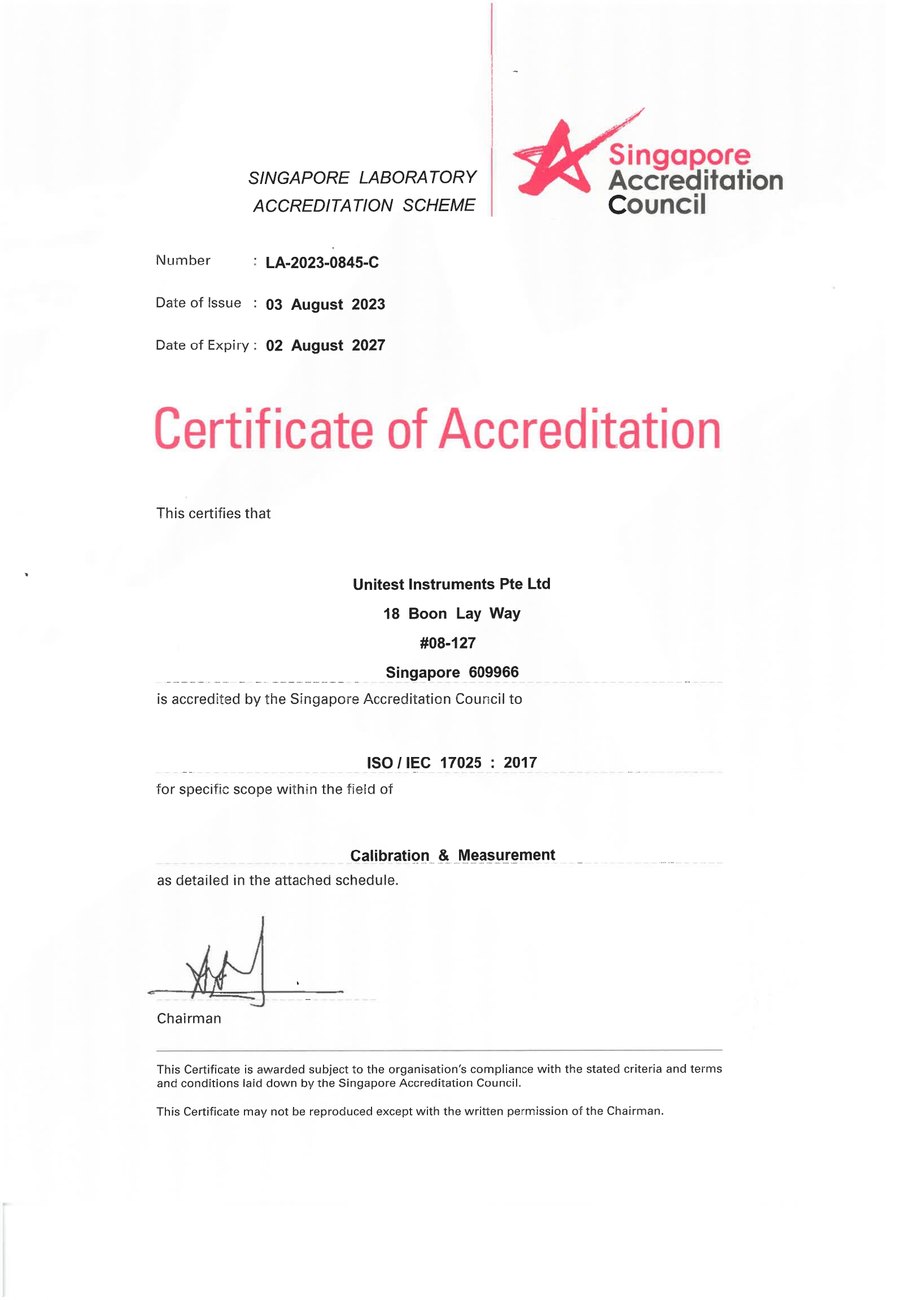
SAC-SINGLAS accredited calibration laboratory (Acc. No. LA-2023-0845-C) serving Singapore's industrial, pharmaceutical, and manufacturing sectors. All content reflects our ISO/IEC 17025 accredited scope and is reviewed by our technical calibration team.
Need IAQ instrument calibration in Singapore?
Unitest Instruments is SAC-SINGLAS accredited (Acc. No. LA-2023-0845-C) to ISO/IEC 17025. Same-week turnaround, certificates accepted by BCA Green Mark assessors and ISO 9001 auditors.