
Key Takeaways
- HSA GDP mandates temperature and humidity mapping for pharmaceutical warehouses; ambient storage must remain between 15°C–30°C and below 75% RH.
- All data loggers and reference instruments must carry current SAC-SINGLAS traceable calibration certificates before the study begins.
- A minimum 7-day continuous study capturing weekday and weekend conditions is required; logging intervals of 5–15 minutes are standard.
- Data logger placement must cover risk zones (loading docks, HVAC vents, corners, and floor-to-ceiling gradients), not just a uniform grid.
- Any change to the building, HVAC, or racking triggers a mandatory requalification mapping study under HSA change control requirements.
Why Warehouse Environmental Mapping Matters in Singapore
Singapore's tropical climate (averaging 27°C and 84% relative humidity year-round), makes uncontrolled warehouse environments a significant risk for temperature-sensitive goods. Without a properly designed and maintained HVAC system, a warehouse can easily exceed the 30°C ceiling required for ambient pharmaceutical storage, even in an air-conditioned building, once you account for solar heat gain through roof panels, heat generated by racking-mounted lighting, and the thermal load from daily goods movement through loading bays.
Temperature and humidity mapping is the formal engineering process of placing calibrated data loggers throughout a storage space to characterise its thermal profile under real operating conditions. The study identifies hot spots, cold spots, moisture gradients, and how conditions vary over time. For regulated industries, the mapping report becomes a qualification document. Evidence that the facility consistently meets the environmental specification for the products stored there.
Beyond regulatory compliance, mapping delivers commercial value. Facilities managers who understand their warehouse's thermal map can optimise placement of high-value or sensitive stock, reduce energy costs by identifying inefficient cooling zones, and negotiate SLA terms with clients who require documented environmental assurance. In Singapore's logistics hub context (where facilities often store pharmaceutical, aerospace, and food products simultaneously), a robust mapping programme is a competitive differentiator.
Singapore Regulatory Framework: Which Agency Applies to You
Responsibility for warehouse environmental conditions is split across multiple Singapore agencies depending on the goods stored. Understanding which regime applies is the first step in building a compliant programme.
Health Sciences Authority (HSA). Pharmaceutical and Health Products
The HSA's Good Distribution Practice (GDP) for medicinal products is the most rigorous standard. Published under the authority of the Health Products Act (Cap. 122D), it requires licensed wholesalers and logistics providers handling registered medicinal products to maintain documented evidence that storage conditions are continuously met. Mapping is explicitly required at facility commissioning, after any facility change, and periodically as part of the ongoing quality system.
HSA's GDP guidelines align with the WHO Technical Report Series 961 (2011) and the PICS GDP Guide (PE 011), which means Singapore-based operators serving export markets in the EU or ASEAN face a single harmonised standard. Ambient medicinal products must be stored at controlled room temperature (15°C to 30°C) with relative humidity not exceeding 75% RH. Cold chain products (2°C to 8°C) and frozen products (below -15°C or per product specification) require separate, validated cold rooms with their own mapping studies.
Singapore Food Agency (SFA). Food and Perishables
Under the Sale of Food Act and its subsidiary legislation, SFA requires licensed food businesses to maintain cold chain integrity for chilled and frozen products. While SFA does not prescribe a formal mapping protocol equivalent to HSA GDP, food safety audits under the Singapore Food Safety Management System (FSMS) (which references Hazard Analysis and Critical Control Points (HACCP)), require operators to document temperature monitoring, demonstrate sensor calibration, and show corrective action records. Temperature monitoring points must be placed at locations representative of the warmest area of the storage space, which is effectively a simplified mapping requirement.
Ministry of Manpower (MOM). Workplace Heat Stress
MOM's Workplace Safety and Health (General Provisions) Regulations require employers to assess environmental hazards including heat stress. For warehouses without air-conditioning (such as open-sided logistics facilities or high-bay steel warehouses in industrial estates), the Wet Bulb Globe Temperature (WBGT) is the key metric. MOM's heat stress guidelines, aligned with SS 586:2020 (Code of Practice for the Management of Occupational Exposure to Heat Stress), set WBGT action limits based on work intensity. Monitoring and documenting WBGT readings in hot zones, again using calibrated instruments, is a practical compliance requirement under MOM's regime.
Civil Aviation Authority of Singapore (CAAS). Airside Cargo
Warehouses handling pharmaceutical or perishable cargo in Singapore Changi Airport's airside cargo terminals must comply with CAAS cargo regulations, which reference IATA's Temperature Control Regulations (TCR). These require that cargo acceptance, build-up, and break-down areas meet the temperature requirements published in the product's air waybill or IATA special handling codes. Airside operators conducting temperature mapping in cargo sheds must do so using instruments calibrated to the same traceability chain required for pharmaceutical GDP. Further emphasising the need for SAC-SINGLAS traceable calibration.
| Agency / Standard | Scope | Temperature Requirement | Mapping Mandatory? |
|---|---|---|---|
| HSA GDP | Pharmaceutical & health products | 15°C–30°C ambient; 2°C–8°C cold chain | Yes, at commissioning and after changes |
| SFA / HACCP | Food & perishables | ≤5°C chilled; ≤-12°C frozen (product-dependent) | Effective yes via FSMS audit |
| MOM WSH | All workplaces (heat stress) | WBGT limits: 28.0–32.2°C depending on work intensity | Required for risk assessment |
| CAAS / IATA TCR | Airside pharma & perishable cargo | Per product/AWB specification | Operationally required |
| BCA Green Mark | Buildings seeking certification | Performance benchmarks for HVAC efficiency | No, but supports compliance evidence |
Calibration Instrument Requirements for Mapping Studies
The quality of a temperature and humidity mapping study is only as good as the instruments used. Regulatory bodies and auditors focus heavily on instrument calibration because a systematic error in your data loggers invalidates the entire study. No matter how well the physical placement was designed.
For pharmaceutical GDP mapping, all temperature and humidity data loggers must be calibrated before the study begins and, where the study runs longer than the calibration interval of the logger, must be recalibrated after. Calibration must be performed by a SAC-SINGLAS accredited laboratory using reference standards traceable to Singapore's National Metrology Centre (NMC). The calibration certificate must show the calibration points, the correction values (offsets), the expanded measurement uncertainty at a coverage factor of k=2 (95% confidence), and the date performed. For more on what a compliant certificate must contain, see our guide to reading a calibration certificate.
Typical Instrument Specifications for Warehouse Mapping
Data loggers suitable for warehouse mapping studies should carry a temperature measurement uncertainty no greater than ±0.5°C and a relative humidity uncertainty no greater than ±3% RH, after applying the calibration correction. For cold chain studies (2°C to 8°C), tighter uncertainty (typically ±0.3°C), is preferred. The logger's battery life must comfortably exceed the study duration, and the logging interval should be configurable to 5 or 15 minutes. Loggers should have a tamper-evident seal applied after calibration and before deployment so that any accidental recalibration or adjustment is detectable.
The reference instrument used to check logger performance in the field (typically a precision thermometer/hygrometer), must itself carry a current calibration certificate. This creates a chain of traceability from the field reading, through the reference standard, to the national standard maintained by NMC. Understanding why this chain matters is fundamental to regulated quality systems; our article on what calibration traceability means explains the concept in detail.
Need your data loggers calibrated before a warehouse mapping study?
Unitest Instruments provides SAC-SINGLAS accredited calibration for temperature and humidity data loggers, with certificates accepted by HSA auditors, ISO 9001 registrars, and pharmaceutical GDP assessors. Same-week turnaround available.
Step-by-Step Warehouse Temperature Mapping Process
A compliant mapping study follows a defined sequence. Skipping steps (particularly the documentation steps), is the most common reason studies are rejected during regulatory audit.
Step 1: Define the Scope and Acceptance Criteria
Before any logger is placed, write a Mapping Protocol document that states: the purpose of the study, the storage area boundaries, the regulatory standard being met (e.g. HSA GDP), the temperature and humidity acceptance limits, the logger placement rationale, the logging interval, the minimum study duration, and the criteria for pass/fail. The acceptance criteria must match the product specification. Not just the general regulatory limit. Some registered products have tighter requirements than the generic 15–30°C ambient band.
Step 2: Calibrate All Instruments
Send all data loggers and the reference standard to a SAC-SINGLAS accredited laboratory at least two weeks before the planned study start date to allow for calibration turnaround. Apply tamper-evident seals after calibration. Retain all calibration certificates. They will be appended to the final mapping report.
Step 3: Plan the Logger Placement Grid
Divide the warehouse floor plan into zones and assign a minimum of one logger per 25–50 sqm. Add additional loggers at every identified risk zone: within 1 metre of loading dock doors, within 1 metre of HVAC supply and return grilles, at the four corners of the space, at mid-floor, and at ceiling level above the highest rack position. For high-bay racking (above 6 metres), place loggers at three vertical levels: floor level, mid-rack, and top-rack. Document the exact planned position of every logger with a warehouse floor plan drawing, using a reference coordinate system.
Step 4: Deploy Loggers and Begin Recording
Position loggers at their planned locations, shielded from direct airflow from HVAC vents (use a radiation shield where necessary) but not so enclosed that natural convection is blocked. Record the actual position of each logger, photograph each placement location. Set all loggers to the agreed logging interval (typically 15 minutes for a 7-day study) and start them simultaneously to allow time-synchronised data comparison. The study should include at least one full weekend to capture the reduced HVAC cycle that many facilities run outside business hours.
Step 5: Monitor and Document Excursions
Do not make any changes to HVAC settings, door usage patterns, or stock placement during the study unless the facility would normally make such changes. Any excursion above or below the acceptance limits must be documented as it occurs, along with the cause and any corrective action taken. If the excursion renders the study invalid, the study must be repeated after the root cause is resolved.
Step 6: Analyse the Data and Write the Report
Download data from all loggers after the study period. Apply the calibration correction offsets to each logger's readings. Generate time-series plots for every logger position and calculate the minimum, maximum, mean, and standard deviation for the study period. Identify the hottest and coldest recorded locations. These become the designated worst-case sensor positions for ongoing continuous monitoring. The final Mapping Report must include: the signed Protocol, all calibration certificates, the floor plan with logger positions, the raw and corrected data sets, the statistical analysis, the worst-case zone identification, the PASS/FAIL conclusion against acceptance criteria, and a recommended ongoing monitoring plan.
Step 7: Implement Ongoing Continuous Monitoring
The mapping study is a qualification exercise, not a substitute for continuous monitoring. Based on the worst-case zones identified, install permanent temperature and humidity sensors at a minimum of those locations. Set alarm thresholds (typically 2°C tighter than the acceptance limit), to allow corrective action before a true excursion occurs. All permanent monitoring sensors must be included in the facility's calibration schedule and recalibrated at defined intervals. For guidance on setting the right calibration interval for your instruments, see our article on how often instruments should be calibrated.
Common Compliance Failures and How to Avoid Them
HSA and ISO 9001 auditors consistently flag the same categories of mapping deficiency. Understanding these in advance prevents costly remediation.
Expired calibration certificates: The most frequent finding. If any data logger used in the study had an expired calibration certificate at the time of deployment, the study data from that logger is considered unreliable and the entire study may be deemed invalid. Build a calibration tracking system (even a simple spreadsheet), with automated alerts 60 days before any certificate expires.
Insufficient study duration: A 24-hour study captures only a fraction of the operating cycle. Weekend data is particularly important because facilities often reduce HVAC operation outside business hours, and Singapore's ambient temperatures on Sunday afternoons can stress air-conditioning systems during peak solar gain. Regulators expect a minimum of 7 continuous days.
Logger placement at convenient rather than risk-based locations: Placing loggers only along walls or at chest height misses the floor-to-ceiling temperature gradient common in high-bay warehouses, and misses the micro-climate immediately behind loading dock doors. The placement must be justified by a documented risk assessment, not convenience.
No worst-case zone identification: The mapping study should conclude by naming the positions with the highest and lowest recorded temperatures and humidity values. These become the anchor points for permanent monitoring. A report that presents raw data without identifying worst-case zones does not satisfy GDP requirements.
No linkage to the ongoing monitoring plan: The mapping report should explicitly state which permanent sensor positions were selected as a result of the study, what alarm thresholds are set, and what the calibration interval for those permanent sensors is. Without this linkage, the mapping study is a historical document with no operational consequence.
Penalties for Non-Compliance in Singapore
The consequences of non-compliance are significant and can be disproportionate to the cost of running a proper mapping programme in the first place.
Under the Health Products Act (Cap. 122D), HSA can issue written warnings, suspend or revoke a wholesale dealer's licence, require product recall across the entire affected batch or supply chain, and initiate prosecution. Conviction can result in a fine of up to S$50,000 per offence and/or imprisonment of up to 2 years. For a licensed pharmaceutical logistics operator, a licence suspension is commercially catastrophic. It halts all regulated operations until remediation is completed and HSA is satisfied.
Under the Sale of Food Act, SFA can suspend or cancel a food establishment licence, issue improvement notices requiring remediation within a fixed timeframe, and prosecute for repeated or egregious violations. Fines range from S$5,000 for a first offence to S$10,000 for subsequent offences per count.
Beyond statutory penalties, operators face reputational and civil liability risk. If temperature excursions lead to product degradation that causes patient harm (for example, a vaccine stored outside its cold chain specification being administered), the operator's failure to maintain and document environmental controls becomes directly relevant to negligence liability. No amount of process optimisation recovers from a product liability case of that nature.
The economics are clear: a comprehensive mapping study for a mid-sized pharmaceutical warehouse costs a small fraction of what a single licence suspension or product recall costs. Investing in proper calibration, rigorous data collection, and documented compliance is straightforwardly the lower-risk and lower-cost path.
Frequently Asked Questions
It depends on the industry. For pharmaceutical and health product warehouses, temperature and humidity mapping is mandatory under HSA's Good Distribution Practice (GDP) guidelines. Food storage facilities regulated by SFA require temperature monitoring for cold chain products. General commercial warehouses are not legally mandated, but mapping is required for ISO 9001 certification, tenant due diligence, and meeting customer audit requirements. Under MOM's Workplace Safety and Health Act, employers must assess and control environmental hazards, which can encompass excessive heat and humidity.
There is no single fixed formula, but the general industry approach is to place one data logger per 25–50 square metres of floor space, with additional loggers at identified risk zones: near loading dock doors, air-conditioning supply and return vents, corners, ceiling level, and floor level. A 1,000 sqm warehouse typically requires a minimum of 20–40 data loggers for a statistically valid mapping study. HSA GDP guidelines require that the mapping covers the entire storage area and identifies the hottest and coldest spots.
Under HSA Good Distribution Practice guidelines, ambient pharmaceutical products must be stored at controlled room temperature, defined as 15°C to 30°C, with relative humidity not exceeding 75% RH. Cold chain products (2°C to 8°C) must remain within that range at all times. Products requiring cold storage (below -15°C) follow tighter limits per the product's registered specifications. Some products carry specific humidity requirements stated on their registration. The mapping must confirm the facility consistently achieves those conditions.
All data loggers and reference instruments used in a mapping study must carry current calibration certificates traceable to a national metrology body, in Singapore, this is the National Metrology Centre (NMC) under A*STAR. For regulated industries (pharmaceutical, food, aerospace), calibration must be performed by a SAC-SINGLAS accredited laboratory such as Unitest Instruments (Acc. No. LA-2023-0845-C). Certificates should show measurement uncertainty, calibration points covering the working range, and the next due date. Expired certificates invalidate the mapping study.
HSA GDP guidelines and international best practice (WHO Technical Report Series 961) recommend a minimum duration that captures the full range of operating conditions. For Singapore warehouses, this typically means at least 7 continuous days including a weekend, at 5- or 15-minute logging intervals. Studies should also be repeated seasonally if significant HVAC changes occur, after facility renovations, after equipment changes, or at a minimum once every 2–3 years as part of ongoing qualification.
Under the Health Products Act (Cap. 122D), HSA can issue a written warning, suspend or revoke a dealer's licence, and require product recall. For serious breaches involving adulterated or degraded health products, prosecution can result in fines of up to S$50,000 per offence and/or imprisonment of up to 2 years. For food storage violations under SFA's Sale of Food Act, penalties include fines up to S$5,000 for a first offence and S$10,000 for repeat offences, plus licence suspension. Beyond legal penalties, non-compliance exposes operators to civil liability if product degradation causes patient or consumer harm.
Yes. Any significant change to the storage environment. Including HVAC replacement, addition of racking systems, installation of new loading docks, changes in storage capacity, or changes to building insulation, triggers a requalification requirement. HSA GDP guidelines classify this as a change control event. A new mapping study must be completed and approved before the modified facility is returned to full service. Minor repairs that do not alter airflow patterns may require only a risk assessment rather than a full re-mapping, but this determination should be documented.
Multiple agencies have jurisdiction depending on the goods stored. The Health Sciences Authority (HSA) governs pharmaceutical and health product warehouses under the Health Products Act and GDP guidelines. The Singapore Food Agency (SFA) regulates food storage temperature under the Sale of Food Act. The Ministry of Manpower (MOM) enforces workplace heat stress standards under the Workplace Safety and Health Act. The Civil Aviation Authority of Singapore (CAAS) applies temperature requirements for airside cargo. BCA's Green Mark scheme sets performance standards for energy-efficient HVAC in warehouses seeking certification.
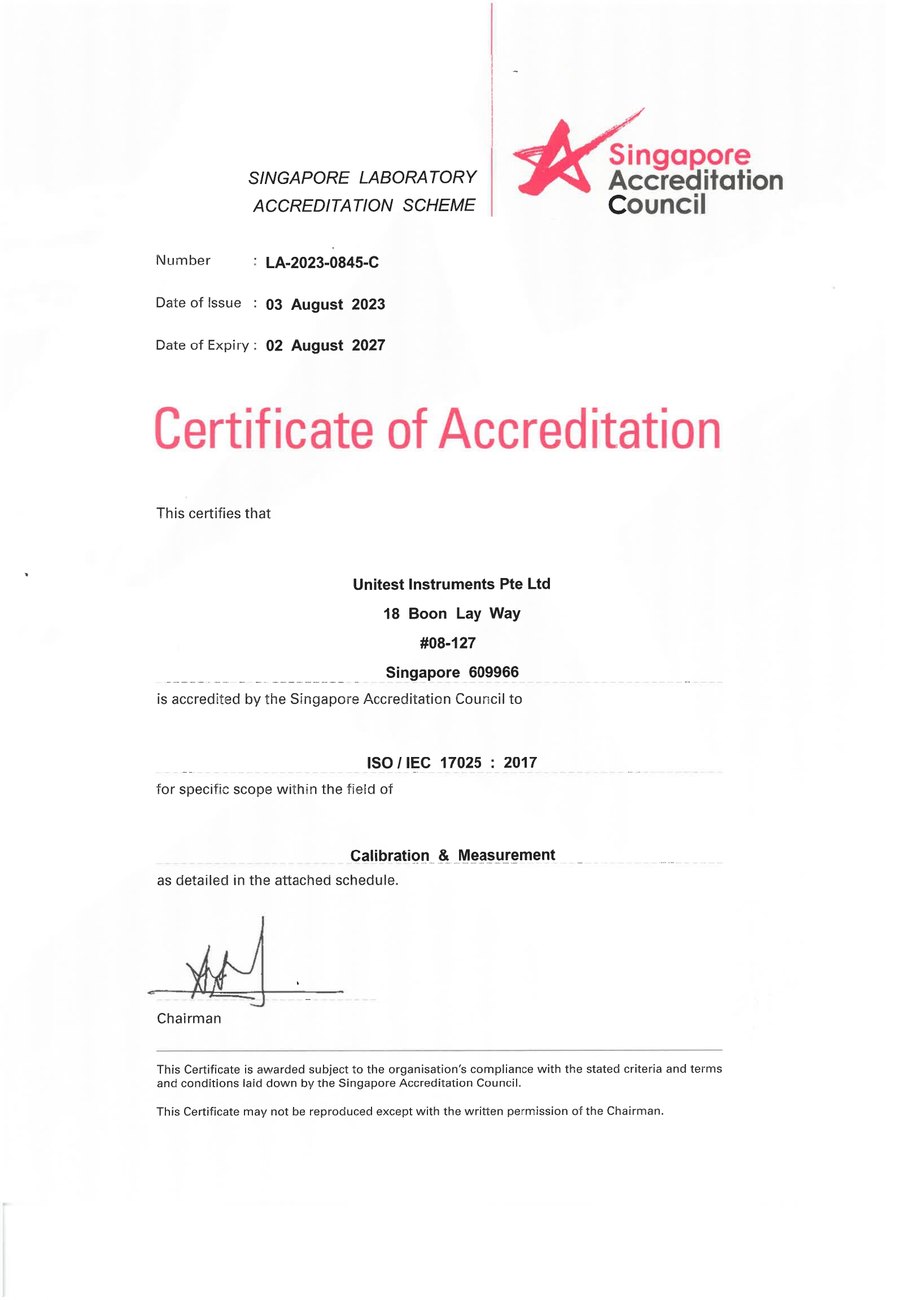
SAC-SINGLAS accredited calibration laboratory (Acc. No. LA-2023-0845-C) serving Singapore's industrial, pharmaceutical, and manufacturing sectors. All content reflects our ISO/IEC 17025 accredited scope and is reviewed by our technical calibration team.
Planning a warehouse mapping study in Singapore?
Unitest Calibration runs temperature and humidity mapping studies as a documented service executed to WHO TRS 961 Annex 9, HSA GDP and GMP protocol, using data loggers calibrated under SAC-SINGLAS accreditation no. LA-2023-0845-C. The accredited traceability sits in the measurement chain behind the study, not in the study itself. Logger calibration on its own is covered on the temperature data logger calibration page, and cold storage on the freezer and cold room calibration page.