
Key Takeaways
- Target ±2% RH accuracy or better for ambient pharma storage; ±1% RH or better for cold-chain and critical zones.
- SAC-SINGLAS accredited calibration (not just factory certificates) is required for GMP qualification and HSA audit readiness.
- Wireless and networked systems such as Rotronic RMS support 21 CFR Part 11 data integrity and real-time alarm escalation, essential for large warehouse footprints.
- Calibration intervals should be formally risk-assessed; annual calibration is the industry minimum in Singapore, with 6-monthly intervals recommended for cold rooms.
- Always size your logger's measurement range and resolution to your storage zone. Ambient (15–30°C, 40–75% RH), refrigerated (2–8°C), or freezer (−25 to −15°C).
Why Pharmaceutical Warehouses in Singapore Need Specialised Data Loggers
Singapore is a major pharmaceutical manufacturing and distribution hub in Southeast Asia, with the Health Sciences Authority (HSA) setting some of the region's most rigorous storage and distribution standards. HSA's Guidance Notes on Good Distribution Practice (GDP) for Medicinal Products, aligned with PIC/S PE 011, require documented, continuous monitoring of temperature and relative humidity across all storage zones. Excursions (even brief ones), must be captured, investigated, and recorded.
Singapore's tropical climate compounds the challenge. Ambient outdoor conditions frequently reach 30–34°C and 80–95% RH. Without a sealed, climate-controlled warehouse and reliable monitoring instrumentation, pharmaceuticals degrade faster than their stated shelf life, and batch integrity becomes questionable. A humidity data logger is not just a regulatory checkbox. It is your earliest warning system for conditions that can destroy product worth millions of dollars.
The key difference between a general-purpose humidity logger and a pharmaceutical-grade one comes down to four factors: accuracy and measurement uncertainty, data integrity (tamper-evident records, audit trails), alarm management (real-time alerts, escalation paths), and calibration traceability (certificates traceable to a national metrology standard). All four are scrutinised during HSA, ISO 9001, and international regulatory audits.
What to Look for Before You Buy: Key Specifications Explained
Accuracy and Resolution
Accuracy is the single most important specification. For ambient pharmaceutical storage (15–25°C, 40–70% RH), target ±2% RH accuracy or better and ±0.5°C temperature accuracy. For refrigerated storage (2–8°C), tighten this to ±1% RH and ±0.3°C. Accuracy should be stated as a maximum error across the full operating range, not just at a single calibration point.
Resolution (the smallest change the instrument can detect) should be at least 0.1% RH and 0.1°C. Many GMP-grade loggers now offer 0.01°C resolution, which is valuable in cold rooms where even 0.5°C variation can indicate equipment performance issues.
Memory Capacity and Logging Interval
WHO TRS 961 recommends logging at intervals of no greater than 15 minutes for ambient zones and 5–10 minutes for cold rooms. A logger covering a one-year calibration cycle at 10-minute intervals needs to store at least 52,560 readings. Most modern units store between 32,000 and 500,000 readings. Verify this matches your logging interval and calibration cycle length, particularly for standalone loggers that are not networked and cannot be remotely interrogated.
Communication Interface
Standalone loggers use USB or RS-232 for periodic data download, which is sufficient for smaller operations. Larger warehouses benefit from Ethernet, Wi-Fi, or proprietary wireless network connectivity that enables real-time monitoring, centralised dashboards, and automated alarm triggers. Ensure that any wireless logger stores data locally (on-device memory) during network outages. Data gaps are an immediate audit finding.
Alarm and Alert Features
Look for configurable high/low set points with audible, visual, and remote (email/SMS) alarm outputs. The alarm must be hard-wired into your escalation SOP. Some systems (e.g. Rotronic RMS) include alarm acknowledgement logging, which creates an automatic audit trail of who responded and when. A significant advantage during regulatory inspections.
Sensor Type and Replacement Cost
Capacitive polymer sensors are the standard for pharmaceutical-grade humidity measurement. Interchangeable sensor heads (as used in Rotronic HC2-series probes) allow the sensor to be removed and individually calibrated without taking the transmitter body offline. A major operational advantage in continuous monitoring environments.
Top Humidity Data Loggers for Pharma Warehouses: Model Comparison
The following models are available through Unitest Instruments or its authorised brand partners (Rotronic, Comark, Fluke, Michell). All are suitable for pharmaceutical warehouse applications when paired with SAC-SINGLAS accredited calibration.
| Model | Brand | RH Accuracy | Temp Accuracy | Communication | Price Range (SGD) | Best For |
|---|---|---|---|---|---|---|
| HC2-SE Probe + HygroLog HL-NT3 | Rotronic | ±1.5% RH | ±0.1°C | USB, RS-485, optional Ethernet | S$1,200–S$2,200 | Primary monitoring, GMP qualification, IQ/OQ documentation |
| RF500A Wireless Data Logger | Comark | ±2% RH | ±0.3°C | Proprietary 868 MHz wireless, USB | S$600–S$1,000 | Multi-zone ambient monitoring, cost-efficient network deployments |
| Fluke 1620A DewK Thermo-Hygrometer | Fluke | ±2% RH | ±0.25°C | USB, Ethernet, Wi-Fi (optional) | S$1,500–S$2,800 | Laboratories, cleanrooms, pharmaceutical R&D areas |
| Michell Instruments HygroMill | Michell | ±1% RH | ±0.2°C | Analogue 4–20 mA, RS-485 Modbus | S$2,500–S$4,500 | High-precision cold rooms, critical storage zones requiring tightest tolerances |
| Rotronic RMS (Remote Monitoring System) | Rotronic | ±1.5% RH (probe-dependent) | ±0.1°C | Ethernet LAN, Wi-Fi, optional GSM | S$4,000–S$12,000+ (system) | Large warehouse networks, 21 CFR Part 11 compliance, multi-site monitoring |
Price ranges are indicative and subject to configuration. Contact unitestshop.com for current pricing and availability. All units require independent SAC-SINGLAS calibration before GMP use.
Need your humidity data logger calibrated to GMP standards?
Unitest Instruments (Acc. No. LA-2023-0845-C) provides SAC-SINGLAS accredited humidity and temperature calibration with full measurement uncertainty statements. Accepted by HSA, ISO 9001, and international regulatory auditors. Same-week turnaround available.
Singapore Regulatory Context: HSA GDP, PIC/S, and WHO Requirements
Singapore's pharmaceutical warehouses operate under a layered regulatory framework. The Health Sciences Authority's GDP Guidance Notes require that all storage facilities maintain temperature and humidity within the conditions specified on each product's label, with continuous documented monitoring. This monitoring must use calibrated instruments, and the calibration must be traceable.
PIC/S PE 011-1 (Guide to Good Distribution Practice for Medicinal Products) specifically requires that "equipment used for monitoring should be calibrated at defined intervals" and that calibration records be retained. WHO Technical Report Series 961, Annex 9, goes further, recommending mapping studies for storage areas using calibrated data loggers to identify hot spots and cold spots before routine monitoring begins.
For exporters and manufacturers supplying markets such as the EU, US (FDA), and Australia (TGA), additional requirements may apply. The EU GDP Guidelines (2013/C 343/01) require that temperature-mapping exercises be performed during both winter and summer conditions in Singapore's climate. Where "winter" effectively means the Northeast Monsoon season (November–January), which can bring slightly lower ambient temperatures. Understanding these seasonal variations is important when specifying alarm set points.
Importantly, Singapore's Accreditation Body (SAC) is a signatory to the ILAC Mutual Recognition Arrangement (MRA). This means that calibration certificates issued by SAC-SINGLAS accredited laboratories (such as Unitest Instruments), are mutually recognised by regulatory bodies in over 100 countries. This is a significant advantage for pharmaceutical companies operating across multiple markets from their Singapore base.
For a full explanation of why accredited calibration matters for regulatory compliance, see our guide: Accredited vs Non-Accredited Calibration: What's the Difference?
Calibration Requirements for Newly Purchased Instruments
One of the most common compliance gaps identified during HSA and ISO 9001 audits is the use of newly purchased instruments that carry only a manufacturer's factory calibration certificate. This is not sufficient for GMP pharmaceutical use in Singapore for two reasons.
First, factory calibration may not be performed to ISO/IEC 17025 standards, and the factory's own quality management system may not be independently audited. Second, the factory certificate does not establish traceability to Singapore's National Metrology Centre (NMC). A requirement under HSA guidelines for instruments used in licensed pharmaceutical premises.
The correct process is: purchase the instrument, send it to a SAC-SINGLAS accredited laboratory such as Unitest for initial calibration, receive an accredited certificate, then place the instrument into service. This initial calibration reading also establishes a baseline that can be compared against future calibrations to detect drift over time. A requirement under most pharmaceutical equipment management SOPs.
Understanding what information should appear on a calibration certificate is equally important. Our article How to Read a Calibration Certificate walks through each field and explains what auditors check for.
Unitest Instruments' SAC-SINGLAS accredited scope covers humidity and temperature measurement across ranges relevant to pharmaceutical warehouse applications. We calibrate both the humidity sensing element and the temperature sensor in combination, issuing a single certificate covering both measurands, which simplifies your documentation management.
Deployment Best Practices: Getting the Most from Your Data Logger
Mapping Studies Before Routine Monitoring
Before selecting fixed monitoring positions, conduct a temperature and humidity mapping study using a larger array of calibrated loggers placed throughout the warehouse. WHO guidance recommends a minimum grid of one logger per 25 m² of floor area, with additional loggers near doors, air-handling units, and external walls. Mapping identifies hot and cold spots. Your permanent loggers should then be positioned at the worst-case locations identified during mapping.
Probe Placement and Shielding
Position probes away from direct airflow from air-conditioning units, which can cause artificially low readings. Probes near external walls or loading dock doors will show faster excursions and should have tighter alarm thresholds. Use radiation shields (sun shields) on outdoor-facing probes to prevent radiant heat from biasing temperature readings. Rotronic and Michell both offer purpose-designed radiation shields and probe housings for pharmaceutical environments.
Alarm Set Points and Excursion Management
Set your warning alarm inside your action limit, for example, if your product specification requires ≤25°C, set your warning alarm at 24°C and your action alarm at 25°C. This gives you response time before a product excursion occurs. Document your alarm set points, response procedures, and escalation contacts in a formal SOP. When an alarm fires, the response, investigation, and corrective action must all be recorded. Your data logger's audit trail is the primary evidence source.
Backup Power and Data Continuity
All pharmaceutical monitoring systems should have uninterruptible power supply (UPS) backup so that data continues to be logged during power interruptions. Standalone loggers with internal batteries automatically handle this; networked systems require UPS on both the logger nodes and the central server/gateway. Verify that your system stores data locally during network outages and synchronises automatically on reconnection. Unrecovered data gaps are a serious audit finding.
Choosing the Right Model for Your Application
The right humidity data logger depends on your warehouse type, size, and regulatory exposure. Here is a practical decision framework:
- Small ambient warehouse (under 500 m², single zone): Comark RF500A or Fluke 1620A. Simple deployment, easy USB data download, lower cost. Pair with annual SAC-SINGLAS calibration.
- Mid-size ambient warehouse (500–5,000 m², multiple zones): Rotronic HC2-SE probes with HygroLog NT3 data loggers, or a small Rotronic RMS installation with 4–12 nodes. Ethernet connectivity enables real-time monitoring without manual data downloads.
- Large distribution centre or GDP-licensed facility: Rotronic RMS (full system) with Ethernet backbone, alarm management software, and 21 CFR Part 11 audit trail. This is the industry standard for Singapore's major pharmaceutical 3PL operators.
- Cold rooms (2–8°C) or freezers (−25 to −15°C): Michell HygroMill or Rotronic HC2-SE with low-temperature probe. Both rated for operation below freezing. Verify that the logger's own electronics (if mounted inside the cold room) are rated for the storage temperature.
- Cleanrooms and aseptic manufacturing: Fluke 1620A or Rotronic HC2-SE. Choose probes with smooth, wipeable surfaces and verify that probe materials are compatible with your cleaning and disinfection agents.
You can browse and purchase Rotronic, Comark, Fluke, and Michell humidity data loggers directly at unitestshop.com, where you can also request SAC-SINGLAS calibration at point of purchase.
Data Integrity and 21 CFR Part 11: What Actually Matters in Practice
For pharmaceutical companies in Singapore supplying markets that reference FDA-aligned data integrity expectations, the phrase "21 CFR Part 11 compliant" appears on nearly every vendor's product sheet, but the practical requirements behind that label are worth understanding rather than taking on trust. The core expectations are audit trails that record who changed what, when, and why (with the original value preserved, not overwritten); electronic signatures tied to a unique, non-shared user login rather than a shared device password; and system validation evidence showing the logging platform was tested to do what it claims before it went into GMP use. A logger that stores raw temperature and humidity values in an editable spreadsheet-style export, with no record of whether or when a value was altered after the fact, does not meet this bar regardless of how the marketing material describes it.
The distinction that trips up many Singapore facilities is between data integrity at the software level and calibration traceability at the measurement level, the two are related but not the same compliance question. A system can have an impeccable, tamper-evident audit trail and still be producing inaccurate readings if the underlying sensor is out of calibration; conversely, a perfectly calibrated sensor feeding into a system with no audit trail still leaves you unable to prove, after the fact, that the record an inspector is reviewing has not been altered. Both layers need to be right, and when evaluating a system like Rotronic RMS or an equivalent networked platform, ask the vendor specifically how the audit trail is implemented (server-side, tamper-evident logging is the standard to look for) separately from asking about the sensor's own accuracy specification and calibration interval.
What Happens After an Excursion: The Investigation Your Logger Needs to Support
The value of a well-specified humidity data logger is not just in preventing excursions, it is in giving your quality team enough information to investigate one properly when it inevitably happens. A defensible excursion investigation, the kind that satisfies an HSA or PIC/S-aligned auditor, needs to answer four questions from the logger's own record: how far outside the specification did the condition go, for how long, was the excursion isolated to one probe location or did it affect the whole zone, and what was happening operationally at the time (a door left open, an air-handling unit fault, a delivery in progress). A logger with only a single alarm threshold and no continuous trend data can tell you that an excursion occurred, but it cannot support the severity assessment that determines whether affected stock needs to be quarantined, tested, or can be released with a documented rationale.
This is the practical argument for continuous logging at short intervals (WHO TRS 961's 5–15 minute recommendation) over sparse spot-checks: a full trend graph showing a gradual two-hour rise and fall tells a very different, much less serious story than the same peak reading captured as an isolated data point with no context either side of it. Build your excursion SOP around pulling the full trend data (not just the alarm event) for the affected zone and time window, cross-referencing it against warehouse activity logs, and documenting the severity rationale in writing before any release decision is made; this is the single most common gap we see when reviewing a facility's data logger deployment against what their own SOP actually requires them to produce during an investigation.
Frequently Asked Questions
For pharmaceutical warehouses in Singapore, HSA GMP guidelines and WHO Technical Report Series 961 recommend humidity measurement accuracy of ±2% RH or better and temperature accuracy of ±0.5°C or better. High-value biologics, vaccines, or cold-chain products may require tighter tolerances. Look for instruments calibrated to a traceable standard (ideally SAC-SINGLAS accredited calibration), so your records satisfy regulatory auditors.
HSA's GMP guidelines do not specify a fixed interval, but most pharmaceutical QA teams in Singapore adopt an annual calibration cycle as a minimum. High-traffic or harsh environments (high humidity, chemical vapours) may require 6-monthly calibration. Your calibration interval should be formally risk-assessed and documented in your equipment management SOP. SAC-SINGLAS accredited calibration certificates are widely accepted by HSA auditors and international regulatory bodies.
A data logger stores readings digitally in internal memory and typically exports via USB, Bluetooth, or LAN, while a traditional chart recorder produces a paper trace. For modern pharma warehouses in Singapore, electronic data loggers are strongly preferred because they align with 21 CFR Part 11 and PIC/S data integrity requirements. Digital records are harder to tamper with, easier to audit, and simpler to archive. Most new installations use networked or wireless loggers rather than chart recorders.
Yes. Factory calibration certificates provided with new instruments are often issued by the manufacturer's own lab and may not meet Singapore's regulatory expectations. For GMP use, you should obtain an independent SAC-SINGLAS accredited calibration certificate (such as those issued by Unitest Instruments, Acc. No. LA-2023-0845-C) before the logger is placed into service. This establishes a traceable baseline and is required for IQ/OQ documentation under GMP validation protocols.
The primary references are HSA's Guidance Notes on Good Distribution Practice (GDP) for Medicinal Products, HSA GMP guidelines aligned with PIC/S PE 009, and WHO Technical Report Series 961 (Annex 9. Model guidance for the storage and transport of time- and temperature-sensitive pharmaceutical products). Cold-chain products must also comply with HSA's requirements on cold chain management. Calibration records with traceable, accredited certificates are a standard audit finding when missing.
WHO and PIC/S guidance recommend logging at intervals no greater than 15 minutes for ambient warehouses, and no greater than 5–10 minutes for cold rooms and temperature-sensitive zones. Shorter intervals (1–5 min) are advisable near air-handling unit outlets or in areas with rapid temperature fluctuation. Most modern loggers allow configurable intervals. Select an interval that captures transient excursions without producing unmanageable data volumes.
Yes, wireless loggers are widely deployed in GMP pharmaceutical warehouses. The critical requirements are: the wireless protocol must not interfere with other equipment (Wi-Fi 2.4/5GHz or proprietary 868/915 MHz ISM bands are common), data transmission must be secure and tamper-evident, and the system must maintain data integrity even during network outages (via onboard memory buffer). Systems such as the Rotronic RMS are purpose-built for GMP wireless monitoring and include audit-trail and alarm escalation features.
A SAC-SINGLAS accredited calibration certificate must include: the instrument identification (make, model, serial number), the calibration date and due date, the reference standards used (with their own traceability chain to NMC Singapore), the measurement results at each calibration point, the measurement uncertainty, and the laboratory's accreditation number (Unitest Instruments: LA-2023-0845-C). Some certificates also include a pass/fail assessment against your stated acceptance criteria. Retain these certificates for the life of the equipment plus a defined retention period per your SOP.
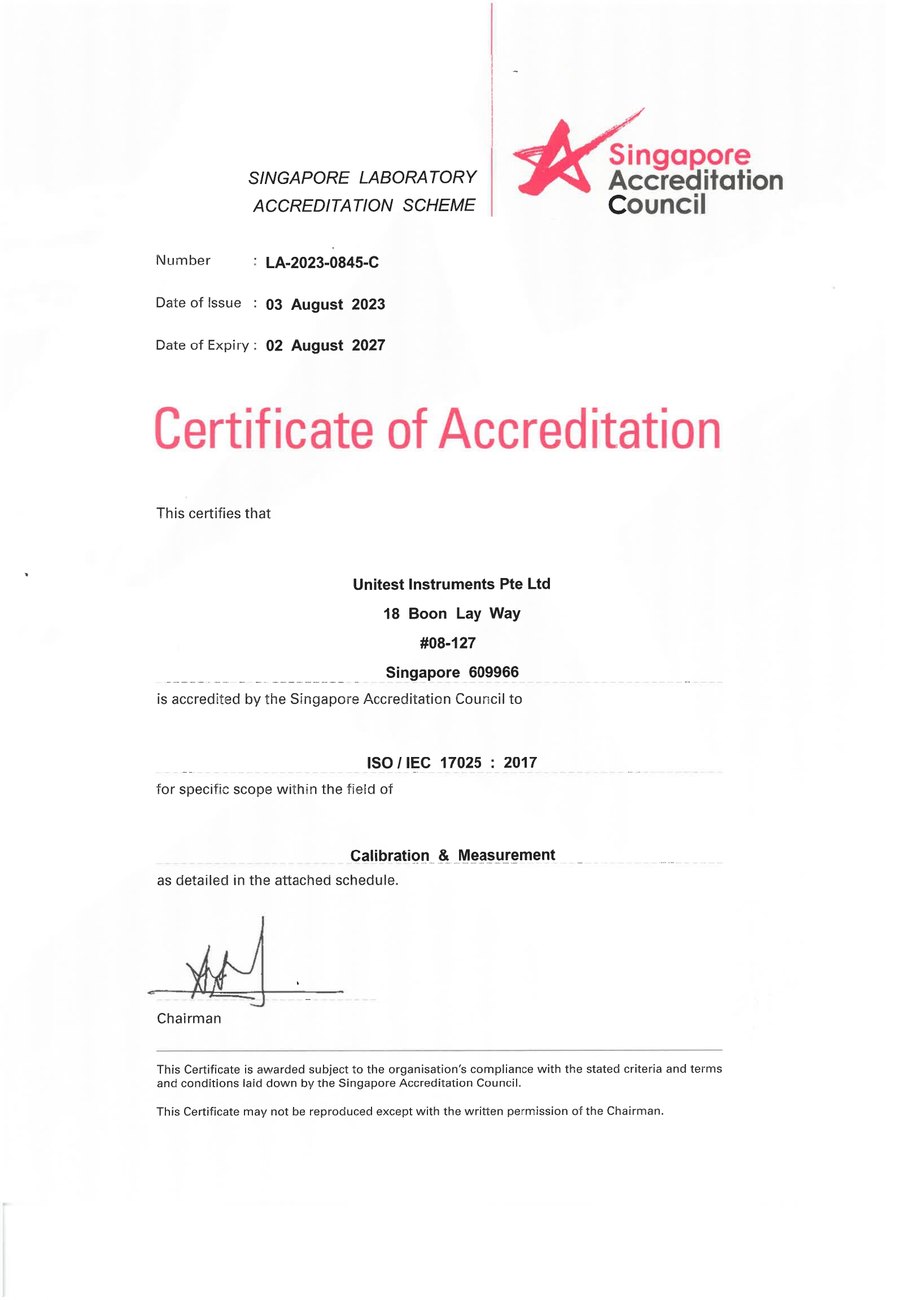
SAC-SINGLAS accredited calibration laboratory (Acc. No. LA-2023-0845-C) serving Singapore's industrial, pharmaceutical, and manufacturing sectors. All content reflects our ISO/IEC 17025 accredited scope and is reviewed by our technical calibration team.
Need humidity and temperature calibration in Singapore?
Unitest Instruments is SAC-SINGLAS accredited (Acc. No. LA-2023-0845-C) to ISO/IEC 17025. Same-week turnaround, certificates accepted by HSA, ISO 9001 auditors, and international regulatory bodies under the ILAC MRA.