
Key Takeaways
- Temperature mapping must use calibrated sensors traceable to NMC Singapore. Non-traceable instruments invalidate the entire validation exercise.
- EN 285 (large sterilisers) requires a minimum of 11 sensors; EN 13060 (bench-top) requires a minimum of 8 sensors distributed to cover all critical chamber zones.
- The acceptance criterion for the sterilisation hold phase is ±2°C of the set temperature at all sensor positions simultaneously.
- Pre-vacuum autoclaves must pass a Bowie-Dick test every operating day before the first patient/product cycle. A failed result means the machine is taken out of service.
- Full requalification is triggered by major maintenance, relocation, load configuration changes, or consistent monitoring drift.
- HSA-licensed pharmaceutical manufacturers and MOH-licensed healthcare institutions both face licence-level consequences for non-compliant validation records.
Why Autoclave Validation Is a Regulatory Requirement in Singapore
Steam sterilisation is the primary method for rendering surgical instruments, medical devices, and pharmaceutical products free from viable microorganisms in Singapore's healthcare and manufacturing sectors. An autoclave that is not validated is, from a regulatory standpoint, an unqualified piece of equipment. Meaning any item processed through it cannot be deemed sterile, regardless of what the machine's display shows.
Singapore's regulatory framework for autoclave validation draws on two primary authorities. The Health Sciences Authority (HSA) oversees pharmaceutical manufacturers and medical device companies under the Health Products Act. Its Good Manufacturing Practice guidelines, aligned with the PIC/S Guide to GMP, require documented installation qualification (IQ), operational qualification (OQ), and performance qualification (PQ) for all sterilisation equipment. The Ministry of Health (MOH) regulates healthcare institutions (hospitals, specialist outpatient clinics, day surgery centres, dental practices), under the Private Hospitals and Medical Clinics Act and its associated licensing conditions. Both sets of requirements converge on the same core technical standards: EN 285 for large steam sterilisers and EN 13060 for small steam sterilisers, both adopted by reference in Singapore's regulatory guidance documents and SS 514.
For facilities managers and compliance officers, the practical implication is straightforward: if your facility sterilises reusable instruments or processes sterile products, you need documented, instrument-traceable evidence that your autoclave achieves the required temperature at every point in the chamber. Temperature mapping is that evidence.
Understanding Temperature Mapping: What It Is and What It Proves
Temperature mapping (also called heat distribution testing during performance qualification), involves placing multiple calibrated temperature sensors throughout the autoclave chamber and recording temperature data at each sensor simultaneously across multiple sterilisation cycles. The goal is to construct a three-dimensional picture of how temperature is distributed in the chamber during each phase of the cycle: the come-up phase (heating), the plateau or hold phase (sterilisation), and the exhaust phase (cooling).
The critical phase is the hold (sterilisation) phase. For the standard porous load (wrapped instrument) cycle at 134°C with a 3-minute hold, every sensor in the chamber must record a temperature within ±2°C of 134°C (that is, between 132°C and 136°C), for the entire hold period simultaneously. If even one sensor drops below 132°C at any point during the hold, the mapping run is a failure and an investigation must follow before the autoclave is cleared for clinical use.
Standard Sterilisation Cycles and Their Temperature Tolerances
| Cycle Type | Set Temperature | Minimum Hold Time | Acceptance Band (all sensors) | Typical Application |
|---|---|---|---|---|
| Porous load (pre-vacuum) | 134°C | 3 minutes | 132°C – 136°C | Wrapped instruments, packs, drapes |
| Unwrapped (flash) | 134°C | 3 minutes | 132°C – 136°C | Immediately-used unwrapped instruments |
| Gravity displacement | 121°C | 15 minutes | 119°C – 123°C | Fluid media, non-porous items |
| Pharmaceutical terminal | 121°C | 15–20 minutes | 119°C – 123°C | Aqueous pharmaceutical preparations |
Mapping must be performed with the autoclave loaded to its maximum validated configuration. An empty chamber mapping does not qualify a loaded cycle. EN 285 also requires that the temperature equilibration time (the time between the chamber reference point reaching the set temperature and the last load sensor reaching it) does not exceed 15 seconds for porous load cycles.
Sensor Requirements and Placement Protocols
The number and placement of temperature sensors is not left to the operator's discretion. Both EN 285 and EN 13060 specify minimum requirements, and Singapore's regulatory bodies expect these to be met as a baseline. Falling short on sensor count or placement is a common finding in audits and is treated as a protocol deficiency that can invalidate the mapping data.
EN 285 Requirements (Large Steam Sterilisers)
For large steam sterilisers (chamber volume exceeding 60 litres), EN 285 requires a minimum of 11 temperature sensors:
- One sensor at the chamber drain (the coolest point in most gravity systems)
- One sensor at the reference point (typically the geometric centre of the test pack, representing the coldest load point)
- A minimum of nine sensors distributed throughout the chamber volume, including positions at the eight corners of the chamber plus the geometric centre
In practice, validation specialists often place additional sensors at identified risk zones (areas near doors, steam inlet points, or load interfaces), to build a more complete picture. This is best practice and is supported by the principle that the mapping study should identify the coldest point in the chamber, which becomes the validated reference point for ongoing routine monitoring.
EN 13060 Requirements (Small/Bench-Top Sterilisers)
For bench-top sterilisers (chamber volume not exceeding 60 litres), EN 13060 requires a minimum of 8 temperature sensors: one at the chamber drain, one at the reference point, and six distributed through the chamber. The same principle of covering the full three-dimensional chamber space applies.
Need calibrated temperature sensors for autoclave validation in Singapore?
Unitest Instruments provides calibration of thermocouples, RTDs, and temperature data loggers to EN 285 and PIC/S requirements, with full traceability to NMC Singapore and calibration certificates accepted by HSA and MOH auditors.
The Bowie-Dick Test: Daily Air Removal Verification
The Bowie-Dick test is distinct from temperature mapping. It does not assess sterilisation temperature achievement, but rather checks that the autoclave's vacuum system is removing air effectively before steam penetration. Air is a poor conductor of heat and, if trapped within a porous load, creates cool pockets that prevent steam from contacting all surfaces. A pre-vacuum autoclave that fails to remove air correctly cannot be trusted to sterilise porous loads, regardless of what the chamber temperature sensors report.
The test uses a standardised test pack (either the traditional Bowie-Dick test pack or an equivalent ISO 11140-4 Class 2 chemical indicator system) placed in the empty chamber at the front of the steriliser in the manufacturer's specified position. The standard pre-vacuum cycle is run. The chemical indicator on the test sheet changes colour uniformly across its entire surface only when steam penetration is complete and uniform. Any non-uniform colour change (streaks, pale patches, or a halo pattern), indicates residual air and constitutes a test failure.
Bowie-Dick Test Frequency and Documentation
MOH licensing requirements for healthcare institutions and the EN 285 standard both specify that the Bowie-Dick test must be performed daily, as the first cycle of the operating day, in every pre-vacuum autoclave used for porous load sterilisation. The results must be documented with:
- Date and cycle run time
- Autoclave identification number
- Test pack batch number and expiry date
- Pass/fail result (the used indicator sheet should be retained or a photograph documented)
- Operator name and signature
A failed Bowie-Dick result must trigger immediate removal of the autoclave from service. The fault (which is most commonly a leaking door seal, a faulty vacuum pump, or a blocked steam line filter), must be identified, corrected, and a successful re-test performed and documented before the autoclave is returned to use. Continuing to use an autoclave after a failed Bowie-Dick test is a serious compliance breach.
Calibration Instruments Required for Autoclave Validation
The quality of a temperature mapping study is entirely dependent on the calibration status of the instruments used. Regulatory bodies (particularly HSA auditors reviewing pharmaceutical GMP compliance), will routinely ask to see the calibration certificates for every instrument used in a validation study. An expired certificate, a certificate from a non-accredited laboratory, or a certificate with inadequate traceability documentation will cause the validation study to be rejected. Understanding this is important, as it directly connects the ISO/IEC 17025 calibration requirements to the practical process of autoclave validation.
Reference Temperature Standard
The calibration hierarchy starts with a reference thermometer used as the on-site working standard against which all probes are compared before and after a mapping study. This reference should be a precision platinum resistance thermometer (PRT) or a NIST/NMC-traceable reference thermometer with an expanded uncertainty of ±0.05°C or better. It must be calibrated by an SAC-SINGLAS accredited laboratory with calibration points that cover the sterilisation range (typically 100°C to 140°C).
Multipoint Temperature Data Loggers and Probes
The mapping itself is performed using multipoint data loggers connected to Type T or Type K thermocouples, or to Pt100 RTD probes rated for saturated steam environments. Type T thermocouples (copper-constantan) are commonly preferred for steam sterilisation validation because they perform well in the 100–150°C range and resist corrosion in a steam environment. All probes must be individually calibrated. Not just the data logger body. Individual probe calibration is required because probe-to-probe variation is the primary source of measurement uncertainty in a multipoint system.
Pressure Reference
In addition to temperature, the chamber pressure must be verified against a calibrated pressure reference. For a 134°C steam cycle, the corresponding saturated steam pressure is approximately 3.0 bar absolute (2.0 bar gauge). A calibrated precision pressure gauge or digital pressure transducer must be used to verify that the autoclave's pressure display is accurate. The understanding of measurement uncertainty is essential here. The pressure reference must have a stated expanded uncertainty that is significantly smaller than the autoclave's acceptance tolerance.
| Instrument | Specification | Calibration Requirement | Calibration Interval (typical) |
|---|---|---|---|
| Reference PRT thermometer | ±0.05°C expanded uncertainty | SAC-SINGLAS accredited lab, NMC traceable | 12 months |
| Type T thermocouple probes | Rated to 150°C, steam-compatible | Individual probe calibration, 3-5 points in range | 12 months or after each mapping study |
| Pt100 RTD probes | Class A or better, 4-wire | Individual probe calibration | 12 months |
| Multipoint data logger | 0.1°C resolution minimum | Calibrated with probes attached | 12 months |
| Pressure reference gauge | ±0.1% FS or better | SAC-SINGLAS accredited lab, NMC traceable | 12 months |
Step-by-Step Compliance Process for Singapore Facilities
For facilities managers approaching autoclave validation for the first time or preparing for a regulatory audit, the following sequence covers the complete compliance lifecycle:
- Installation Qualification (IQ): Document that the autoclave is installed according to the manufacturer's specifications. Record model, serial number, utilities connections, chamber dimensions, and initial calibration status of all built-in instruments (temperature sensors, pressure gauges, chart recorders).
- Operational Qualification (OQ): Verify that the autoclave operates within specification across its full operating range using calibrated external instruments. This includes verifying cycle parameters (temperature, pressure, hold time, and vacuum levels), against the machine's own displays.
- Performance Qualification (PQ) / Temperature Mapping: Run at least three successive successful mapping runs with the validated load configuration. All sensors must meet the acceptance criteria in all three runs. One failed run requires investigation and does not necessarily invalidate the study, but three consecutive passes are required for qualification.
- Routine Monitoring: After qualification, ongoing daily Bowie-Dick tests, cycle parameter recording, and periodic biological indicator testing maintain the validated state. Built-in temperature sensors should be calibrated at least annually.
- Requalification Triggers: Document a formal change control procedure. Any trigger event (major repair, relocation, load configuration change, consistent monitoring drift, or failed routine test), requires a formal requalification event before the autoclave returns to validated use.
Penalties for Non-Compliance in Singapore
Regulatory consequences for autoclave validation failures in Singapore are graduated based on the severity and sector. For HSA-licensed pharmaceutical manufacturers, GMP non-compliance related to sterilisation validation can result in warning letters with required corrective action plans, import/export restrictions on affected products, product recall orders, suspension of manufacturing licence for affected product categories, or in serious cases, revocation of the manufacturer's licence. The HSA conducts both scheduled and unannounced GMP inspections, and sterilisation records are a priority review area.
For MOH-licensed healthcare institutions, the consequences are channelled through the licensing framework. MOH can impose conditions on a facility's licence, require a mandatory corrective action timeline, restrict the use of specific equipment pending rectification, or in the most serious cases (where patient safety is at immediate risk), suspend part or all of a facility's licensed activities. Beyond direct regulatory action, a facility that cannot demonstrate validated sterilisation equipment faces significant liability exposure in the event of surgical site infections or adverse events linked to instrument processing.
It is worth noting that CAAS-regulated aviation maintenance organisations and MPA-regulated marine vessel operators that maintain sterilisation equipment for medical bays are also expected to comply with their respective authority's requirements for equipment maintenance and calibration records. While these are less common contexts, the principle is identical: documented, traceable calibration is the foundation of any defensible compliance position.
Frequently Asked Questions
Temperature mapping is the process of placing calibrated temperature sensors at multiple locations throughout an autoclave chamber to verify that every point reaches and maintains the required sterilisation temperature. In Singapore, healthcare facilities regulated by MOH and pharmaceutical manufacturers licensed by HSA are required to validate and periodically revalidate their sterilisation equipment. This aligns with SS 514, EN 285 for large steam sterilisers, and HSA's GMP guidelines. Without temperature mapping, you cannot demonstrate that all parts of your load achieved the required sterility assurance level, which is a critical compliance gap during inspections.
The minimum depends on the chamber volume and applicable standard. EN 285 requires at least 11 temperature sensors for large steam sterilisers: one in the chamber drain, one at the reference point (test pack), and at least nine distributed throughout the chamber including corners, centre, and near the door. For smaller bench-top autoclaves covered under EN 13060, a minimum of 8 sensors is required. All sensors must be individually calibrated with traceability to NMC Singapore, and must have a measurement uncertainty within the allowable tolerance band, typically ±0.5°C expanded uncertainty or better.
The Bowie-Dick test checks the efficacy of air removal and steam penetration in pre-vacuum steam sterilisers. It verifies that the vacuum system is functioning correctly and that steam can penetrate the porous load without being obstructed by residual air pockets. In Singapore, the Bowie-Dick test is required daily before the first sterilisation cycle for any pre-vacuum autoclave used in healthcare settings. This requirement follows EN 285 and ISO 11140-4. A failed result means the autoclave must be taken out of service until the fault is corrected and a re-test passes.
Autoclave validation requires: (1) calibrated temperature data loggers with Type T or Type K thermocouples or Pt100 RTD probes rated for steam environments up to 140°C; (2) a calibrated pressure reference to verify chamber pressure; (3) a traceable reference thermometer for in-situ comparison. All instruments must carry current calibration certificates traceable to A*STAR NMC via an SAC-SINGLAS accredited laboratory. Calibration uncertainty for the reference standard should not exceed one-third of the acceptance tolerance, for a ±2°C band, the reference instrument should achieve ±0.5°C or better.
Full autoclave requalification (including temperature mapping) is typically required annually as a minimum, after any major maintenance or relocation, after any significant load configuration change, and when Bowie-Dick or routine monitoring results show consistent drift or failures. HSA GMP guidelines require documented change control procedures that trigger revalidation. MOH licensing audits expect evidence of periodic requalification. Calibration instruments used in each requalification must carry valid, in-date calibration certificates.
For a 134°C porous load cycle, EN 285 requires: all sensors must read within ±2°C of the set temperature during the plateau phase; no sensor may fall below 134°C during the hold period; and temperature equilibration time must not exceed 15 seconds for wrapped goods. For 121°C gravity cycles, a ±2°C band (119–123°C) applies throughout the hold. If any sensor records outside the acceptance band during the hold phase, the mapping run fails and must be investigated before the autoclave can be validated for use.
For HSA-licensed pharmaceutical manufacturers, non-compliance can result in warning letters, licence suspension, product recalls, or licence revocation. For MOH-licensed healthcare institutions, consequences include conditions imposed on the licence, mandatory corrective action plans, restriction of equipment use, or suspension of licensed activities. Beyond regulatory penalties, facilities using non-validated autoclaves face civil liability if patient harm results from inadequate sterilisation. Routine calibration and documented validation are the primary evidence of due diligence in any regulatory or legal review.
Temperature mapping can be performed by trained in-house personnel or by a qualified external validation service provider. However, the calibration of the instruments used for mapping must be performed by an SAC-SINGLAS accredited laboratory for Singapore regulatory acceptance. HSA and MOH auditors will review the calibration certificates for all instruments used in the validation study. Using uncalibrated or non-traceably calibrated instruments renders the entire mapping exercise non-compliant, even if the procedure itself was correctly followed.
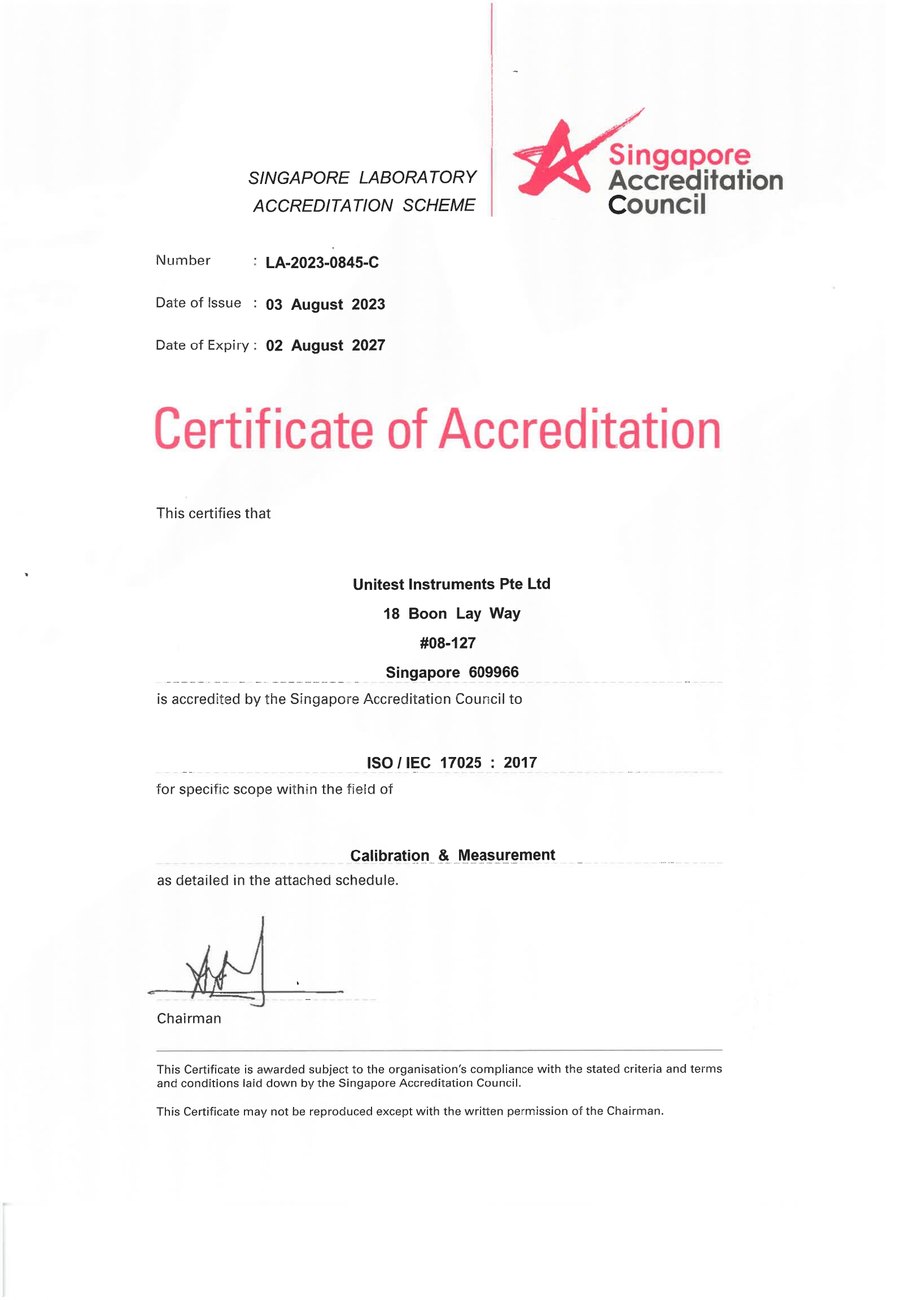
SAC-SINGLAS accredited calibration laboratory (Acc. No. LA-2023-0845-C) serving Singapore's industrial, pharmaceutical, and manufacturing sectors. All content reflects our ISO/IEC 17025 accredited scope and is reviewed by our technical calibration team.
Need temperature and pressure calibration for autoclave validation in Singapore?
Unitest Instruments is SAC-SINGLAS accredited (Acc. No. LA-2023-0845-C) to ISO/IEC 17025. We calibrate thermocouples, RTDs, data loggers, and pressure references for sterilisation validation studies. Same-week turnaround, certificates accepted by HSA and MOH auditors.