
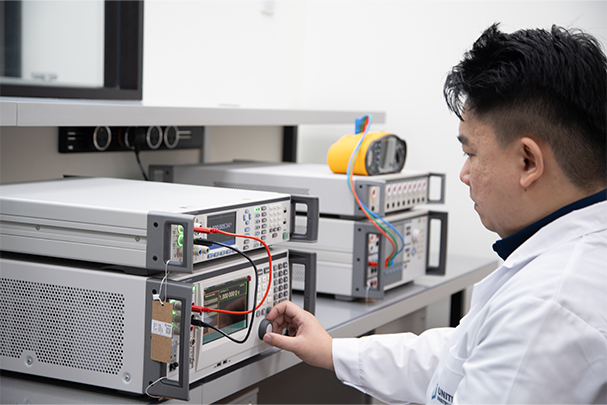
Key Takeaways
- IEC 61000-4-30 defines Class A (highest accuracy, legally defensible) and Class S (survey/general use). Confirm which class your application requires before purchasing.
- Singapore's SS 628 and EMA grid code reference IEC 61000-4-30 Class A for formal power quality compliance assessments at the point of supply.
- Fluke 1760 and Vitrek PA900 are the leading Class A instruments for 3-phase logging; the Fluke 435-II is the most common portable Class A option in Singapore.
- Harmonic capture up to the 50th order, voltage/current THD, flicker (Pst/Plt), and unbalance measurement are non-negotiable for most Singapore industrial applications.
- A newly purchased analyzer should be calibrated by a SAC-SINGLAS accredited laboratory before its first measurement campaign. Factory certificates issued pre-shipment may be months old.
Why the Class A / Class S Distinction Matters
Most buyers focus on brand, channel count, or display quality when purchasing a power quality analyzer. The single most important (and most frequently overlooked), specification is the instrument's compliance class under IEC 61000-4-30, the international standard that defines how power quality parameters must be measured, aggregated, and reported.
Class A instruments meet the strictest accuracy, aggregation timing, and synchronisation requirements. Their measurements are reproducible: two Class A instruments from different manufacturers, measuring the same event simultaneously, must agree within the standard's defined uncertainty limits. This reproducibility is what makes Class A measurements admissible in billing disputes, insurance claims, and regulatory submissions.
Class S instruments relax several of these requirements. Aggregation intervals may be handled differently, uncertainty limits are wider, and some parameters may have looser timing constraints. For internal energy surveys, commissioning checks, and routine troubleshooting, Class S delivers entirely adequate results at meaningfully lower cost. The mistake is buying Class S when the intended use case is Class A, by the time you realise the gap, you may have collected weeks of non-defensible data.
In Singapore, the Energy Market Authority (EMA) and SP Group reference IEC 61000-4-30 Class A in their grid connection standards and power quality requirements. Facilities seeking to formally demonstrate compliance with SS 628 (Singapore's national power quality standard, harmonised with EN 50160) should use Class A instruments calibrated to a traceable reference.
Who Needs This Instrument. Matching Buyer to Class
Before comparing models, define your use case. The table below maps common Singapore applications to the appropriate instrument class.
| Application | Sector | Recommended Class | Rationale |
|---|---|---|---|
| Utility connection compliance audit | Industrial / Commercial | Class A | SP Group / EMA require legally defensible measurements |
| Billing dispute with TNB / SP | All sectors | Class A | Data must be reproducible and traceable for arbitration |
| Harmonic emission assessment (SS 628) | Industrial, data centres | Class A | Regulatory submission requires IEC 61000-4-30 Class A data |
| Energy audit (BCA Green Mark / ISO 50001) | Commercial buildings | Class S or A | Class S acceptable for internal audits; Class A for certification submissions |
| Plant troubleshooting (VFD, UPS, HVAC) | Manufacturing, F&B | Class S | Diagnostic accuracy is sufficient; cost advantage significant |
| Data centre PUE / power monitoring | Data centres | Class A preferred | SS 564 and TIA-942 auditors may require traceable measurement evidence |
| Commissioning site survey | M&E consultants | Class S | Baseline survey; full logging at a later stage may escalate to Class A |
The calibration status of your instrument is as important as its class. As explained in our guide on accredited vs non-accredited calibration, only a SAC-SINGLAS accredited certificate provides the traceability chain required for Singapore regulatory submissions and ISO 9001 / ISO 50001 audit evidence.
Key Specifications to Evaluate
1. Measurement Parameters and Harmonic Order
At minimum, your analyzer should capture: voltage (RMS, THD, individual harmonics to at least the 50th order), current (RMS, THD, individual harmonics), active and reactive power (P, Q, S), power factor and displacement power factor, frequency, voltage unbalance (negative and zero sequence), flicker (short-term Pst and long-term Plt), and events (sags, swells, interruptions, transients). Any instrument lacking 50th-order harmonic capture will miss the higher-frequency emissions increasingly common from variable-speed drives, switched-mode power supplies, and EV charging infrastructure. All proliferating rapidly across Singapore's industrial and commercial estates.
2. Number of Channels and Input Configuration
Three-phase four-wire (3P4W) systems dominate Singapore's LV and MV networks. Ensure your analyzer supports 3P4W with a neutral current channel. If you are working in data centres with dual-bus (A+B feed) or generator switchover applications, a four-voltage, four-current channel instrument is essential. Some instruments also offer a fifth voltage input for a reference channel in sub-metering applications.
3. Current Measurement Method
Flexible Rogowski coils allow installation around bus bars and cables without disconnection. Invaluable for live panel work in Singapore's always-on facilities. Fixed-range CT inputs are more accurate for steady-state logging on known current ranges. High-end instruments like the Fluke 1760 support both. Verify the current range covers both your minimum (accurate low-load monitoring) and maximum (fault current capture) expected values.
4. Data Storage, Logging Duration, and Connectivity
SS 628 and IEC 61000-4-30 require a minimum 7-day continuous measurement campaign for formal power quality assessment. Ensure your instrument has sufficient on-board storage (or SD card expansion) for 10-minute aggregated data plus waveform capture events across the full period. Remote access via Ethernet or 4G is increasingly valuable for Singapore's always-monitored facilities. It eliminates on-site visits during a multi-week logging campaign.
Model Comparison: Top Power Quality Analyzers at Unitest
Unitest Instruments stocks and calibrates power quality analyzers from Fluke, Vitrek, and Amprobe. Three of the most trusted brands in Singapore's industrial and facilities sectors. The following comparison covers the instruments most frequently specified by M&E engineers and energy auditors in Singapore.
| Model | Class | Channels | Key Spec | Price Range (SGD, indicative) | Best For | Shop Link |
|---|---|---|---|---|---|---|
| Fluke 435-II | Class A | 3V + 4I | 50th harmonic, Pst/Plt flicker, 400 Hz option available | S$5,800–8,200 | Portable field audits, compliance checks, M&E commissioning | View on Unitestshop |
| Fluke 1760 | Class A | 4V + 4I + ref | Long-term logging, 50th harmonic, Ethernet + USB, IEC 61000-4-30 compliant | S$15,000–22,000 | Permanent or semi-permanent 3-phase logging, utility compliance, data centres | View on Unitestshop |
| Fluke 437-II | Class A | 3V + 4I | Measures 400 Hz aviation/military power; all standard 50/60 Hz parameters | S$7,200–9,500 | Changi Airport, MRO facilities, naval / defence installations | View on Unitestshop |
| Vitrek PA900 | Class A | Up to 8V + 8I | 0.04% basic accuracy, 3 MHz sampling, DC + AC, multi-phase power analysis | S$18,000–28,000 | R&D labs, motor test benches, inverter/VFD characterisation, precision power | View on Unitestshop |
| Amprobe AM-520 | Class S | 1V + 1I (clamp) | TRMS, harmonic to 31st, data logging, compact clamp design | S$1,800–2,800 | Single-phase troubleshooting, facilities maintenance, quick energy checks | View on Unitestshop |
Calibrate your new power quality analyzer before first use
A factory certificate issued months before delivery may not reflect your instrument's current accuracy. Get a SAC-SINGLAS accredited certificate (accepted by ISO 9001 and ISO 50001 auditors across Singapore), before your first measurement campaign.
Singapore Standards and Regulatory Context
Singapore's power quality landscape is shaped by three overlapping regulatory layers: EMA's grid connection codes (which reference IEC 61000 series), the Singapore Standards (SS) harmonised with European EN standards, and sector-specific requirements from bodies such as BCA, MTI, and the Ministry of Health for healthcare facilities.
SS 628: Power Quality Requirements
SS 628 is Singapore's core power quality standard, broadly equivalent to EN 50160. It defines voltage characteristics including frequency tolerance (50 Hz ±1%), voltage magnitude variation (±10% of nominal in 95% of 10-minute intervals), harmonic voltage limits (THD ≤8%, individual harmonic limits by order), flicker limits (Plt ≤1.0 for most supply points), and unbalance limits (≤2% negative sequence in 95% of 10-minute intervals over one week). Demonstrating compliance with SS 628 at the point of supply to EMA or SP Group requires Class A measurement instruments and a defensible calibration chain.
BCA Green Mark and ISO 50001
Singapore's BCA Green Mark scheme and ISO 50001 energy management standard both require documented energy measurement. While these do not prescribe Class A instruments explicitly, the measurement uncertainty requirements and audit trail expectations effectively push serious practitioners toward Class A instruments with accredited calibration. Power factor correction projects (common in Singapore due to SP Group's reactive energy tariff structure), require accurate reactive power measurement that Class A instruments provide with greater confidence.
Pharmaceutical and Healthcare Facilities
Singapore's pharmaceutical manufacturers (Jurong Island, Tuas Biomedical Park) and healthcare facilities face additional requirements: power quality measurements are often cited in GMP validation documentation and building qualification protocols. An instrument with a current, traceable calibration certificate is not optional in these environments, it is a GMP requirement. Understanding what information a calibration certificate must contain is essential before selecting an instrument for use in a regulated facility.
What to Do After Purchase: The Calibration Step
One of the most common and costly mistakes made by facilities teams and M&E contractors in Singapore is using a newly purchased power quality analyzer without first obtaining an independent calibration. Manufacturers issue factory calibration certificates, but these are typically generated weeks or months before the instrument ships, and transit conditions (temperature shock, humidity, vibration) can shift calibration parameters measurably in sensitive instruments.
For a power quality analyzer that will be used in regulatory submissions, billing verification, or ISO-audited energy management programmes, the correct workflow is:
- Receive the instrument and verify physical condition.
- Send to a SAC-SINGLAS accredited laboratory (such as Unitest Instruments, Acc. No. LA-2023-0845-C) for an as-received calibration covering voltage, current, power factor, frequency, and harmonic measurement accuracy.
- Receive the calibration certificate showing measured values, reference standards used, traceability chain, and measurement uncertainty.
- Commence your measurement campaign with confidence that your data is traceable to NMC Singapore.
Calibration intervals for power quality analyzers are typically 12 months for standard professional use, and 6 months for instruments used in legal or regulatory contexts. Our detailed guide on how often instruments should be calibrated covers the risk-based approach to setting calibration intervals aligned with your quality management system.
Accessories and System Completeness
The analyzer itself is only part of the measurement system. For accurate, safe measurements in Singapore's industrial environments, ensure your kit includes the correct current transformers or Rogowski coils for your target current range, voltage test leads rated to CAT III 1000V or CAT IV 600V as appropriate for the installation, a carrying case with sufficient padding for field transport, and appropriate personal protective equipment (PPE) compliant with SP Safety and SS 473 for LV live work.
Fluke's i430-Flex flexible current probes are widely used with the 435-II for installation on bus bars without disconnection. Vitrek's PA900 system supports custom shunt configurations for precision current measurement in laboratory and test bench settings. Amprobe's clamp-style instruments integrate the current sensor, minimising setup time for quick spot checks.
For logging campaigns exceeding 7 days, consider instruments with remote communication capability. The Fluke 1760's Ethernet interface allows access from outside the panel room, reducing the need for repeat site visits. Particularly valuable in Singapore's high-security industrial zones where visitor access is tightly controlled.
Transient and Event Capture: The Function Most Buyers Underrate
Buyers evaluating a power quality analyzer often focus heavily on steady-state accuracy specifications (voltage, current, THD) while giving less attention to how well the instrument captures transient events, sags, swells, and interruptions, even though these events are frequently the actual root cause behind the equipment failures and nuisance trips that trigger the investigation in the first place.
A voltage sag lasting only a few cycles can trip a sensitive PLC or VFD without leaving any obvious trace in the facility's own logs, and diagnosing repeated, unexplained equipment resets often comes down entirely to whether the analyzer captured the triggering event with sufficient time resolution and voltage waveform detail to correlate it against the facility's own incident timeline. Class A instruments under IEC 61000-4-30 are required to detect and time-stamp sags, swells, and interruptions against strictly defined thresholds and half-cycle RMS aggregation, which is precisely what makes their event logs usable as evidence when investigating whether a fault originated inside the facility or upstream on the utility supply, a distinction with real financial consequences when equipment damage is involved and liability is being determined.
When evaluating instruments for a facility with a history of unexplained equipment trips, prioritise event capture depth (how many cycles of waveform detail are stored before and after a trigger event) and trigger sensitivity configuration alongside the headline harmonic and THD specifications, since a beautifully specified instrument that only logs a bare sag/swell timestamp without the surrounding waveform detail often cannot answer the actual question the facility needs answered.
Interpreting Harmonic Data: What the Numbers Actually Mean for Your Facility
Purchasing an instrument capable of measuring harmonics to the 50th order is only useful if the resulting data is interpreted correctly, and this is a genuine skills gap in many Singapore facilities that have the right hardware but no in-house expertise to turn a harmonic spectrum into an actionable decision.
Total Harmonic Distortion (THD) alone is a coarse summary metric; two facilities with an identical THD figure can have very different underlying problems depending on which individual harmonic orders are dominant. A facility with a high 3rd harmonic current typically points toward single-phase non-linear loads (LED drivers, IT equipment power supplies) overloading the neutral conductor, a specific and correctable wiring/loading issue, whereas dominant 5th and 7th harmonics are the signature of three-phase VFD and rectifier loads, which usually point toward a need for harmonic filtering or a phase-shifting transformer rather than a wiring fix. SS 628's harmonic voltage limits are set per individual harmonic order precisely because a facility can pass an aggregate THD check while still exceeding the limit for one specific troublesome harmonic, which is why a competent power quality assessment reviews the individual harmonic spectrum, not just the summary THD figure, before concluding a facility is or is not compliant.
Planning a Measurement Campaign: Duration, Placement, and Load Profile
The instrument's specification only delivers useful results if the measurement campaign itself is planned correctly, and this planning stage is where many first-time buyers underinvest relative to the money spent on the hardware. IEC 61000-4-30 and SS 628 both expect a minimum seven-day continuous measurement window specifically because power quality parameters vary meaningfully across a full weekly cycle, weekday production loads differ from weekend idle conditions, and some facilities run distinctly different shift patterns on different days, all of which affect the statistical validity of the aggregated 10-minute interval data used for compliance assessment.
Placement of the current sensors matters just as much as duration: measuring at the main incomer captures the facility's aggregate power quality signature as seen by the utility, which is the correct location for an SS 628 compliance assessment or a billing dispute, but diagnosing a specific problem (a particular production line's nuisance trips, for example) usually requires measuring at a sub-distribution board closer to the suspected source, since harmonics and transients generated deep in a facility's own wiring are often substantially attenuated by the time they reach the main incomer and may not be clearly visible in an aggregate reading taken there. Facilities new to power quality monitoring should discuss the specific question they are trying to answer with their instrument supplier or calibration provider before finalising sensor placement, since the same instrument, positioned in the wrong place, can produce technically accurate but practically useless data.
Frequently Asked Questions
Class A analyzers comply with IEC 61000-4-30 at the highest measurement accuracy level. They are required for revenue metering, legal dispute resolution, and utility compliance verification. Class S analyzers meet a less stringent accuracy tier, making them suitable for general energy audits, troubleshooting, and facility surveys where regulatory-grade evidence is not required. Class A instruments are typically 30–60% more expensive but are mandated by standards such as EN 50160 for power quality assessment at point of supply.
For formal power quality assessments submitted to SP Group or used as legal evidence, Class A instruments aligned with IEC 61000-4-30 are strongly recommended and often required. General facility surveys for internal energy management can use Class S instruments. When in doubt, consult EMA guidelines and your calibration laboratory. Unitest Instruments can advise on instrument selection for specific regulatory contexts.
The Fluke 1760 is the benchmark Class A instrument for comprehensive power quality logging over days or weeks in industrial plants. For field troubleshooting and single-phase or three-phase spot checks, the Fluke 435-II (Class A) or 437-II (aviation-grade, 400 Hz) are excellent choices. The Fluke 1770 series adds cloud connectivity. Unitest Instruments stocks and calibrates Fluke power quality analyzers. Contact us for current availability and pricing.
Instruments can drift during shipping and storage. A factory calibration certificate issued months before delivery may not reflect the instrument's current state. For measurements that will be used in audits, compliance reports, or billing disputes, a fresh SAC-SINGLAS accredited calibration certificate (traceable to Singapore's National Metrology Centre), gives you defensible, ISO 9001-compatible evidence of accuracy at the point of measurement.
Data centres in Singapore typically prioritise: voltage and current THD (Total Harmonic Distortion), voltage sags and swells, power factor and displacement power factor, unbalance across three phases, transients and interruptions, and frequency deviation. Many also log power consumption (kWh) for PUE (Power Usage Effectiveness) reporting under BCA Green Mark or SS 564 requirements. A Class A instrument with 50th-order harmonic capture is recommended for full compliance documentation.
Most manufacturers specify a 1-year calibration interval for power quality analyzers used in professional applications. Heavy field use, exposure to extreme temperatures or humidity (common in Singapore's tropical climate), or use in legally metrological applications may warrant a shorter interval of 6 months. Your SAC-SINGLAS calibration certificate will specify the recommended interval and next calibration due date.
No. Power quality analyzers measure live electrical parameters (voltage, current, harmonics, power factor, flicker, transients). Insulation resistance and earth continuity testing require dedicated instruments such as an insulation resistance tester (megohmmeter) or a multifunction installation tester. Some advanced models like the Fluke 435-II include a basic insulation test mode, but for rigorous testing to SS 638 (Singapore Wiring Regulations), a dedicated tester calibrated to IEC 61557 is required.
Entry-level Class S instruments (e.g. Fluke 345 clamp-style) start around SGD 2,000–3,500. Mid-range Class A portable analyzers (e.g. Fluke 435-II) typically range from SGD 5,000–8,500. High-end 3-phase logging systems (e.g. Fluke 1760, Vitrek PA900) range from SGD 12,000–25,000 depending on channel count and accessories. These figures are indicative. Contact Unitest Instruments for current Singapore pricing including GST.
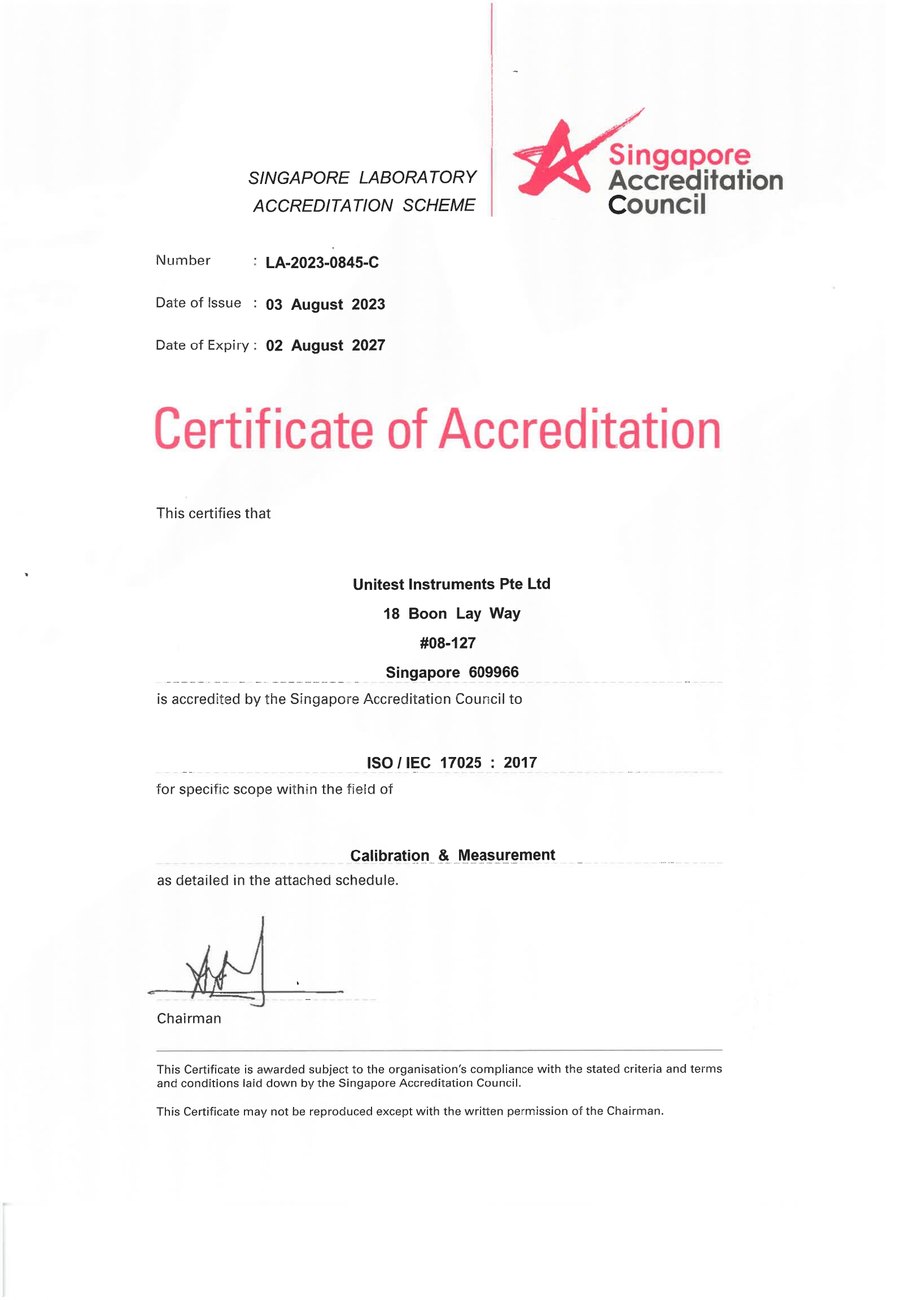
SAC-SINGLAS accredited calibration laboratory (Acc. No. LA-2023-0845-C) serving Singapore's industrial, pharmaceutical, and manufacturing sectors. All content reflects our ISO/IEC 17025 accredited scope and is reviewed by our technical calibration team.
Need power quality analyzer calibration in Singapore?
Unitest Instruments is SAC-SINGLAS accredited (Acc. No. LA-2023-0845-C) to ISO/IEC 17025. Same-week turnaround, certificates accepted by ISO 9001 auditors.