
Key Takeaways
- MOM's WSH (Major Hazard Installations) Regulations 2017 require documented gas detection and alarm systems at all MHI-classified facilities on Jurong Island.
- Both portable and fixed gas detectors must be calibrated at defined intervals. Most sites use quarterly cycles; the regulatory minimum is typically six-monthly.
- Calibration certificates must include a stated measurement uncertainty and a traceable reference chain to NMC Singapore to be accepted by WSH auditors.
- SAC-SINGLAS accreditation (ISO/IEC 17025) is the recognised standard that satisfies the traceability requirement without additional documentation burden.
- Out-of-tolerance "as-found" readings trigger a mandatory retrospective risk assessment covering the period since the last valid calibration.
Why Jurong Island Demands Stricter Gas Detection Standards
Jurong Island is home to over 100 companies operating in petrochemicals, specialty chemicals, pharmaceuticals, and energy. The co-location of these facilities (combined with the presence of large inventories of flammable, toxic, and asphyxiant substances), makes it one of the highest-consequence industrial clusters in Asia. A single undetected gas leak can escalate rapidly from a localised release to a major incident involving multiple facilities on the island.
The Workplace Safety and Health (Major Hazard Installations) Regulations 2017 classify most large chemical and petrochemical facilities on Jurong Island as Major Hazard Installations (MHIs). This classification triggers an elevated set of obligations: quantitative risk assessments, documented Safety Management Systems (SMS), third-party SMS audits, and continuous monitoring of hazardous atmospheres. Gas detection is not an optional layer. It is a core control measure woven into the MHI framework.
Beyond MOM's WSH framework, SCDF's Fire Safety Act governs the installation and maintenance of gas detection systems connected to fire suppression or emergency ventilation. Facilities storing or processing flammable gases above prescribed threshold quantities must obtain SCDF approval for their gas detection layouts and demonstrate that detection systems are maintained to manufacturer and regulatory standards.
Instruments Used: Fixed Systems and Portable Devices
Fixed Gas Detection Systems
Fixed gas detectors are permanently installed in process areas, tank farms, compressor houses, pump stations, loading bays, and utility tunnels. They feed continuous readings to a Distributed Control System (DCS) or Supervisory Control and Data Acquisition (SCADA) platform, triggering alarms and automated safety responses (isolating valves, activating deluge systems, sounding site-wide alerts), when target gas concentrations cross pre-set thresholds.
The most widely deployed fixed detection technologies on Jurong Island include electrochemical sensors for toxic gases (H2S, CO, Cl2, NH3), catalytic bead or infrared (IR) sensors for flammable gas as a percentage of Lower Explosive Limit (%LEL), photoionisation detection (PID) for volatile organic compounds (VOCs), paramagnetic or electrochemical oxygen sensors, and open-path IR or UV/IR beam detectors for large open-area coverage in tank farms. Flame detectors (UV/IR) are often co-located with gas detectors but are governed by separate calibration requirements under SCDF's standards for fire detection equipment.
Portable Gas Detectors
Portable multi-gas monitors are issued to every worker entering a confined space, conducting maintenance in hazardous zones, or working in areas without continuous fixed detection coverage. On Jurong Island, the standard four-gas monitor configuration measures oxygen (O2), flammable gas (%LEL), hydrogen sulphide (H2S), and carbon monoxide (CO) simultaneously. Workers performing hot work, vessel entry, or isolation-related tasks may carry additional single-gas or multi-gas instruments calibrated specifically to the substances present in the work permit area.
Permit-to-work (PTW) systems on most Jurong Island facilities require documentary evidence that the portable gas detector used for area clearance was calibrated within its valid calibration window and bump-tested on the day of use. Safety Officers and EHS managers must maintain a calibration register that is immediately available for inspection by MOM's factory inspectors during unannounced site visits.
Key Parameters Monitored on Jurong Island
The following table summarises the primary gas parameters monitored across typical Jurong Island chemical and petrochemical operations, the detection technology most commonly used, and the typical alarm threshold established under Singapore's WSH guidelines and international standards such as ACGIH TLVs.
| Gas / Parameter | Typical Detection Technology | Key Alarm Threshold | Regulatory Reference |
|---|---|---|---|
| Oxygen (O2) | Electrochemical | Low: <19.5% / High: >23.5% v/v | WSH (General Provisions) Reg; OSHA 1910.146 |
| Flammable Gas (%LEL) | Catalytic bead or IR | Alert: 10%LEL / Alarm: 25%LEL | MOM WSH; IEC 60079-29-1 |
| Hydrogen Sulphide (H2S) | Electrochemical | TWA: 1 ppm / STEL: 5 ppm (WSH) | WSH (General Provisions); SS554 |
| Carbon Monoxide (CO) | Electrochemical | TWA: 25 ppm / STEL: 100 ppm | WSH OEL schedule |
| Ammonia (NH3) | Electrochemical or PID | TWA: 20 ppm / STEL: 35 ppm | WSH OEL schedule |
| Chlorine (Cl2) | Electrochemical | TWA: 0.5 ppm / STEL: 1 ppm | WSH OEL schedule |
| VOCs (benzene, toluene etc.) | PID (photoionisation) | Benzene TWA: 1 ppm | WSH OEL schedule; REACH equivalent |
| Hydrogen (H2) | Catalytic bead or electrochemical | Alert: 10%LEL / Alarm: 25%LEL | IEC 60079-29-1; SCDF FSA |
| Sulphur Dioxide (SO2) | Electrochemical | TWA: 0.25 ppm / STEL: 0.5 ppm | WSH OEL schedule |
Alarm setpoints must be documented in the facility's Hazardous Area Classification drawing set and referenced in the Safety Management System. Any change to alarm setpoints at an MHI facility requires a formal Management of Change (MoC) process and, in many cases, a revised process hazard analysis.
Need gas detector calibration accepted by MOM auditors?
Unitest Instruments (Acc. No. LA-2023-0845-C) issues fully traceable calibration certificates for portable and fixed gas detectors. Same-week turnaround, measurement uncertainty stated, accepted by WSH and ISO 9001 auditors across Jurong Island and Singapore.
Calibration Intervals: What the Regulations and Industry Practice Require
There is a common misconception that Singapore has a single prescribed calibration interval for gas detectors. In practice, MOM does not specify a fixed universal interval in the WSH (General Provisions) Regulations. Instead, facilities are required to calibrate at the frequency specified in their Safety Management System, which must be justified by the manufacturer's recommendations, historical sensor drift data, and the consequence of a missed alarm in that specific process environment.
That said, the following intervals represent established industry practice on Jurong Island and are rarely challenged by auditors if properly documented:
- Bump test (functional check): Before each use, or at minimum daily for portable instruments in active use in hazardous areas.
- Full calibration of portable detectors: Every three to six months. High-risk environments (confined space programmes, hot work permits, MHI facilities) commonly adopt a three-month cycle.
- Full calibration of fixed detectors: Every three to six months. Fixed IR open-path sensors may extend to twelve months if drift logs support it, but this requires documented justification.
- Sensor replacement check: After every sensor replacement, a full calibration must be performed before the instrument is returned to service. Regardless of when the last calibration occurred.
Understanding how calibration intervals interact with your overall instrument lifecycle is covered in detail in our guide to how often instruments should be calibrated and how to set the right interval. A risk-based approach (where instruments in higher-consequence locations are calibrated more frequently), is increasingly expected by MOM auditors conducting SMS reviews at MHI facilities.
What SAC-SINGLAS Accreditation Means for Compliance Evidence
Calibration certificates are only as valuable as the trust auditors place in them. For gas detection instruments on Jurong Island, the relevant standard is ISO/IEC 17025. The international framework for testing and calibration laboratory competence. In Singapore, SAC-SINGLAS (Singapore Accreditation Council – Singapore Laboratory Accreditation Scheme) is the national body that assesses and accredits laboratories to ISO/IEC 17025.
When a calibration certificate carries the SAC-SINGLAS mark and accreditation number, it communicates three critical things to an MOM auditor or ISO 9001 third-party assessor:
- The calibration was performed by a technically competent laboratory whose measurement processes have been independently assessed.
- The reference standards used are traceable to Singapore's National Metrology Centre (NMC) or an equivalent national body. Satisfying the legal traceability requirement under the Weights and Measures Act.
- The stated measurement uncertainty was calculated using a validated method, meaning the certificate's accuracy claims can be relied upon quantitatively.
Calibration certificates from non-accredited service providers (even if produced on professional-looking forms), typically lack the traceability chain documentation and stated measurement uncertainty that auditors require. This is examined in depth in our article on accredited versus non-accredited calibration: what the difference means for your compliance records.
For Jurong Island facilities operating under an ISO 9001 quality management system, the requirement is explicit: measuring equipment used to demonstrate conformity to requirements must be calibrated or verified against measurement standards traceable to international or national measurement standards. SAC-SINGLAS accreditation is the cleanest way to satisfy this clause without additional supplier qualification documentation.
What a Facilities or QA Team Actually Needs to Do
Beyond understanding the regulatory landscape, facilities teams and QA managers on Jurong Island need a practical compliance workflow they can execute consistently. The following represents the minimum viable programme that will withstand a MOM factory inspection or an SMS third-party audit.
Step 1: Compile a Complete Gas Detector Asset Register
Every gas detection instrument (fixed and portable), must be listed in a calibration register that records the make, model, serial number, sensor types, installation location or responsible department, calibration due date, and the name of the accredited calibration provider. This register is the first document auditors request. Instruments not on the register are treated as uncontrolled measuring equipment and can trigger a major non-conformance.
Step 2: Define and Document Calibration Intervals in Your SMS
Your Safety Management System must specify the calibration interval for each class of gas detection instrument and the rationale for that interval. Reference the manufacturer's specification, any historical drift data you hold, and the consequence assessment for the detection zone. If you are adopting a six-month interval for fixed detectors, document why, for example, that the sensors operate in a clean, temperature-controlled environment with no aggressive chemical exposure and that drift logs over the past two years show less than 2% variation between calibrations.
Step 3: Establish a Bump Test Protocol
Bump testing must be a formal, documented activity. Not a casual practice left to individual workers. Your protocol should specify the reference gas concentration to be used, the minimum acceptable response (typically alarm activation), the record format, and the action to be taken if a bump test fails. Failed bump tests must result in the instrument being withdrawn from service and sent for full calibration before any return to use.
Step 4: Use a SAC-SINGLAS Accredited Laboratory for Calibration
When selecting a calibration service provider, verify that their SAC-SINGLAS accreditation scope explicitly covers the gas types and concentration ranges relevant to your instruments. An accreditation number alone is not sufficient, the scope matters. Unitest Instruments (Acc. No. LA-2023-0845-C) covers a broad range of gas detection parameters. Ask for a copy of the current scope before placing your first order.
Step 5: Review Calibration Certificates on Receipt
Do not file calibration certificates without checking them. The certificate must include: the instrument serial number matching your asset register; the test gas, concentration, and reference cylinder details; as-found and as-left readings for each test point; stated measurement uncertainty; the SAC-SINGLAS accreditation mark and number; calibration date and the technician's signature. Any missing element should be queried before the certificate is accepted into your compliance file. Our article on how to read a calibration certificate walks through each field in detail.
Step 6: Manage Out-of-Tolerance Findings
When an instrument is found outside tolerance at calibration ("as-found" failure), the calibration laboratory should notify you immediately. Your SMS must specify the escalation path: notify the WSH Officer, assess the risk period, conduct a retrospective review of any safety-critical decisions made using that instrument's readings, and document the outcome. This is not optional. It is explicitly required under the MHI framework's requirements for safety-critical equipment performance monitoring.
Gas Detection as a Safety Instrumented Function: Calibration Under Management of Change
On a Major Hazard Installation, a significant proportion of fixed gas detectors are not just monitoring points, they are inputs to a Safety Instrumented System (SIS) that automatically triggers isolation valves, deluge systems, or emergency ventilation once a gas concentration crosses a defined threshold. This has a direct and often underappreciated consequence for how calibration must be planned and executed: a gas detector functioning as a SIS input carries the same rigour requirements under IEC 61511 as any other safety-critical instrument in the loop, meaning its calibration procedure, acceptance tolerance, and proof-test interval must be derived from the same SIL verification calculation that governs the pressure and level transmitters elsewhere in the safety loop, not set independently by the instrumentation team as a standalone gas-detector decision.
The practical implication is that any change to a SIS-linked gas detector's calibration interval, sensor type, or alarm setpoint is not simply an instrumentation maintenance decision, it is a change to a safety function and must go through the facility's formal Management of Change (MoC) process, including a re-assessment of whether the SIL target is still met with the proposed change. Facilities sometimes discover this gap only after an internal audit finds a gas detector's calibration interval was quietly extended by the maintenance team based on drift data alone, without the corresponding MoC review confirming the SIL PFD calculation still holds at the new interval; this is exactly the kind of finding that turns a routine site visit into a more serious MOM enforcement conversation, because it demonstrates a gap between the documented Safety Management System and what is actually happening on the plant floor.
What an MOM Inspector Actually Checks During a Site Walkthrough
Beyond reviewing the paper trail described above, MOM's factory inspectors conducting an unannounced site visit on Jurong Island typically follow a recognisable pattern worth preparing for specifically, because the physical walkthrough often surfaces gaps that a desk-based document review would miss entirely. Inspectors commonly select a small, random sample of portable gas detectors currently in the field (not the ones sitting neatly in the equipment store) and check three things on the spot: whether the instrument's calibration due-date label matches the register, whether the instrument has a bump-test record for the current day if it is in active use, and whether the physical instrument's serial number actually matches the one on its calibration certificate, a mismatch that occurs more often than facilities expect when instruments are swapped between technicians or departments without updating the register.
For fixed detection systems, inspectors frequently ask to see the alarm response test record (evidence that the detector's high alarm setpoint genuinely triggers the automated safety response it is documented to trigger, not just that the sensor reads correctly) alongside the calibration certificate, since a perfectly calibrated sensor feeding into a relay or logic solver that has never had its actual alarm-triggered response verified end-to-end is a documentation gap that a straightforward calibration certificate review will not catch. Facilities that run a periodic, documented functional test of the full detection-to-response chain, not just the sensor's measurement accuracy, are noticeably better positioned during this kind of walkthrough, and it is worth building this distinction explicitly into your SMS so your own internal audits are checking the same thing an MOM inspector will.
Frequently Asked Questions
Gas detection on Jurong Island is governed primarily by the Workplace Safety and Health (General Provisions) Regulations under MOM, the WSH (Major Hazard Installations) Regulations 2017, SCDF's Fire Safety Act requirements for flammable gas installations, and the ENV (Toxic Substances) Act for certain chemical emissions. All MHI-classified facilities must also comply with the Workplace Safety and Health (MHI) Regulations which mandate quantitative risk assessments and continuous gas monitoring in defined hazardous zones.
MOM's WSH guidelines and most OEM manufacturers recommend bump-testing gas detectors before each use or at least daily in high-risk environments, and full calibration at intervals not exceeding six months. However, many major hazard installations on Jurong Island adopt a three-month or quarterly calibration cycle as part of their Process Safety Management programmes. Fixed continuous monitors integrated into DCS or SCADA systems are typically calibrated every three to six months. The specific interval must be documented in the facility's Safety Management System and justified by historical drift data.
No. A bump test (or functional check) exposes the sensor to a known concentration of target gas to confirm it produces an alarm response. It does not verify the accuracy of the displayed reading. A full calibration adjusts the instrument's response against a certified reference gas standard traceable to a national metrology body, and produces a calibration certificate documenting the correction factors applied. Bump tests are typically performed daily; full calibrations are required at defined periodic intervals and must be recorded for regulatory audit purposes.
Under Singapore's Workplace Safety and Health framework, calibration certificates used as compliance evidence must be traceable to Singapore's National Metrology Centre (NMC) or an equivalent national body. SAC-SINGLAS accreditation (ISO/IEC 17025) provides this traceability guarantee. MOM auditors and third-party WSH auditors routinely reject certificates from non-accredited service providers. Using an accredited laboratory also ensures measurement uncertainty is properly quantified on the certificate. A requirement that non-accredited providers frequently omit.
The most commonly monitored gases on Jurong Island include hydrogen sulphide (H2S), carbon monoxide (CO), oxygen (O2 deficiency and enrichment), flammable gases as % LEL (methane, propane, ethylene), ammonia (NH3), chlorine (Cl2), hydrogen (H2), benzene (C6H6), and volatile organic compounds (VOCs). Petrochemical refinery operations also frequently monitor SO2 and NOx. The exact list depends on the process chemicals and the site's hazardous area classification under the ATEX/IECEx or SS559 zone scheme.
A compliant gas detector calibration certificate from a SAC-SINGLAS accredited laboratory should include: the instrument make, model, and serial number; the target gas, concentration range, and test points used; the reference gas cylinder certificate number and traceability chain to NMC Singapore; the as-found and as-left readings; the calculated measurement uncertainty; the calibration date and due date; and the accreditation number (LA-2023-0845-C for Unitest Instruments). Certificates without a stated measurement uncertainty are not fully ISO/IEC 17025 compliant and may be rejected by auditors.
Yes, in-house calibration is permissible if your facility has a documented calibration procedure, certified reference gas standards with valid traceability to NMC, trained and competency-assessed technicians, and a calibration management system producing audit-ready records. However, the reference gas cylinders used for in-house calibration must themselves be sourced from an accredited supplier and re-verified periodically. For MHI-classified installations, many facilities choose to outsource calibration to a SAC-SINGLAS accredited laboratory to eliminate the traceability burden and ensure certificates are unimpeachable in a WSH audit.
If a gas detector's as-found reading falls outside the acceptable tolerance (typically ±5–10% of the certified reference value for toxic gas sensors, or ±5% LEL for flammable gas sensors), the instrument must be removed from service immediately. The safety implications must be assessed: if the detector was under-reading, a retrospective risk assessment covering the period since the last valid calibration may be required and should be reported to your WSH officer. The instrument is either adjusted and recalibrated within specification, or decommissioned and replaced. All out-of-tolerance findings must be recorded in your calibration management system.
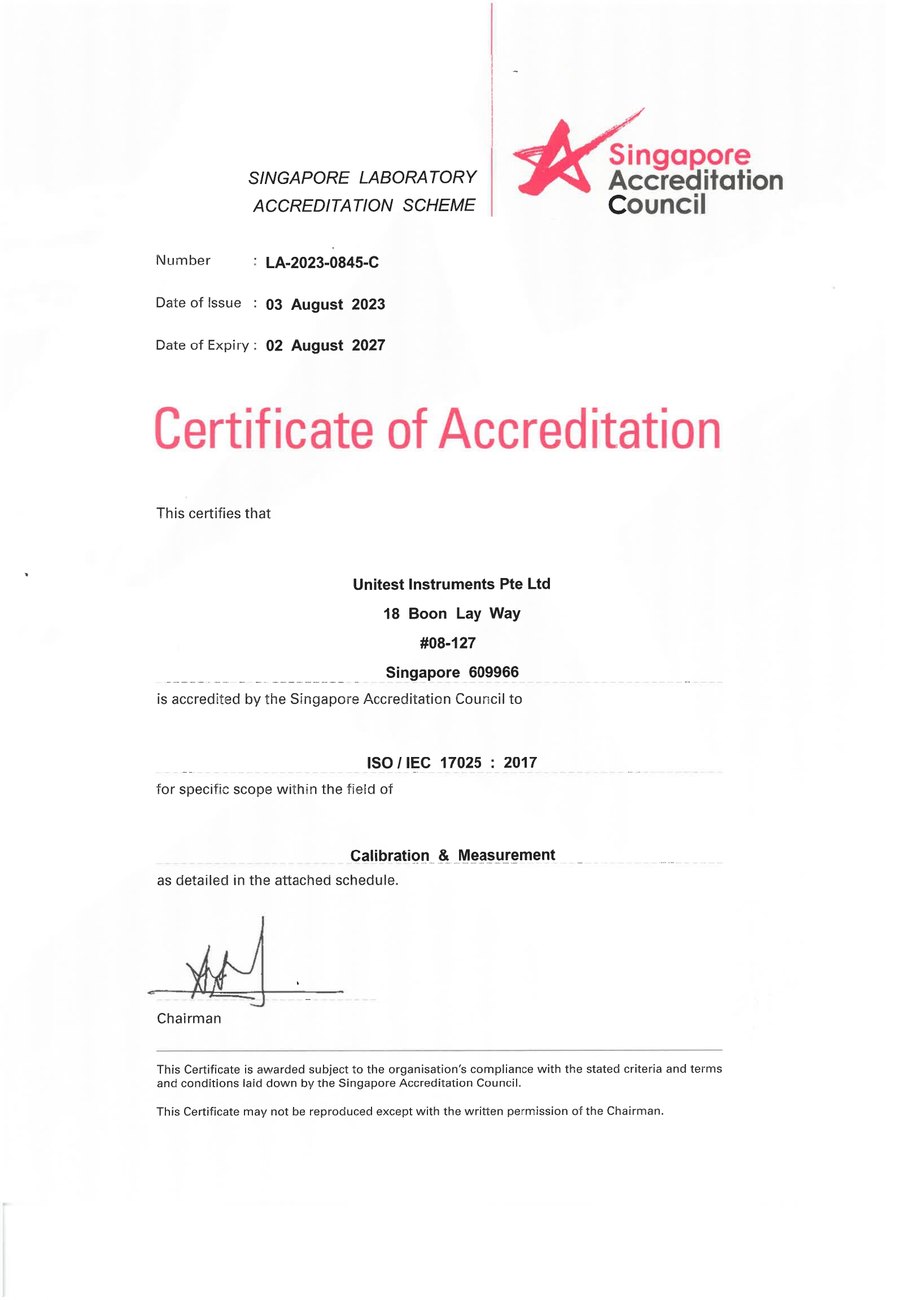
SAC-SINGLAS accredited calibration laboratory (Acc. No. LA-2023-0845-C) serving Singapore's industrial, pharmaceutical, and manufacturing sectors. All content reflects our ISO/IEC 17025 accredited scope and is reviewed by our technical calibration team.
Need gas detector calibration in Singapore?
Unitest Instruments is SAC-SINGLAS accredited (Acc. No. LA-2023-0845-C) to ISO/IEC 17025. Same-week turnaround, certificates accepted by ISO 9001 auditors and MOM WSH inspectors.