
Key Takeaways
- The Fluke ii900 detects compressed air and gas leaks from up to 50 m away using a 64-microphone SoundMap, no shutdown, no scaffolding required.
- Traditional ultrasonic probes excel at close-range pinpointing inside dense equipment clusters where the ii900's wide field of view creates ambiguity.
- Soap bubble testing is the cheapest method but is unreliable in moving air, requires physical access, and cannot survey large areas efficiently.
- Pressure decay testing is the only method that delivers a quantified total leak rate. Essential for factory acceptance and compliance documentation.
- For ISO 9001 and energy audits in Singapore, you typically need both a survey tool (ii900) and a documentation method (pressure decay or calibrated flowmeter).
- Unitest Instruments supplies and calibrates instruments across all these methods (including Fluke products), and can advise on calibration intervals to keep you audit-ready.
Why Leak Detection Matters in Singapore's Industrial Context
Compressed air is often called the "fourth utility" in manufacturing, and Singapore's industrial facilities pay dearly for it. With electricity tariffs for industrial consumers consistently above SGD 0.20/kWh, a poorly maintained compressed air system can haemorrhage tens of thousands of dollars annually through leaks alone. Industry benchmarks suggest that 20–30% of compressed air generated in a typical plant escapes through leaks in joints, valves, hoses, and fittings before reaching any tool or process.
Beyond energy cost, leaks create pressure drops that reduce tool performance, cause compressors to short-cycle (accelerating wear), and contribute to unnecessary carbon emissions. A growing concern as Singapore tightens its Carbon Tax framework under the Carbon Pricing Act. The practical question for maintenance managers is not whether to find leaks, but which detection method gives the best return on their survey time and equipment spend.
This is where the Fluke ii900 has disrupted a market that previously relied on ultrasonic probes, soap solution, and pressure decay tests. But it is not a universal replacement. Understanding what each method does well (and where it falls short), is what this article is about.
What the Fluke ii900 Actually Does (and Does Not Do)
The ii900 is a sonic industrial imager: a palm-sized device fitted with an array of 64 MEMS microphones that captures sound across a frequency range of 2 kHz to 52 kHz. It converts the detected sound field into a colour SoundMap (a visual heat map showing sound intensity), which is overlaid on a real-time camera image of the scene in front of you. Brighter colours indicate louder ultrasonic sources; the technician can immediately see which fitting, valve, or hose section is the loudest emitter.
What makes this genuinely useful is that it works at distance. A leak from a 0.2 mm orifice at 6 bar can typically be detected from 50 metres away in a moderately quiet plant environment. Crucially, it operates while plant is running: there is no need to pressurise a dead system or halt production. A technician can walk an entire compressor room or pipework gallery in minutes, photographing leak candidates with the built-in camera and exporting a report directly from the device.
What the ii900 cannot do: it does not measure leak rate in litres per minute or cubic metres per hour. It identifies and prioritises leak locations visually, but quantification requires a separate measurement step. It also cannot distinguish between gas types. If you need to know whether you are detecting nitrogen or natural gas, you need a separate gas analyser. In very high ambient noise environments (above approximately 85 dB broadband), background noise can partially mask smaller leaks and reduce effective detection range.
Traditional Leak Detection: Three Methods Compared
1. Ultrasonic Probes (Contact and Scanning)
Traditional handheld ultrasonic detectors (from manufacturers such as UE Systems (Ultraprobe range), SDT, and others), convert high-frequency leak-generated ultrasound into an audible signal or a bar-graph reading the technician interprets. Some models include a parabolic dish for standoff detection; most are used as scanning wands moved slowly across surfaces and joints.
Their strengths: they are highly sensitive at close range, they can detect leaks through structural surfaces (useful for checking valve internals), and they cost significantly less than the ii900 (typically SGD 3,000–8,000 versus SGD 18,000–25,000 for the ii900 at the time of writing). Their limitation is speed and spatial ambiguity: the technician must scan joint by joint, and in a dense cluster of pneumatic fittings it can be very difficult to isolate which of six adjacent fittings is the culprit. All will register as the probe sweeps past.
2. Soap Bubble Solution
The oldest and simplest method: apply soapy solution to a suspected joint and look for bubbles. The cost is negligible, no training is required, and positive identification is unambiguous, a bubble is a bubble. Its limitations are severe for large-scale surveys: you must physically access every joint, the method fails in draughty conditions (the bubble disperses before growing visible), and it creates a mess that must be cleaned from electrical components. It is unsuitable for any joint above head height without access equipment, and entirely impractical for overhead pipework galleries. Soap solution testing is best reserved for post-repair verification of a specific joint, not for surveying an entire system.
3. Pressure Decay and Pressure Drop Testing
Pressure decay testing works by pressurising a sealed system (or subsystem) to a defined pressure, isolating the supply, and monitoring the rate of pressure drop over a defined time window. From the pressure drop rate and system volume, the total leak rate can be calculated. This is the only method in this comparison that delivers a calibrated, quantified total leak rate. Making it indispensable for factory acceptance testing and for compliance documentation under standards such as ISO 8573 (compressed air quality) or customer-specified leak rate limits.
Its limitation is that it gives no location information whatsoever. A system that fails a pressure decay test still requires another method to find and fix the leaks. It also requires the system to be taken offline and pressurised in a controlled way, which is not always practical in production environments. For manufactured assemblies (pneumatic cylinders, valve manifolds, machine tools), pressure decay is the standard production-line check; for running plant surveys, it is not the primary tool.
Head-to-Head Comparison Table
The table below summarises the key parameters across all four methods. Where a method is clearly superior, it is noted; where trade-offs exist, we explain them honestly.
| Parameter | Fluke ii900 Acoustic Imager | Ultrasonic Probe (wand) | Soap Bubble Solution | Pressure Decay Test |
|---|---|---|---|---|
| Detection range | Up to 50 m standoff | 0.1–2 m (scanning wand); up to 6 m with parabolic dish | Contact only. Within arm's reach | N/A. Whole-system method |
| Plant shutdown required? | No. Live plant operation | No. Live plant operation | No, but access needed | Yes. System must be isolated |
| Leak location accuracy | High at distance; can be ambiguous in dense clusters | Good at close range; requires patient scanning | Exact. Visual confirmation | None. Total system rate only |
| Survey speed (large area) | Very fast. Entire areas surveyed in minutes | Slow. Joint-by-joint scanning | Very slow. Requires physical access to every joint | Fast for a defined subsystem; impractical for whole plant |
| Leak rate quantification | No. Relative dB level only | No. Relative signal level only | No | Yes. Calculated from pressure drop and volume |
| Works in noisy environments? | Partial. High broadband noise reduces range | Partial. Similar noise sensitivity | Yes. Unaffected by noise | Yes. Pressure measurement is unaffected by noise |
| Overhead / difficult access | Excellent. No climbing required | Poor. Must be close to source | Very poor. Physical access mandatory | N/A |
| Report / documentation output | Built-in photo + data export; app integration | Manual recording; some models have logging | Manual notes / photos | Data logger output; integrates with test systems |
| Approximate instrument cost (SGD) | SGD 18,000–25,000 | SGD 3,000–8,000 | Under SGD 50 (consumable) | SGD 2,000–15,000 (test bench / data logger) |
| Calibration requirement | Annual factory/service verification recommended | Annual calibration recommended | None | Pressure transducer calibration required. Traceable |
| Best use case | Wide-area plant surveys; overhead pipework; live production environments | Dense equipment clusters; valve internal leak checks | Post-repair verification of specific joints | Factory acceptance testing; compliance leak rate documentation |
Need calibration for your leak detection instruments in Singapore?
Unitest Instruments calibrates pressure transducers, ultrasonic instruments, and associated measurement equipment to ISO/IEC 17025, with certificates accepted by ISO 9001 auditors. Same-week turnaround available.
Clear Winner Recommendations by Use Case
Use Case 1: Annual energy audit of a large compressor room
Winner: Fluke ii900. Speed is everything here. A technician with an ii900 can walk an entire compressor room (headers, distribution lines, branch takeoffs, regulators, dryers), and photograph a prioritised list of leak candidates in under two hours. The same task with a scanning ultrasonic probe takes a full day or more. For Singapore facilities filing energy audit reports under the Energy Conservation Act or pursuing ISO 50001 certification, the ii900 pays for itself within one or two surveys through energy savings identified.
Use Case 2: Diagnosing a single leaking valve cluster in a machine
Winner: Ultrasonic probe (close range). When you already know which machine has a problem and need to identify exactly which of eight adjacent solenoid valves is leaking, a close-range ultrasonic probe gives better spatial discrimination than the ii900's imaging field. The probe can be held adjacent to each valve port in sequence and the dB reading compared directly. In this scenario, the ii900's wide field of view is a disadvantage. Multiple adjacent sources all appear on the SoundMap simultaneously and it can be difficult to isolate the single worst offender.
Use Case 3: Pre-delivery acceptance test of a pneumatic assembly
Winner: Pressure decay test. If you are a machine builder or a precision pneumatic OEM needing to certify that an assembled product meets a specified leak rate of, say, less than 0.5 cm³/min at 6 bar, pressure decay is the only method that gives you a documented, quantified pass/fail result. The ii900 cannot tell you whether your assembly is within specification. It can only tell you where sound is coming from. Pressure decay, with a calibrated transducer and data logger, gives you a traceable certificate. See our article on what a calibration certificate actually tells you for more on what "traceable" means in practice.
Use Case 4: Checking a repaired joint after maintenance
Winner: Soap bubble solution (for the specific joint). If a technician has just re-torqued a compression fitting and wants to confirm that specific joint is now leak-free before closing up the panel, soap solution gives an immediate, unambiguous visual answer at essentially zero cost. The ii900 is overkill for a single-point verification. Save the expensive instrument time for surveys.
Use Case 5: Overhead pipework survey in a food manufacturing facility
Winner: Fluke ii900, decisively. Overhead pipework in food factories often runs at 4–6 m above the production floor. Getting a scanning ultrasonic probe within 0.5 m requires a MEWP (elevated work platform) or scaffolding, with associated permit-to-work paperwork, production disruption, and safety risk. The ii900 detects the same leaks from the floor. For food, pharmaceutical, and semiconductor facilities where contamination risk from overhead work is a concern, this is a compelling safety and compliance argument.
The Calibration Angle: Why Instrument Verification Matters for Audit Readiness
Whichever leak detection tool you use, the instruments involved in measurement need to be calibrated at defined intervals if their output is to be trusted in an audit context. This applies most critically to pressure transducers and gauges used in pressure decay testing. If the transducer reading is drifting by 0.5%, your calculated leak rate is equally in error. As we discuss in our article on how often instruments need calibration, the interval depends on the instrument's stability, its criticality in your process, and any regulatory or customer requirements you are subject to.
For the Fluke ii900 itself, Fluke recommends annual factory service verification to check microphone array sensitivity and frequency response. While the ii900 is primarily a qualitative survey tool rather than a quantitative measurement instrument, facilities operating under ISO 50001 (energy management) or undertaking formal energy audits under Singapore's Energy Conservation Act may be asked to demonstrate that their survey instruments are maintained in calibrated condition. Unitest Instruments can advise on calibration records for associated pressure instruments and on the appropriate service cycle for sonic imaging equipment.
It is worth noting that the pressure transducers and data loggers used in pressure decay test benches fall squarely within the calibration scope of an ISO/IEC 17025 accredited laboratory. Unitest holds SAC-SINGLAS accreditation (Acc. No. LA-2023-0845-C) and can issue certificates that satisfy the requirements of ISO 9001 quality management audits. The same certificates your QA auditor will look for when reviewing your calibration records.
For a deeper understanding of what traceability means in the calibration chain and why it matters for your audit evidence, see our explainer on measurement traceability in calibration.
Procurement Considerations for Singapore Buyers
Singapore buyers have a few additional factors to weigh when deciding between investing in an ii900 and sticking with traditional methods or a rental model.
Enterprise Development Grant (EDG) and Productivity Solutions Grant (PSG) eligibility: Investments in productivity-enhancing measurement and testing equipment may be eligible for grant support under Enterprise Singapore's programmes. The ii900, as a capital investment in maintenance productivity, could qualify depending on how the application is structured. Engage your relevant agency or consultant to assess eligibility before purchase.
Shared equipment and contract survey services: For SMEs where annual compressed air surveys do not justify owning an SGD 20,000 instrument, two alternatives exist: rent from an equipment rental provider, or engage a specialist contractor to conduct the survey. Unitest Instruments can discuss both paths. The key question is how many surveys per year are realistic. If the answer is one, rental often wins on economics; if two or more, ownership starts to pay.
After-sales support and calibration: Singapore is well-served by Fluke's regional distribution network. When evaluating purchase, confirm that the local distributor can provide factory-authorised service verification for the ii900 and confirm calibration documentation for your quality management system. Unitest, as a Fluke-stocking distributor and accredited calibration laboratory, sits at the intersection of supply and compliance support. We can both supply the instrument and maintain your calibration records.
Frequently Asked Questions
The Fluke ii900 is a sonic industrial imager. A handheld camera that uses an array of 64 MEMS microphones to visualise and locate sources of ultrasonic sound, particularly compressed air and gas leaks. It converts inaudible high-frequency leak signals (typically 2–52 kHz) into a visual SoundMap overlaid on a live camera image, allowing technicians to identify leaks from up to 50 metres away while equipment is running, without climbing ladders or shutting down production lines.
A traditional contact or scanning ultrasonic probe (such as models from UE Systems or SDT) is highly sensitive but requires point-to-point scanning: the technician must physically move the wand close to each suspected joint, fitting, or valve one by one. The Fluke ii900 works at a distance and images an entire panel or pipework section simultaneously, showing the strongest leak sources as a colour heat map. For wide areas or overhead pipework the ii900 is dramatically faster. For pinpointing very small leaks in a dense cluster of fittings, a close-range probe can still be more precise.
For most routine compressed air surveys the ii900 replaces soap bubble testing entirely. Soap bubbles require physical access to every joint, produce false negatives in draughty conditions (the bubble blows away), and generate a consumable waste stream. The ii900 works at distance, in moving air, and during normal plant operation. The one scenario where soap bubbles still win: verifying very small leaks (below about 0.01 l/min) after a repair, where visual confirmation of zero bubble formation is reassuring to an auditor. For large-area surveying, the ii900 is vastly superior.
Pressure decay (or pressure drop) testing involves pressurising a sealed system to a set value, isolating the supply, and measuring how quickly pressure falls over a defined time window. It gives a quantified total leak rate for the entire system but cannot locate individual leaks. It is best suited for factory acceptance testing of assembled subassemblies (valves, cylinders, pneumatic panels) before installation, or for compliance verification where a pass/fail leak rate threshold must be documented. Acoustic imaging complements it: use pressure decay to confirm the system meets specification, then use the ii900 to find any leaks that failed the test.
Yes. The ii900's microphone array and frequency response should be verified at defined intervals. Fluke recommends annual factory or authorised service verification. For Singapore facilities operating under ISO 9001, ISO 14001, or process safety management frameworks, calibration records for measurement instruments including acoustic imagers are expected during audits. Unitest Instruments, as a SAC-SINGLAS accredited laboratory (Acc. No. LA-2023-0845-C), can advise on calibration intervals and provide accredited calibration services for associated pressure and measurement instruments. Contact us to discuss your ii900 calibration needs.
The Fluke ii900 can typically detect a 0.2 mm orifice leak at 6 bar from up to 50 metres away in a moderately quiet industrial environment. Detection range reduces in very high ambient noise environments (above 85 dB) and increases when background noise is lower. At closer range (1–5 m) it can detect leaks as small as those produced by a single loose compression fitting. Traditional ultrasonic probes typically require the technician to be within 0.3–1 m of the leak source for reliable detection.
This depends on compressed air infrastructure size. Studies suggest compressed air leaks account for 20–30% of total compressed air consumption in typical industrial facilities. In Singapore where electricity costs are significant, even a medium-sized facility running a 75 kW compressor can lose S$15,000–25,000 per year to leaks. A single ii900-assisted leak survey typically pays back the instrument cost within one to two surveys. For SMEs with smaller air systems (compressors below 22 kW), renting the instrument or hiring a leak survey service may be more cost-effective than purchasing outright. Unitest can supply the ii900 and also advise on calibration to keep it audit-ready.
Yes. The ii900 can detect any pressurised gas leak that generates ultrasonic turbulence. Including nitrogen, CO2, argon, helium, natural gas (where safe to operate), and steam. It is not a gas identification instrument and cannot tell you what gas is leaking or give a concentration reading, so it must be paired with appropriate gas detection instruments for hazardous environments. For combustible or toxic gas surveys, always follow your site's safety protocols and use a certified gas detector in parallel.
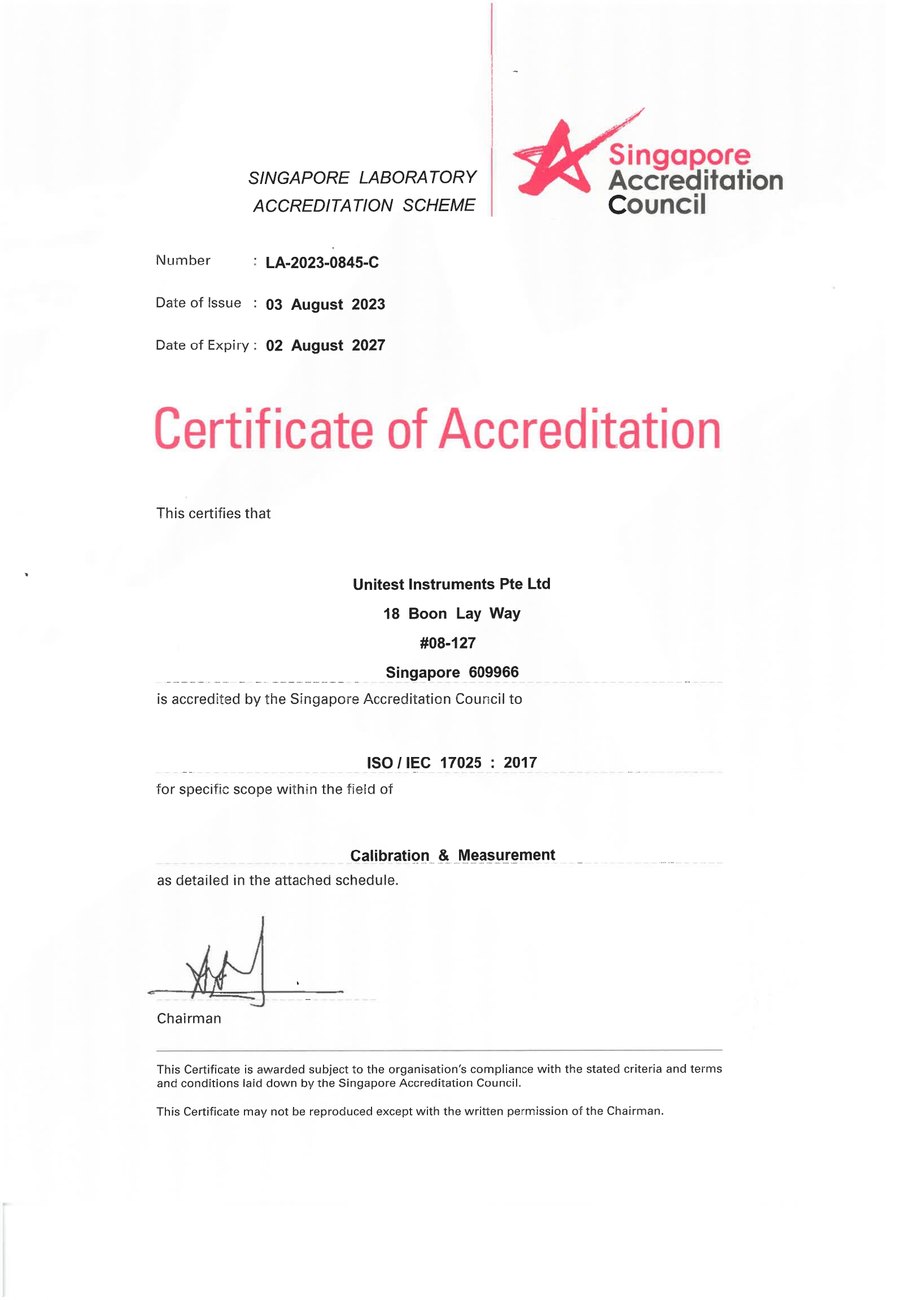
SAC-SINGLAS accredited calibration laboratory (Acc. No. LA-2023-0845-C) serving Singapore's industrial, pharmaceutical, and manufacturing sectors. All content reflects our ISO/IEC 17025 accredited scope and is reviewed by our technical calibration team.
Need pressure or acoustic instrument calibration in Singapore?
Unitest Instruments is SAC-SINGLAS accredited (Acc. No. LA-2023-0845-C) to ISO/IEC 17025. Same-week turnaround, certificates accepted by ISO 9001 auditors.