
Key Takeaways
- Coltraco instruments are designed with defined calibration access points and published specifications. Making traceable calibration meaningful and reproducible.
- Generic detectors can be cost-effective for visual-screening tasks but rarely satisfy ISO 9001, ISO/IEC 17025, or SCDF audit requirements without a traceable calibration certificate.
- The total cost of ownership often narrows the gap: generic units may need replacing more frequently, and a failed audit caused by inadequate instrumentation can cost far more than the price difference.
- Coltraco's Portascanner range is purpose-built for fire suppression cylinder ullage checks. No generic detector can substitute for this regulated application in Singapore.
- Unitest Instruments (SAC-SINGLAS Acc. No. LA-2023-0845-C) supplies and calibrates both Coltraco and other ultrasonic instruments, and will advise which is appropriate for your specific use case.
Why the Comparison Matters for Singapore Buyers
Singapore's industrial and manufacturing sectors operate under a dense layer of compliance requirements. ISO 9001 quality management systems, SCDF fire protection codes, MOM workplace safety regulations, and in regulated sectors such as pharmaceuticals and aerospace, additional GMP and AS9100 requirements. Each of these frameworks requires that measurement instruments used in quality or safety-critical decisions be calibrated to a traceable standard.
Ultrasonic leak detectors sit at an interesting boundary. In many facilities, they are used informally. An engineer walks the plant with a handheld unit, marks suspected leaks with paint, and schedules repairs. In this role, an uncalibrated generic unit may be entirely adequate. In other facilities, the same instrument type is used to generate a compressed-air leak audit report that feeds into an energy management programme, an OHSAS audit, or a maintenance compliance record. In those cases, the instrument's calibration status matters enormously.
The problem is that many buyers do not make this distinction at the point of purchase. They buy the cheapest unit that detects ultrasound, then discover at audit time that their results cannot be verified. Understanding what differentiates Coltraco instruments from the generic market (before you buy), is the point of this article.
What Coltraco Actually Offers (and What Generic Units Typically Provide)
Coltraco Ultrasonics, a UK-based manufacturer, has been producing ultrasonic instruments for industrial leak detection, condition monitoring, and fire suppression integrity since the late 1980s. Their flagship Portaflow range covers airborne and contact ultrasonic detection, while the Portascanner series addresses pressurised gas and liquid container integrity. The instruments are designed from the outset to be calibratable. Meaning they have stable, documented reference points that a calibration laboratory can test against and issue a meaningful uncertainty statement for.
Generic ultrasonic detectors (typically manufactured in China and sold under multiple brand names on e-commerce platforms), are designed primarily to detect ultrasound at low cost. They work, often quite well for qualitative screening. What they typically lack is: published measurement uncertainty, consistent production tolerances between units, a defined calibration procedure, and manufacturer-backed technical support. Some generic units also use poorly shielded electronics that are susceptible to radio frequency interference in industrial environments, producing false readings near variable speed drives, welding equipment, or large motors.
The Calibration Traceability Gap
This is the most commercially significant difference. When you send a Coltraco instrument to an accredited laboratory such as Unitest Instruments, we can issue a calibration certificate with a stated measurement uncertainty and a traceability chain back to Singapore's National Metrology Centre (NMC). That certificate satisfies ISO 9001 clause 7.1.5, which requires that monitoring and measurement resources be calibrated or verified against measurement standards traceable to international or national standards. As we explain in our article on accredited vs non-accredited calibration, the distinction between an accredited certificate and a non-accredited one is precisely this traceable uncertainty chain. Without it, a certificate is simply a piece of paper.
For generic instruments, we can often issue a certificate of calibration, but if the instrument lacks stable production tolerances or a defined calibration point, the certificate documents what the instrument read on the day of calibration. It does not give meaningful assurance about what it will read tomorrow, or about how its reading compares to a physical reference. This is a fundamental limitation, not a bureaucratic one.
Head-to-Head Feature Comparison
The table below compares Coltraco Portaflow-series instruments against the typical specification profile of generic ultrasonic detectors available in Singapore's industrial supply market. Note that "generic" is not a single product (individual units will vary), but the characteristics below reflect what we routinely observe when generic units are presented for calibration at our laboratory.
| Feature | Coltraco (Portaflow Series) | Typical Generic Unit |
|---|---|---|
| Detection frequency | 40 kHz, narrow-band filtered, documented | 38–40 kHz, often undocumented bandwidth |
| Published measurement uncertainty | Yes. Stated in product specification | Rarely published; typically absent |
| Calibration access / reference point | Defined by manufacturer; lab-calibratable | No defined calibration point in most units |
| Accredited calibration possible | Yes. SAC-SINGLAS accredited certificate issued | Certificate issuable; traceability chain may be incomplete |
| Detection modes | Airborne + contact (most models) | Usually airborne only; contact often unavailable |
| RFI / EMI shielding | Industrial-grade electronics shielding | Variable; often inadequate near VFDs or welding |
| IP / ingress protection rating | IP54 or better (model-dependent) | Rarely stated; typically IP40 or unrated |
| Fire suppression cylinder checks | Yes. Portascanner 520 purpose-built for this | Not suitable; no calibrated signal processing for ullage |
| Manufacturer technical support | Direct from Coltraco; local support via Unitest | Usually none; replacement-only warranty |
| Typical Singapore price range (USD) | USD 1,500 – 4,500 depending on model | USD 80 – 600 |
| ISO 9001 / SCDF audit acceptance | Yes, with SAC-SINGLAS accredited calibration certificate | Not guaranteed; frequently queried at audit |
| Calibration interval (recommended) | 12 months (manufacturer recommendation) | No manufacturer guidance; often not recalibrated |
Not sure if your ultrasonic detector can be calibrated to audit standard?
Unitest Instruments assesses and calibrates both Coltraco and third-party ultrasonic instruments. We will tell you honestly whether your instrument can support a traceable certificate. Before you commit to a programme.
Use-Case Verdict: Which Should You Choose?
Rather than a blanket recommendation, the right choice depends on what you intend to do with the measurement result. Below are the most common scenarios we encounter in Singapore facilities.
Routine Compressed Air Leak Screening (No Audit Trail Required)
If your maintenance team walks the plant quarterly, flags suspected leaks, and schedules repairs based on the engineer's judgment (with no requirement to submit a calibrated measurement result to an auditor, a client, or a regulator), then a good-quality generic unit or a mid-market branded unit will serve you adequately. At this level, the skill of the operator matters more than the instrument's calibration certificate. The saving on instrument cost can be reinvested in operator training.
ISO 9001 or ISO 50001 Energy Management Audits
ISO 9001 clause 7.1.5 and ISO 50001's measurement requirements both stipulate that instruments used in quality or energy management decisions must be calibrated with traceability to national or international standards. If your compressed-air leak audit is a documented input to your quality management system or energy baseline, your ultrasonic detector must have an accredited calibration certificate. Here, Coltraco instruments are the safer choice, and the calibration certificate from Unitest Instruments (SAC-SINGLAS, ISO/IEC 17025) will satisfy your auditor. Understanding what a calibration certificate must contain will help you verify that any certificate you hold is audit-compliant.
SCDF Fire Suppression System Maintenance
This is a non-negotiable domain for Coltraco. The Portascanner 520 (and related Portasteam models) are designed specifically for non-invasive integrity and fill-level checking of pressurised fire suppression cylinders. A task that requires a calibrated, purpose-built instrument. Singapore's SCDF regulations require periodic inspection of fire suppression systems, and where ultrasonic methods are used to verify cylinder integrity, the instrument must be fit for purpose and calibrated. No generic detector is appropriate here, both from a regulatory standpoint and from a safety standpoint: a missed low-fill cylinder is a life-safety failure.
Marine and Offshore Applications
Singapore's position as a major marine hub means many facilities maintain vessels or serve the offshore industry. Classification societies (Lloyd's Register, DNV, ABS) increasingly require documented calibration for instruments used in condition monitoring programmes. Coltraco instruments have a long track record in the marine sector. The Portaflow 220 and 330 series are used routinely for hull ultrasonic surveys. Generic units, even if they detect ultrasound correctly, will not satisfy a class surveyor who asks for the calibration certificate and uncertainty statement.
Pharmaceutical and Semiconductor Manufacturing
These sectors operate under GMP (Good Manufacturing Practice) or equivalent regimes that require every measurement instrument in the production environment to be part of a documented calibration programme. The instrument's measurement uncertainty must be known and must be appropriate for the decision being made. In cleanroom environments, Coltraco instruments with documented specifications are the appropriate choice. Generic units typically cannot be enrolled in a GMP instrument management system because they lack the manufacturer data needed to complete the qualification documentation.
Total Cost of Ownership: Is the Premium Justified?
The sticker price difference between a Coltraco instrument and a generic equivalent is substantial. Often a factor of 5 to 10. However, the total cost of ownership calculation changes when you account for the full picture.
Generic instruments in demanding industrial environments (heat, vibration, dust, humidity) often have a service life of 2–4 years before sensitivity degrades to the point where the instrument is no longer useful. Coltraco instruments, with IP-rated housings and industrial electronics, routinely operate for 8–12 years with periodic calibration and occasional probe replacement. Over a 10-year horizon, the per-year instrument cost may be comparable or even favour Coltraco.
The second cost factor is audit risk. A single audit non-conformance citing uncalibrated measurement equipment can trigger a corrective action programme, a re-audit, and in the worst cases, product holds or certification suspension. For a manufacturing facility with ISO 9001 certification, the cost of a major non-conformance dwarfs the price difference between a Coltraco and a generic detector. The calibration certificate is not an administrative overhead. It is insurance against a far larger cost.
The third factor is operator time. Coltraco instruments with good signal-to-noise performance and narrow-band filtering reduce false readings in noisy industrial environments, which means operators spend less time chasing phantom leaks. In a large facility with frequent audits, this productivity difference compounds into real cost savings over time.
Calibration: What Happens When You Send Either Instrument to Our Lab
Unitest Instruments calibrates both Coltraco and generic ultrasonic instruments at our SAC-SINGLAS accredited laboratory (Acc. No. LA-2023-0845-C). The process differs in important ways depending on what you bring in.
For a Coltraco instrument, we test the instrument against our accredited acoustic reference standards, compare the reading against the manufacturer's published specification, calculate the measurement uncertainty using a documented uncertainty budget, and issue a calibration certificate that states: the as-found reading, the as-left reading after any adjustment, the expanded uncertainty (typically at 95% confidence, k=2), and the traceability chain back to NMC Singapore. This certificate can be presented to any ISO 9001, ISO/IEC 17025, or SCDF auditor without query.
For a generic instrument, the process depends on the specific unit. If the instrument has a stable output and consistent behaviour across multiple test points, we can issue a certificate that documents what the instrument read against our reference. However, if the instrument shows inconsistent behaviour, high noise, or no stable calibration point, we will tell you, and we will not issue a certificate that overstates confidence in the result. Our advice in that situation is typically to replace the instrument with one that can be meaningfully calibrated. You can read more about what ISO/IEC 17025 requires of calibration laboratories to understand why we cannot simply issue a certificate for an instrument that cannot support one.
Setting the right recalibration interval is equally important. For most ultrasonic leak detectors used in industrial settings, annual calibration is the standard starting point, but the correct interval depends on your usage intensity, environment, and the consequences of an out-of-tolerance result. Our detailed guide on calibration intervals explains how to set and justify an interval that satisfies auditors and matches your operational reality.
Why Reading dB Values Correctly Matters More Than the Instrument You Own
An ultrasonic leak detector's displayed value, typically expressed in decibels (dB) on a relative scale rather than an absolute physical unit, is one of the most commonly misinterpreted outputs in industrial condition monitoring, and this misunderstanding causes real errors regardless of whether the instrument is a Coltraco or a generic unit. The dB reading is heavily influenced by the sensor's distance and angle from the leak source, which means the same physical leak can produce a substantially different reading depending on whether the operator holds the sensor 5 cm or 30 cm from the suspected point, and comparing two readings taken at inconsistent distances is comparing two different measurements, not tracking the same leak's severity over time. A defensible leak audit programme fixes this variable explicitly in its procedure, specifying a standard measurement distance (commonly 15 cm for airborne detection) and requiring operators to record the distance used alongside the reading, rather than treating the dB figure as a self-contained, universally comparable number.
Background ultrasonic noise is the second major confound, particularly relevant in Singapore's dense, multi-process manufacturing floors where several compressed air lines, pneumatic actuators, and mechanical equipment can all be generating ultrasound simultaneously within earshot of a single measurement point. A quality instrument with narrow-band filtering (a genuine differentiator Coltraco offers over most generic units) rejects a meaningful portion of this ambient noise, but no instrument eliminates it entirely, and an audit conducted during a noisy production shift will systematically read higher across the board than the same audit conducted during a quiet maintenance window. Documenting the operational state of the surrounding plant at the time of each audit, and repeating audits under comparable conditions each cycle, is what actually makes a leak trend defensible to an energy auditor, independent of which instrument brand generated the readings.
Structuring a Compressed Air Leak Programme That Actually Survives an Energy Audit
Many Singapore facilities run ultrasonic leak surveys as a standalone activity disconnected from their broader energy management documentation, which works fine informally but falls apart the moment an ISO 50001 auditor asks for the underlying evidence chain behind a claimed energy saving. A defensible programme starts with the instrument's calibration certificate (the traceability foundation this article has focused on), but needs three additional layers to actually hold up: a documented survey procedure specifying measurement distance, ambient noise conditions, and frequency of survey; a consistent leak-tagging and repair-tracking system so that a leak identified in one survey can be confirmed closed (or still open) in the next, rather than each survey producing an unlinked snapshot; and a translation methodology from the raw dB or estimated CFM leak reading into an actual energy cost figure, since "we found 40 leaks" means very little to an energy auditor without a documented, consistent method for converting detected leaks into an estimated compressed air loss and the associated electricity cost.
Facilities that get this right treat the ultrasonic instrument as one component of a larger, auditable system rather than the whole programme, and this is precisely where the calibration certificate earns its keep beyond just satisfying a single audit checkbox: a stated, traceable measurement uncertainty on the instrument used to generate every survey reading is what lets your energy savings claims withstand scrutiny when a client, certification body, or grant assessor asks not just "did you find leaks" but "how confident are you in the numbers behind the savings you are claiming."
Frequently Asked Questions
For high-stakes applications. Compressed air systems in manufacturing, fire suppression integrity, marine hull surveys, or any environment where a missed leak has safety or compliance consequences, yes. Coltraco instruments carry documented measurement uncertainty, are designed for periodic calibration against traceable references, and come with manufacturer support. Generic units can work for routine screening tasks, but their undocumented uncertainty makes them unsuitable where results feed into audit records or regulatory submissions.
Technically, any ultrasonic transducer can be presented for calibration. In practice, many generic units lack a stable reference point, consistent production tolerances, or manufacturer-published specifications, which means a calibration certificate can be issued but the instrument may drift unpredictably between services. Coltraco instruments are designed with defined calibration access points and published specifications, making calibration results meaningful and repeatable. Unitest Instruments calibrates both; we will advise honestly if a particular generic model is not suitable for accredited calibration.
Most manufacturers recommend annual calibration for ultrasonic leak detectors used in industrial settings. ISO 9001-certified facilities typically require a documented calibration interval for every measurement instrument used in production quality checks. If your detector is used daily in harsh conditions (heat, vibration, dust), a 6-month interval is more appropriate. See our article on calibration intervals for a full framework on setting the right interval for your application.
Yes. Unitest Instruments is an authorised distributor and calibration service provider for Coltraco Ultrasonics products in Singapore. We supply the Portaflow, Portascanner, and Portasteam ranges, and we calibrate them in our SAC-SINGLAS accredited laboratory (Acc. No. LA-2023-0845-C). We also supply and calibrate a range of other ultrasonic instruments depending on your application and budget.
Contact ultrasonic detectors use a probe pressed directly against a surface to detect ultrasonic vibrations transmitted through pipework, valves, or structures. Useful for bearing analysis and internal steam trap testing. Airborne ultrasonic detectors use a directional microphone to pick up ultrasound radiating through the air from pressurised leaks, electrical discharge, or gas escape points. Many quality instruments (including Coltraco's Portaflow range) support both modes. Generic units often support only one mode and may have poorly shielded electronics that pick up interference in industrial environments.
Most industrial ultrasonic leak detectors operate in the 38–40 kHz range, which is above audible human hearing and below the frequency range that most industrial electrical interference occupies. Coltraco instruments are typically tuned to 40 kHz with narrow-band filtering. Generic instruments vary widely. Some advertise multi-frequency operation but without published filter specifications, making it difficult to confirm performance. When procuring for critical applications, always ask for the instrument's -3dB bandwidth specification.
A certificate from a SAC-SINGLAS accredited laboratory (such as Unitest Instruments, Acc. No. LA-2023-0845-C) will be accepted by ISO 9001 auditors in Singapore and is recognised under the ILAC mutual recognition arrangement internationally. Certificates from non-accredited providers or in-house calibrations without documented traceability to Singapore's National Metrology Centre (NMC) are frequently queried during audits. An accredited certificate states the measurement uncertainty and confirms traceability. Both are required to satisfy ISO/IEC 17025 and ISO 9001 clause 7.1.5.
Yes. Coltraco's Portascanner 520 and related products are specifically designed for non-invasive ullage (fill-level) and seal integrity checking of fire suppression cylinders, a requirement under the Singapore Civil Defence Force (SCDF) fire protection maintenance framework. Generic ultrasonic leak detectors are not suitable for this application because they lack the calibrated signal processing and the reference standards required to give a reliable pass/fail determination on cylinder integrity. Unitest can advise on the correct Coltraco instrument and calibrate it to the appropriate standard.
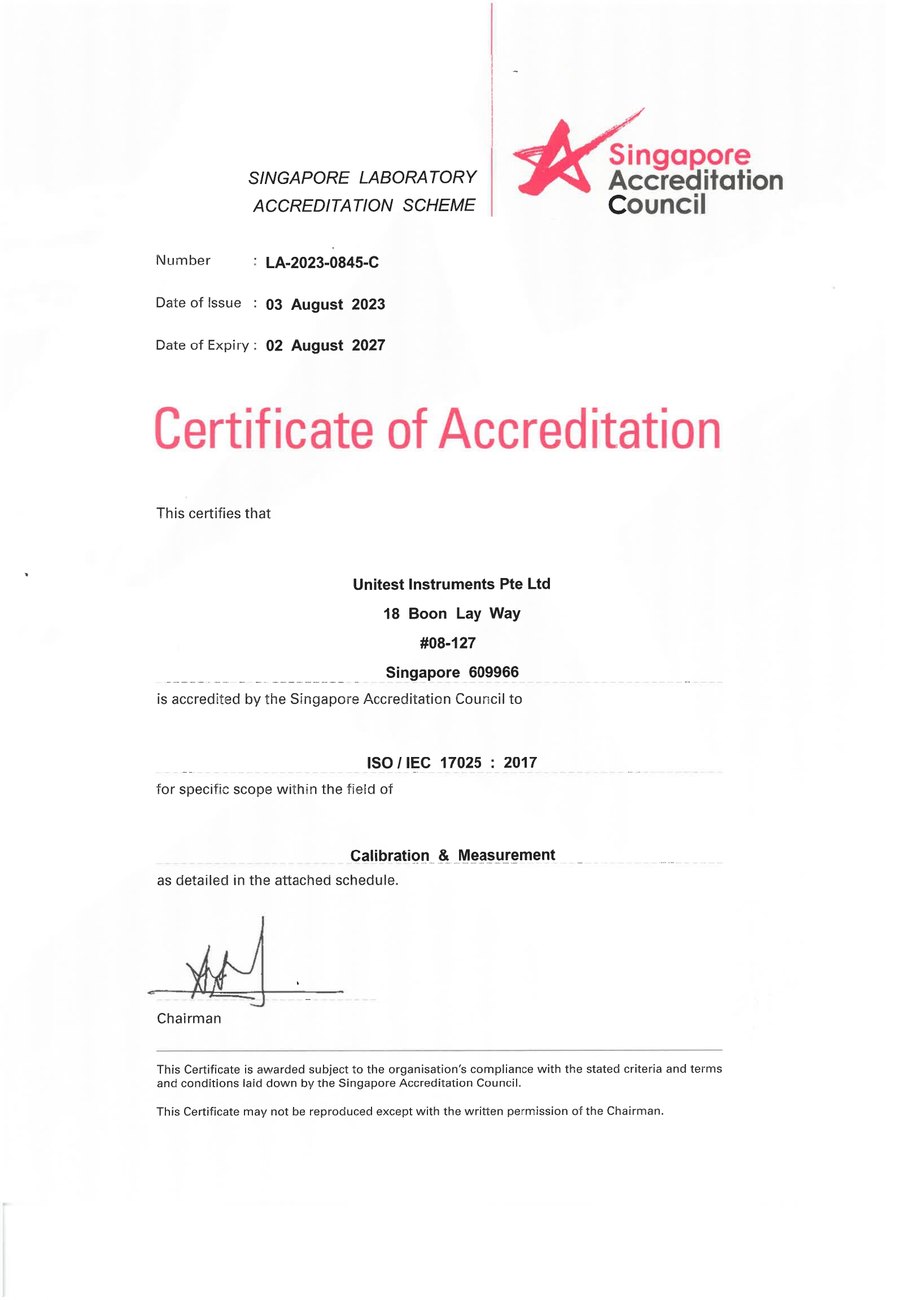
SAC-SINGLAS accredited calibration laboratory (Acc. No. LA-2023-0845-C) serving Singapore's industrial, pharmaceutical, and manufacturing sectors. All content reflects our ISO/IEC 17025 accredited scope and is reviewed by our technical calibration team.
Need ultrasonic leak detector calibration in Singapore?
Unitest Instruments is SAC-SINGLAS accredited (Acc. No. LA-2023-0845-C) to ISO/IEC 17025. We calibrate Coltraco and third-party ultrasonic instruments with same-week turnaround. Certificates accepted by ISO 9001 auditors and SCDF.