
Key Takeaways
- Ultrasonic leak detectors find compressed-air leaks by detecting the 38–40 kHz sound produced at the leak point. The system stays live during the survey.
- Sonic imaging instruments (Fluke ii900) give a visual "heat map" of leak intensity; point-and-detect instruments (Fluke 805, Amprobe ULD-300) are lower-cost but require closer positioning.
- Singapore ISO 50001 and EMA Energy Conservation Act audits require instruments with traceable calibration. A SAC-SINGLAS certificate is the gold standard locally.
- A single 3 mm leak at 7 bar costs a Singapore plant approximately S$800–1,200 per year in wasted electricity. Most plants have 20–50 such leaks.
- Calibrate your instrument before its first formal audit and at least annually thereafter to maintain ISO 9001 and ISO 50001 compliance.
Who Needs an Ultrasonic Leak Detector?
If your facility runs a compressed-air system (and most Singapore manufacturing, pharmaceutical, and F&B plants do), you almost certainly have leaks costing you money right now. The Compressed Air and Gas Institute estimates that 25–30% of all compressed air generated in an average industrial plant is lost to leakage. At Singapore's electricity tariff of around S$0.29 per kWh, that translates to tens of thousands of dollars annually for a medium-sized plant running a 75 kW compressor bank.
The following roles and organisations benefit most from owning or regularly using an ultrasonic leak detector:
- Facilities and energy managers in manufacturing plants under ISO 50001 or Singapore's Energy Conservation Act (ECA) mandatory energy audit regime.
- Maintenance engineers in semiconductor fabs, pharmaceutical cleanrooms, and electronics assembly lines where unscheduled downtime is expensive.
- Building services contractors conducting compressed-air health checks as part of preventive maintenance contracts.
- Energy auditors preparing reports for Singapore's Energy Efficiency Fund (EEF) grant applications.
- Quality managers whose ISO 9001 or GMP auditors request documented evidence of calibrated test equipment on-site.
If you fall into any of these categories, the question is not whether to invest in leak detection. It is which instrument gives you the best combination of sensitivity, usability, and audit-ready documentation.
Compressed air is sometimes called the fourth utility in industrial facilities, alongside electricity, water, and gas, and it is consistently the most expensive utility per unit of useful output once generation, distribution, and leakage losses are accounted for. Unlike electricity or water, where a leak or waste is often immediately visible on a utility bill or a dripping tap, compressed-air leakage is silent and largely invisible without dedicated detection equipment, which is precisely why so many Singapore facilities carry a 20 to 30 percent leakage rate for years without anyone identifying the scale of the waste. A single ultrasonic survey, properly conducted and documented, frequently pays for the instrument's purchase price within the first year purely from the leaks it identifies and the resulting compressor load reduction.
Key Specifications to Compare Before Buying
Not all ultrasonic leak detectors are created equal. The following specifications determine how quickly and accurately you can locate leaks, and how defensible your findings will be to an external auditor.
Operating Frequency
Most instruments centre on 38–40 kHz. Wide-band instruments that sweep 20–100 kHz and allow tuning are better suited to extremely noisy environments like shipyards or foundries, because you can select the frequency band that rises above the specific noise floor of your plant. For typical Singapore light-industrial and cleanroom environments, a fixed 40 kHz instrument is sufficient.
Detection Method: Sonic Imaging vs Point-and-Detect
Sonic imaging instruments (such as the Fluke ii900) use a phased microphone array to build a real-time spatial "sound map" overlaid on a camera image. You see exactly where the leak is (even from several metres away), without physically tracing every pipe run. This dramatically reduces survey time in large plants. Point-and-detect instruments use a single transducer and require the operator to sweep the wand close to joints and fittings; they are slower but far less expensive and perfectly adequate for smaller facilities.
Sensitivity and Minimum Detectable Leak Rate
Look for instruments that can detect leaks equivalent to 0.1 L/min or smaller at the instrument's rated detection distance. Manufacturer-specified minimum leak rates are sometimes quoted at short range (10–30 cm); ensure you compare specifications at a consistent distance. For large plants where you need to detect leaks from 3–5 metres away, sonic imaging instruments with their focused microphone arrays have a significant advantage.
Display and Data Logging
For ISO 50001 and ECA-reportable audits, you need to document each leak location, estimated flow rate, and repair priority. Instruments with built-in data logging, leak-rate estimation, and report-export capability (USB or Bluetooth to a PC) save significant post-survey administration time. Basic instruments require the surveyor to photograph and note findings manually.
IP Rating and Operating Environment
Singapore's humidity and the conditions in marine MRO or outdoor utility areas demand at minimum IP54 ingress protection. Instruments used in explosive atmospheres (paint booths, solvent-handling areas) require ATEX or IECEx certification.
The Physics Behind Ultrasonic Leak Detection, and Why It Works So Well in Noisy Plants
When compressed gas escapes through a small orifice, whether a pinhole in a hose, a worn fitting thread, or a leaking solenoid valve seat, the turbulent flow through that restriction generates broadband acoustic energy across a wide frequency range, but a disproportionate amount of that energy falls in the ultrasonic band above roughly 20 kHz, beyond the upper limit of human hearing. This is genuinely useful for industrial leak detection because most of the loud, disruptive noise present on a typical factory floor (machinery, conveyors, compressors, forklifts) is concentrated in the audible range below 20 kHz and drops off sharply above it, meaning an ultrasonic detector tuned to listen specifically in the 38 to 40 kHz band is inherently far less affected by ambient plant noise than a human ear or a standard audio-range microphone would be.
Because these instruments cannot simply play ultrasonic frequencies back to a human operator (people cannot hear them), they use a technique called heterodyning: the detected ultrasonic signal is mixed with an internally generated reference frequency, producing a difference frequency that falls within the audible range and can be heard through headphones or a speaker, alongside a numeric dB or signal-strength readout on the display. This is why an ultrasonic leak detector produces a distinctive rushing or hissing sound through the headphones as the probe approaches a leak, even though the actual physical signal being detected is entirely inaudible to the unaided ear. Directionality also plays a role in how effectively these instruments locate a leak's precise origin: ultrasonic frequencies are highly directional compared to lower audible frequencies, meaning the signal strength changes noticeably and predictably as the probe or microphone array is pointed toward versus away from the leak source, which is precisely what allows an experienced operator (or a sonic imaging instrument's phased array) to pinpoint a leak's exact location rather than simply confirming a leak exists somewhere nearby.
How Ultrasonic Leak Detectors Are Actually Calibrated
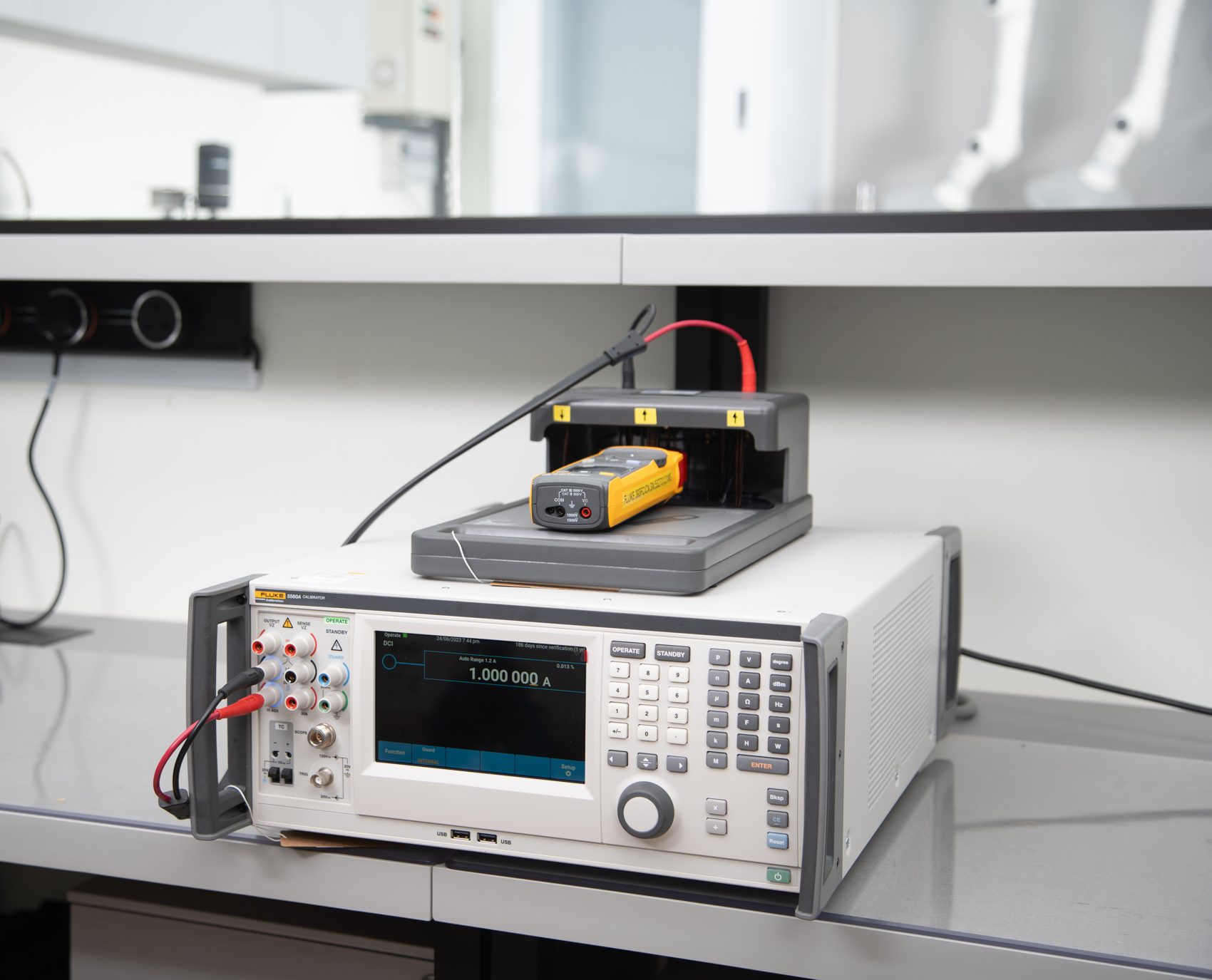
Calibrating an ultrasonic leak detector accredited to ISO/IEC 17025 verifies that the instrument's microphone, signal processing, and displayed dB or sensitivity reading respond correctly and repeatably to a known, controlled ultrasonic source, typically a calibrated ultrasonic reference emitter that produces a stable, characterised acoustic output at defined frequencies and distances. The instrument under test is positioned at specified distances from the reference source, and its reported signal level is compared against the reference emitter's certified output, establishing the instrument's actual sensitivity and confirming its frequency response matches its stated specification across the operating band.
This calibration matters more than it might first appear for audit and grant-reporting purposes, because an ultrasonic leak detector's own sensitivity directly determines the minimum leak size a survey can actually detect. An instrument that has drifted to reduced sensitivity, whether from microphone degradation, internal electronic drift, or physical damage, will systematically under-report leaks below its now-elevated effective detection threshold, producing a survey report that looks complete and professional while silently missing a real portion of the plant's actual leak population. For ISO 50001 energy audits and Energy Efficiency Fund grant submissions, where the reported leak count and associated cost-savings estimate feed directly into a formal energy management record, a documented, accredited calibration of the survey instrument is what gives that reported figure genuine credibility rather than an unverifiable claim.
Top Ultrasonic Leak Detectors Available Through Unitest
The following instruments are available through Unitest Instruments and cover the full range from entry-level point-and-detect to professional sonic imaging. All can be sent for SAC-SINGLAS accredited calibration upon purchase.
| Model | Type | Frequency | Detection Range | Data Logging | Price Range (SGD) | Best For |
|---|---|---|---|---|---|---|
| Fluke ii900 | Sonic Imager | 2–100 kHz (selectable) | Up to 100 m | Yes. Image + dB export | S$6,500–8,500 | Large plants, ISO 50001 audits, noisy environments |
| Fluke ii910 | Sonic Imager (Pro) | 2–100 kHz (selectable) | Up to 120 m | Yes. Full report export | S$9,000–12,000 | High-value audit contracts, multi-site programmes |
| Amprobe ULD-300 | Point-and-Detect | 40 kHz fixed | Up to 5 m | Basic dB display | S$800–1,200 | SME facilities teams, routine maintenance checks |
| Fluke 805 (Vibration + Ultrasonic) | Point-and-Detect + Vibration | 38 kHz + vibration sensor | Up to 3 m | Yes. Trend logging via PC | S$2,200–3,200 | Combined bearing/leak surveys, predictive maintenance teams |
| Fluke 3000 FC Wireless Module | Wireless add-on system | Varies by sensor module | Contact / proximity | Yes. Fluke Connect platform | S$1,500–2,500 (system) | Remote monitoring of known leak points between surveys |
All models listed above are available for purchase at unitestshop.com. Unitest stocks genuine Fluke and Amprobe instruments with full manufacturer warranty and local service support.
Calibrate Your Leak Detector Before the Next Audit
Unitest Instruments provides SAC-SINGLAS accredited calibration for ultrasonic instruments. Get a traceable certificate accepted by ISO 9001 and ISO 50001 auditors, with same-week turnaround available.
How to Conduct a Compressed-Air Leak Survey Step by Step
A well-structured leak survey takes two to four hours for a medium-sized plant and produces a prioritised repair list with estimated annual savings per leak. The following method is aligned with ISO 50001 audit requirements and Singapore's EMA energy-audit guidelines.
Step 1. System Walk-Down and Map Preparation
Before switching on the detector, walk the entire compressed-air distribution system and mark a simple schematic: compressor room, main headers, branch lines, drop points, and major consumers. Note areas with high ambient noise (punch presses, CNC machining centres) where you may need to tune the detector frequency or use a focusing cone accessory. This map becomes the backbone of your report.
Step 2. Survey During Production Hours
Counterintuitively, it is best to survey during normal production when the system is under full pressure. At shutdown, pressure drops and small leaks may not produce a detectable signal. Move systematically along each branch, holding the detector at 30–60 cm from fittings, connectors, valves, and hose connections. For sonic imaging instruments, you can sweep from 3–5 metres away, dramatically speeding up the survey.
Step 3. Tag, Record, and Estimate Each Leak
Tag every leak point with a numbered cable tie or sticker. Record the location, estimated dB reading, visual leak size estimate, and system pressure at that point. Most modern instruments include a conversion table from dB reading and pressure to approximate flow rate in L/min or SCFM. This flow rate, combined with compressor specific-power data, gives you the annual energy cost of each leak.
Step 4. Prioritise and Report
Sort leaks by annual cost, not by size alone. A small leak on a high-pressure (10 bar) nitrogen line costs far more than a larger leak on a 4 bar instrument-air branch. Classify repairs into three tiers: Immediate (annual saving >S$500, repair cost <S$200), Planned (next scheduled shutdown), and Monitor (minor, below repair threshold). Submit the report with your instrument's calibration certificate attached. This is what your ISO 9001 auditor will request.
Singapore Standards and Compliance Requirements
Singapore's regulatory and standards landscape increasingly mandates documented compressed-air energy management. Understanding the applicable frameworks helps you choose the right instrument and calibration frequency.
Energy Conservation Act (ECA, Cap. 92C) requires large energy users (above 54 TJ/year of energy consumption) to conduct mandatory energy audits every three years, submit energy management plans, and appoint registered energy auditors. Compressed-air systems are a listed audit scope. Instruments used in ECA-reportable audits must be calibrated, and SAC-SINGLAS accredited certificates are the preferred form of traceability evidence accepted by EMA.
ISO 50001:2018 is increasingly required for companies applying for EEF grants or demonstrating energy governance to MNC customers. The standard requires that monitoring and measurement equipment be calibrated at defined intervals against national or international measurement standards. Exactly what a SAC-SINGLAS calibration certificate provides. Our article on ISO/IEC 17025 calibration requirements explains in detail what the standard demands of your calibration provider.
Singapore Standard SS 591 covers energy auditing of building services including compressed-air systems. For facilities undergoing BCA Green Mark or BCA SLEB certification, compressed-air leak rates are assessed as part of the mechanical services energy audit.
For a broader understanding of what makes a calibration certificate valid and auditor-defensible, see our guide to reading a calibration certificate.
The Case for SAC-SINGLAS Calibration on a New Instrument
Many facilities teams skip calibration on a newly purchased instrument, assuming it left the factory in specification. This is a risky assumption for three reasons.
First, instruments can be damaged in transit. A dropped carton or rough handling during freight from the distributor's warehouse is not uncommon. A calibration check immediately on receipt gives you a baseline and protects your warranty claim if the instrument is out of specification. Second, factory calibration certificates from overseas manufacturers are typically issued against the manufacturer's internal reference standards, which may not be traceable to Singapore's national measurement standards. For EMA-reportable audits, the Singapore Accreditation Council's guidance strongly recommends using SAC-accredited calibration for measurement evidence. Third, a baseline certificate issued at the start of the instrument's service life makes it straightforward to demonstrate stability at subsequent calibration intervals, which is a specific requirement of ISO 50001 monitoring and measurement control clauses.
Unitest Instruments holds SAC-SINGLAS accreditation No. LA-2023-0845-C under ISO/IEC 17025, with traceability to the National Metrology Centre (NMC) of Singapore. Our calibration certificates are accepted by EMA-registered energy auditors, ISO 9001 and ISO 50001 third-party auditors, and HSA GMP inspectors across Singapore. Same-week turnaround is available for most instrument types.
Beyond the formal calibration certificate itself, it is worth building a simple functional verification habit into the instrument's day-to-day use between full calibration cycles. A small, known leak source (a controlled orifice fitting or a dedicated ultrasonic reference source, if your instrument includes one) checked before starting each survey confirms the detector is still responding normally and gives the surveying technician confidence in the day's results without waiting for the next annual calibration cycle. This mirrors the bump-test discipline used for gas detectors: a quick functional check does not replace accredited calibration, but it catches a genuinely failed or badly drifted instrument before an entire survey's worth of data is collected on a device that was quietly no longer working correctly.
Frequently Asked Questions
An ultrasonic leak detector senses the high-frequency sound (typically 38–40 kHz) produced when pressurised gas escapes through a crack, valve seat, or fitting. The turbulent flow at the leak point generates ultrasound that travels through the air or along solid structures. The instrument down-converts this signal into the audible range and displays a bar-graph or dB reading so the technician can pinpoint and quantify the leak without shutting down the system. Because ultrasound is directional and does not travel as far as lower-frequency noise, even small leaks can be isolated in noisy factory environments.
The primary users in Singapore are precision-engineering and electronics manufacturers (Jurong, Tuas, Woodlands corridors), semiconductor fabs, pharmaceutical manufacturers under GMP and HSA requirements, food and beverage plants, shipyards and marine MRO facilities, and data-centre operators running pneumatic cooling systems. Government-linked companies working toward ISO 50001 energy-management certification also conduct mandatory compressed-air energy audits, making leak detection a compliance requirement rather than an optional maintenance activity.
Most industrial-grade ultrasonic leak detectors operate in the 38–40 kHz centre-frequency range. This band provides the best balance between sensitivity to small leaks and immunity to low-frequency machine noise. Some advanced instruments (such as the Fluke ii900) sweep a wider band (20–100 kHz) and let you tune to the frequency with the strongest signal for a specific environment. A narrow-band instrument tuned only to 40 kHz is sufficient for most compressed-air surveys; wide-band instruments are preferred in very noisy environments like shipyards or hot-press lines.
Yes. Like any measurement instrument, an ultrasonic leak detector's sensitivity can drift over time due to transducer ageing, mechanical shock, or environmental ingress. For ISO 9001 and ISO 50001 compliance, the calibration interval should be defined by your measurement uncertainty requirements. Typically annually for general industrial surveys and six-monthly for instruments used in formal energy audits. Unitest Instruments, as a SAC-SINGLAS accredited laboratory (Acc. No. LA-2023-0845-C), can calibrate ultrasonic leak detectors against traceable references. Fresh calibration on a newly purchased instrument also verifies it meets the manufacturer's published specifications before it enters service.
For a medium-sized manufacturing plant of 5,000–10,000 sq m, a professional compressed-air leak survey using ultrasonic equipment typically costs S$1,500–4,500 depending on system complexity and reporting requirements. Companies purchasing their own instruments (S$1,500–8,000 for the detector) recover the cost after one or two surveys, especially if they carry out quarterly checks. Enterprise Energy Management grants under Singapore's Energy Efficiency Fund (EEF) may co-fund leak-detection surveys and energy-management software for qualifying companies.
Yes. Any pressurised gas that escapes through an orifice produces ultrasound, so the same instrument can locate leaks in nitrogen, argon, CO2, refrigerant lines, and vacuum systems (where air ingress creates ultrasound). Dedicated refrigerant-leak detectors using heated-diode or infrared sensing are more sensitive at very low refrigerant concentrations, but ultrasonic detection is faster for a broad survey because it does not require knowing the gas type and is unaffected by background refrigerant contamination.
The primary standard is ISO 50001:2018 (Energy Management Systems), which is increasingly required for companies receiving Singapore's Energy Efficiency Fund grants. SS 591 (Singapore Standard for Energy Auditing of Building Services) covers compressed air as a building service. The Compressed Air and Gas Institute (CAGI) publishes internationally recognised audit methodologies. For facilities under EMA regulation, the Energy Conservation Act (Cap. 92C) mandates energy audits for large energy users, which must include compressed-air systems. Instruments used in reportable audits should carry SAC-SINGLAS or equivalent accredited calibration certificates.
The standard formula is: Annual energy waste (kWh) = Leak flow rate (L/min) × compressor specific power (kW per L/min) × annual operating hours. A 3 mm leak at 7 bar generates approximately 12–15 L/min of lost flow, which at typical SG electricity tariffs of S$0.28–0.32 per kWh and 6,000 operating hours costs roughly S$800–1,200 per year per leak. A plant with 30 such leaks wastes S$24,000–36,000 annually. Most plants achieve leak rates of 20–30% of compressor output before a survey; best practice is under 5%. This ROI argument makes the business case for purchasing your own ultrasonic detector straightforward.
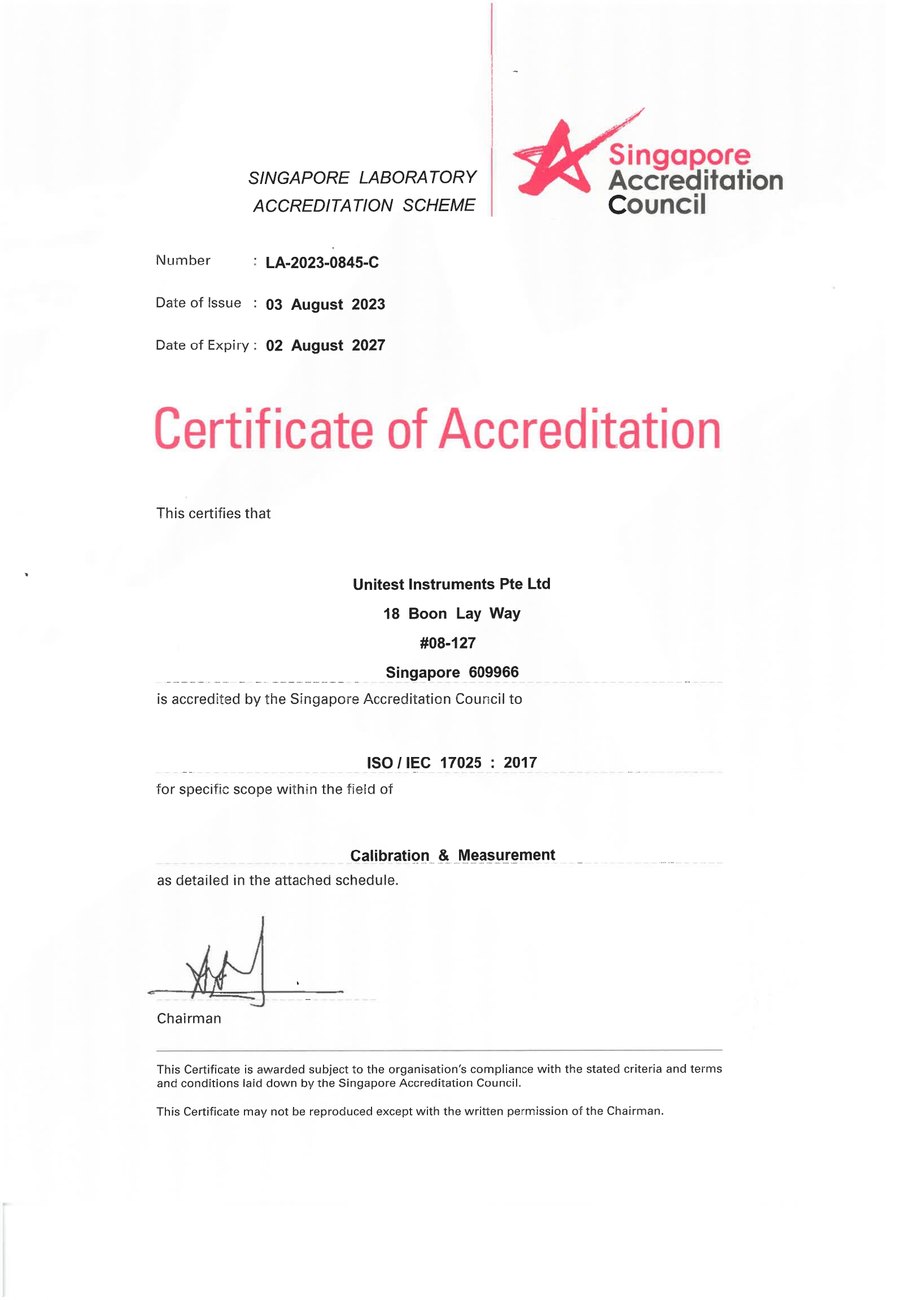
SAC-SINGLAS accredited calibration laboratory (Acc. No. LA-2023-0845-C) serving Singapore's industrial, pharmaceutical, and manufacturing sectors. All content reflects our ISO/IEC 17025 accredited scope and is reviewed by our technical calibration team.
Need ultrasonic instrument calibration in Singapore?
Unitest Instruments is SAC-SINGLAS accredited (Acc. No. LA-2023-0845-C) to ISO/IEC 17025. Same-week turnaround, certificates accepted by ISO 9001 auditors.