
Key Takeaways
- SS 638 is Singapore's Code of Practice for Electrical Installations. Mandatory for all non-residential fixed electrical installations above 45 kVA, enforced under the Electricity Act (Cap. 89A) by EMA.
- Six core tests are required before energisation: continuity, insulation resistance, polarity, earth fault loop impedance, RCD operation, and prospective short-circuit current measurement.
- Periodic inspection and testing (PI&T) is required every five years for most commercial and industrial premises. More frequently for hospitals, ATEX locations, and data centres.
- Non-compliance penalties include fines up to S$10,000, supply disconnection, EIL suspension, and personal liability for injury or fire damage.
- Test instruments must be calibrated with traceable measurement uncertainty. SAC-SINGLAS accredited calibration (ISO/IEC 17025) provides the chain of traceability required by EMA auditors and ISO 9001 certification bodies.
What Is SS 638 and Why Does It Matter?
SS 638, formally titled Code of Practice for Electrical Installations, is the primary technical standard governing the design, installation, inspection, testing, and verification of fixed electrical installations in Singapore. It is published by Enterprise Singapore (formerly SPRING Singapore) and is adopted by reference in the Electricity (Electrical Installations) Regulations and the Workplace Safety and Health (Electrical Work) Regulations administered by EMA and MOM respectively.
The standard is substantially aligned with IEC 60364 (Low-Voltage Electrical Installations) (the international reference), but incorporates Singapore-specific provisions for tropical climate conditions, local supply characteristics (230 V / 50 Hz single-phase; 400 V three-phase), and SP Group's distribution network parameters. Facilities managers should not assume that an installation verified to IEC 60364 in another jurisdiction is automatically compliant with SS 638; local loop impedance values, earthing arrangements, and RCD requirements differ.
Compliance with SS 638 is not optional. The Electricity Act makes it a condition of holding an Electrical Installation Licence (EIL), which is required for any non-residential installation exceeding 45 kVA maximum demand. Without a valid EIL, SP Group will not maintain a supply connection. In practice, this means SS 638 compliance is a pre-condition of operating any substantial commercial, industrial, or institutional facility in Singapore.
Scope: Which Installations Must Comply?
SS 638 applies to all fixed low-voltage electrical installations (up to and including 1000 V AC) in non-residential premises. This encompasses office buildings, factories, warehouses, shopping malls, hospitals, schools, hotels, data centres, and mixed-use developments with substantial common electrical infrastructure. Construction site temporary installations and marina/port electrical systems also fall within scope, with additional overlay requirements from MOM (WSH Act) and MPA respectively.
Residential installations in private dwellings below 45 kVA are typically governed by simpler provisions under SP Group's service conditions, but condominium common areas, multi-tenant industrial buildings, and purpose-built student accommodation with centralised electrical systems are firmly within SS 638's remit. If in doubt, a Licensed Electrical Worker (LEW) can advise whether the installation requires an EIL and full SS 638 compliance.
| Installation Type | Primary Regulator | PI&T Interval | Key Additional Requirements |
|---|---|---|---|
| Commercial / Office | EMA | 5 years | BCA building services approval for major works |
| Industrial / Factory | EMA + MOM | 5 years | WSH Act compliance; ATEX zones may require annual testing |
| Hospital / Healthcare | EMA + MOH | 1–3 years (risk-based) | IEC 60364-7-710 medical locations; additional IT earthing systems |
| Data Centre | EMA + IMDA | Annual recommended | High availability requirements; UPS and generator integration testing |
| Construction Site (temporary) | MOM + EMA | Before each energisation phase | WSH (Electrical Work) Regs; all RCDs tested ≤30 mA |
| Maritime / Port | EMA + MPA | 5 years or at refit | Shore supply and vessel interface earthing |
What SS 638 Requires: The Six Mandatory Tests
Before any new installation (or a substantially modified existing installation) is energised, SS 638 Section 6 requires a comprehensive programme of initial verification testing. These tests must be carried out by or under the supervision of a Licensed Electrical Worker, and results must be documented on the prescribed EMA test report form. The following six tests form the mandatory core.
1. Continuity of Protective Conductors and Equipotential Bonding
This test verifies that all protective earth (PE) conductors, main equipotential bonding conductors, and supplementary bonding conductors form a continuous low-resistance path back to the main earthing terminal. A low-resistance ohmmeter (typically injecting 200 mA DC) is used. SS 638 does not prescribe a maximum resistance limit in ohms. Instead, the measured value is used to confirm the conductor's cross-section and length are consistent with design, and to calculate the loop impedance contribution. Any unexpected high resistance reading indicates a broken, corroded, or incorrectly connected earth conductor.
2. Insulation Resistance
Insulation resistance (IR) testing is performed with all circuit protective conductors connected and all switches in the closed position, using a DC test voltage of 500 V (for circuits up to 500 V rated) or 1000 V (for circuits rated 500 V to 1000 V). The minimum acceptable IR value is 1 MΩ between live conductors and earth, measured separately for each circuit after disconnecting sensitive equipment such as electronic dimmers, motor speed drives, and electronic ballasts. As a practical benchmark, healthy new cabling typically reads 100 MΩ or more; readings approaching the 1 MΩ minimum signal insulation degradation that warrants further investigation before energisation.
3. Polarity
The polarity test confirms that all single-pole protective and switching devices (MCBs, fuses, switches) are connected in the live conductor only, never in the neutral. It also verifies that socket outlet wiring follows the correct L-N-E assignment and that the phase rotation for three-phase circuits is consistent. This is typically performed using a continuity tester or multifunction installation tester before energisation. Incorrect polarity is a latent danger. A switched-neutral installation may appear functional but leaves equipment live when the switch is open, creating an electrocution hazard during maintenance.
4. Earth Fault Loop Impedance
Earth fault loop impedance (Zs) measurement is one of the most critical SS 638 tests. It verifies that in the event of a line-to-earth fault, the prospective fault current will be sufficient to operate the circuit's protective device (MCB or fuse) within the disconnection time specified by the standard , 0.4 seconds for socket outlet circuits, 5 seconds for distribution circuits. The measured Zs must be equal to or less than the maximum tabulated value for the protective device rating and type. SP Group's external loop impedance (Ze) at the metering point must be measured or obtained from SP Group's published data as the starting figure.
5. RCD Operation Test
Residual current devices must be tested at their rated tripping current (IΔn) and at 5× IΔn to verify correct operation and trip time. SS 638 requires 30 mA RCDs used for additional protection to trip within 40 ms at IΔn and within 40 ms at 150 mA (5×). Type S (selective) RCDs in discrimination schemes must have a delayed tripping characteristic consistent with their coordination role. All RCDs must also be functionally tested by pressing the test button. RCD testing requires a calibrated RCD tester that can apply the precise test currents at the correct phase angle. A non-calibrated instrument may produce incorrect trip-time measurements, leading to a false pass on a device that will not operate safely in a fault condition.
6. Prospective Short-Circuit Current
The prospective short-circuit current (Ipsc) at the origin of the installation must be measured or calculated. This figure is used to verify that all switchgear and protective devices installed have an adequate fault current breaking capacity (rated short-circuit capacity, or Ics/Icu). If the measured Ipsc exceeds the breaking capacity of any device, that device is at risk of catastrophic failure (explosion, fire, or arc flash), during a bolted fault. For most Singapore commercial installations fed from a 400 V distribution board, Ipsc values at the incomer typically range from 6 kA to 50 kA depending on distance from the substation and cable impedance.
Need calibration for your SS 638 test instruments?
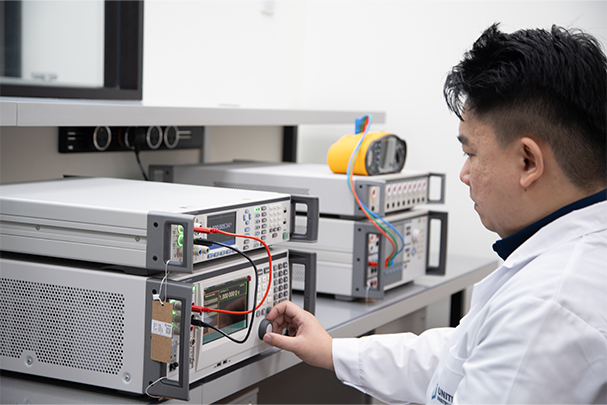
Unitest Instruments calibrates insulation resistance testers, loop impedance testers, RCD testers, and multifunction installation testers, with SAC-SINGLAS accredited certificates accepted by EMA auditors and ISO 9001 certification bodies.
Step-by-Step SS 638 Compliance Process
For facilities managers overseeing a new installation or a periodic inspection, the following sequence represents the practical compliance pathway under Singapore's regulatory framework.
Step 1. Appoint a Licensed Electrical Worker
All testing, inspection, and certification under SS 638 must be performed by or under the direct supervision of an EMA-licensed LEW of the appropriate grade. For installations above 1000 kVA maximum demand, a Grade A1 LEW is required. Verify the LEW's licence is current at EMA's online registry before engagement. The LEW is the responsible person who will sign the EIL test report and submit it to EMA, facilities managers cannot self-certify.
Step 2. Verify Instrument Calibration Before Testing
Before any testing begins, confirm that all test instruments hold current calibration certificates traceable to national standards. This is where many facilities teams fall short: instruments are often used with expired calibrations or certificates from non-accredited providers. For SS 638 compliance purposes (and for any ISO 9001, ISO 45001, or BIZFIVE audit), instruments should be calibrated by a SAC-SINGLAS accredited laboratory. As explained in our guide on accredited vs non-accredited calibration, accredited calibration provides a legally defensible chain of traceability that non-accredited calibration cannot match. Calibration certificates must state measurement uncertainty. See our article on how to read a calibration certificate for what to check.
Step 3. Conduct Pre-Energisation Tests in the Correct Sequence
The six tests described in the section above must be conducted in a defined order to avoid damaging sensitive equipment or producing misleading results. Insulation resistance testing must be performed before the supply is connected and before RCD testing. Polarity verification should precede loop impedance testing. Document every reading (the EMA test report requires measured values, not just pass/fail), and retain records for at least five years (the next inspection interval).
Step 4. Submit the EIL Application or Periodic Inspection Report to EMA
For new installations, the LEW submits the Electrical Installation Licence application to EMA together with the completed test report and single-line diagram. EMA reviews the submission and, if satisfactory, issues the EIL. Typically within 10 to 15 working days for straightforward installations. For periodic inspections, the LEW submits the PI&T report to EMA within 28 days of the inspection date. Facilities managers should calendar the next PI&T date immediately upon receiving the current report, as EMA can initiate enforcement action against installations where PI&T has lapsed.
Step 5. Remediate Any Deficiencies Before Re-Test
If any test produces a result outside SS 638's prescribed limits, for example, insulation resistance below 1 MΩ, or loop impedance exceeding the maximum for the installed protective device. The deficiency must be investigated and remediated before the installation can be energised or before the PI&T report can be certified. Common causes include degraded cable insulation (moisture ingress, physical damage), incorrect MCB ratings, inadequate earth conductor sizing, or failed RCD mechanisms. The LEW must re-test after remediation to confirm compliance.
Calibration Instrument Requirements for SS 638 Testing
The accuracy of SS 638 test results is only as good as the instruments used to obtain them. EMA does not prescribe specific instrument models, but the test report requires the instrument make, model, and calibration certificate reference to be recorded. Creating a direct audit trail between the result and the instrument's calibrated accuracy.
The key instruments required for a full SS 638 test programme, and their calibration requirements, are as follows:
| Instrument | SS 638 Test | Key Parameter Calibrated | Typical Calibration Interval |
|---|---|---|---|
| Low-resistance ohmmeter | Protective conductor continuity | DC resistance (0.01 Ω – 200 Ω), test current ≥200 mA | 12 months |
| Insulation resistance tester | Insulation resistance | DC test voltage (500 V / 1000 V), resistance (0.1 MΩ – 2 GΩ) | 12 months |
| Earth fault loop impedance tester | Earth fault loop impedance (Zs) | Impedance (0.01 Ω – 200 Ω), external loop Ze | 12 months |
| RCD tester | RCD operation and trip time | Trip current (mA), trip time (ms), phase angle | 12 months |
| Prospective fault current meter | Prospective short-circuit current | AC impedance, fault current (kA) | 12 months |
| Multifunction installation tester | Multiple (combined above) | All parameters above. Each function individually | 12 months |
Understanding measurement uncertainty is essential when interpreting test results near the SS 638 limits. As detailed in our article on measurement uncertainty in calibration, every measurement has an associated uncertainty. A calibrated instrument with a stated uncertainty of ±2% on a 1 MΩ reading means the true value could be between 0.98 MΩ and 1.02 MΩ. A result of 1.01 MΩ from a non-calibrated instrument is not a reliable pass. Facilities managers should request calibration certificates that explicitly state expanded uncertainty (k=2, 95% confidence) for each measured quantity.
Penalties for Non-Compliance and Common Enforcement Actions
EMA's enforcement posture has tightened in recent years, particularly following several high-profile electrical fires in industrial premises that were subsequently found to have lapsed or deficient SS 638 inspection records. The regulatory and commercial consequences of non-compliance span several dimensions.
Under Section 85 of the Electricity Act, operating a non-licensed or non-compliant installation is a criminal offence. For individuals (including company directors personally liable), the penalty is a fine up to S$10,000 and/or up to 12 months' imprisonment per offence. For corporate entities, EMA can pursue the company directly. Repeat offences attract doubled maximum penalties. EMA also has the authority to issue a Discontinuance Order (requiring SP Group to disconnect supply), which effectively halts operations until compliance is restored.
Insurance implications are equally serious. Most commercial and industrial property insurance policies exclude fire and electrical damage claims arising from installations that are not maintained in compliance with applicable standards. An uninsured fire claim in a commercial building can run into millions of dollars. Vastly exceeding the cost of the five-yearly PI&T programme. Facilities managers who can document a full SS 638 compliance history are in a materially stronger position when dealing with insurers after an incident.
ISO 9001 and ISO 45001 certification auditors treat lapsed electrical compliance as a significant non-conformance under the control of equipment and measurement provisions. A finding that test instruments are uncalibrated, or that the last PI&T was performed beyond the mandated interval, typically generates a major non-conformance that must be resolved before the certification can be maintained or renewed.
Frequently Asked Questions
SS 638 is Singapore's Code of Practice for Electrical Installations, published by Enterprise Singapore and referenced under the Electricity Act (Cap. 89A). It applies to all fixed electrical installations in non-residential buildings. Including factories, commercial premises, hospitals, data centres, and industrial facilities. Building owners, facilities managers, and Licensed Electrical Workers (LEWs) are all responsible for ensuring installations comply with the standard. Residential installations below 45 kVA are typically covered by separate provisions, but any mixed-use or larger residential development with common services falls under SS 638.
SS 638 requires a full suite of initial verification tests before any new or substantially modified installation is energised. Mandatory tests include: (1) Continuity of protective conductors and equipotential bonding; (2) Insulation resistance between live conductors and earth. Minimum 1 MΩ at 500 V DC for circuits up to 500 V; (3) Polarity verification; (4) Earth fault loop impedance measurement; (5) RCD operation testing. Trip time must be within prescribed limits; and (6) Prospective short-circuit current measurement at the origin of the installation. All test results must be recorded on the Electrical Installation Licence test report submitted to EMA.
Under the Electricity Act and EMA's licensing requirements, periodic inspection and testing (PI&T) intervals are prescribed by installation type. For most commercial and industrial premises, PI&T is required every five years. High-risk premises such as hospitals, explosive-atmosphere locations (ATEX), and data centres may require more frequent inspection, often annually. A Licensed Electrical Worker must sign off the inspection report, which is then submitted to EMA. Facilities managers should also consider testing after any significant modification, fire, flood, or electrical fault event, regardless of the scheduled interval.
Non-compliance with Singapore's Electricity Act and the conditions of an Electrical Installation Licence can attract significant penalties. Under Section 85 of the Electricity Act, operating an unlicensed or non-compliant installation can result in fines of up to S$10,000 and/or imprisonment of up to 12 months for a first offence. EMA also has the power to order disconnection of supply, suspend or revoke the EIL, and require reinstatement works at the owner's cost. Beyond regulatory penalties, non-compliant electrical installations void insurance coverage and create serious personal liability exposure if a fire, electrocution, or equipment failure is traced to an untested installation.
Test instruments used for SS 638 compliance testing. Including insulation resistance testers, earth loop impedance testers, RCD testers, and multifunction installation testers. Must be calibrated with traceable measurement uncertainty. Best practice is to use instruments calibrated by a SAC-SINGLAS accredited laboratory such as Unitest Instruments (Acc. No. LA-2023-0845-C), which provides traceability to Singapore's National Metrology Centre (NMC). Calibration certificates must quote measurement uncertainty. EMA auditors and ISO 9001/45001 auditors regularly request evidence of instrument calibration as part of compliance verification.
The Energy Market Authority (EMA) is the primary regulator for electrical installations under the Electricity Act. The Building and Construction Authority (BCA) oversees the structural and building services aspects of electrical installations through the Building Control Act. The Ministry of Manpower (MOM) has jurisdiction over electrical safety as a workplace hazard under the Workplace Safety and Health Act, particularly relevant in factories and construction sites. For specific sectors, additional oversight applies: NEA for environmental compliance in industrial settings, MPA for maritime electrical installations, and CAAS for aviation ground installations.
Yes. Temporary electrical installations on construction sites must comply with SS 638 and are additionally subject to MOM's Workplace Safety and Health (Electrical Work) Regulations. Temporary supplies above 230 V single-phase or used in wet, confined, or flammable environments require particular attention to RCD protection, earthing, and cable management. The BCA and MOM regularly inspect sites, and a main contractor's WSHE officer is accountable for ensuring temporary installation test records are maintained. Calibrated test instruments must be on site to verify RCD trip times, insulation resistance, and earth continuity before each phase of temporary electrical work is energised.
SS 638 specifies a minimum insulation resistance of 1 MΩ for circuits operating up to 500 V, measured at 500 V DC. For circuits between 500 V and 1000 V, the test voltage increases to 1000 V DC and the minimum resistance remains 1 MΩ. In practice, healthy new installations should measure far above this threshold. Values below 2 MΩ warrant investigation even if they technically pass. Instruments used for this test must be calibrated to ensure the applied test voltage and measured resistance are accurate; a poorly calibrated meter can give a false pass on a borderline installation.
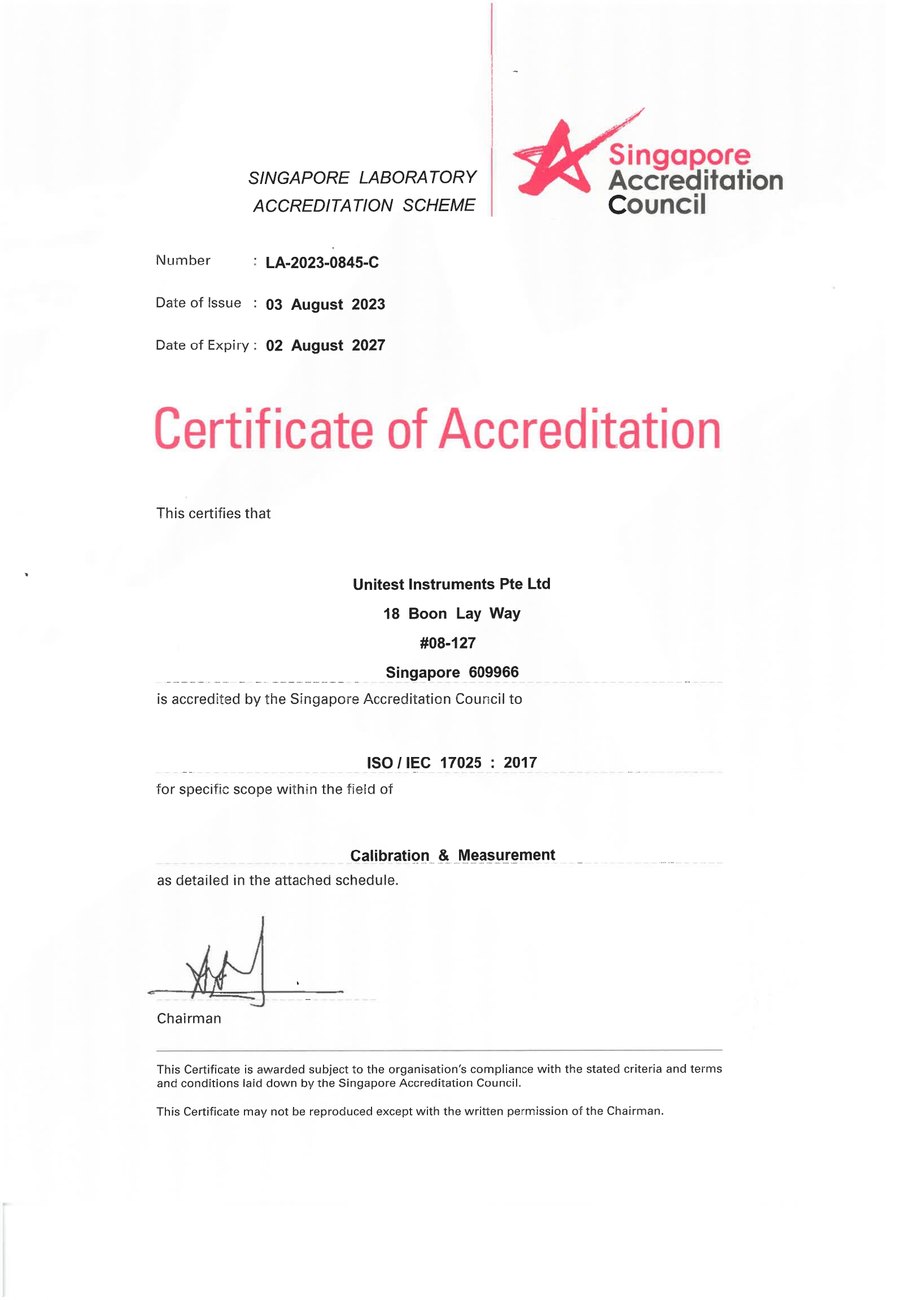
SAC-SINGLAS accredited calibration laboratory (Acc. No. LA-2023-0845-C) serving Singapore's industrial, pharmaceutical, and manufacturing sectors. All content reflects our ISO/IEC 17025 accredited scope and is reviewed by our technical calibration team.
Need electrical test instrument calibration in Singapore?
Unitest Instruments is SAC-SINGLAS accredited (Acc. No. LA-2023-0845-C) to ISO/IEC 17025. Same-week turnaround, certificates accepted by ISO 9001 auditors and EMA-licensed LEWs.