
Key Takeaways
- Chilled mirror hygrometers measure dew point directly from thermodynamic first principles, making them primary reference instruments, but they still require periodic calibration to confirm accuracy and detect mirror contamination effects.
- Calibration uses primary humidity generators or reference chilled mirror instruments traceable to Singapore's National Metrology Centre (NMC), ensuring your readings sit inside a verified international traceability chain.
- A valid calibration certificate from a SAC-SINGLAS accredited laboratory (Acc. No. LA-2023-0845-C) must state measurement uncertainty at each calibration point, not just a pass/fail result.
- Recommended calibration interval is 12 months under normal use; 6 months or after any contamination event for pharmaceutical, food, or cleanroom applications.
- HSA GMP, SFA food storage regulations, and ISO 9001 audits all require traceable humidity calibration. An accredited certificate satisfies all three simultaneously.
Why the Chilled Mirror Hygrometer Is the Reference Standard
Most humidity sensors (capacitive, resistive, psychrometric), measure a secondary property (the electrical or physical response of a material to moisture) and convert it to a humidity value via a calibration function. The chilled mirror hygrometer is fundamentally different. It measures dew point temperature directly: an optically monitored mirror surface is cooled until condensation forms, and the temperature at that exact moment is the dew point. No material drift, no empirical correction factor. Just a thermodynamic measurement anchored in the Kelvin scale.
This is why national metrology institutes around the world, including Singapore's National Metrology Centre (NMC), use chilled mirror technology as the basis for their primary humidity standards. It is also why industrial laboratories, pharmaceutical clean rooms, and semiconductor fabs use chilled mirror instruments as their working reference when validating networks of cheaper capacitive sensors. The instrument sits at the top of the humidity measurement hierarchy.
But even primary reference instruments accumulate errors. Mirror contamination (from airborne organics, salt aerosols, or process gases), shifts the optical detection point. Temperature sensor drift in the mirror thermocouple or RTD changes the reported dew point. Over time, without periodic verification against a higher-level standard, even the best chilled mirror instrument will quietly drift outside its specification. This is why calibration is not optional, even for the gold standard.
What Happens During a Chilled Mirror Hygrometer Calibration
Calibration of a chilled mirror hygrometer is a multi-point comparison exercise performed in a controlled laboratory environment. At Unitest Instruments (SAC-SINGLAS Acc. No. LA-2023-0845-C), the procedure follows ISO/IEC 17025 requirements and is traceable to Singapore's NMC. Here is what happens step by step.
1. Pre-calibration inspection and stabilisation
The instrument is received, uniquely identified, and visually inspected for physical damage, mirror contamination, and filter condition. It is then powered and allowed to stabilise in the laboratory environment (typically 23 ± 1 °C with controlled ambient humidity), for a minimum period specified in the calibration procedure. This stabilisation period ensures the instrument's internal thermal equilibrium matches the controlled reference conditions before any measurements are taken.
2. Reference standard setup
The primary reference used for chilled mirror calibration is a humidity generator (either a two-pressure type or two-temperature type), that produces a precisely known, stable stream of humid gas at defined dew point or relative humidity values. These generators are themselves calibrated against NMC Singapore's primary humidity standards and carry current calibration certificates with stated measurement uncertainties. Alternatively, a reference chilled mirror hygrometer of known and recently verified accuracy (with lower uncertainty than the unit under test) may be used as the reference comparator.
3. Multi-point measurement comparison
The instrument under calibration is exposed to at least five calibration points spanning its intended operating range, for example, dew points from −10 °C to +30 °C for a general-purpose instrument, or from +5 °C to +25 °C for a pharmaceutical clean room application. At each set point, the laboratory allows the system to reach thermal stability, then records multiple readings from both the instrument under test and the reference standard. The mean value and standard deviation are calculated for each set of readings at each point.
4. Uncertainty calculation
This is the step that separates an accredited calibration from a simple comparison check. Under ISO/IEC 17025, the laboratory must calculate and state the measurement uncertainty for each calibration point. Uncertainty sources include the uncertainty of the reference standard, the repeatability of the instrument under test, the resolution of the instrument's display, environmental variations during the measurement, and any correction applied to the reference value. The combined uncertainty is expressed at a 95% confidence level (coverage factor k=2). For more on how uncertainty is quantified and what it means for your compliance, see our article on measurement uncertainty explained.
5. Certificate generation
The calibration results (reference values, instrument readings, deviations, and uncertainties at each point), are recorded in the laboratory's calibration management system and reviewed by a second qualified technician before the certificate is issued. The certificate is signed and carries the SAC-SINGLAS accreditation mark and laboratory number LA-2023-0845-C, confirming it was performed under the laboratory's accredited scope.
Need your chilled mirror hygrometer calibrated in Singapore?
Unitest Instruments (Acc. No. LA-2023-0845-C) provides multi-point dew point and humidity calibration traceable to NMC Singapore. Same-week turnaround, certificates accepted by HSA, ISO 9001, and BCA auditors.
Field Calibration vs Laboratory Calibration: Which Is Right for You?
Both options exist for humidity instruments, and the right choice depends on your application, required measurement uncertainty, and regulatory context. The table below summarises the key differences for chilled mirror hygrometers specifically.
| Factor | Laboratory Calibration | Field Calibration (On-site) |
|---|---|---|
| Reference standard quality | Primary humidity generator or NMC-traceable reference chilled mirror; lowest achievable uncertainty | Portable reference with higher uncertainty due to transport and ambient variability |
| Typical measurement uncertainty | ±0.05 °C to ±0.15 °C dew point (k=2) | ±0.3 °C to ±1.0 °C dew point (k=2) depending on portable reference |
| Environmental control | Temperature, humidity, vibration all controlled; stable measurement conditions | Subject to ambient conditions at site; humidity and temperature can fluctuate |
| Mirror inspection and cleaning | Full optical inspection possible; mirror cleaning performed if required | Limited inspection; contamination may not be detectable with portable equipment |
| ISO/IEC 17025 accreditation | Available from accredited laboratories such as Unitest Instruments (LA-2023-0845-C) | Rarely accredited to ISO/IEC 17025 for chilled mirror instruments |
| Regulatory acceptance | Accepted by HSA GMP, ISO 9001 auditors, BCA, SFA without additional evidence | May require supplementary justification for accreditation audits |
| Typical turnaround | 3–5 working days (express available) | Same day or next day |
| Best for | Reference-class instruments, pharmaceutical, semiconductor, NMI-traceable applications | Low-accuracy humidity loggers or when instrument cannot be transported |
For chilled mirror hygrometers (which are used precisely because maximum accuracy is required), laboratory calibration is almost always the correct choice. The instrument's chief advantage over cheaper sensor types is its low measurement uncertainty; field calibration against a portable reference often negates this advantage by introducing a higher overall uncertainty than the instrument itself can achieve.
Reference Standards and Traceability to NMC Singapore
Traceability is not a label. It is a documented chain of comparisons, each with stated uncertainties, connecting your instrument's readings back to a national or international primary standard. For humidity in Singapore, that chain terminates at the National Metrology Centre (NMC), which is Singapore's designated national measurement institute and a member of the BIPM's CIPM Mutual Recognition Arrangement (CIPM MRA).
NMC Singapore maintains primary humidity standards based on fundamental principles (gravimetric hygrometry and two-pressure generators referenced against primary thermometry), with measurement capabilities that extend from frost point temperatures below −70 °C to dew points above +80 °C. Unitest Instruments calibrates its reference humidity standards directly against NMC, ensuring an unbroken traceability chain from your chilled mirror hygrometer certificate to the SI unit of temperature (Kelvin), from which dew point and all derived humidity quantities are derived. For a full explanation of what calibration traceability means and why it matters, see our guide on traceability in calibration.
When you receive a calibration certificate from Unitest Instruments (SAC-SINGLAS Acc. No. LA-2023-0845-C), the certificate identifies the reference standards used, their calibration dates, and their own certificates, so you can trace every number on the page back through the chain to NMC. This is the documentation an ISO 9001 or GMP auditor will request when they verify your humidity measurement system.
Singapore Regulatory Context: Who Requires Humidity Calibration?
Singapore does not have a single statute that mandates humidity instrument calibration universally, but multiple sector regulators have requirements that, in practice, demand it. The following sectors face the most direct obligations.
Health Sciences Authority (HSA). Pharmaceutical and medical device manufacturers
HSA's GMP guidelines, aligned with PIC/S PE 009, require pharmaceutical manufacturers to calibrate all instruments used in product manufacture and environmental monitoring, including humidity sensors and transmitters in clean rooms, cold stores, and drying ovens. Chilled mirror hygrometers used as reference instruments in pharmaceutical facilities must carry calibration certificates traceable to national standards, and certificates from SAC-SINGLAS accredited laboratories are explicitly recognised. Non-calibrated or non-traceable humidity measurement is a finding in HSA GMP inspections.
Singapore Food Agency (SFA). Food storage and processing
SFA regulations require food storage facilities (particularly cold stores and controlled-atmosphere warehouses), to maintain calibrated temperature and humidity monitoring equipment. Humidity control is critical for preventing mould, mycotoxin formation, and moisture-driven spoilage, particularly for grain, dried goods, and produce. Calibrated humidity instruments are required to demonstrate that storage conditions meet the prescribed limits.
Building and Construction Authority (BCA). Green Mark and ACMV systems
BCA's Green Mark scheme and Singapore Standard SS 553 (Code of Practice for Air-Conditioning and Mechanical Ventilation in Buildings) reference the use of calibrated sensors in HVAC/ACMV monitoring and commissioning. Building owners commissioning or re-commissioning ACMV systems are expected to verify humidity sensor accuracy using traceable calibration.
Workplace Safety and Health (WSH) Act
Under the WSH Act, employers in environments where humidity directly affects worker health (such as textile processing, pharmaceutical manufacturing, and certain food production lines), must maintain safe working conditions. Where humidity measurement forms part of the safety control system, calibrated and traceable instruments are part of the due diligence obligation.
Calibration Interval Recommendations
ISO/IEC 17025 requires users of measuring equipment to establish calibration intervals based on the instrument's performance history, manufacturer recommendations, the criticality of the measurements, and the consequences of out-of-tolerance readings. For chilled mirror hygrometers, the following intervals are generally applicable.
Under normal laboratory or HVAC reference use (where the instrument is operated in a clean, controlled environment with filtered sample gas), annual calibration (every 12 months) is the standard recommendation and is consistent with most manufacturers' guidance. For instruments used in pharmaceutical clean rooms, semiconductor fabs, or food processing environments (where exposure to process gases, cleaning agents, or particulates increases contamination risk), a 6-month interval is more appropriate. Any instrument that has been exposed to a contamination event (visible mirror discolouration, operation outside its specified range, immersion in high-humidity environments, or proximity to chemical vapours) should be calibrated before being returned to service, regardless of its scheduled interval.
Our guide on how often to calibrate your instruments provides a systematic framework for determining the right interval for your specific application and risk level.
What a Proper Calibration Certificate Must Show
Not all calibration certificates are equivalent. A certificate issued by a SAC-SINGLAS accredited laboratory under ISO/IEC 17025 must contain specific elements that demonstrate the result is valid, traceable, and fit for regulatory use. When you receive a chilled mirror hygrometer calibration certificate (from Unitest Instruments (LA-2023-0845-C) or any other laboratory), verify it contains all of the following.
- Laboratory identification and accreditation statement. The laboratory's name, address, and SAC-SINGLAS accreditation number, with a statement that the calibration was performed within the laboratory's accredited scope.
- Unique instrument identification. Make, model, serial number, and asset tag of the instrument calibrated. Generic descriptions are insufficient for audit purposes.
- Calibration date. The date(s) the calibration was performed, not the date the certificate was issued. These may differ.
- Environmental conditions. The temperature and relative humidity of the laboratory during calibration, confirming measurements were taken under controlled conditions.
- Reference standards used. Identification of all reference instruments used, with their calibration certificate numbers, calibration dates, and the name of the calibrating laboratory, confirming traceability to NMC Singapore.
- Calibration results at each point, for each set point: the reference value, the instrument reading, the deviation, and the expanded measurement uncertainty at k=2 (95% confidence level). A certificate that shows only "PASS" without numerical results does not meet ISO/IEC 17025 requirements.
- Statement of conformance (if required). If you need the certificate to state whether the instrument is within specification, the certificate must also state the decision rule applied (e.g. simple acceptance, guard band). This is a requirement introduced by ISO/IEC 17025:2017.
- Authorised signature. The signature of the responsible technician or signatory, confirming the results have been reviewed and approved.
For a comprehensive breakdown of every field on a calibration certificate and how to interpret it for audits, read our guide on what a calibration certificate means and how to read it.
Purchasing a Chilled Mirror Hygrometer in Singapore
If you are sourcing a chilled mirror hygrometer for laboratory, pharmaceutical, or industrial reference use in Singapore, Unitest Instruments stocks a range of instruments from leading manufacturers including MBW Calibration, General Eastern, and Michell Instruments. Covering dew point ranges from −90 °C to +95 °C, with optional heated sample systems for high-humidity or corrosive gas applications. Visit unitestshop.com to browse the current range, or contact our team to discuss which instrument is appropriate for your measurement range, process conditions, and required uncertainty.
When purchasing a new chilled mirror hygrometer, confirm whether the manufacturer's factory calibration certificate is traceable to a national standard and whether it includes stated measurement uncertainties. Factory certificates often cover only a single calibration point or a limited range. Commissioning a full multi-point calibration from a SAC-SINGLAS accredited laboratory at the point of purchase gives you a baseline certificate with full uncertainty statements and establishes the starting point for your calibration interval records.
Frequently Asked Questions
During calibration, the chilled mirror hygrometer is exposed to a series of stable, known humidity or dew point values generated by a primary humidity generator or reference humidity standards in a controlled laboratory environment. The instrument's readings are compared against the reference values at multiple set points. Typically covering the instrument's operating range. Any systematic offsets are recorded, measurement uncertainty is calculated at each point, and all results are documented on a calibration certificate traceable to NMC Singapore.
The chilled mirror hygrometer is considered the primary reference standard for humidity because it measures dew point directly using a fundamental physical principle. It optically detects the exact temperature at which condensation forms on a mirror surface. Unlike capacitive or resistive sensors that rely on material properties that drift over time, the chilled mirror technique is rooted in thermodynamic first principles, making it the basis for national and international humidity measurement traceability chains. National metrology institutes, including NMC Singapore, use chilled mirror technology in their primary humidity standards.
Most manufacturers and accreditation bodies recommend calibrating chilled mirror hygrometers at least once every 12 months under normal operating conditions. If the instrument is used in critical pharmaceutical, food, or cleanroom environments (or if it has been subjected to contamination, physical shock, or repair), calibration should be performed more frequently, typically every 6 months or after any such event. ISO/IEC 17025 requires laboratories to have a documented calibration interval policy based on instrument performance history, and intervals should be reviewed at each calibration using the as-found deviation data.
Laboratory calibration uses humidity reference standards traceable to national metrology institutes. In Singapore, these are traceable to the National Metrology Centre (NMC). Typical reference instruments include two-pressure humidity generators, two-temperature humidity generators, and high-accuracy reference chilled mirror hygrometers calibrated directly against NMC primary standards. All reference equipment must carry current calibration certificates with stated measurement uncertainties. Unitest Instruments (LA-2023-0845-C) maintains its reference standards on a documented calibration schedule with direct NMC traceability.
A valid calibration certificate must include: unique identification of the instrument (make, model, serial number); calibration date; the laboratory's SAC-SINGLAS accreditation number (e.g. LA-2023-0845-C) and ISO/IEC 17025 statement; reference standards used with their traceability to NMC Singapore; measurement results at each calibration point showing the instrument reading, the reference value, and the deviation; the expanded measurement uncertainty for each point at coverage factor k=2 (95% confidence); and the authorised signature of the calibration technician. A certificate that shows only a pass/fail result without numerical uncertainty is not compliant with ISO/IEC 17025.
Singapore does not have a single blanket statutory requirement mandating humidity calibration for all industries, but sector-specific regulations effectively require it. HSA GMP guidelines for pharmaceutical manufacturers require calibrated, traceable humidity instruments in controlled environments. The Singapore Food Agency (SFA) requires food storage facilities to maintain calibrated temperature and humidity monitoring. BCA Green Mark and SS 553 for ACMV systems also reference calibrated sensors. Workplace Safety and Health (WSH) Act obligations apply in environments where humidity affects worker safety. A SAC-SINGLAS accredited calibration certificate satisfies all of these requirements simultaneously.
Laboratory calibration is performed in a controlled environment where temperature, pressure, and humidity are stable and known, using primary reference standards with the lowest achievable measurement uncertainties, typically ±0.05 °C to ±0.15 °C dew point at k=2. Field calibration is performed on-site using portable reference equipment, which typically has higher measurement uncertainty (±0.3 °C to ±1.0 °C) due to environmental variability and the limitations of transportable standards. For chilled mirror hygrometers (which are themselves used as field references), laboratory calibration against primary standards is strongly preferred to maintain the integrity of their readings. Field calibration rarely qualifies for ISO/IEC 17025 accreditation for this instrument type.
Yes, provided the certificate is issued by a SAC-SINGLAS accredited laboratory (such as Unitest Instruments, Acc. No. LA-2023-0845-C) under ISO/IEC 17025. ISO 9001 Clause 7.1.5 requires monitoring and measuring equipment to be calibrated against measurement standards traceable to international or national measurement standards, and the results to be documented. A certificate from an accredited laboratory satisfies this requirement directly. Certificates from non-accredited sources may require additional evidence of traceability to satisfy ISO 9001 auditors. For more detail, see our article on accredited vs non-accredited calibration.
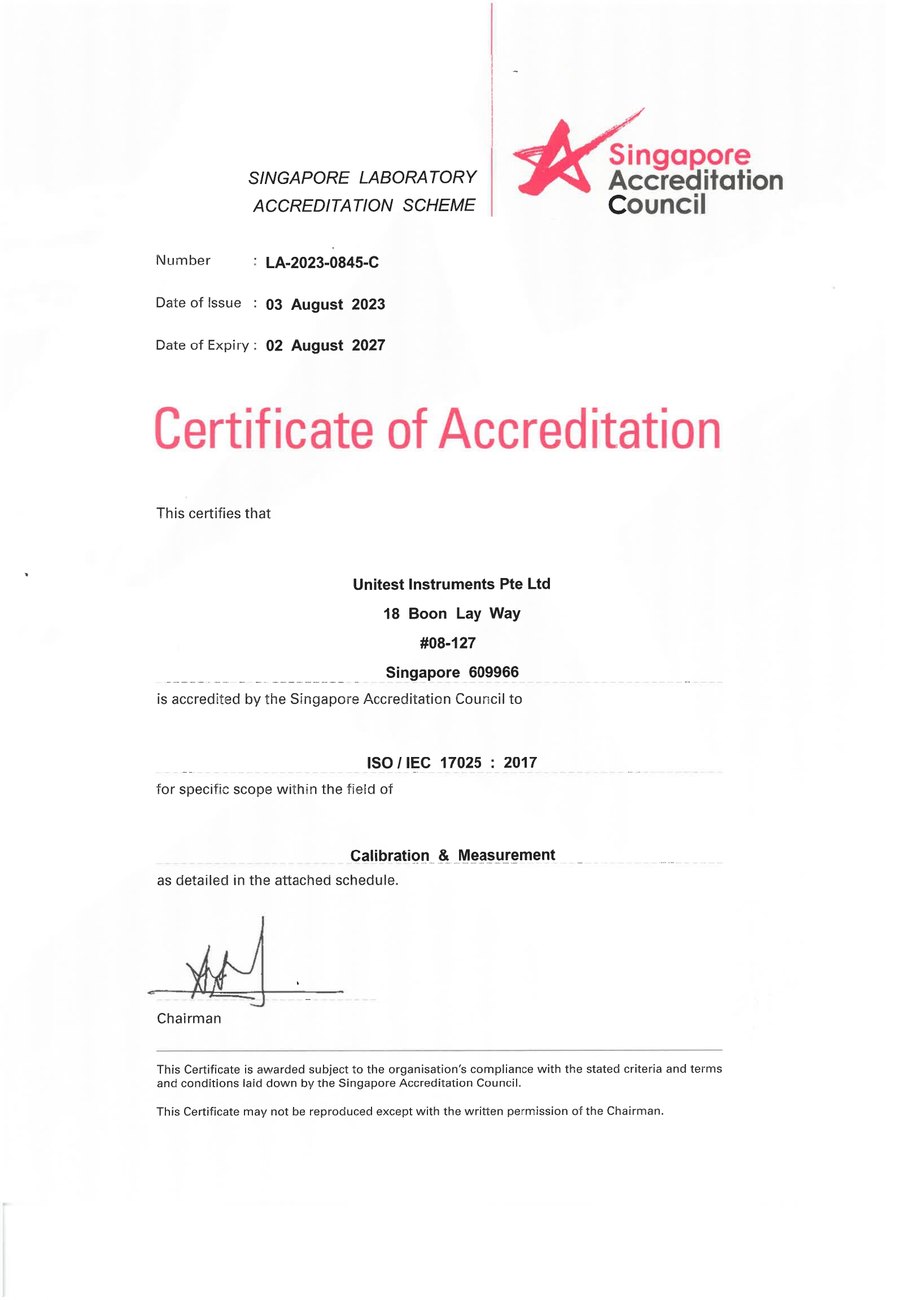
SAC-SINGLAS accredited calibration laboratory (Acc. No. LA-2023-0845-C) serving Singapore's industrial, pharmaceutical, and manufacturing sectors. All content reflects our ISO/IEC 17025 accredited scope and is reviewed by our technical calibration team.
Need humidity calibration in Singapore?
Unitest Instruments is SAC-SINGLAS accredited (Acc. No. LA-2023-0845-C) to ISO/IEC 17025. Same-week turnaround, certificates accepted by ISO 9001 auditors, HSA GMP inspections, and BCA assessments.