
Key Takeaways
- Chilled mirror hygrometers are more accurate (±0.1 °C Td) but cost 5–15× more and require regular mirror cleaning. They are reference instruments, not field workhorses.
- Capacitive sensors offer ±1–2% RH accuracy from reputable brands and are well-suited to Singapore's high-humidity tropical environment with the right IP-rated housing.
- Mirror contamination from aerosols or VOCs in industrial air can degrade chilled mirror accuracy to worse than a well-maintained capacitive sensor.
- Both sensor types must be calibrated by an ISO/IEC 17025 accredited laboratory to produce certificates accepted by ISO 9001, GMP, and HSA auditors in Singapore.
- Unitest Instruments sells and calibrates both technologies under SAC-SINGLAS accreditation (Acc. No. LA-2023-0845-C), so you can get independent advice before committing to a purchase.
How Each Technology Actually Works
Capacitive humidity sensors
A capacitive sensor contains a thin-film polymer or metal oxide element sandwiched between two electrodes. As water vapour is absorbed into or desorbed from the sensing layer, its dielectric constant changes, altering the capacitance of the element. Onboard electronics convert this capacitance shift into a relative humidity (RH) reading. The process is fast (response times of 5–30 seconds are typical), and the sensor can operate continuously without any consumables or moving parts.
Modern capacitive elements are manufactured with remarkably tight tolerances, and premium brands (Vaisala, Sensirion, E+E Elektronik, Rotronic) achieve inter-changeability specifications of ±1.5% RH or better straight from the factory. A calibration from an accredited laboratory narrows this further and establishes traceability. The sensing element does drift over time due to UV exposure, chemical contamination, or mechanical stress, which is why periodic recalibration is essential. See our article on how often you should calibrate your instruments for a risk-based framework.
Chilled mirror hygrometers
A chilled mirror hygrometer operates on a fundamentally different principle: it measures dew point directly using thermodynamics rather than inferring humidity from a material property. A thermoelectric cooler (Peltier element) chills a small polished mirror. A beam of light is focused on the mirror surface, and a photodetector measures reflected intensity. When the mirror temperature drops below the dew point, water begins to condense, scattering the light beam. A servo control circuit adjusts the mirror temperature to maintain a precise equilibrium between condensation and evaporation, at this equilibrium, the mirror temperature equals the dew point of the sample air.
Because the measurement is based on a thermodynamic phase transition rather than a polymer film property, chilled mirror instruments are considered fundamental or primary measurement devices. Their accuracy is limited mainly by the precision of the mirror temperature measurement (typically a platinum resistance thermometer (PRT)), and by the cleanliness of the mirror surface. High-quality instruments from MBW Calibration, General Eastern, or Buck Research achieve uncertainties of ±0.1 °C Td or better under laboratory conditions.
Head-to-Head Feature Comparison
The table below summarises the key performance and practical differences between capacitive sensors and chilled mirror hygrometers. Note that figures represent representative ranges; specific models vary considerably.
| Feature | Capacitive Sensor | Chilled Mirror Hygrometer |
|---|---|---|
| Measurement principle | Dielectric constant change in polymer/metal oxide film | Direct dew-point measurement via thermoelectric mirror cooling |
| Typical accuracy | ±1–2% RH (premium); ±2–5% RH (industrial grade) | ±0.1–0.2 °C Td (≈ ±0.5–1% RH equivalent) |
| Measurement range | 0–100% RH; −40 °C to +85 °C ambient | −75 °C to +95 °C dew point (model-dependent) |
| Response time | 5–30 seconds (T63) | 30 seconds to several minutes (depends on dew point step) |
| Purchase price | S$150–S$2,500 (transmitter + probe) | S$5,000–S$30,000+ (laboratory grade) |
| Calibration cost | Lower. Typically S$80–S$250 per point | Higher. Complex multi-point dew-point calibration |
| Maintenance | Filter/membrane replacement; periodic recalibration | Regular mirror cleaning; optical alignment check; desiccant replacement |
| Sensitivity to contamination | Moderate. Filter caps reduce but do not eliminate risk | High. Oils, aerosols, and VOCs coat the mirror and cause systematic error |
| Continuous duty cycle | Yes. Designed for 24/7 operation | Possible but not ideal; mirror must be kept clean |
| Best for | HVAC, pharma storage, food processing, cleanrooms, data centres, field use | Calibration labs, semiconductor fabs, specialty gas, reference standard use |
| Output options | 4–20 mA, 0–10 V, RS-485/Modbus, digital (I²C, SPI) | Serial RS-232/485, analogue; fewer integration options |
| Traceability path | Via ISO/IEC 17025 accredited lab calibration certificate | Direct primary reference; calibrated at NMI level |
Why RH Alone Is Not Always the Right Number: Understanding Dew Point and Absolute Humidity
Relative humidity is the most commonly quoted humidity metric, but it is worth understanding that %RH is inherently a temperature-dependent, relative figure, the same absolute amount of water vapour in the air produces a different %RH reading depending on the air temperature at the moment of measurement. This is precisely why a chilled mirror hygrometer's native output is dew point, not %RH directly: dew point (the temperature at which the air's actual moisture content would begin to condense) is a direct, temperature-independent measure of the absolute water vapour content, and %RH is then calculated from dew point and the current air temperature together.
For applications where the process temperature varies (a compressed air line that heats up under load, or an HVAC duct where supply air temperature changes with the season), dew point or absolute humidity (grams of water per kilogram of dry air, or per cubic metre) is often the more meaningful quantity to monitor and control, because it tracks the actual moisture load independent of temperature swings that would otherwise make a %RH reading swing even though the true moisture content has not changed. Capacitive sensors report %RH natively and require an additional temperature measurement and calculation to derive dew point, while chilled mirror instruments do the reverse, measuring dew point directly and calculating %RH as the secondary output. Understanding which quantity your process actually needs to control, not simply defaulting to %RH because it is the most familiar unit, is a genuinely useful question to ask before specifying either sensor type.
Response Time and Why It Matters for Process Control, Not Just Data Logging
The response time figures quoted in the comparison table above are not just a convenience metric; they determine whether a sensor is suitable for closed-loop process control versus passive monitoring alone. A capacitive sensor's 5 to 30 second response time is fast enough to feed a building management system's control loop for humidification or dehumidification equipment, allowing the control system to react to genuine changes in room conditions within a reasonable timeframe. A chilled mirror hygrometer's slower equilibration time, which can extend to several minutes for a large dew-point step change as the Peltier cooler and control loop settle to a new equilibrium, makes it poorly suited to fast-acting control loops even though its steady-state accuracy is superior.
This is one of the practical reasons chilled mirror instruments are rarely deployed as the primary sensor driving an HVAC or process control loop, even in applications where their accuracy would be genuinely valuable. They are more commonly used as a periodic reference check against which faster-responding capacitive sensors are validated, combining the chilled mirror's accuracy with the capacitive sensor's speed in a two-tier measurement architecture, rather than as a replacement for the capacitive sensor in the control loop itself.
Accuracy in the Real World. It Is More Complicated Than the Spec Sheet
The headline accuracy figures for chilled mirror instruments look compelling, but real-world performance depends heavily on operating conditions. In a clean, temperature-controlled calibration laboratory with filtered, particle-free air, a chilled mirror delivers its specified uncertainty without issue. But in an industrial environment (a pharmaceutical manufacturing floor, a food processing facility, or a warehouse loading bay), the picture changes.
Aerosols, machine oils, cleaning chemical vapours, and volatile organic compounds (VOCs) deposit on the mirror surface. This contamination shifts the measured dew point upward (contaminants act as condensation nuclei), introducing a positive systematic error that is difficult to detect without a reference comparison. Regular mirror inspection and cleaning with lens-grade isopropyl alcohol is essential, but this takes the instrument out of service and requires trained personnel.
A well-maintained, premium capacitive sensor from a reputable brand, freshly calibrated, will deliver ±1–2% RH performance reliably across months of continuous operation in these same environments. For the overwhelming majority of industrial and commercial humidity measurement tasks, that accuracy is perfectly adequate. Understanding what measurement uncertainty actually means for your process is the starting point, our guide to measurement uncertainty explained covers this in plain language.
Need humidity sensor calibration in Singapore?
Unitest Instruments calibrates both capacitive and chilled mirror humidity instruments under our SAC-SINGLAS accreditation. Certificates are traceable to NMC Singapore and accepted by ISO 9001 and GMP auditors. Same-week turnaround available.
Use Case Recommendations: Clear Winners by Application
Pharmaceutical and life sciences storage (GMP environments)
Winner: Capacitive sensor. GMP guidelines (WHO, HSA, PIC/S) require documented, traceable humidity monitoring of storage areas. A calibrated capacitive transmitter with a current ISO/IEC 17025 certificate meets this requirement fully. Multiple sensors can be networked via Modbus to a central data logger, providing continuous 21 CFR Part 11-compatible records. Chilled mirror instruments offer no regulatory advantage here and introduce unnecessary maintenance burden.
Calibration laboratories and reference standards
Winner: Chilled mirror hygrometer. If you are operating an in-house calibration facility, validating humidity chambers, or comparing your working sensors against a reference, the chilled mirror is the correct tool. Its primary measurement principle provides the lowest achievable uncertainty, and its dew-point output can be converted to %RH, vapour pressure, or absolute humidity with a single temperature measurement. NMI-traceable calibration of the mirror's PRT is all that is needed to anchor the entire humidity chain.
HVAC, building management, and data centres
Winner: Capacitive sensor. HVAC and data centre humidity control requires real-time feedback to building management systems (BMS). Capacitive transmitters with 4–20 mA or Modbus outputs integrate natively with every major BMS platform. They are compact, low-power, and designed for continuous 24/7 operation. Response speed matters here. A capacitive sensor's 5–30 second response time is far more useful for closed-loop control than a chilled mirror's slower equilibration.
Semiconductor and electronics manufacturing cleanrooms
Winner: Depends on the application. Process monitoring at ambient humidity levels (typically 30–60% RH) is handled well by high-grade capacitive sensors. However, for very low dew-point monitoring of process gases or ultra-dry environments (below −20 °C Td), the chilled mirror is the only practical choice. Capacitive polymer elements lose sensitivity and reliability at extremely low moisture levels. For mixed requirements, a chilled mirror at the reference point with capacitive sensors distributed at monitoring points is a cost-effective architecture.
Food processing and cold-chain monitoring
Winner: Capacitive sensor. Cold storage, freezer rooms, and defrost cycle monitoring all benefit from capacitive sensors rated to sub-zero temperatures. Units with IP65/IP67 ratings handle the wash-down environments typical of food facilities. Chilled mirror instruments are poorly suited to low-temperature duty cycles because the Peltier cooler must cool the mirror below ambient temperature, in a −20 °C freezer, this becomes impractical.
What Unitest Sells and Calibrates
Unitest Instruments is a supplier and SAC-SINGLAS accredited calibration service for both sensor technologies. We stock and calibrate capacitive humidity transmitters and probes from leading brands including Vaisala, Rotronic, and E+E Elektronik, and we calibrate chilled mirror hygrometers from MBW Calibration, General Eastern, and equivalent reference instruments.
Our calibration services cover the full humidity and dew-point range under ISO/IEC 17025 (Acc. No. LA-2023-0845-C), with results traceable to Singapore's National Metrology Centre. Calibration certificates from our laboratory are accepted by ISO 9001 quality management system auditors, HSA for GMP inspections, and the Agri-Food and Veterinary Authority (AVA) for food safety regulatory purposes.
If you are unsure which technology your process requires, we are happy to assess your application before you commit to a purchase. Buying the right instrument from the outset is significantly cheaper than calibrating an expensive chilled mirror instrument that your process did not need. Understanding what an accredited vs non-accredited calibration actually means for your compliance obligations is a useful starting point for this conversation.
How Each Sensor Type Is Actually Calibrated
Calibrating a capacitive humidity sensor accredited to ISO/IEC 17025 typically uses a humidity generator, either a two-pressure/divided-flow system or a saturated salt solution chamber, that produces a stable, precisely known %RH environment at several fixed points spanning the sensor's intended use range. The sensor under test is exposed to each point until it reaches equilibrium, and its reading is compared against the generator's reference condition, itself independently verified, often using a chilled mirror hygrometer as the laboratory's own internal reference standard. This is a direct illustration of how the two technologies connect in practice: the chilled mirror serves as the reference instrument that ultimately underpins the accuracy of every capacitive sensor calibration performed against it.
Calibrating the chilled mirror instrument itself is a somewhat different exercise, since it is already the primary measurement technology. Rather than comparing it against a generated humidity environment, the calibration instead focuses on verifying the accuracy of the platinum resistance thermometer embedded in the mirror assembly (since the mirror's own PRT reading, at the point of optical equilibrium, is what defines the reported dew point), traceable through a temperature calibration chain back to the National Metrology Centre. This is why a chilled mirror hygrometer's calibration certificate often looks structurally different from a capacitive sensor's certificate, reporting temperature calibration data for the internal PRT rather than a direct %RH comparison, even though both certificates ultimately serve the same purpose of establishing traceable measurement confidence.
Total Cost of Ownership: A Realistic Five-Year View
Purchase price is only part of the equation. The table below models a representative five-year total cost of ownership (TCO) for a single humidity measurement point, assuming Singapore-based procurement and calibration.
| Cost Element | Capacitive Sensor (Premium) | Chilled Mirror Hygrometer |
|---|---|---|
| Initial purchase | S$800–S$2,500 | S$8,000–S$25,000 |
| Annual calibration (×5) | S$500–S$1,250 | S$1,500–S$4,000 |
| Maintenance consumables | S$50–S$200 (filter caps, cleaning) | S$300–S$800 (mirror polish, desiccant, optical checks) |
| Downtime / labour | Low. Swap-out probes available | Moderate. Mirror cleaning requires trained technician |
| Approximate 5-year TCO | S$4,000–S$9,000 | S$20,000–S$50,000 |
For most Singapore SMEs and even mid-sized manufacturers, the five-year TCO difference (typically S$15,000–S$40,000 per measurement point), is difficult to justify unless the chilled mirror's accuracy advantage directly translates to product quality or regulatory compliance. In our experience calibrating instruments across pharmaceutical, electronics, and food sectors in Singapore, fewer than 10% of industrial humidity measurement points genuinely require chilled mirror-level accuracy.
A middle-ground option worth mentioning for organisations weighing this decision is renting or contracting periodic chilled mirror verification rather than purchasing the instrument outright. Several Singapore calibration laboratories, including Unitest, can perform an on-site or in-lab reference comparison using a chilled mirror standard against your existing capacitive sensor fleet as part of a periodic verification programme, giving you access to reference-grade accuracy confirmation without the capital cost, maintenance burden, and specialist training a permanently owned chilled mirror instrument requires. This is frequently the most cost-effective way for a facility with a handful of genuinely critical measurement points to gain confidence in its capacitive sensor fleet's accuracy without the five-figure investment a dedicated chilled mirror purchase represents.
Frequently Asked Questions
A capacitive sensor measures humidity by detecting changes in electrical capacitance across a polymer or metal oxide film as water vapour is absorbed. A chilled mirror hygrometer measures the dew point directly: it cools a mirror until condensation forms, then uses a photodetector to precisely locate that dew-point temperature. Chilled mirror sensors offer higher fundamental accuracy and are considered primary reference instruments, while capacitive sensors are faster, cheaper, and far more practical for everyday industrial use.
Chilled mirror hygrometers are more accurate. High-quality instruments achieve dew-point uncertainties of ±0.1 °C Td or better, which translates to approximately ±0.5–1% RH at typical conditions. Premium capacitive sensors achieve ±1–2% RH, while lower-cost units range from ±2–5% RH. However, chilled mirror accuracy assumes the mirror is clean; contamination from aerosols or volatile organics in industrial environments can introduce errors larger than a well-maintained capacitive sensor.
Choose capacitive sensors for production monitoring, HVAC control, pharmaceutical storage rooms, cleanrooms, food processing, data centres, and any application requiring continuous duty-cycle measurement at moderate accuracy (±1–3% RH). Capacitive sensors are robust, low-maintenance, low-cost, and available in compact form factors that integrate easily into PLCs and data loggers. They are the practical choice for the vast majority of industrial and commercial humidity measurement tasks in Singapore.
Choose a chilled mirror hygrometer when you need primary-reference-level accuracy, typically for calibration laboratory use, reference standard comparisons, very low dew-point measurement (below −20 °C Td), or validation of high-value manufacturing processes such as semiconductor fabrication or specialty gas production. They are also the preferred choice when traceability to national metrology standards is required for regulatory submissions at the highest accuracy tier.
Capacitive sensors used in regulated environments (pharmaceutical, food, medical device manufacture) are typically calibrated every 6–12 months. General industrial use may extend to 12–24 months depending on process conditions. Chilled mirror hygrometers used as laboratory references are usually calibrated annually, but require more frequent verification of mirror cleanliness and optical alignment. Both sensor types should be calibrated by an ISO/IEC 17025 accredited laboratory to produce certificates acceptable to auditors.
In principle yes, but only if the capacitive sensor itself holds a valid calibration certificate traceable to national standards. A capacitive transfer standard with a current SAC-SINGLAS or equivalent accredited certificate can serve as a working reference for lower-tier instruments in the same facility. However, for primary calibration work (especially where measurement uncertainty below ±1% RH is needed), a chilled mirror hygrometer or a calibrated humidity generator is preferred.
Yes. Singapore's ambient relative humidity commonly exceeds 80–90% RH, and temperature fluctuations can cause condensation on poorly designed sensors. Capacitive sensors with protective filter caps and hydrophobic coatings are generally well-suited to tropical field use. Chilled mirror hygrometers are more sensitive to aerosol and particulate contamination from humid outdoor air; they are best reserved for controlled laboratory environments. For outdoor or semi-exposed process monitoring in Singapore, a high-quality capacitive sensor with IP-rated housing is usually the right call.
Yes. Unitest Instruments supplies both capacitive humidity transmitters and chilled mirror hygrometers, and calibrates both under our SAC-SINGLAS accreditation (Acc. No. LA-2023-0845-C) to ISO/IEC 17025. Our calibration certificates are traceable to Singapore's National Metrology Centre (NMC) and are accepted by ISO 9001, GMP, and regulatory auditors. Contact us to discuss the right sensor for your application and arrange calibration.
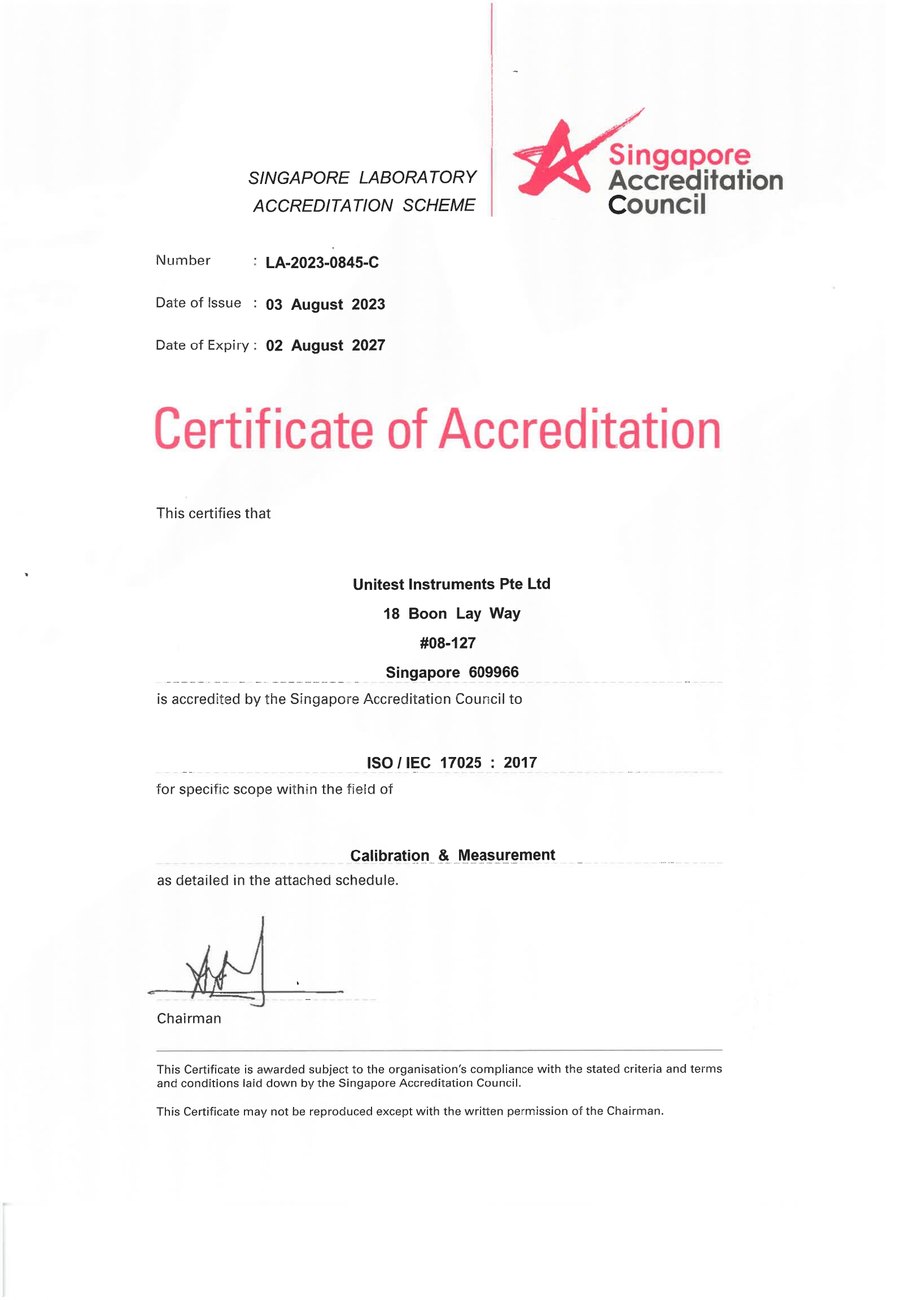
SAC-SINGLAS accredited calibration laboratory (Acc. No. LA-2023-0845-C) serving Singapore's industrial, pharmaceutical, and manufacturing sectors. All content reflects our ISO/IEC 17025 accredited scope and is reviewed by our technical calibration team.
Need humidity sensor calibration in Singapore?
Unitest Instruments is SAC-SINGLAS accredited (Acc. No. LA-2023-0845-C) to ISO/IEC 17025. Same-week turnaround, certificates accepted by ISO 9001 auditors.