
Key Takeaways
- A calibrated humidity generator is a reference instrument: its certificate must show NMC-traceable corrections, not just a pass/fail stamp.
- Five or more set-points spanning 10–95 %RH are required for a technically complete calibration across the operating range.
- Annual calibration suits most industrial users; pharmaceutical GMP and HSA-regulated environments typically require 6-month intervals.
- Measurement uncertainty (expanded U at k=2), must appear on every ISO/IEC 17025-compliant certificate. A certificate without it is not accreditation-compliant.
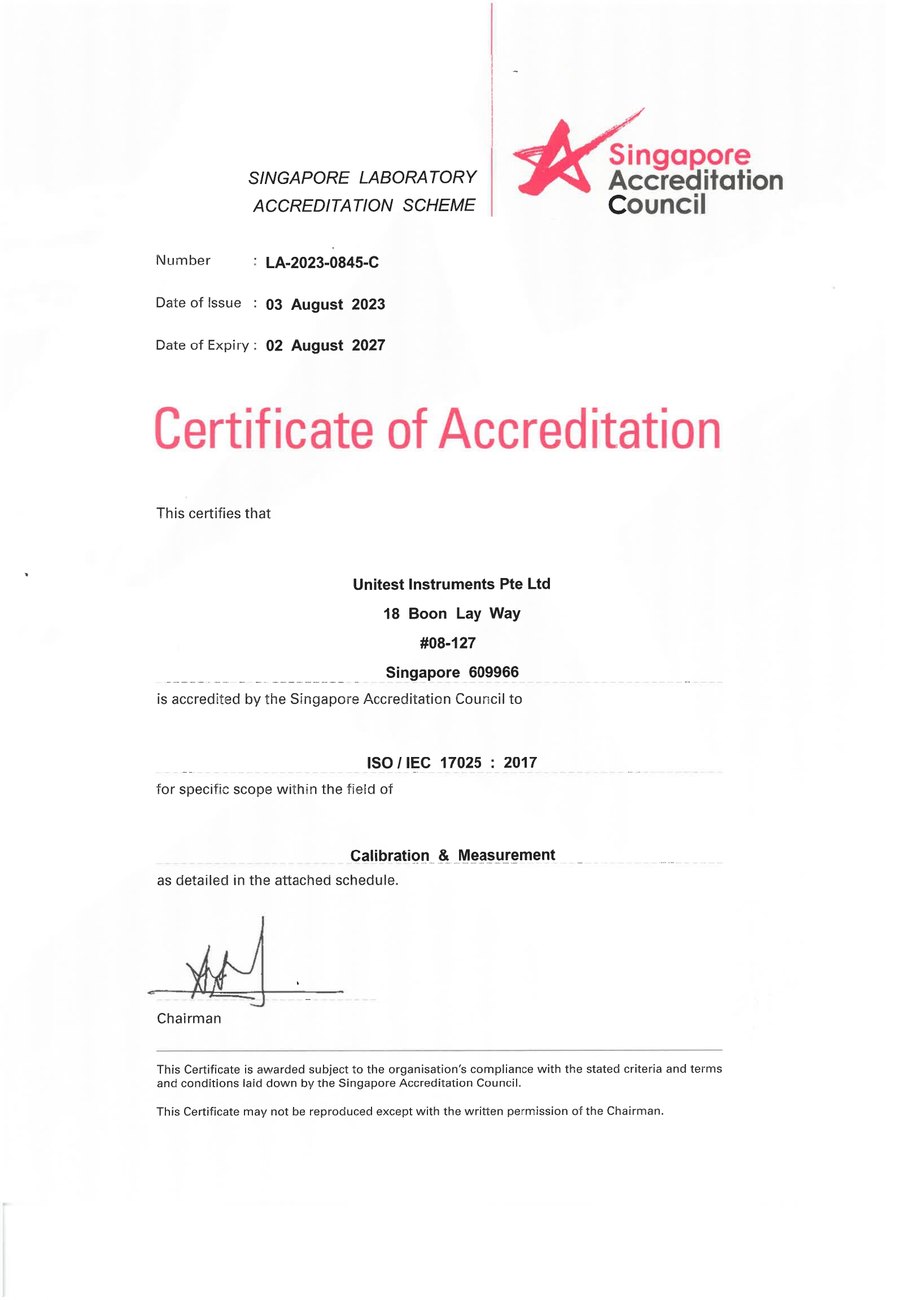
- Only a SAC-SINGLAS accredited laboratory (e.g. Acc. No. LA-2023-0845-C) can issue certificates accepted across Singapore's MOM, HSA, and ISO 9001 audit frameworks.
What Is a HygroGen-Class Humidity Generator?
A HygroGen-class humidity generator. Typified by instruments such as the Michell HygroGen2, the Rotronic HygroGen, and equivalent portable two-pressure or two-flow humidity sources. Is a precision instrument designed to produce a stable, known relative humidity atmosphere within a small test chamber. Unlike a large walk-in stability cabinet, a HygroGen-class device is compact enough to sit on a laboratory bench or be transported to a process environment, making it the standard tool for verifying humidity sensors, data loggers, and transmitters at the point of use.
The generator achieves its set-point by precisely controlling the mixing ratio of dry and saturated air streams, or by regulating the temperature of a dew-point-based saturation chamber. The displayed value (in percent relative humidity (%RH)), is derived from internal reference sensors or a built-in chilled-mirror device. Over time, these internal references drift, contamination enters the saturation cell, and the generator's output diverges from its display. Without periodic calibration against a higher-level traceable standard, every downstream humidity measurement that relied on this generator is compromised.
This is why HygroGen-class generators are not exempt from the calibration chain merely because they are themselves a reference instrument. They occupy the working reference level of the hierarchy, sitting below the national primary standard and above the instruments they verify. That position demands regular upward traceability (to Singapore's National Metrology Centre (NMC)), to remain metrologically valid.
What Measurements Are Made During Calibration?
When a HygroGen-class generator arrives at Unitest Instruments' SAC-SINGLAS accredited laboratory (Acc. No. LA-2023-0845-C), the calibration process begins with a visual and functional pre-check: the saturation cell is inspected for contamination, the dew-point or capacitive internal sensors are checked for obvious damage, and the chamber seals are examined. Only after confirming the instrument is in serviceable condition does the formal measurement sequence begin.
The reference instrument. A transfer-standard chilled-mirror dew-point hygrometer calibrated directly against NMC Singapore's primary humidity standard. Is placed inside the generator's test chamber. The generator is then commanded through a sequence of set-points. For a full-range calibration, a minimum of five set-points is used:
- 11 %RH. Relevant to dry storage environments, electronics manufacturing, and lithium battery production
- 33 %RH. Mid-range dry point, used for pharmaceutical intermediate storage and seed banks
- 53 %RH. General ambient reference, common in environmental monitoring
- 75 %RH. Standard pharmaceutical stability chamber set-point (ICH Q1A long-term)
- 95 %RH. High-humidity reference for tropical industrial testing, HVAC commissioning, and mould-risk assessment
At each set-point, the chamber is allowed to fully stabilise. Typically 5 to 15 minutes depending on the generator's specification and the ambient conditions in the laboratory. Stabilisation is confirmed when the reference sensor's reading varies by less than 0.1 %RH over a minimum of 3 minutes. The calibration technician then records a minimum of five individual reference readings and averages them. The difference between the generator's displayed value and the averaged reference reading is the error (correction) at that set-point. This is recorded for both relative humidity and the corresponding temperature, since %RH is temperature-dependent.
Reference Standards and Traceability to NMC Singapore
Traceability is not a marketing claim. It is a documented and unbroken chain of calibrations linking your instrument's measurement result to the primary definition of the SI unit of amount of substance or thermodynamic temperature (from which humidity is derived). As explained in our article on what calibration traceability means and why it matters, every step in the chain must be performed by an accredited laboratory and must include a stated measurement uncertainty.
At Unitest Instruments, the traceability chain for humidity calibration works as follows:
- NMC Singapore (A*STAR). Holds Singapore's primary humidity standard, a two-temperature two-pressure generator with measurement uncertainty at the 0.05 %RH level.
- Unitest's transfer standard. A chilled-mirror dew-point hygrometer calibrated directly by NMC at regular intervals (typically every 12 months). This instrument is our working reference.
- Your HygroGen-class generator. Calibrated against the transfer standard by our accredited technical team. The certificate we issue (under SAC-SINGLAS Acc. No. LA-2023-0845-C) is the documented link in your traceability chain.
- Your field instruments. Humidity sensors, data loggers, and transmitters verified against your calibrated generator.
This four-level hierarchy is the minimum acceptable for regulated industries in Singapore. Any shorter chain (for example, calibrating field sensors against a generator that itself has no current traceable calibration), breaks the chain and invalidates the measurement for regulatory purposes. See our full guide on calibration traceability for a detailed treatment of how to document and audit your chain.
Field Calibration vs. Laboratory Calibration: Which Should You Choose?
For humidity generators specifically, this is a decision that materially affects the achievable measurement uncertainty and, therefore, which applications the resulting certificate is valid for.
| Factor | Laboratory Calibration | Field (On-Site) Calibration |
|---|---|---|
| Typical expanded uncertainty | ±0.8–1.5 %RH (k=2) | ±2.0–3.5 %RH (k=2) |
| Ambient temperature control | Climate-controlled lab (±0.5 °C) | Subject to process-area conditions |
| Accepted for GMP / HSA use | Yes. Full SAC-SINGLAS certificate | Case-by-case; often not accepted |
| Accepted for ISO 9001 audits | Yes. Universally accepted | Only if accredited lab performs it |
| Instrument needs to leave site | Yes (typically 2–5 working days) | No. Technician visits |
| Suitable for portable generators | Preferred. Lower uncertainty | Acceptable for non-critical checks |
| Cost | Lower per certificate | Higher (travel + setup time) |
| Regulatory compliance | Full. MOM, HSA, BCA-applicable | Limited to non-regulated contexts |
The practical recommendation for Singapore users is straightforward: if your humidity generator is used to verify instruments in a GMP environment, a pharmaceutical stability chamber, a cleanroom qualification, or any context where an HSA or MOM inspector might review your records, laboratory calibration at an accredited laboratory is the only defensible choice. For portable generators used purely for internal process checks in non-regulated manufacturing, on-site calibration by an accredited laboratory's field team is a reasonable alternative, provided the achievable uncertainty still meets your process tolerance.
Calibrate Your Humidity Generator at Unitest's Accredited Laboratory
We handle HygroGen-class instruments with NMC-traceable references, same-week turnaround, and certificates accepted by HSA, MOM, and ISO 9001 auditors across Singapore.
Calibration Interval Recommendations for Singapore Users
There is no single mandated calibration interval for humidity generators. The correct answer depends on the instrument's historical stability, the measurement uncertainty it is required to achieve, and the regulatory framework governing its use. As our detailed guide on how often calibration is required explains, interval determination is a risk-based process that should be documented in your quality management system.
That said, the following starting-point intervals are technically defensible for most Singapore use cases and are consistent with what HSA GMP auditors and ISO 9001 auditors expect to see:
- General industrial use (non-regulated): 12-month interval. Review after three calibration cycles using the as-found data to determine whether the interval is appropriate or can be extended.
- Pharmaceutical stability testing and GMP environments: 6-month interval as a baseline, with review against as-found drift. PIC/S-aligned quality systems typically default to 6 months for reference-level instruments.
- Cleanroom qualification and HVAC commissioning: Calibrate immediately before each qualification event and verify immediately after, regardless of the scheduled interval.
- Post-transport or post-repair: Mandatory out-of-cycle calibration before the generator is returned to service. Transportation shocks and vibration are known to disturb the saturation cell and dew-point mirror of portable generators.
What a Proper Calibration Certificate Must Show
Not all calibration certificates are equal. A certificate issued by a non-accredited service provider may look similar to a SAC-SINGLAS certificate but will lack the independently verified elements that make it defensible under ISO/IEC 17025. Our article on reading a calibration certificate covers the full anatomy of a certificate; for humidity generators specifically, the following elements are non-negotiable:
- Laboratory identification and accreditation number: The issuing laboratory's name, address, and SAC-SINGLAS accreditation number (e.g. LA-2023-0845-C) must appear on every page.
- Instrument identification: Make, model, and serial number of the generator under calibration, and the serial number of the reference instrument used.
- Calibration date and next due date: Both must be stated. A certificate without a next due date does not support interval management.
- Set-points tested and reference readings: Every set-point commanded, the averaged reference reading, and the calculated correction (error) must be tabulated. Vague statements such as "within specification" without data are not acceptable.
- Expanded measurement uncertainty (U): Stated for each set-point, at a defined coverage factor (typically k=2, 95% confidence). This is the most commonly missing element in non-accredited certificates and its absence is a direct violation of ISO/IEC 17025 Clause 7.8.2.
- Traceability statement: A statement identifying the national standard to which the reference instrument is traceable, in Singapore, this is NMC Singapore (A*STAR).
- Authorised signatory: The certificate must be signed by a technically competent person authorised by the laboratory's quality management system.
When in doubt about whether a certificate you hold is compliant, our team at Unitest Instruments is happy to review it, contact us via our calibration enquiry page. If you need to purchase a new HygroGen-class instrument, Unitest also supplies calibration-ready humidity generators through unitestshop.com, where each unit can be dispatched with a factory certificate or an accredited laboratory certificate depending on your requirement.
Accredited vs. Non-Accredited Calibration: The Compliance Difference
Singapore's regulatory and quality management ecosystem (MOM, HSA, BCA, ISO 9001, and ISO/IEC 17025), consistently distinguishes between calibration performed by an accredited laboratory and calibration performed by an unaccredited service provider. Understanding the difference is essential for anyone managing a calibration programme for humidity generators used in regulated or semi-regulated contexts.
An accredited laboratory (such as Unitest Instruments operating under SAC-SINGLAS Acc. No. LA-2023-0845-C), has been independently assessed by the Singapore Accreditation Council (SAC) against the full requirements of ISO/IEC 17025. This assessment covers technical competence (including the qualifications of calibration technicians), the adequacy of reference standards and their traceability, the laboratory's environmental controls, its measurement uncertainty methodology, and its quality management system. The accreditation is renewed through surveillance audits and periodic reassessment. When you receive a certificate bearing the SAC-SINGLAS mark, you are receiving the output of a system that has been independently verified to be technically sound.
A non-accredited calibration provider may perform the same physical procedure with the same type of reference instrument, but without the third-party oversight. There is no independent verification that the reference instrument itself is traceable, that the uncertainty calculation is correct, or that the technician is competent. For ISO 9001 auditors and HSA GMP inspectors, this difference matters: the SAC-SINGLAS mark is the recognised evidence of competence in Singapore, and its absence shifts the burden of proof onto you to demonstrate the calibration is valid. A burden that is difficult to discharge in an audit context. Our article comparing accredited vs. non-accredited calibration explores this difference in detail for all instrument types.
Why the Saturation Cell Is the Component Most Likely to Fail
Of every component inside a HygroGen-class generator, the saturation cell (the internal chamber or wick system where the air stream is brought to equilibrium with a water reservoir or saturated salt medium) is the one most likely to be the actual root cause when a generator drifts out of tolerance between scheduled calibrations. In Singapore's high-throughput pharmaceutical and semiconductor facilities, generators running near-continuously to feed stability chambers or cleanroom qualification cycles put the saturation cell through repeated wet-dry cycling, and mineral deposits from the water source, biological growth in the reservoir, or simple mechanical wear on the wick material gradually change how efficiently the cell reaches true saturation at a given set-point. The generator's internal control loop will still report that it has reached its commanded set-point, because it is reading its own internal sensor rather than an independent reference, which is precisely why this class of drift is invisible until an external calibration against a traceable transfer standard catches it.
Facilities running generators in continuous or near-continuous duty should treat water reservoir quality as a maintenance item independent of the calibration interval: use deionised or distilled water rather than tap water to minimise mineral deposit build-up, inspect and clean the saturation cell per the manufacturer's schedule, and flag any generator whose as-found calibration data shows a consistent, worsening bias in the same direction across successive calibration cycles, since that pattern typically indicates a cell approaching the end of its serviceable life rather than a random measurement fluctuation. Unitest's calibration technicians note visible cell condition on the certificate's remarks section specifically so this kind of trend is visible in your instrument history over time, not just as a single pass/fail result.
Interim Verification Checks Between Full Calibrations
Because a HygroGen-class generator sits at the working reference level of your traceability chain, an undetected drift between scheduled calibrations has an outsized downstream effect, potentially invalidating every field instrument verified against it during that period. A practical risk mitigation, widely used by Singapore pharmaceutical and semiconductor QC teams, is a simple interim verification check performed in-house between full accredited calibrations. This does not replace the accredited calibration and does not produce a SAC-SINGLAS certificate, but it does provide an early warning of drift.
The most common approach is a single-point check against a certified saturated salt solution (the same reference class used for humidity data logger and water activity meter checks) at a mid-range set-point such as 75 %RH, performed monthly for generators in GMP-critical service or quarterly for general industrial use. If the generator's displayed reading diverges from the salt reference by more than the generator's own specification allows, that is the signal to schedule an out-of-cycle accredited calibration rather than waiting for the next scheduled date. Documenting these interim checks in the instrument record also gives your QA team supporting evidence, alongside the formal as-found data, when scoping a product impact assessment if the generator is eventually found out-of-tolerance at its next full calibration.
One caution worth stating plainly: an interim salt-check reading that agrees with the generator does not extend its formal calibration due date, and it should never be presented to an auditor as a substitute for the SAC-SINGLAS certificate itself. Its value is purely as an internal early-warning signal that lets your team act between calibrations rather than discover a problem retrospectively, and it should be logged as exactly that, a supplementary internal record, in your instrument file.
Frequently Asked Questions
During calibration, a reference chilled-mirror hygrometer traceable to Singapore's National Metrology Centre is placed inside the generator's test chamber. The generator is commanded through a series of set-points (typically 11 %RH, 33 %RH, 53 %RH, 75 %RH and 95 %RH), and the reference sensor records the actual humidity and temperature at each point after stabilisation. The difference between the generator's displayed value and the reference reading is the correction, and measurement uncertainty is calculated and stated on the calibration certificate issued under SAC-SINGLAS Acc. No. LA-2023-0845-C.
Accredited laboratories in Singapore, including Unitest Instruments (SAC-SINGLAS Acc. No. LA-2023-0845-C), use chilled-mirror dew-point hygrometers or two-pressure reference generators as their working reference standards. These references are periodically submitted to the National Metrology Centre (NMC) of A*STAR, which holds Singapore's primary humidity standard, ensuring an unbroken traceability chain from your instrument to the SI unit of measurement.
For most industrial and pharmaceutical applications in Singapore, an annual calibration interval (every 12 months) is recommended as a starting point. However, ISO/IEC 17025 and good laboratory practice require intervals to be determined by the instrument's historical stability data. Generators used in critical GMP or regulated pharmaceutical environments (HSA-regulated cleanrooms, for example) often require 6-month intervals. Generators that are transported frequently or subjected to large temperature swings should also be calibrated more frequently. After any repair or known shock event, an out-of-cycle calibration is mandatory.
A valid SAC-SINGLAS calibration certificate for a humidity generator must show: the instrument make, model, and serial number; the calibration date and due date; the laboratory's accreditation number (e.g. LA-2023-0845-C) and the SAC-SINGLAS logo; the reference standard used and its own calibration traceability; the set-point values tested; the reference readings at each set-point; the corrections (or errors) found; and the expanded measurement uncertainty (U) at a stated confidence level (typically 95%, k=2). Certificates that omit measurement uncertainty are not compliant with ISO/IEC 17025.
Yes. Several Singapore regulatory frameworks mandate the calibration of humidity-generating or measuring instruments. The Ministry of Manpower's Workplace Safety and Health (WSH) Act requires that instruments used for environmental monitoring of hazardous substances be maintained with documented calibration records. HSA's GMP guidelines (aligned with PIC/S) require pharmaceutical manufacturers to calibrate all equipment that could affect product quality, which includes humidity generators used for stability testing chambers and cleanroom qualification. BCA-regulated controlled environments involving moisture-sensitive materials also require traceable humidity measurement.
Both on-site (field) calibration and in-laboratory calibration are possible, but they differ significantly in achievable uncertainty. Laboratory calibration consistently delivers lower measurement uncertainty (typically ±1.0 %RH or better), which is required for regulated GMP and pharmaceutical applications. On-site calibration is more convenient for large or fixed installations but is typically limited to ±2–3 %RH uncertainty due to ambient variability. Always confirm whether your regulatory or quality-system requirement specifies a maximum permissible uncertainty before choosing field calibration.
An accredited calibration (performed by a SAC-SINGLAS accredited laboratory such as Unitest Instruments, Acc. No. LA-2023-0845-C) follows a quality management system audited against ISO/IEC 17025 by the Singapore Accreditation Council. The certificate carries internationally recognised traceability, is accepted by ISO 9001 auditors, HSA, MOM, and most multinational QMS frameworks. A non-accredited calibration may be performed to the same technical procedure but there is no independent third-party verification of the laboratory's competence, traceability chain, or measurement uncertainty calculations. For regulated industries, only accredited certificates are accepted.
HygroGen-class generators typically cover approximately 5 %RH to 95 %RH and a temperature range of 5 °C to 60 °C. Unitest Instruments' accredited scope under SAC-SINGLAS Acc. No. LA-2023-0845-C covers 10 %RH to 95 %RH at temperatures from 15 °C to 50 °C. Sufficient for the vast majority of industrial and pharmaceutical use cases in Singapore. Calibration is normally performed at five or more set-points distributed across this range to characterise linearity across the full working span of the instrument.
SAC-SINGLAS accredited calibration laboratory (Acc. No. LA-2023-0845-C) serving Singapore's industrial, pharmaceutical, and manufacturing sectors. All content reflects our ISO/IEC 17025 accredited scope and is reviewed by our technical calibration team.
Need humidity generator calibration in Singapore?
Unitest Instruments is SAC-SINGLAS accredited (Acc. No. LA-2023-0845-C) to ISO/IEC 17025. Same-week turnaround, certificates accepted by ISO 9001 auditors, HSA, and MOM.