
Key Takeaways
- Capacitive RH sensors drift 1–3% RH per year. Singapore's tropical climate accelerates ageing, making annual or biannual calibration essential.
- Lab calibration achieves expanded uncertainty as low as ±0.5% RH (k=2); field calibration typically delivers ±2–3% RH due to uncontrolled ambient conditions.
- SAC-SINGLAS accreditation (Acc. No. LA-2023-0845-C) and NMC traceability are mandatory for certificates accepted by HSA GMP, ISO 9001, and pharmaceutical regulators.
- A compliant certificate must state the serial number, calibration conditions, reference standard identity, errors at each test point, and expanded uncertainty with coverage factor.
- Pharmaceutical cleanrooms and cold-chain facilities should calibrate every 6 months; general HVAC and industrial transmitters should calibrate annually as a minimum.
What Happens During RH Transmitter Calibration?
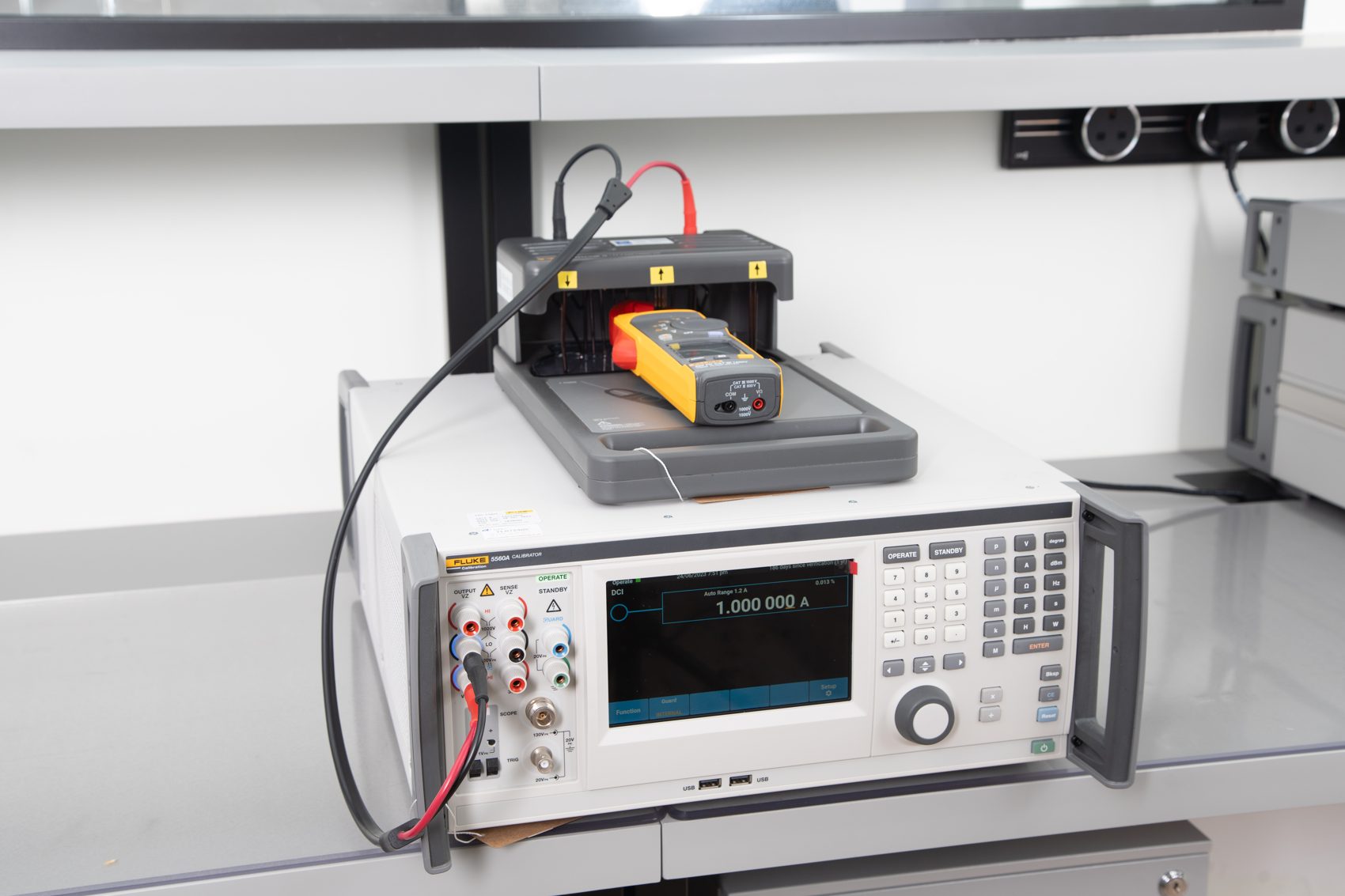
Relative humidity transmitter calibration is a systematic comparison process. The instrument under test is removed from service and transported to an accredited laboratory. Or, for field calibration, a portable reference is brought to the installation site. In a laboratory setting, the transmitter is placed inside a humidity generator or climate chamber capable of maintaining target humidity levels with high stability. A reference hygrometer, whose traceability chain runs back to Singapore's National Metrology Centre (NMC), sits alongside the unit under test and provides the "true" humidity value at each set-point.
The chamber is programmed to stabilise at a minimum of three humidity levels across the transmitter's working range. For most industrial transmitters rated from 0–100% RH, the test points are typically set at approximately 11%, 50%, and 75% RH. Selected to cover the low, mid, and high portions of the scale. At each set-point, the chamber is allowed to reach thermal and humidity equilibrium (a stabilisation period that can range from 20 to 45 minutes depending on chamber design), after which the technician records simultaneous readings from both the reference standard and the instrument under test.
The difference between each pair of readings is the error at that point. These errors, combined with contributions from the reference standard's uncertainty, the chamber's stability, and temperature effects, are combined in quadrature to produce the expanded measurement uncertainty. Expressed at a 95% confidence level with a coverage factor of k=2. All data are captured in the calibration record and reported on the final certificate issued under Unitest Instruments' SAC-SINGLAS accreditation (Acc. No. LA-2023-0845-C).
What Drifts, and Why Singapore Accelerates It
The working element of virtually every modern humidity transmitter is a thin-film capacitive sensor: a hygroscopic polymer dielectric sandwiched between two electrodes. As ambient humidity changes, the polymer absorbs or releases water vapour, altering its dielectric constant and therefore the sensor's capacitance. Over time, this polymer degrades, and several mechanisms are at work simultaneously.
Chemical contamination is the dominant drift cause in industrial environments. Volatile organic compounds (VOCs), solvents, ammonia, chlorine-based cleaning agents, and silicone vapours can permanently alter the polymer's absorption characteristics. A sensor exposed to weekly cleaning with bleach-based products in a food processing plant may drift 4–6% RH within a year, far outside its rated accuracy.
Thermal cycling and mechanical fatigue also contribute. Repeated expansion and contraction of the sensor chip at the electrode-dielectric interface causes micro-cracking that changes the baseline capacitance. In Singapore's climate, where outdoor-facing sensors cycle between air-conditioned interiors (22–24°C) and high-humidity exteriors (28–34°C, 80–95% RH), this ageing is notably faster than in temperate environments.
Condensation events (caused by insufficient warm-up time after cold storage, or by sudden ambient changes), can physically damage the polymer film and cause step-change drift rather than the gradual drift typical of ageing. After any condensation event, the transmitter should be verified against a reference before readings are trusted for process or compliance purposes.
Field Calibration vs Lab Calibration: A Practical Comparison
The question of whether to calibrate in the field or in a laboratory comes down to three factors: the required measurement uncertainty, the regulatory context, and the operational disruption you can accept. Both approaches are legitimate, but they serve different purposes and produce certificates with materially different uncertainty values.
| Factor | Field Calibration | Lab Calibration (SAC-SINGLAS) |
|---|---|---|
| Typical expanded uncertainty | ±2–3% RH (k=2) | ±0.3–0.8% RH (k=2) |
| Reference standard | Portable reference hygrometer (calibrated, but with higher field uncertainty) | Chilled-mirror hygrometer or precision capacitive reference, NMC-traceable |
| Environmental control | Ambient. Temperature and humidity may fluctuate during the check | Stabilised humidity chamber, temperature-controlled lab |
| Operational disruption | Minimal. Transmitter stays installed | Requires removal and transport; turnaround typically 2–5 working days |
| Certificate accepted by | ISO 9001 (where specified uncertainty is adequate); internal QC | ISO 9001, GMP/HSA, SFA/HACCP, BCA Green Mark, IMDA, ISO 14001 |
| Adjustment possible? | Limited. Typically only offset correction at one point | Full multi-point adjustment and linearisation where instrument permits |
| Cost | Lower per visit; higher if reference must also be lab-calibrated regularly | Higher per instrument; lower audit risk and rework cost |
| Regulatory status | Acceptable only where standards permit higher uncertainty | Required for pharmaceutical GMP, cold chain compliance, and safety-critical use |
As a rule of thumb: if the measurement feeds a process that affects product quality, human safety, regulatory compliance, or energy performance reporting, choose lab calibration. If the transmitter is part of a general building monitoring system where a ±3% RH uncertainty is acceptable and the primary goal is trend detection rather than absolute accuracy, field calibration may suffice, provided the field reference is itself currently calibrated to an accredited standard.
For a deeper discussion of when accredited laboratory calibration is required versus when non-accredited calibration is acceptable, see our article on accredited vs non-accredited calibration, which walks through the regulatory triggers in detail.
Need your RH transmitters calibrated to an accredited standard?
Unitest Instruments issues SAC-SINGLAS certificates (Acc. No. LA-2023-0845-C) traceable to NMC Singapore. Accepted by ISO 9001 auditors, HSA GMP inspectors, and SFA cold-chain requirements. Same-week turnaround available.
Reference Standards and Traceability for RH Calibration
Traceability is the documented, unbroken chain of comparisons that links your transmitter's calibration result back to a national or international standard. For relative humidity, the primary reference in Singapore is maintained by the National Metrology Centre (NMC), which participates in the BIPM/CIPM Mutual Recognition Arrangement. Meaning NMC's humidity standards are internationally equivalent to those of PTB (Germany), NPL (UK), and NIST (USA).
Within an accredited laboratory, the working reference standard is typically a chilled-mirror hygrometer or a precision capacitive transfer standard. The chilled-mirror hygrometer determines the dew point temperature by optically detecting condensation on a temperature-controlled mirror surface. A fundamental measurement that does not depend on a calibrated film or polymer. This makes it highly stable over time and suitable as a transfer standard for routine laboratory use. Unitest Instruments' reference standards are calibrated against NMC Singapore on a regular schedule, ensuring our measurement chain is current and auditable.
Saturated salt solutions (lithium chloride for 11% RH, magnesium chloride for 33% RH, sodium chloride for 75% RH, and potassium chloride for 85% RH) serve as fixed-point humidity references for chamber verification and occasional spot checks, because each salt produces a known equilibrium humidity at a defined temperature. However, because their uncertainty is higher than a calibrated chilled-mirror reference and they are sensitive to temperature, they are used as verification tools rather than primary calibration references in an accredited laboratory.
Understanding traceability is essential for evaluating any calibration certificate you receive. Our article on what calibration traceability means explains how to read the traceability chain on a certificate and what questions to ask if a supplier's certificate does not clearly state the reference standard used.
Calibration Interval Recommendations for RH Transmitters
There is no single mandated calibration interval for all humidity transmitters. The appropriate interval depends on the application, the environment, the consequences of out-of-tolerance measurement, and any explicit requirements from your quality management system or regulator. The following guidance reflects industry practice in Singapore across the main sectors where RH transmitters are used.
| Application / Sector | Recommended Interval | Regulatory Driver |
|---|---|---|
| Pharmaceutical cleanrooms (ISO Class 5–8) | Every 6 months | HSA GMP Guidelines; Good Distribution Practice (GDP) |
| Cold chain storage (pharmaceutical, food) | Every 6 months | SFA HACCP; HSA GDP; WHO cold chain guidance |
| Food processing environments | Every 6–12 months | SFA; HACCP; ISO 22000 |
| Electronics manufacturing (ESD control rooms) | Every 12 months | IPC-A-610; ISO 9001 quality system |
| General HVAC / building management | Every 12 months | ISO 9001 (where product quality is affected); BCA Green Mark |
| Museums, archives, and heritage conservation | Every 6–12 months | NHB conservation standards; insurance requirements |
| Chemical storage (safety monitoring) | Every 6–12 months | MOM WSH Act; SCDF fire code |
Beyond fixed intervals, it is good practice to trigger an unscheduled calibration check whenever: the transmitter has been subjected to a known contamination event (chemical spill, cleaning product exposure); condensation has occurred on the sensor; the transmitter was dropped or physically damaged; readings appear implausible relative to adjacent sensors; or a process audit flags the instrument for verification. For a comprehensive discussion of how to set and justify calibration intervals within your quality system, see our guide on how often instruments should be calibrated.
What a Proper Calibration Certificate Must Show
A calibration certificate for an RH transmitter is a legal and technical document. When an ISO 9001 auditor, an HSA inspector, or a BCA assessor reviews your calibration records, they are checking for specific elements that confirm the certificate was produced by a competent, accredited laboratory using a traceable reference standard. A certificate that is missing any of these elements (even if the calibration itself was performed correctly), may be rejected, forcing a repeat calibration and potentially putting your compliance status at risk.
The following elements are mandatory on any ISO/IEC 17025-compliant calibration certificate for an RH transmitter:
- Laboratory identification and accreditation mark: The full name and address of the laboratory, plus the SAC-SINGLAS mark and accreditation number (for Singapore-issued certificates, this is Acc. No. LA-2023-0845-C for Unitest Instruments).
- Unique certificate number: Allows the certificate to be retrieved, cross-referenced, and verified by the laboratory if challenged.
- Instrument identification: Manufacturer, model, and serial number of the instrument under test. A certificate without a serial number cannot be unambiguously linked to a specific instrument.
- Calibration date and location: The date(s) calibration was performed and whether it was carried out at the laboratory or on-site.
- Environmental conditions: The temperature and relative humidity in the laboratory during calibration. These affect the reference standard and must be recorded.
- Reference standard used: The make, model, serial number, and calibration certificate number of the reference hygrometer, including its own traceability statement.
- Measured values at each test point: The nominal set-point, the reference reading, the instrument's reading, and the error (difference) at each point.
- Expanded measurement uncertainty: Stated in % RH, with the coverage factor (typically k=2) and confidence level (typically 95%).
- Signature of the authorised calibration technician or laboratory manager.
Certificates that show only a "pass/fail" result without numerical data, or that do not state the uncertainty, are not ISO/IEC 17025 compliant and are not accepted for regulatory purposes. For a full breakdown of how to read and evaluate a calibration certificate, our article on what a calibration certificate should contain is a practical reference.
Singapore Regulatory Context: Who Requires Calibrated RH Transmitters?
Singapore's regulatory landscape requires calibrated humidity instrumentation across a wider range of sectors than many facility managers realise. The Health Sciences Authority (HSA) enforces Good Manufacturing Practice (GMP) guidelines for pharmaceutical manufacturers and distributors, which require that all instruments used in production, storage, and quality testing (including environmental humidity monitors), be calibrated at defined intervals and that calibration records be retained for inspection. The HSA's Good Distribution Practice (GDP) guidelines extend these requirements to licensed pharmaceutical wholesalers and cold-chain logistics providers.
The Singapore Food Agency (SFA) requires HACCP-certified food manufacturers to control and monitor processing environments, including humidity in relevant areas (proving chambers, drying rooms, cold stores). HACCP audit bodies require evidence of calibrated monitoring instruments, and certificates from SAC-SINGLAS accredited laboratories are the accepted standard of evidence.
The Building and Construction Authority's (BCA) Green Mark scheme requires that commercial buildings submit energy performance data supported by calibrated sensors. While the primary focus is on energy meters and temperature sensors, humidity transmitters integrated into HVAC demand-control systems fall within the scheme's instrumentation requirements. Similarly, companies seeking ISO 14001 Environmental Management System certification must demonstrate control of environmental monitoring equipment, including calibration records.
The Workplace Safety and Health (WSH) Act, administered by the Ministry of Manpower (MOM), requires employers to ensure that instruments used to assess occupational exposure or safety-critical parameters are fit for purpose. In facilities where humidity control is a safety parameter. Such as chemical storage areas where static electricity is a fire risk, or pharmaceutical compounding rooms where RH affects product stability. MOM inspectors may request calibration evidence during workplace safety audits.
Frequently Asked Questions
During an RH transmitter calibration, the instrument under test is placed in a controlled humidity chamber alongside a reference hygrometer traceable to NMC Singapore. The chamber is stabilised at a minimum of three humidity set-points (typically 11%, 50%, and 75% relative humidity), and the transmitter's readings are compared against the reference at each point. Any offset, gain error, or non-linearity is recorded, and the measurement uncertainty is calculated. If the errors fall within the instrument's specified tolerance, a calibration certificate is issued. If they exceed tolerance, the instrument is adjusted or flagged for replacement.
Most industrial and pharmaceutical applications require RH transmitter calibration every 6 to 12 months. Transmitters in cleanrooms, cold chain storage, or pharmaceutical manufacturing (under GMP/HSA guidelines) are often calibrated every 6 months due to the critical nature of the measurement. General HVAC and industrial transmitters in stable environments may be calibrated annually. Singapore's MOM Workplace Safety and Health (WSH) regulations require that instruments used in safety-critical monitoring be maintained and calibrated according to manufacturer recommendations, which typically means at least annual calibration. Always consult your quality system requirements (ISO 9001, GMP, HACCP) for the specific interval applicable to your process.
Field calibration uses a portable reference hygrometer to check an RH transmitter in-situ without removing it from its installation. It is faster and less disruptive but offers higher measurement uncertainty (typically ±2–3% RH) because ambient conditions cannot be fully controlled. Lab calibration, performed in an accredited facility such as Unitest Instruments (SAC-SINGLAS Acc. No. LA-2023-0845-C), uses a stabilised humidity chamber and a reference standard traceable to NMC Singapore, achieving measurement uncertainty as low as ±0.5% RH. Lab calibration is required for GMP, pharmaceutical, and any process where a documented, low-uncertainty certificate is needed for regulatory compliance.
RH sensor drift is primarily caused by contamination of the capacitive sensing element. Airborne chemicals, dust, oils, and cleaning agents can alter the dielectric properties of the hygroscopic polymer film. In Singapore's tropical climate, sensors exposed to consistently high humidity (85–95% RH) undergo accelerated polymer ageing and delamination. Temperature cycling also causes mechanical stress on the sensor chip. Most capacitive RH sensors drift by 1–3% RH per year under normal industrial conditions; sensors in harsh chemical or cleanroom environments may drift faster. Regular calibration catches drift before it causes out-of-spec product or a reportable incident.
A compliant calibration certificate (per ISO/IEC 17025) must include: the unique identification of the instrument (serial number, model, manufacturer); the calibration date and due date; the calibration method and conditions (temperature and humidity during calibration); the reference standard used and its traceability chain to NMC Singapore; the measured values at each test point; the errors found; the expanded measurement uncertainty (at a stated coverage factor, typically k=2, 95% confidence); and the laboratory's accreditation mark and accreditation number. For Unitest Instruments, the SAC-SINGLAS mark and Acc. No. LA-2023-0845-C must appear on the certificate for it to be accepted by ISO 9001, GMP, and regulatory auditors.
Several Singapore regulatory frameworks require calibrated humidity instrumentation. The Health Sciences Authority (HSA) GMP guidelines require calibration records for all instruments used in pharmaceutical production and storage, including RH transmitters in cleanrooms and cold rooms. The Singapore Food Agency (SFA) and HACCP certification require humidity monitoring in food processing and cold chain. The Building and Construction Authority (BCA) Green Mark scheme requires calibrated environmental sensors for energy performance monitoring. MOM's WSH Act requires that safety-critical instruments be fit for purpose and maintained. ISO 9001-certified manufacturers must also calibrate all instruments that affect product quality.
On-site (field) calibration is possible and practical for transmitters in applications where moderate uncertainty (±2–3% RH) is acceptable, such as general HVAC or building management. However, field calibration has limitations: the reference equipment must itself be currently calibrated, ambient conditions must be stable, and the resulting certificate typically carries higher uncertainty. For GMP, pharmaceutical, or safety-critical applications, an accredited lab calibration (such as that offered by Unitest Instruments under SAC-SINGLAS Acc. No. LA-2023-0845-C) is required to produce the low-uncertainty, traceable certificate that regulators and auditors demand. Unitest offers both lab-based and on-site calibration. Contact us to determine which is appropriate for your application.
Accredited calibration laboratories use chilled-mirror hygrometers or precision capacitive reference sensors as the working standards for RH calibration. These reference instruments are calibrated against primary or national standards maintained by Singapore's National Metrology Centre (NMC), which in turn participates in the BIPM/CIPM mutual recognition arrangement ensuring international equivalence. Saturated salt solutions (LiCl, MgCl2, NaCl, KCl) are also used as fixed-point humidity references for chamber verification. Unitest Instruments maintains reference standards traceable to NMC Singapore and issues certificates under SAC-SINGLAS accreditation Acc. No. LA-2023-0845-C.
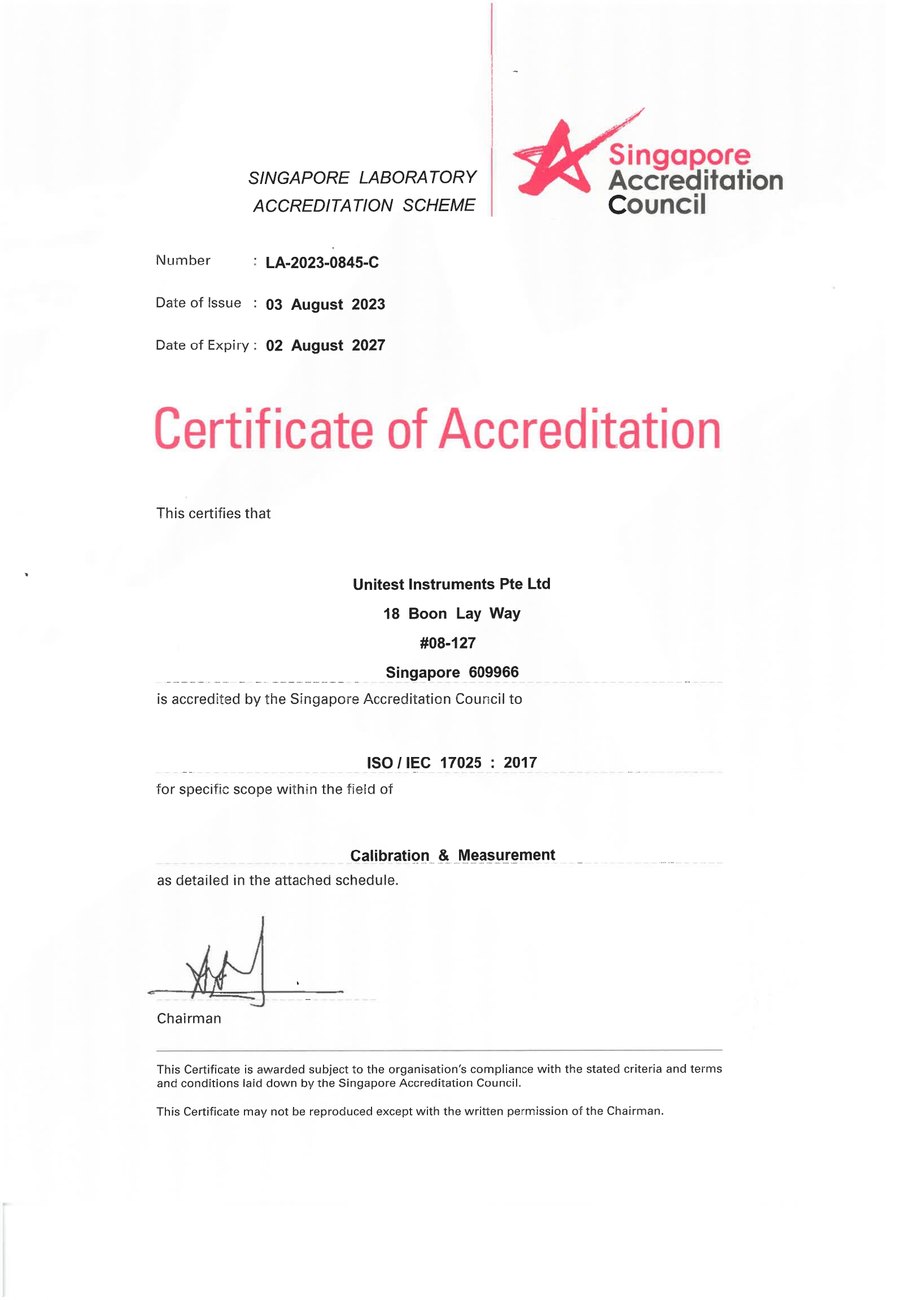
SAC-SINGLAS accredited calibration laboratory (Acc. No. LA-2023-0845-C) serving Singapore's industrial, pharmaceutical, and manufacturing sectors. All content reflects our ISO/IEC 17025 accredited scope and is reviewed by our technical calibration team.
Need relative humidity calibration in Singapore?
Unitest Instruments is SAC-SINGLAS accredited (Acc. No. LA-2023-0845-C) to ISO/IEC 17025. Same-week turnaround, certificates accepted by ISO 9001 auditors, HSA GMP inspectors, and SFA cold-chain regulators.