
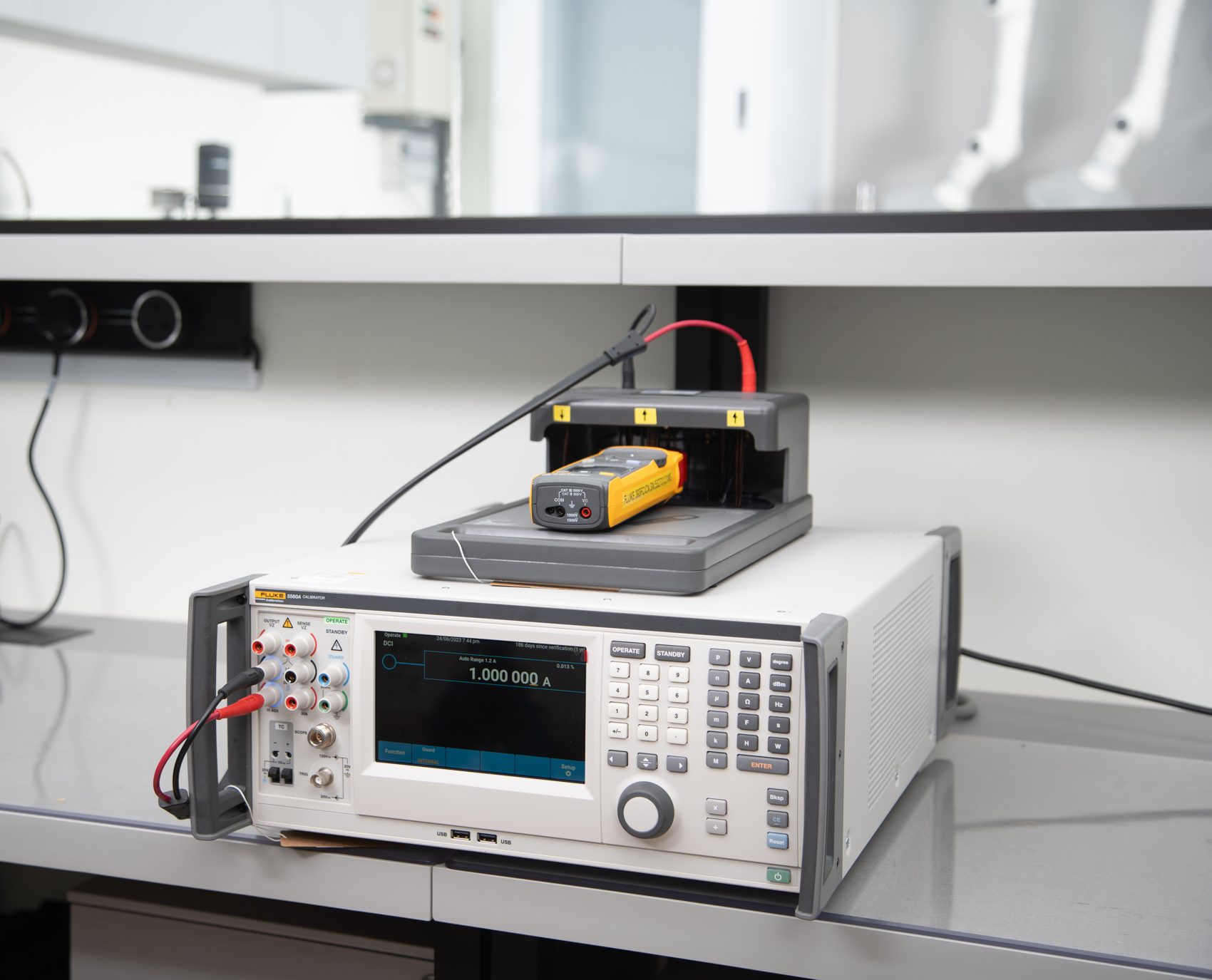
Key Takeaways
- Capacitive sensors are adequate for ±2–3% RH accuracy and cover 95% of Singapore industrial applications including pharma, food, and HVAC.
- Chilled mirror hygrometers deliver ±0.1°C dew point accuracy and are the primary reference standard, but cost 5–10× more and require expert maintenance.
- Singapore's HSA GMP, SS 590, and ISO 9001 audits require SAC-SINGLAS accredited calibration certificates, not just in-house or manufacturer certificates.
- For continuous monitoring in regulated environments, a wireless datalogger (Rotronic HF5 or Comark RF513) with alarm output is required, spot-check meters are not sufficient.
- Newly purchased humidity instruments should be SAC-SINGLAS calibrated before first use, not assumed to be within spec from the factory.
Who Needs This Guide
Singapore's humidity measurement market spans an unusually wide range of requirements, from HVAC technicians checking office air quality to pharmaceutical QA managers defending GDP-compliant cold chain records under HSA audit. The instrument that works for one will fail the other, and buying the wrong technology wastes budget or creates compliance risk.
This guide is written for three audiences: regulated-industry buyers (pharmaceutical, medical device, food and beverage) who need to satisfy audit requirements; engineering and facilities teams responsible for cleanroom, data centre, or manufacturing environment control; and calibration and metrology professionals who need reference-grade instruments or are building a humidity calibration chain. For each audience, the technology choice and the calibration requirement are different.
Singapore's tropical climate (with ambient relative humidity typically ranging from 70% to 90% and dew points of 22°C to 26°C), also means that moisture management is not an occasional concern. It is a year-round operational reality that makes instrument selection and calibration interval decisions particularly consequential.
Capacitive Sensors: How They Work and Where They Excel
A capacitive humidity sensor works by exposing a hygroscopic polymer film (sandwiched between two electrodes), to the ambient air. As water molecules are absorbed or desorbed by the polymer, its dielectric constant changes, which alters the electrical capacitance of the sensing element. This capacitance change is measured electronically and converted to a relative humidity reading. Modern capacitive sensors incorporate an integrated temperature sensor (typically a Pt100 or NTC thermistor) so that relative humidity and temperature are measured simultaneously from a single probe head.
The key advantages of capacitive sensors are compactness, robustness, and cost-effectiveness. A high-quality industrial capacitive probe such as the Rotronic HC2-S can achieve ±0.8% RH accuracy at 23°C with a response time of under 10 seconds. The sensor head is typically interchangeable, meaning recalibration can be performed by sending the probe to an accredited laboratory while the transmitter body remains installed in the field, minimising process downtime.
Capacitive sensors do have limitations. Accuracy degrades at the extremes of the measurement range (below 10% RH or above 95% RH). They can be affected by chemical contaminants. Solvents, acids, and cleaning agents can permanently damage the polymer sensing element. In applications where the ambient atmosphere contains aggressive chemicals, a membrane-protected probe or a chilled mirror instrument is a safer choice.
Chilled Mirror Hygrometers: Primary Reference Performance
A chilled mirror hygrometer operates on a fundamentally different physical principle. A small mirror surface is thermoelectrically cooled while a beam of light is directed at it. A photodetector monitors the intensity of light reflected from the mirror. When the mirror surface reaches the dew point temperature, water vapour begins to condense and scatter the reflected light. The instrument detects this change and uses a feedback control loop to maintain the mirror temperature exactly at the dew point. A precision platinum resistance thermometer (PRT) measures this temperature directly, yielding a dew point reading that is anchored to a fundamental thermodynamic quantity rather than a secondary electrical signal.
This physical first-principles approach gives chilled mirror instruments an accuracy that capacitive sensors cannot match: the Michell Instruments S8000 Remote achieves ±0.1°C dew point uncertainty across its full measurement range. This level of performance makes chilled mirror hygrometers the primary reference instrument used by national metrology institutes (including Singapore's National Metrology Centre (NMC)), and by accredited calibration laboratories when calibrating other humidity instruments.
The trade-offs are significant. Chilled mirror instruments are mechanically complex, relatively large, require clean dry air through the sensing cell, and demand periodic mirror cleaning. They cost between S$8,000 and S$30,000 depending on the model and measurement range. For applications where ±2–3% RH accuracy is sufficient, this investment is not justified. But for compressed air quality monitoring under ISO 8573, dew point measurement in natural gas, or maintaining a calibration hierarchy that underpins multiple lower-accuracy instruments, the chilled mirror is the correct and often the only acceptable choice.
Need your humidity sensor calibrated to Singapore's national standard?
Unitest Instruments (Acc. No. LA-2023-0845-C) issues SAC-SINGLAS traceable humidity and temperature calibration certificates accepted by HSA, ISO 9001 auditors, and NEA. Same-week turnaround available.
Model Comparison: Top Humidity Instruments Available from Unitest
The table below covers the principal humidity instruments sold by Unitest and its partner brands (Rotronic, Michell Instruments, Comark, Fluke, and Amprobe), across the main application categories. Prices are indicative Singapore market ranges (SGD, ex-GST); contact Unitest for current pricing and availability.
| Model | Technology | Accuracy (RH or Dew Point) | Price Range (SGD) | Best For |
|---|---|---|---|---|
| Rotronic HF5 | Capacitive, datalogger | ±1.5% RH, ±0.3°C | S$380 – S$520 | Pharmaceutical cold rooms, food storage, GDP logging |
| Rotronic HC2-S Probe | Capacitive, transmitter probe | ±0.8% RH, ±0.1°C | S$480 – S$680 | Cleanroom monitoring, HVAC, industrial transmitters |
| Comark RF513 | Capacitive, wireless logger | ±2% RH, ±0.5°C | S$290 – S$420 | Food retail, warehouse monitoring, multi-point WiFi networks |
| Fluke 971 | Capacitive, handheld | ±2.5% RH, ±0.5°C | S$380 – S$450 | HVAC commissioning, field spot checks, building diagnostics |
| Michell Instruments S8000 Remote | Chilled mirror, dew point | ±0.1°C dew point | S$9,500 – S$14,000 | Primary calibration reference, compressed air, semiconductor |
| Amprobe THWD-5 | Capacitive, handheld with wet bulb | ±3% RH, ±0.5°C | S$180 – S$260 | General maintenance, site surveys, non-regulated spot checks |
All models listed above can be purchased through unitestshop.com. For regulated applications, Unitest strongly recommends purchasing SAC-SINGLAS accredited calibration at the point of sale so the instrument arrives at your site with a valid, traceable certificate and is ready for immediate deployment in your QMS without further delay.
Selecting the Right Instrument for Your Singapore Application
Pharmaceutical and Medical Device Manufacturing
HSA's GMP guidelines (aligned with PIC/S PE 009) require that environmental monitoring instruments in classified areas carry calibration certificates traceable to national standards. The Rotronic HC2-S probe paired with a Rotronic transmitter, or the Rotronic HF5 standalone datalogger, are the most widely specified instruments in Singapore pharmaceutical facilities. Both deliver ±1–1.5% RH accuracy and support IQOQ validation documentation. They must be calibrated at SAC-SINGLAS accredited laboratory intervals (typically annually) to maintain HSA audit readiness. See our guide on how often to calibrate your instruments for a full discussion of interval-setting methodology.
Food Storage, Cold Chain, and Retail
Singapore Food Agency (SFA) and the cold chain guidelines under SS 590 require documented temperature and humidity records for perishable food storage. The Comark RF513 wireless datalogger is a practical choice for food retail and distribution. It transmits readings to a cloud dashboard over WiFi, supports multiple alarm thresholds, and generates downloadable PDF compliance reports. For cold storage facilities with large numbers of monitoring points, Rotronic's monitoring system (connecting multiple HC2-S probes to a central gateway) provides a scalable architecture. All dataloggers should be calibrated annually at a minimum, and the calibration certificate should be retained on-site for SFA inspection.
HVAC, Building Services, and Data Centres
For HVAC commissioning and ongoing building management, the Fluke 971 handheld is the most popular tool among Singapore M&E contractors. It measures RH, temperature, wet bulb, dew point, and enthalpy in a single compact instrument. For permanent installation in air handling units or data centre hot-aisle monitoring, a duct-mount capacitive transmitter (such as the Rotronic HC2-S in duct housing) feeding into a BMS is the standard approach. Data centres following ASHRAE A1–A4 thermal guidelines typically require RH monitoring at inlet and return air points, with alarms set to the ASHRAE recommended range of 20–80% RH non-condensing.
Compressed Air and Industrial Gas Quality
ISO 8573-1 specifies dew point as the parameter for compressed air moisture classification (Classes 1–6, from −70°C to +10°C pressure dew point). Capacitive sensors are unreliable at low dew points (below −20°C) because the sensing polymer cannot accurately track moisture concentrations at such low levels. For compressed air quality validation in Singapore manufacturing facilities, a chilled mirror instrument such as the Michell Instruments S8000 is the correct choice. For ongoing in-line monitoring (rather than periodic spot checks), Michell's chilled mirror inline instruments or their capacitive low-dew-point probes provide a cost-effective solution above −20°C dew point. For the full picture on calibration traceability requirements for this class of instrument, see our article on what traceability means in calibration.
Calibration Requirements and SAC-SINGLAS Accreditation
Humidity measurement is one of the most calibration-sensitive disciplines in metrology. The sensing element in a capacitive sensor drifts over time as the polymer film ages, is exposed to chemical contaminants, or undergoes mechanical stress. A sensor that was within specification when purchased may be reading 4–5% RH high after two years of use in a tropical, chemically active environment. Without any visible sign of failure. This is why calibration at defined intervals against traceable references is not optional for regulated applications: it is the only mechanism that can detect and correct this silent drift.
In Singapore, SAC-SINGLAS accreditation is the accepted framework for demonstrating that a calibration laboratory's measurements are traceable to national and international standards. Unitest Instruments holds SAC-SINGLAS accreditation No. LA-2023-0845-C for humidity and temperature calibration under ISO/IEC 17025. This means our calibration references are periodically verified against NMC Singapore's primary standards, our measurement uncertainty is formally quantified and reported, and our technical competence is independently assessed.
A calibration certificate from a non-accredited laboratory, for example, a manufacturer's factory certificate, an in-house calibration, or a certificate from an overseas laboratory without recognised accreditation. Does not satisfy the audit requirements of HSA, ISO 9001 certification bodies, or NEA. If your current calibration provider cannot show you their SAC-SINGLAS scope of accreditation certificate, you should ask whether their certificates will be accepted at your next audit.
What to Look For When Specifying a Humidity Sensor
Beyond the fundamental technology choice (capacitive vs chilled mirror), several specification parameters determine whether an instrument is fit for your application. The following checklist covers the key parameters to evaluate before purchasing.
- Measurement range: Ensure the sensor covers your full expected operating range, including worst-case ambient conditions. In Singapore, ambient RH can reach 95% or higher; ensure the sensor is rated for operation at these levels without damage.
- Accuracy and resolution: Match the published accuracy specification to your process tolerance. For GDP pharmaceutical logging, ±1–2% RH is typically acceptable; for HVAC design verification, ±2–3% RH may be sufficient. Ensure the accuracy specification is stated at a defined temperature (typically 23°C) and understand how it varies with temperature.
- Response time: For dynamic process monitoring, a sensor with a 10–30 second T90 response time is needed. For ambient logging where conditions change slowly, a 60-second response is acceptable.
- Output and connectivity: Specify 4–20 mA, 0–10 V, Modbus RTU, or digital wireless (WiFi, LoRa) depending on your data acquisition infrastructure. Wireless dataloggers eliminate cabling cost in retrofit applications.
- IP rating and chemical resistance: For wash-down environments, food processing, or outdoor installation, specify IP65 or higher. For chemically aggressive environments, confirm chemical compatibility with the sensor manufacturer.
- Calibration interval and serviceability: Choose instruments with interchangeable probe heads so the probe can be sent for calibration without removing the transmitter body from the installation. Rotronic and Michell instruments are designed with this field serviceability in mind.
Common Deployment Mistakes That Undermine Accuracy
A correctly specified, freshly calibrated humidity sensor can still produce misleading data if it is installed or positioned poorly, and in Singapore's humid, air-conditioned building stock a handful of mistakes recur across facilities of every type. The most common is mounting a duct or wall-mounted probe too close to a supply air diffuser, where the localised airflow and temperature gradient do not represent the space's actual conditions; a probe reading 45% RH two metres from a chilled air diffuser may sit beside a location reading 60% RH in the same room's occupied zone. Guidance in SS 553 and ASHRAE standards recommends siting sensors away from direct airflow, external walls, and doorways, and at a height representative of the occupied or product zone rather than at ceiling level for convenience of cabling.
A second frequent error is condensation damage from thermal shock: moving a capacitive probe rapidly from an air-conditioned space (often below 60% RH) into a hot, humid outdoor or non-conditioned area can cause moisture to condense directly on the sensing polymer, producing a saturated 100% RH reading that can take considerable time to recover and, in some sensor designs, can leave a permanent accuracy shift if condensation occurs repeatedly. Allowing the probe to acclimatise gradually, or specifying a sensor with a hydrophobic membrane filter rated for this kind of transition, avoids the problem for technicians who routinely move between environments during a single survey. A third mistake, specific to wireless dataloggers used in cold chain and food retail, is placing the unit where its wireless signal must pass through multiple concrete or metal-lined walls, causing intermittent data gaps that are indistinguishable from a genuine excursion when the compliance report is reviewed weeks later; a signal strength survey during installation, not after a gap is discovered, is the only reliable way to avoid this.
Total Cost of Ownership: Capacitive vs. Chilled Mirror
The purchase price comparison between a S$500 capacitive probe and a S$12,000 chilled mirror instrument tells only part of the ownership story, and buyers who evaluate only sticker price frequently make the wrong choice for their actual usage pattern. Capacitive sensors have a lower upfront cost but a shorter accuracy lifespan in demanding environments, meaning a facility running a fleet of twenty capacitive probes across a pharmaceutical warehouse may find itself replacing sensing elements or entire probe heads every two to three years as chemical exposure and mechanical wear degrade the polymer film beyond what recalibration can correct, an ongoing replacement cost that should be budgeted alongside the annual calibration fee. Chilled mirror instruments carry a much higher upfront cost and a more involved calibration and maintenance regime, including periodic mirror cleaning and moving-part servicing, but a well-maintained unit can remain a serviceable and accurate primary reference for a decade or more, which is precisely why calibration laboratories and metrology institutes standardise on the technology despite its cost. For a facility deciding between the two, the honest calculation weighs the number of measurement points needed (favouring capacitive sensors deployed at scale), the accuracy tier actually required by the application, and whether the instrument will function as a working monitoring device or as a reference standard against which other instruments are checked.
Frequently Asked Questions
Capacitive sensors measure relative humidity (RH) by detecting changes in electrical capacitance as moisture is absorbed by a polymer film. They are compact, affordable, and suitable for most industrial and HVAC applications. Chilled mirror hygrometers measure dew point by cooling a mirror surface until condensation forms, then detecting that temperature optically. They are the primary reference standard for high-accuracy dew point measurement and are used in metrology labs, semiconductor fabs, and calibration references. Capacitive sensors are adequate for ±2–3% RH accuracy; chilled mirror instruments achieve ±0.1°C dew point or better.
Singapore's Health Sciences Authority (HSA) GMP guidelines, aligned with PIC/S PE 009, require that environmental monitoring instruments used in classified areas (Grades A–D) carry traceable calibration certificates. For most cleanroom and cold storage applications, a calibrated capacitive sensor (such as the Rotronic HC2-S or Rotronic HF5) with an SAC-SINGLAS traceable certificate is sufficient. For primary calibration reference or dew-point-critical processes, a chilled mirror instrument (such as the Michell Instruments S8000 Remote) is the appropriate choice. Calibration intervals should be at least annually, or whenever the instrument has been subject to shock or repair.
The recommended calibration interval for humidity sensors in Singapore depends on the application and regulatory requirements. For regulated industries (pharmaceutical, food processing, medical devices), annual calibration is the minimum and is specified in guidelines such as HSA GMP and SS 590. For HVAC monitoring and general manufacturing, 6–12 months is typical. After any physical shock, repair, or battery replacement, or if readings appear anomalous, the instrument should be re-calibrated immediately. Unitest Instruments' SAC-SINGLAS accredited laboratory (Acc. No. LA-2023-0845-C) can issue ISO/IEC 17025 certificates accepted by HSA, ISO 9001 auditors, and NEA.
For food storage and cold chain monitoring in Singapore (aligned with SS 590 and SFA requirements), an accuracy of ±2–3% RH is generally acceptable for compliance logging. Instruments like the Comark RF513 wireless logger or the Rotronic HF5 datalogger meet this level. If you are monitoring controlled-atmosphere storage for fresh produce or specialty pharmaceuticals, tighter accuracy of ±1% RH may be warranted, which requires a higher-grade capacitive sensor or verification against a reference chilled mirror instrument.
Fluke's 971 Temperature Humidity Meter and the Fluke 975 AirMeter are dedicated handheld instruments for humidity measurement. The Fluke 971 measures RH from 5% to 95% with ±2.5% RH accuracy and is well-suited for HVAC commissioning, building diagnostics, and spot checks in Singapore's tropical climate. It is not a replacement for a calibrated datalogger in regulated environments, but it is a practical and robust tool for field technicians. All Fluke humidity instruments should be SAC-SINGLAS calibrated before use in any audit-traceable application.
SAC-SINGLAS (Singapore Accreditation Council. Singapore Laboratory Accreditation Scheme) accreditation under ISO/IEC 17025 means that a calibration laboratory has been independently assessed and found competent to perform measurements traceable to national and international standards. For humidity calibration, this means results are traceable to Singapore's National Metrology Centre (NMC). An SAC-SINGLAS accredited calibration certificate (such as those issued by Unitest Instruments, Acc. No. LA-2023-0845-C) is accepted by HSA GMP auditors, ISO 9001 certification bodies, and NEA inspectors. Non-accredited calibration certificates may not satisfy audit requirements.
Dew point is the temperature at which air becomes saturated and condensation begins to form. Unlike relative humidity, dew point is an absolute measure of moisture content that does not change with temperature. Making it the preferred parameter for compressed air quality, semiconductor manufacturing, natural gas processing, and any application where condensation risk must be assessed independently of ambient temperature fluctuations. In Singapore's climate, dew points typically range from 22°C to 26°C. Chilled mirror hygrometers measure dew point directly with the highest accuracy; capacitive sensors can calculate dew point mathematically from RH and temperature readings but with lower precision.
A spot-check handheld meter (such as the Fluke 971 or Comark N2014) is suitable for commissioning, troubleshooting, and periodic manual readings. A continuous datalogger (such as the Rotronic HF5 or Comark RF513 wireless logger) is required whenever you need an unattended audit trail, for example, in pharmaceutical cold rooms, food storage facilities, and museum archives. In Singapore, regulatory bodies including HSA and SFA require documented continuous records, not spot readings, for controlled storage environments. For critical applications, the datalogger should be connected to an alarm system so out-of-range conditions trigger immediate notification.
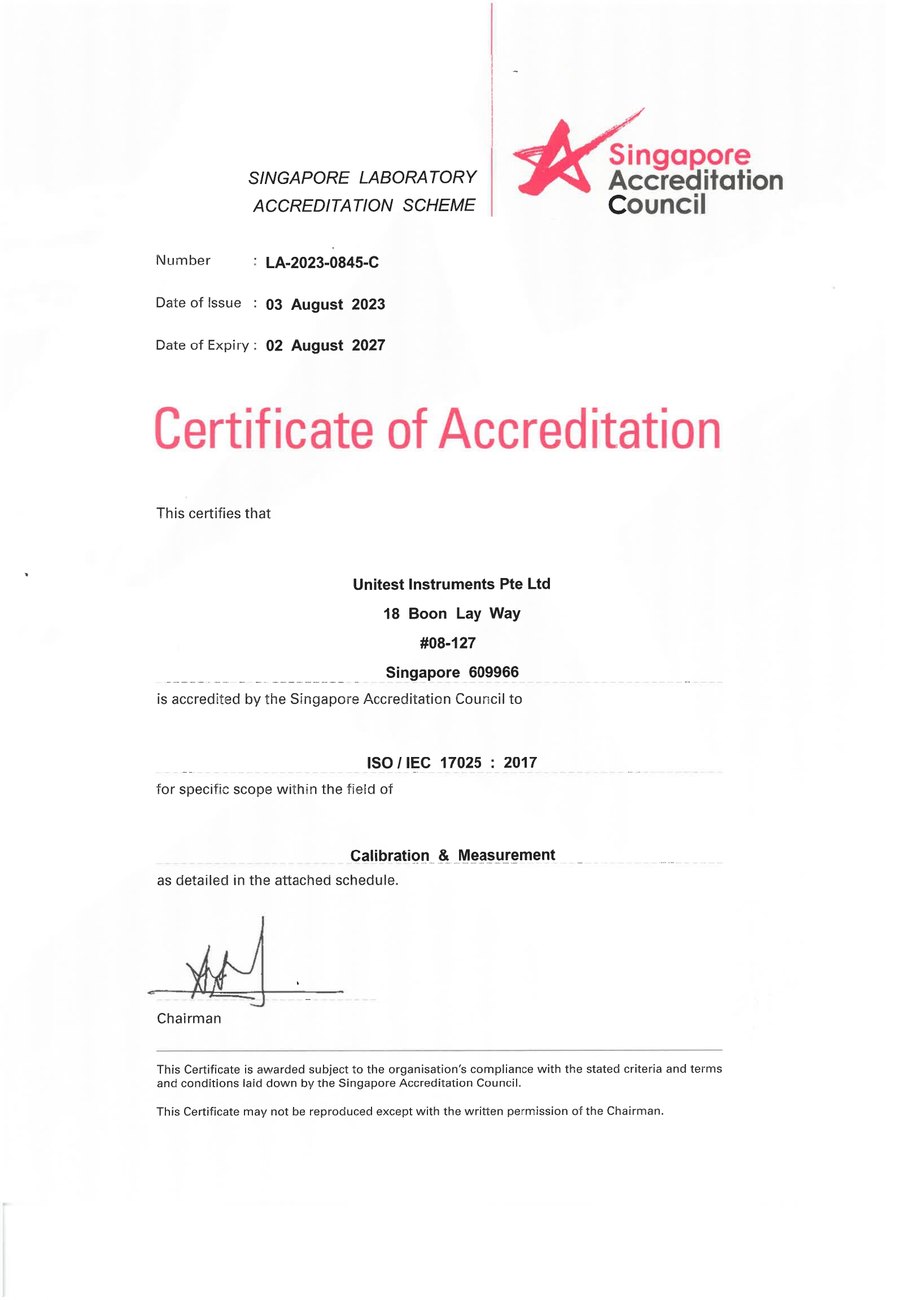
SAC-SINGLAS accredited calibration laboratory (Acc. No. LA-2023-0845-C) serving Singapore's industrial, pharmaceutical, and manufacturing sectors. All content reflects our ISO/IEC 17025 accredited scope and is reviewed by our technical calibration team.
Need humidity sensor calibration in Singapore?
Unitest Instruments is SAC-SINGLAS accredited (Acc. No. LA-2023-0845-C) to ISO/IEC 17025. Same-week turnaround, certificates accepted by ISO 9001 auditors, HSA, and NEA.