
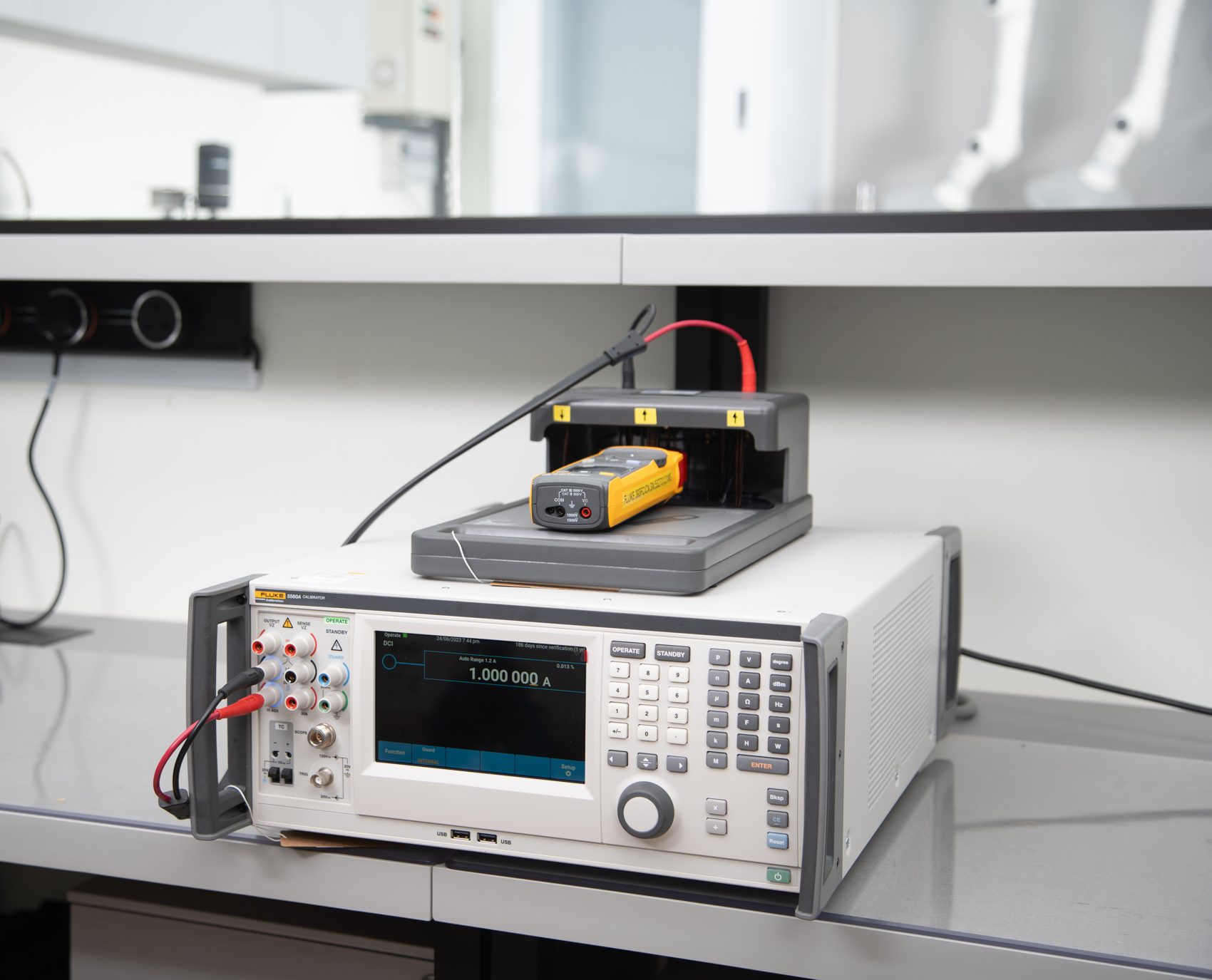
Key Takeaways
- SS 553 requires all TAB (testing, adjusting, and balancing) instruments to be calibrated and traceable to national standards before commissioning reports are accepted.
- SAC-SINGLAS accredited certificates (Acc. No. LA-2023-0845-C) are the only certificates recognised by BCA inspectors and ISO 9001 auditors without question.
- Singapore's humid tropical environment accelerates humidity sensor drift. Calibrate hygrometers and RH sensors every 6 months, not the default 12.
- An instrument register with due dates and responsible owners is the minimum QA infrastructure every HVAC contractor should maintain.
- Out-of-tolerance findings require an impact assessment on all measurements made since the last valid calibration. Not just a recalibration of the instrument.
Why Calibration Is Non-Negotiable for HVAC Work in Singapore
Singapore operates in a year-round tropical climate with average outdoor temperatures of 25–33 °C and relative humidity consistently above 70%. This environment is not merely demanding on the occupants of buildings. It places relentless stress on the instruments your technicians carry to commissioning sites, plant rooms, and rooftop AHU decks. Thermistors drift, pressure sensors develop hysteresis, and capacitive humidity sensors absorb moisture that shifts their baseline. An instrument that was accurate six months ago may be reading 3–5% RH high today, and without a calibration record, you have no way to know.
Beyond instrument physics, there is the regulatory and commercial reality. Singapore's Building and Construction Authority (BCA) and the Singapore Standard SS 553:2016 (Code of Practice for Air-Conditioning and Mechanical Ventilation in Buildings) require that testing, adjusting, and balancing (TAB) be conducted with calibrated instruments. M&E consultants increasingly include explicit calibration requirements in their specifications. Specifying that all instruments carry certificates issued within 12 months by a SAC-SINGLAS accredited laboratory. Building owners and facilities managers, especially those maintaining ISO 9001 or ISO 14001 certification, will audit your calibration records. A missing or expired certificate on a commissioning report is not a paperwork issue. It can delay project handover and trigger contractual penalties.
The good news is that a well-organised calibration programme is neither expensive nor complicated. For a typical HVAC contractor's instrument fleet, the annual cost of proper calibration is a fraction of one project's professional indemnity risk, and the audit-readiness it provides is an active commercial differentiator when tendering for government, healthcare, and Grade-A commercial projects.
Key Instruments Used by HVAC Contractors and Their Calibration Parameters
Understanding what you are calibrating (and why), helps you prioritise correctly and brief your calibration lab accurately. The table below covers the instruments most commonly used in Singapore's HVAC industry, the parameters being measured, and the typical accuracy requirements seen in M&E specifications.
| Instrument | Parameter Measured | Typical Accuracy Spec | Calibration Interval | Compliance Driver |
|---|---|---|---|---|
| Digital thermometer / thermocouple | Temperature (°C) | ±0.3 °C or better | 6–12 months | SS 553, ISO 9001 |
| Pressure gauge / manometer | Gauge pressure (Pa, kPa, bar) | ±0.5% FS or ±1% FS | 12 months | SS 553, refrigerant handling |
| Differential pressure transmitter | Differential pressure (Pa) | ±1–2% FS | 12 months | TAB reports, ACMV design verification |
| Anemometer / airflow meter | Air velocity (m/s), volumetric flow (L/s) | ±3–5% of reading | 6–12 months | SS 553 TAB, ventilation rate compliance |
| Hygrometer / humidity sensor | Relative humidity (% RH) | ±2–3% RH | 6 months | SS 553, healthcare ACMV, cleanrooms |
| Clamp meter / power analyser | Current (A), voltage (V), power (W) | ±1–2% of reading | 12 months | Energy audits, BCA GEAM |
| Refrigerant leak detector | Refrigerant concentration (ppm) | Manufacturer specification | 12 months | NEA F-gas regulations, safety |
| CO₂ / CO sensor | Gas concentration (ppm) | ±50 ppm CO₂ or ±5% reading | 6–12 months | IAQ assessments, SS 554 |
| Data logger (temperature/RH) | Temperature and RH over time | Per logger spec | 12 months | Pharmaceutical cold-chain, clean facilities |
Note that the intervals listed are industry-standard starting points. Your actual intervals should be determined by considering usage frequency, the harshness of the operating environment, manufacturer recommendations, and any contractual obligations from your clients. As explained in our guide on how often calibration is needed, there is no single universal interval. Risk-based scheduling produces better outcomes than rigid annual cycles alone.
Singapore's Regulatory and Standards Landscape for HVAC Calibration
Singapore has several overlapping requirements that HVAC contractors must navigate. Understanding which standard applies to your project type helps you decide exactly what level of calibration documentation you need to produce.
SS 553:2016. Air-Conditioning and Mechanical Ventilation
This is the primary standard governing HVAC design, installation, and commissioning in Singapore. Section 15 of SS 553 addresses commissioning, testing, and balancing and explicitly requires that instruments used during TAB be calibrated. TAB reports submitted to M&E consultants must include calibration certificates for all test instruments. If your certificates are expired or issued by a non-accredited laboratory, the consultant may reject your TAB report and require re-testing. A costly outcome on a tight handover schedule.
BCA Green Mark and GEAM
Projects pursuing BCA Green Mark certification or subject to the Gross Floor Area Exemption for M&E (GEAM) provisions must demonstrate energy performance. This requires power measurement instruments (clamp meters, power analysers) that are calibrated and traceable. An uncalibrated clamp meter introduced into an energy baseline measurement is not just inaccurate. It can invalidate the entire energy audit submission.
ISO 9001 Quality Management
If your HVAC company holds or is seeking ISO 9001 certification, Clause 7.1.5 requires that measuring instruments be calibrated at specified intervals against measurement standards traceable to international or national standards. The standard requires you to retain calibration records as documented information. SAC-SINGLAS certificates satisfy this traceability requirement directly, which is why understanding the difference between accredited and non-accredited calibration matters for your QA system.
Healthcare, Pharmaceutical, and Cleanroom Projects
If your HVAC work involves operating theatres, pharmaceutical manufacturing facilities, or cleanrooms regulated under GMP (Good Manufacturing Practice), the calibration requirements are significantly stricter. Temperature uniformity studies, filter integrity testing, and airflow visualisation must all use instruments with current, accredited calibration certificates. The Health Sciences Authority (HSA) and international GMP inspectors will review calibration records during facility qualification audits.
Need calibration certificates for your HVAC instruments?
Unitest Instruments calibrates the full range of HVAC test equipment (thermometers, pressure gauges, anemometers, humidity sensors), with same-week turnaround and SAC-SINGLAS accredited certificates accepted by BCA inspectors and ISO auditors.
What SAC-SINGLAS Accreditation Means for Your Compliance Evidence
SAC-SINGLAS is Singapore's national laboratory accreditation scheme, administered by the Singapore Accreditation Council (SAC) under Enterprise Singapore. When a laboratory holds SAC-SINGLAS accreditation, it means the laboratory has been independently assessed against ISO/IEC 17025 (the international standard for calibration and testing laboratory competence), and found to meet it. The accreditation is not self-declared; it is audited and renewed on a regular cycle.
For HVAC contractors, the practical consequence is significant. A calibration certificate issued by Unitest Instruments (Acc. No. LA-2023-0845-C) carries the SAC-SINGLAS mark, which means it is automatically recognised by government agencies, building owners, ISO auditors, and M&E consultants across Singapore. You do not need to prove the lab's competence, the accreditation already does that. In contrast, a certificate from a non-accredited workshop, even if technically performed carefully, requires you to justify the calibration method, reference standards, and traceability chain every time an auditor questions it.
A complete calibration certificate from an ISO/IEC 17025 accredited lab includes the measurement uncertainty alongside the actual and reference values. If your certificate does not show expanded measurement uncertainty, it does not comply with ISO/IEC 17025, and you should ask your calibration provider why. Our article on what a calibration certificate contains walks through every field and what it means for your compliance case.
Calibration Intervals for Singapore's Tropical Environment
Instrument manufacturers set calibration intervals based on laboratory or temperate-climate assumptions. Singapore's conditions (sustained heat, high humidity, and rapid thermal cycling between air-conditioned plant rooms and outdoor environments), accelerate drift in several instrument categories that HVAC contractors use daily.
Humidity Sensors: Calibrate Every 6 Months
Capacitive RH sensors are particularly vulnerable in Singapore's climate. The polymer sensing element absorbs ambient moisture over time, causing baseline shift that is not apparent to the user during normal operation. A humidity sensor that reads accurately in January may be reading 4% RH high by July. Enough to affect ACMV control decisions and invalidate air quality assessments. Six-month calibration intervals are the industry consensus for Singapore HVAC humidity instruments.
Pressure Gauges: Annual Calibration, Inspect After Shock Events
Bourdon tube and digital pressure gauges used in HVAC work are subject to mechanical shock during transport and installation. A gauge dropped or overtightened during a commissioning visit can shift its calibration immediately. Annual calibration is the baseline interval, but any gauge that has been subjected to a shock event (a drop, a pressure spike, or over-range exposure), should be sent for calibration before its next use, regardless of when it was last certified.
Airflow Meters and Anemometers: 6–12 Months Depending on Use
Hot-wire and vane anemometers are sensitive to contamination from dust, grease, and fibres encountered in plant rooms and ceiling spaces. Contamination on the sensing element introduces consistent bias errors. Instruments used on construction sites or in dusty environments should be calibrated every 6 months; those reserved for clean commissioning work can extend to 12 months. Always inspect the sensor visually before use and clean it according to the manufacturer's instructions.
Setting Up a Calibration Management System for Your HVAC Company
For most HVAC contractors, calibration management does not require dedicated software. A well-designed spreadsheet instrument register is sufficient to maintain control and survive an ISO 9001 audit. The register should capture: instrument description; make, model, and serial number; assigned calibration interval; date of last calibration; calibration certificate number; date calibration is due; the person responsible for ensuring it is sent; and the storage location. Every instrument that makes a measurement used in a commissioned work or compliance report must appear on this register.
Set calendar reminders four to six weeks before each instrument's due date. This lead time allows for laboratory processing, certificate issue, and return of the instrument before it is needed on site. Rushing calibration at the last minute (or worse, using an instrument after its certificate has expired because "it was only a few days"), creates audit risk and, in the event of a measurement dispute, legal exposure.
When an instrument is sent for calibration, log the dispatch date and the certificate number when the instrument returns. File the certificate digitally against the instrument serial number. When you submit a TAB report or commissioning package, include copies of all relevant certificates. Some clients and M&E consultants now require that certificates be hyperlinked or annexed to electronic commissioning records. A digital filing system makes this straightforward.
Out-of-Tolerance Findings: What Your Team Must Do
If your calibration lab finds an instrument outside its tolerance specification, they will issue an "as-found" certificate showing the pre-adjustment values. This is not merely a calibration outcome. It is a quality event that requires documented investigation. Your QA procedure should specify: who is notified when an out-of-tolerance finding occurs; how far back in time measurements from that instrument must be reviewed; whether any commissioning reports, energy audits, or IAQ assessments made with that instrument need to be revised; and whether affected clients or building owners must be notified.
Out-of-tolerance investigations feel bureaucratic when the drift is small, but they are the mechanism that keeps your quality system honest. An instrument that was 4% RH high for six months was producing incorrect measurements for six months, and the commissioning reports, maintenance records, or control setpoint decisions that relied on those measurements were wrong. Documenting your investigation and its conclusion (even if the conclusion is "drift was within acceptable limits for the application") shows auditors that your quality system is functioning, not just paperwork.
Managing Instrument Fleets Across Multiple Site Teams
A mid-sized Singapore HVAC contractor running several concurrent projects, a hospital ACMV upgrade, a commercial tower TAB commissioning, and a data centre cooling retrofit, typically has instruments moving between site teams, sitting in vans, and occasionally getting borrowed between crews under deadline pressure. This mobility is where instrument registers most commonly break down in practice: an anemometer signed out to the data centre team on Monday shows up on the hospital job by Thursday because a technician grabbed whatever was in the office, and unless your register tracks physical custody as well as calibration due date, nobody notices that the instrument used on the hospital's IAQ assessment was actually the unit whose calibration certificate had expired the week before.
The practical fix scales with company size rather than requiring an enterprise asset management system. For a fleet under twenty instruments, a simple sign-out log at the point instruments leave the office, cross-referenced against the same calibration due-date register described above, closes this gap at negligible administrative cost. For larger fleets and multi-crew operations, colour-coded calibration labels (a new colour issued each calibration cycle, visible at a glance without reading the fine print) let a site supervisor or QA reviewer spot an instrument carrying last cycle's colour during a spot-check, well before it becomes a finding in a client's commissioning report review. Whichever system you use, the underlying discipline is the same one that matters across every regulated industry we calibrate for: the instrument physically present on site must be traceable, in real time, to a specific entry in your calibration register, not just theoretically accounted for somewhere in a spreadsheet.
Turning Calibration Discipline Into a Tender Advantage
Singapore's HVAC tender landscape, particularly for government, healthcare, and Grade-A commercial developments, increasingly asks bidders to demonstrate their quality management approach as part of the technical evaluation, not just price. Contractors who can produce a clean, organised calibration register and sample certificates on request during a pre-award clarification, rather than scrambling to locate paperwork after the fact, are making a genuinely differentiating impression on the M&E consultants and building owners evaluating the bid, because it signals that the same discipline will carry through to the commissioning and handover phase where calibration gaps most often cause costly rework and schedule slippage.
This is worth stating plainly to your commercial and tendering team, not just your site technicians: a well-run calibration programme is not purely a compliance cost centre, it is evidence you can put in front of a client during a tender interview that answers the unspoken question every consultant is really asking, "will this contractor's numbers hold up when we check them." For contractors pursuing BCA Green Mark or ISO 9001-certified project work specifically, being able to hand over a complete calibration certificate pack alongside the TAB report on the day of handover, rather than chasing outstanding certificates during the defects liability period, measurably shortens the path to final account settlement.
Building this evidence base is straightforward once the underlying register and sign-out discipline described above are in place: it costs nothing beyond the calibration you should already be doing, and it converts a routine compliance obligation into something your business development team can actively reference in proposals, rather than something your site team quietly hopes nobody asks about too closely.
Frequently Asked Questions
HVAC contractors typically need to calibrate thermometers and temperature loggers, pressure gauges and manometers, anemometers and airflow meters, humidity sensors and hygrometers, refrigerant leak detectors, differential pressure transmitters, clamp meters and power analysers, and CO₂/CO sensors used for air quality verification. Any instrument used to make a compliance or commissioning claim should carry a valid calibration certificate from a SAC-SINGLAS accredited laboratory.
Singapore's BCA and SS 553 guidelines do not mandate a single interval for all instruments, but industry practice is: temperature instruments every 6–12 months, pressure gauges every 12 months, airflow and velocity meters every 6–12 months, and humidity sensors every 6 months due to sensor drift in tropical conditions. High-use or harsh-environment instruments should be calibrated more frequently. Always check your manufacturer's datasheet and your client's contractual requirements, as some M&E specifications require annual calibration certificates as a minimum.
SAC-SINGLAS (Singapore Accreditation Council – Singapore Laboratory Accreditation Scheme) is Singapore's national scheme for accrediting calibration and testing laboratories to ISO/IEC 17025. A certificate issued by a SAC-SINGLAS accredited lab carries government-recognised traceability to Singapore's national measurement standards (NMC). For HVAC contractors, this means your calibration certificates will be accepted without question by BCA inspectors, ISO 9001 auditors, and building owners. Unlike certificates from non-accredited labs, which may be rejected or require additional justification.
Yes. Singapore Standard SS 553 (Code of Practice for Air-Conditioning and Mechanical Ventilation in Buildings) requires that all test instruments used during commissioning, testing, and balancing (TAB) of HVAC systems be calibrated and traceable to national standards. Building owners and their M&E consultants increasingly specify that TAB reports must be accompanied by valid calibration certificates from accredited laboratories. Submitting a TAB report with expired or non-accredited certificates can result in rejection and costly re-testing.
A proper ISO/IEC 17025 calibration certificate includes: the instrument's make, model, and serial number; the calibration date and recommended next calibration date; the reference standards used (traceable to NMC Singapore); the actual measured values versus the reference values at multiple test points; the expanded measurement uncertainty (at 95% confidence); the calibration laboratory's SAC-SINGLAS accreditation number; and the authorising technician's signature. Certificates without measurement uncertainty stated are not compliant with ISO/IEC 17025 and may not satisfy auditors.
Both options are available in Singapore. Many accredited laboratories, including Unitest Instruments, offer on-site calibration for instruments that cannot be removed without disrupting operations, for example, permanently installed differential pressure transmitters or BMS sensors. On-site calibration must still meet ISO/IEC 17025 requirements for the calibration environment and reference equipment. For portable instruments like clamp meters and thermometers, laboratory calibration is generally more accurate and cost-effective.
If an instrument is found outside its specified tolerance during calibration, the laboratory will issue a certificate marked "as-found" showing the out-of-tolerance condition. You must then decide whether to adjust, repair, or replace the instrument. Critically, you should review any measurements that instrument made since its last known-good calibration. This is called an out-of-tolerance impact assessment. For commissioned HVAC systems, this may require re-testing affected areas and notifying the building owner or M&E consultant.
Start with an instrument register: list every measuring instrument, its serial number, its current calibration due date, and the person responsible. Assign calibration intervals based on manufacturer recommendations and usage frequency. Send instruments in batches before their due dates to avoid gaps in certification. Store calibration certificates digitally and link them to commissioning reports. Set calendar reminders 4–6 weeks before each expiry. If you are ISO 9001 certified or working towards it, your Quality Manual should define the entire calibration control process, and your internal auditors will check it during surveillance audits.
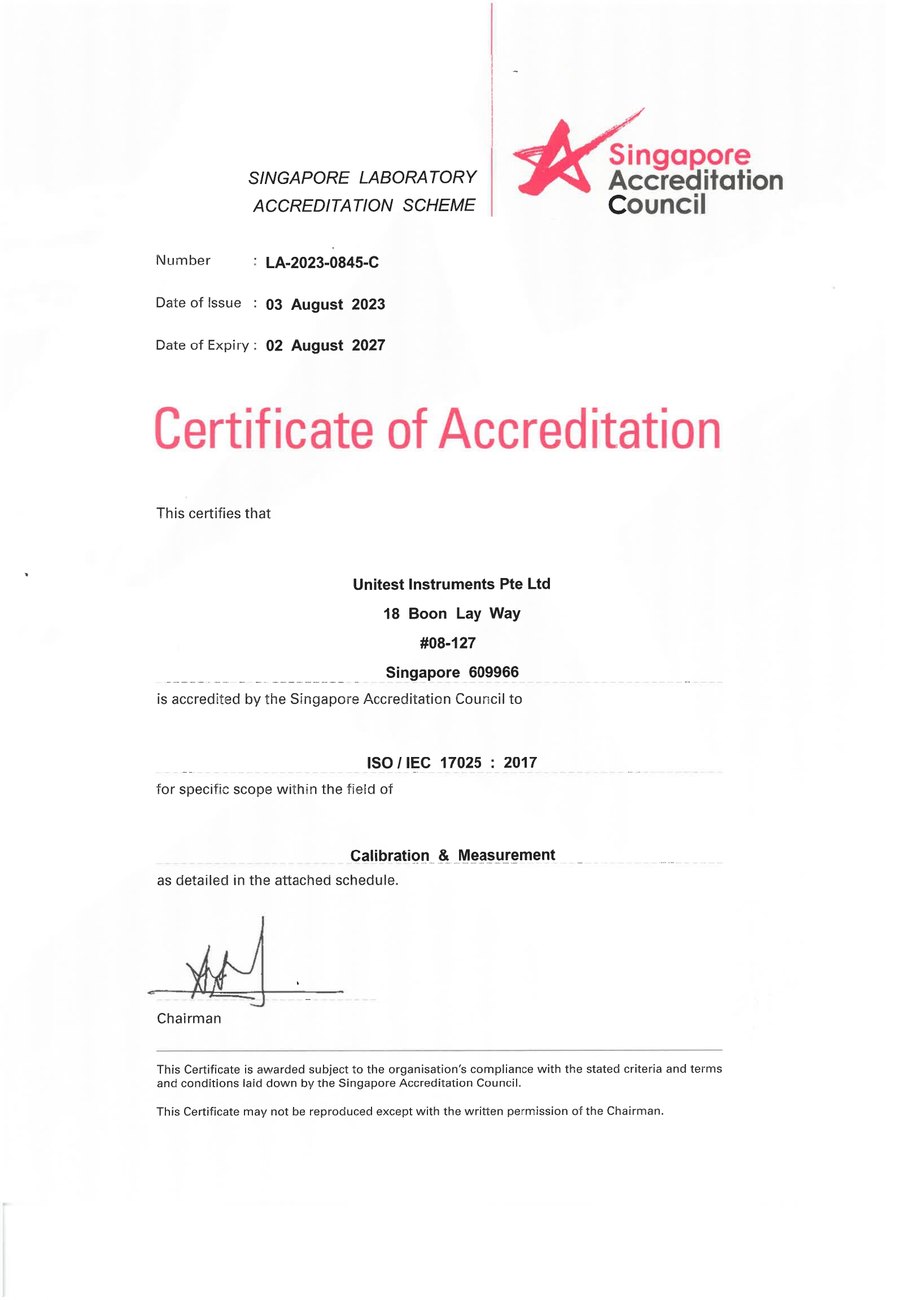
SAC-SINGLAS accredited calibration laboratory (Acc. No. LA-2023-0845-C) serving Singapore's industrial, pharmaceutical, and manufacturing sectors. All content reflects our ISO/IEC 17025 accredited scope and is reviewed by our technical calibration team.
Need HVAC instrument calibration in Singapore?
Unitest Instruments is SAC-SINGLAS accredited (Acc. No. LA-2023-0845-C) to ISO/IEC 17025. Same-week turnaround, certificates accepted by ISO 9001 auditors and BCA inspectors.