
Key Takeaways
- Vane anemometers suit most HVAC supply/return grille measurements; thermal probes are essential for low-velocity (<0.5 m/s) and cleanroom work.
- Singapore's SS 553:2016 and SS 554:2009 require traceable, calibrated instrumentation, not just any off-the-shelf meter.
- The Fluke 925 and Amprobe TMA10-A are the top-selling HVAC anemometers on unitestshop.com, covering 80% of TAB technician needs.
- Volume flow (L/s or CFM) is calculated from velocity × duct area. Choose a meter with a built-in area function to speed up balancing work.
- New instruments should be calibrated before first use; field instruments used for commissioning should be recalibrated annually at minimum.
Who Needs an Anemometer for HVAC Work in Singapore?
Any mechanical engineer, TAB (Testing, Adjusting, and Balancing) technician, facility manager, or building services consultant who needs to measure airflow at supply diffusers, return grilles, exhaust fans, or ductwork openings will need an anemometer as a core tool. In Singapore, this spans a wide range of sectors: commercial offices complying with BCA Green Mark, hospitals maintaining precise pressure cascade control, semiconductor fabs running ISO 14644 cleanroom protocols, industrial facilities meeting Ministry of Manpower ventilation requirements, and school buildings audited for SS 554 indoor air quality compliance.
The importance of choosing the right instrument (and ensuring it is properly calibrated), cannot be overstated. HVAC systems in Singapore's tropical climate run continuously and are often over-designed, making precise air balancing critical for both energy efficiency and occupant comfort. An under-specified anemometer or one with unchecked drift will produce TAB reports that fail regulatory review, requiring costly re-measurement and potentially delaying project handover.
Beyond regulatory compliance, there is a genuine energy cost dimension worth understanding. A building's chillers, air handling units, and fans are sized and controlled based on the airflow rates a TAB survey confirms are actually being delivered, and systematic measurement error, whether from an uncalibrated instrument or a poorly executed survey method, propagates directly into how the building's HVAC system is subsequently tuned and operated. An over-reported airflow can lead to a system that is throttled below its genuine design intent, causing comfort complaints and poor indoor air quality; an under-reported airflow can lead to unnecessary energy waste as the system is pushed harder than actually required. Getting the measurement right at commissioning is not simply a paperwork exercise, it is the foundation the building's ongoing energy performance is built on for the life of the installation.
Understanding the Three Main Anemometer Technologies
Before comparing specific models, it helps to understand the three measurement principles you will encounter in the HVAC market, since each has a distinct performance envelope suited to different tasks.
Vane (Impeller) Anemometers
Vane anemometers use a rotating propeller that spins in proportion to air velocity. They are robust, easy to use, and accurate across a wide velocity range (typically 0.4 to 30 m/s), making them the standard tool for measuring at supply diffusers, fan outlets, and return grilles. The main limitation is a lower sensing threshold, below approximately 0.4 m/s, impeller inertia prevents reliable readings. Most vane meters also display temperature simultaneously, which is useful for HVAC commissioning where both airflow and supply air temperature must be verified.
Thermal (Hot-Wire) Anemometers
Thermal anemometers measure air velocity by detecting the heat loss from a fine resistance wire. Because the sensing element is microscopic, they detect very low velocities (down to 0.01 m/s) with high accuracy, making them indispensable for cleanroom qualification, fume hood face velocity testing, and low-supply-velocity diffuser work. The trade-off is sensitivity to contamination (the probe tip must be kept clean), and a narrower upper velocity range compared to vane types.
Multifunction Air Quality Meters
High-end instruments like the Fluke 975 AirMeter combine a vane or thermal velocity sensor with humidity, temperature, CO2, and sometimes CO sensors in a single device. These are favoured by facility managers and commissioning specialists who need to diagnose HVAC performance holistically. Measuring not just airflow but the quality of the air being delivered. For BCA Green Mark audits and SS 554 IAQ assessments, a multifunction meter can replace three separate instruments on site.
Why a Single Reading in the Middle of a Duct Is Not Enough
A common mistake among technicians new to TAB work is taking a single velocity reading at the centre of a duct or grille opening and using it, alone, to calculate volume flow. Air velocity across any duct cross-section is never uniform: friction against the duct walls slows air near the surface, while turbulence, upstream fittings, and duct geometry create a velocity profile that is typically fastest somewhere near, but not exactly at, the geometric centre. Using a single centre-point reading and multiplying by the full cross-sectional area systematically overstates true volume flow, sometimes significantly, because it assumes the centre velocity applies uniformly across the entire duct.
The correct approach, and the method referenced in SS 553 commissioning guidance and equivalent international TAB standards, is a traverse: dividing the duct cross-section into a grid of equal-area segments and taking a velocity reading at the centroid of each segment, then averaging all the readings to obtain a genuinely representative mean velocity. For a rectangular duct, this typically means a grid of at least 16 to 25 points depending on duct size; for a round duct, a log-Tchebycheff or equal-area method distributes points along diameters at specific, standard-defined radial positions rather than evenly spaced intervals, because velocity gradients near the duct wall are steeper and benefit from denser sampling there. Skipping the traverse and relying on a handful of convenient spot readings is one of the most common reasons a commissioning report gets challenged during BCA or main contractor review, and it is entirely avoidable with a properly executed grid measurement.
Instrument Response Time and Turbulent Flow: Why Averaging Matters
Real airflow in a duct or at a diffuser face is rarely perfectly steady; turbulence causes genuine, continuous fluctuation in instantaneous velocity even under otherwise stable HVAC operating conditions. An anemometer's displayed reading is itself a form of averaging (vane instruments mechanically smooth fluctuations through the impeller's own rotational inertia, while thermal instruments typically apply an electronic averaging window), and understanding this behaviour matters when comparing readings between different instrument types or interpreting an unstable, jumping display.
Most quality HVAC anemometers include a built-in time-averaging function (commonly displaying a running average over a user-selectable period, alongside instantaneous, minimum, and maximum values), and using this averaging function rather than reading the instantaneous display at a single arbitrary moment produces a more representative and repeatable result, particularly at diffusers with genuinely turbulent discharge patterns. For commissioning documentation specifically, recording the averaged value alongside the averaging period used gives a reviewer confidence that the reported figure represents genuine steady-state performance rather than a single, possibly unrepresentative instant plucked from a fluctuating display.
Top Anemometer Models Available Through Unitest
Unitest supplies anemometers from Fluke and Amprobe. Two brands with deep engineering heritage and global service networks. The following models are available at unitestshop.com and represent the most commonly specified instruments for Singapore HVAC commissioning work.
| Model | Type | Velocity Range | Accuracy | Key Features | Price Range (SGD) | Best For |
|---|---|---|---|---|---|---|
| Fluke 925 | Vane | 0.4 – 25 m/s | ±3% rdg ±0.1 m/s | Air volume (CFM/m³/h), temperature, min/max/avg | S$380 – S$450 | General HVAC TAB, supply/return grilles, fan outlet testing |
| Fluke 923 | Vane | 0.4 – 30 m/s | ±3% rdg ±0.1 m/s | Compact form, large display, duct area input, USB data transfer | S$320 – S$390 | Field technicians needing a compact everyday meter |
| Amprobe TMA10-A | Thermal | 0.1 – 25 m/s | ±3% rdg ±0.05 m/s | Low-velocity sensitivity, temperature, datalogger, telescoping probe | S$520 – S$620 | Cleanroom face velocity, fume hoods, low-velocity diffusers |
| Amprobe TMAN-10 | Thermal | 0.1 – 30 m/s | ±3% rdg ±0.05 m/s | Built-in datalogger, SD card logging, multi-point averaging, humidity sensor | S$680 – S$820 | Commissioning documentation, multi-point TAB surveys requiring data export |
| Fluke 975 AirMeter | Multifunction | 0.25 – 15 m/s (vane) | ±3% rdg | Velocity + temp + RH + CO2 + CO in one device; Bluetooth; Fluke Connect | S$1,600 – S$1,900 | IAQ audits, BCA Green Mark, SS 554 assessments, facility management |
Note: price ranges are indicative and subject to change. Check unitestshop.com for current pricing and availability, or contact Unitest for volume pricing and calibration bundle packages.
Need your anemometer calibrated before your next commissioning project?
Unitest Instruments calibrates anemometers to traceable standards. Certificates accepted by BCA, NEA, and ISO 9001 auditors. Same-week turnaround available.
Singapore Standards and Regulatory Context
Singapore has a well-defined regulatory framework for HVAC measurement that directly determines which instruments are acceptable and how they must be validated. Understanding these requirements is not optional for anyone working on commercial or institutional HVAC projects.
SS 553:2016. Air-Conditioning and Mechanical Ventilation
Singapore Standard SS 553 is the primary code governing air-conditioning and mechanical ventilation system design, installation, commissioning, and maintenance in non-residential buildings. It mandates that all HVAC systems be properly commissioned and balanced, with airflow rates verified against design specifications. TAB reports submitted under SS 553 must be based on measurements taken with calibrated instruments, and increasingly, main contractors and qualified persons (QPs) are specifying SAC-SINGLAS accredited calibration certificates as the acceptable evidence standard.
SS 554:2009. Indoor Air Quality
SS 554 sets the code of practice for indoor air quality in air-conditioned buildings. It defines acceptable ranges for air velocity, temperature, humidity, CO2, and particulates in occupied spaces. Facility managers conducting periodic IAQ audits need instruments capable of measuring all relevant parameters, which is where a multifunction instrument like the Fluke 975 AirMeter becomes particularly valuable, covering velocity, temperature, humidity, and CO2 in a single device.
BCA Green Mark and NEA Requirements
BCA's Green Mark scheme for new and existing buildings requires demonstrated HVAC energy efficiency, which is partly evidenced through airflow commissioning data. NEA workplace health requirements under the Workplace Safety and Health Act also specify minimum ventilation rates for industrial facilities. Both frameworks assume that the measurement instruments used have been calibrated against traceable standards. Making a SAC-SINGLAS certificate from Unitest the correct documentary evidence to present.
ISO 14644 Cleanrooms
For semiconductor, pharmaceutical, and medical device facilities in Singapore, ISO 14644-3 governs cleanroom testing and monitoring. Face velocity testing at unidirectional flow workstations and air change rate verification in classified rooms require thermal anemometers with measurement uncertainties well below 5%, which is why the Amprobe TMA10-A and TMAN-10, when calibrated by Unitest, are commonly specified for these applications. Understanding how measurement uncertainty is quantified is particularly important in cleanroom contexts where tight specifications must be demonstrated.
How to Choose the Right Model for Your Application
With five models across two technologies and a wide price range, the decision comes down to three questions: What velocity range do you need? Do you need data logging and documentation? And do you need multiparameter measurement?
For TAB Technicians and Building Services Contractors
If your primary work is balancing supply and return air at standard commercial HVAC grilles and diffusers, the Fluke 925 is the right instrument. Its 0.4–25 m/s range covers virtually all supply air velocities in Singapore's commercial buildings, the duct area input function converts velocity to volume flow instantly, and Fluke's build quality means it will survive years of daily field use. The Fluke 923 is a cost-saving alternative if you do not need the volume flow direct readout and prefer a more compact form factor.
For Commissioning Engineers and Cleanroom Specialists
If your work includes low-velocity supply diffusers (common in VAV systems at minimum flow setpoint), cleanroom qualification, or laboratory fume hood testing, the Amprobe TMA10-A is the correct choice. Its thermal probe reads down to 0.1 m/s (eight times more sensitive than vane instruments), and the telescoping probe makes it practical for ceiling-level measurements. For projects requiring formal data export and audit trails, upgrade to the Amprobe TMAN-10, which logs measurements to an SD card and exports CSV data for commissioning report generation.
For Facility Managers and IAQ Auditors
The Fluke 975 AirMeter is the instrument for facility management teams conducting periodic HVAC health checks and IAQ assessments. Rather than carrying four separate instruments, the 975 measures air velocity, temperature, relative humidity, CO2, and CO simultaneously, with Bluetooth connectivity to the Fluke Connect app for data logging and reporting. For organisations pursuing or maintaining BCA Green Mark certification, having a single calibrated instrument covering all SS 554 parameters simplifies both measurement and documentation significantly.
Calibration: The Step Most Buyers Skip
Purchasing a quality anemometer is only half the equation. In Singapore's regulatory environment, the instrument's calibration status is equally important, and it is the step that many buyers overlook until a project audit or QP review forces the issue.
A new anemometer fresh from the factory carries a manufacturer's factory calibration certificate. Useful for general assurance, but not equivalent to SAC-SINGLAS accredited calibration. Factory certificates are not traceable to Singapore's National Metrology Centre (NMC) and do not carry the measurement uncertainty statements required by ISO 9001 quality systems and government-mandated commissioning reports. Understanding the difference between accredited and non-accredited calibration is essential before submitting any commissioning report to a QP or building authority.
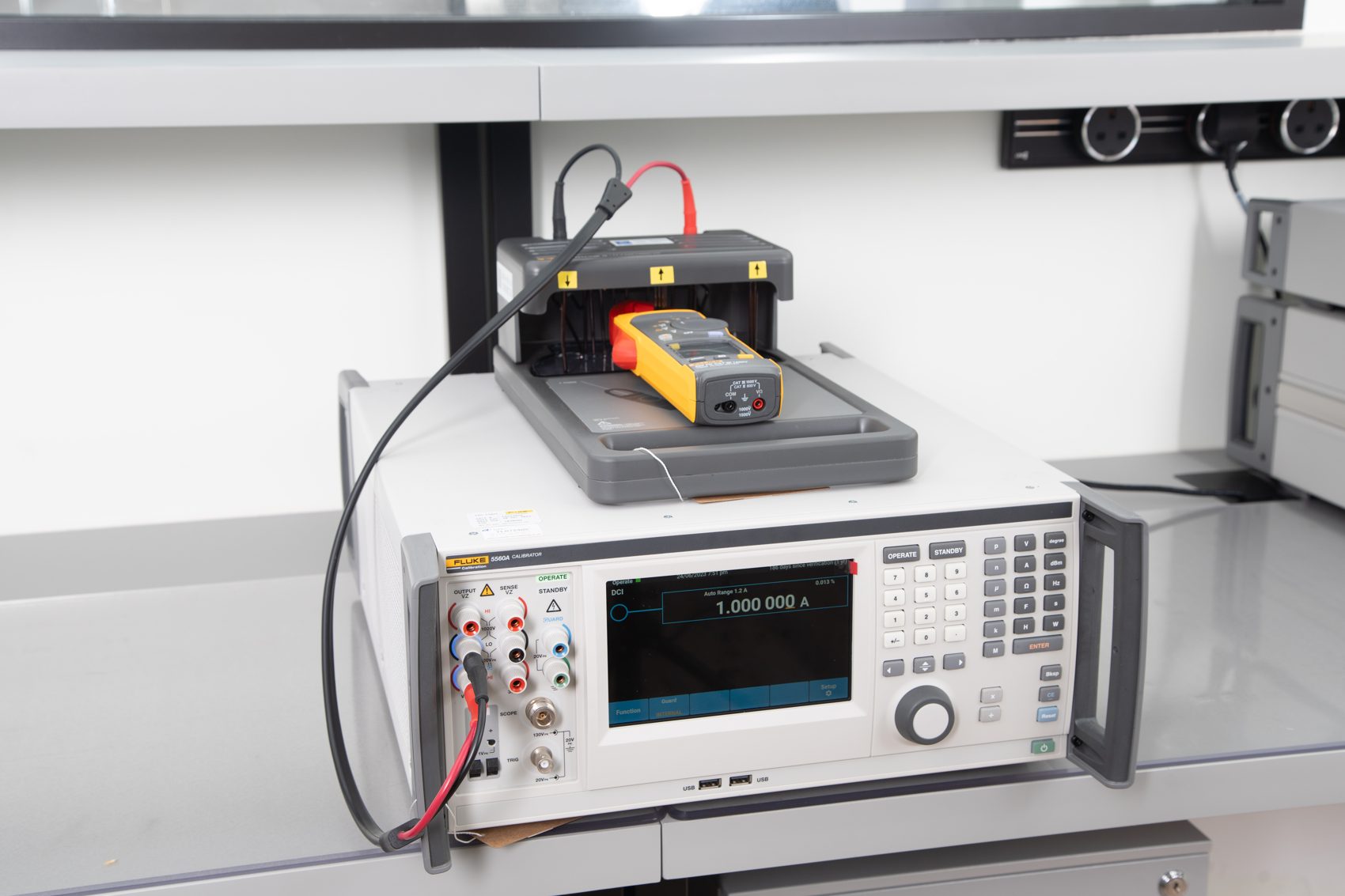
Unitest Instruments holds SAC-SINGLAS accreditation (Acc. No. LA-2023-0845-C) to ISO/IEC 17025, covering anemometer calibration within our accredited scope. Our calibration service for anemometers includes:
- Calibration against traceable reference standards, with traceability to Singapore's NMC
- Full measurement uncertainty analysis per GUM (Guide to the Expression of Uncertainty in Measurement)
- A calibration certificate bearing the SAC-SINGLAS mark, accepted by BCA, NEA, and ISO 9001 auditors
- Same-week turnaround for most instruments
- Calibration-on-purchase option. Your new instrument arrives pre-calibrated and ready to use
Annual recalibration is the standard interval for HVAC anemometers in active use. Instruments subjected to harsh conditions (dusty construction sites, high-temperature plant rooms, or frequent transport), should be checked every six months. If your anemometer is dropped or physically damaged, it should be recalibrated immediately, regardless of when it was last serviced.
How Anemometer Calibration Actually Works
Calibrating a vane or thermal anemometer to ISO/IEC 17025 accreditation requires a wind tunnel or calibrated flow bench capable of generating a stable, known, uniform air velocity across a range of test points spanning the instrument's specified operating range. The reference velocity itself is established using a primary or secondary reference method, commonly a calibrated reference anemometer of substantially better accuracy than the instrument under test, or a precision flow measurement device whose own traceability chain leads back to the National Metrology Centre. The instrument under test is positioned in the airstream at each calibration point, allowed to stabilise, and its reading compared against the wind tunnel's known reference velocity, with the resulting error and measurement uncertainty recorded at each point.
For thermal (hot-wire) anemometers specifically, calibration must also verify performance is consistent at the low end of the velocity range, since this is precisely the operating regime these instruments are specified and purchased for, and a calibration that only tests mid-range and high-range velocities would miss exactly the performance characteristic a cleanroom or fume hood application actually depends on. Vane anemometer calibration similarly needs to confirm accuracy is maintained near the top of the stated range, since impeller-based sensors can show non-linear behaviour as they approach their maximum rated velocity. A calibration certificate that reports results across the full range relevant to your actual application, rather than a single convenient mid-range point, is what gives the certificate genuine value for the specific work you intend to use the instrument for.
Frequently Asked Questions
For most HVAC air balancing tasks, a vane (impeller) anemometer is the best starting point due to its wide velocity range and durability. However, for low-velocity supply grilles, cleanroom commissioning, or fume hood verification, a thermal (hot-wire) anemometer offers the accuracy and sensitivity that vane probes cannot match. Multifunction meters that combine vane sensing with temperature and humidity measurement are ideal for full HVAC commissioning work in Singapore's tropical climate.
Unitest supplies anemometers from Fluke and Amprobe, both available via unitestshop.com. Key models include the Fluke 925 Vane Anemometer, Fluke 923 Compact Vane Anemometer, Amprobe TMA10-A Multifunction Thermo-Anemometer, Amprobe TMAN-10 Anemometer with Datalogger, and Fluke 975 AirMeter. A multifunction instrument measuring air velocity, temperature, humidity, and CO2 in a single device.
Yes. If your anemometer readings are used to meet SS 553 (air-conditioning design), SS 554 (IAQ), BCA Green Mark, or any ISO 9001-audited commissioning report, the instrument must be calibrated by an accredited laboratory. Unitest Instruments holds SAC-SINGLAS accreditation (Acc. No. LA-2023-0845-C) to ISO/IEC 17025, and our calibration certificates are traceable to Singapore's National Metrology Centre. Accepted by BCA, NEA, and ISO auditors.
For most field instruments used in HVAC commissioning and TAB work, annual calibration is the standard interval. High-usage instruments or those used in dusty or high-temperature environments may require six-monthly checks. If an instrument is dropped, repaired, or returns readings inconsistent with reference measurements on a known system, it should be recalibrated immediately regardless of interval. Our article on how often to calibrate your instruments provides a detailed framework for setting your recalibration schedule.
The primary standards are SS 553:2016 (Code of Practice for Air-Conditioning and Mechanical Ventilation in Buildings), SS 554:2009 (Code of Practice for Indoor Air Quality for Air-Conditioned Buildings), and BCA's Green Mark scheme requirements. For healthcare and cleanroom environments, ISO 14644-3 and NEA guidelines impose additional measurement requirements. All these frameworks require traceable, calibrated instrumentation.
Yes. A good vane or thermal anemometer measures air velocity at both supply diffusers and return grilles. For supply grilles with directional airflow, position the probe perpendicular to the airstream at the face of the diffuser, taking multiple readings and averaging them. For return grilles, which draw air from multiple directions, a flow capture hood (or balometer) is more accurate. Some Fluke and Amprobe instruments are designed to work in conjunction with hoods.
Air velocity (m/s or ft/min) is the speed of air at a single point in the duct or at a grille face. Air volume flow rate (L/s or CFM) is the total volume of air moving through a cross-section per unit time. Calculated by multiplying average velocity by the cross-sectional area. Most modern anemometers have a built-in area input function that converts velocity readings to volume flow automatically, which is essential for HVAC balancing and TAB reporting.
A SAC-SINGLAS calibration certificate is issued by a laboratory accredited by the Singapore Accreditation Council under ISO/IEC 17025. It confirms that your anemometer was calibrated against traceable reference standards and that the measurement uncertainty is quantified and documented. For HVAC commissioning reports submitted to BCA, NEA, or under ISO 9001 quality systems, this certificate is the required evidence that your instrument's readings can be trusted, and is increasingly specified by building owners and main contractors in Singapore.
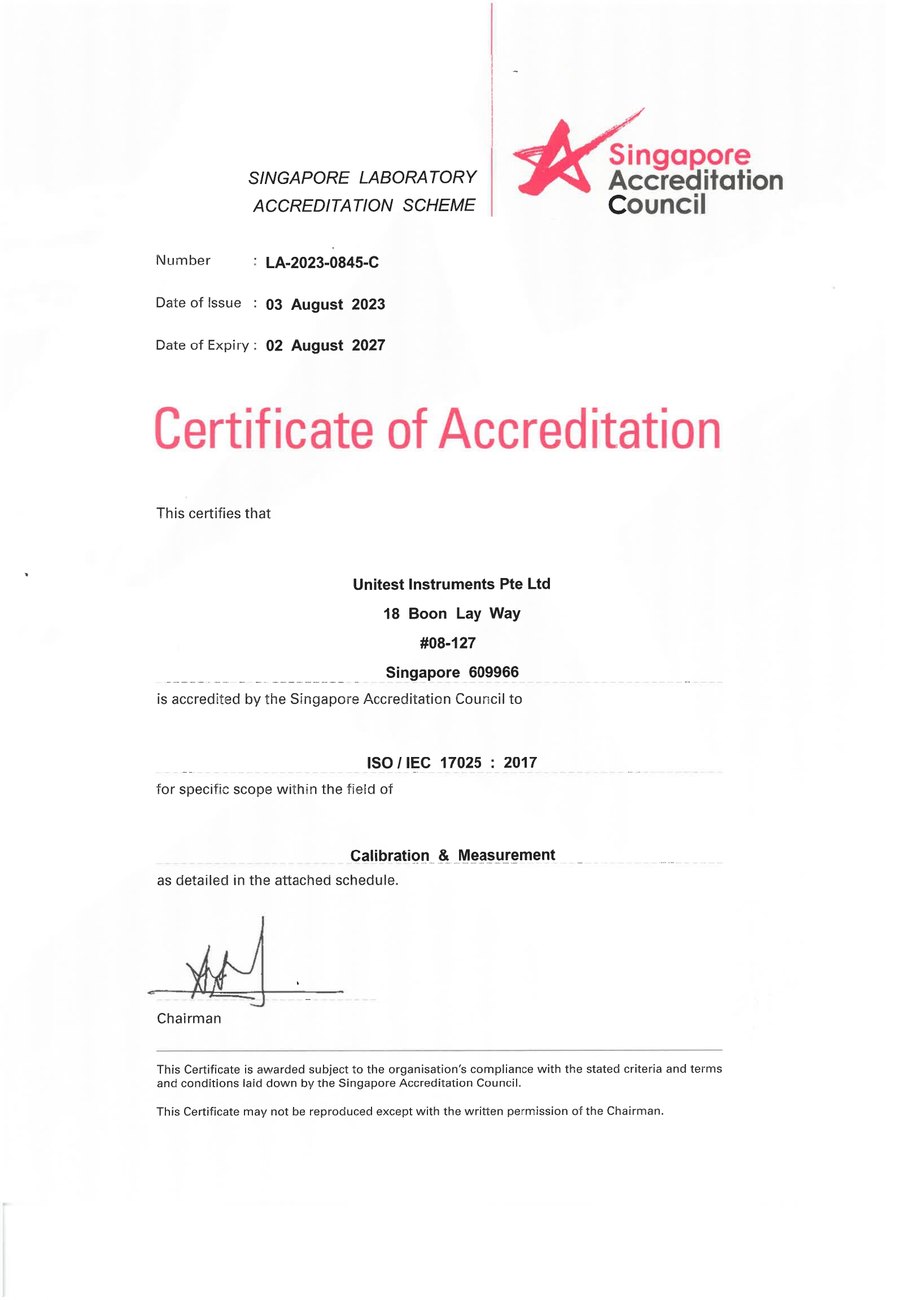
SAC-SINGLAS accredited calibration laboratory (Acc. No. LA-2023-0845-C) serving Singapore's industrial, pharmaceutical, and manufacturing sectors. All content reflects our ISO/IEC 17025 accredited scope and is reviewed by our technical calibration team.
Need anemometer calibration in Singapore?
Unitest Instruments is SAC-SINGLAS accredited (Acc. No. LA-2023-0845-C) to ISO/IEC 17025. Same-week turnaround, certificates accepted by ISO 9001 auditors.