
Key Takeaways
- Sound pressure level (SPL) varies with distance. Doubling the distance from a point source reduces SPL by approximately 6 dB in a free field (inverse-square law).
- Sound power level (SWL) is a fixed property of the source; it does not change with distance, room size, or acoustic conditions.
- Sound level meters (IEC 61672-1) measure SPL; sound power is calculated from multiple SPL readings using ISO 3744, ISO 3745, or ISO 9614.
- Singapore's NEA sets boundary SPL limits: 65 dB(A) daytime, 55 dB(A) nighttime for residential receivers. Instruments must be calibrated to IEC 61672 Class 1 or Class 2.
- A-weighting (dB(A)) approximates human hearing sensitivity and is mandated by MOM for occupational noise at 85 dB(A) Leq over 8 hours.
- Field calibration with an IEC 60942 sound calibrator before and after every measurement session is mandatory for legally defensible data.
Defining the Two Quantities: Physics First
Sound is a mechanical wave. A propagating oscillation of pressure through a medium. When a vibrating surface disturbs the surrounding air, it creates alternating compressions and rarefactions. Sound pressure (symbol p, unit: pascal, Pa) quantifies the instantaneous deviation from ambient atmospheric pressure at any specific point in space. Because human hearing spans an enormous dynamic range (from the threshold of hearing at approximately 20 µPa to the threshold of pain near 200 Pa), engineers use the logarithmic Sound Pressure Level (SPL, symbol Lp):
Lp = 20 · log₁₀ (p / p₀) [dB re 20 µPa]
where p₀ = 20 µPa is the internationally agreed reference pressure (ISO 1683:2015). A normal conversation at 1 m registers roughly 60 dB SPL; a jet engine at 30 m registers approximately 130 dB SPL.
Sound power (symbol W, unit: watt) describes the total acoustic energy radiated by a source in all directions per unit time. It is an intrinsic property. A 5 kW industrial air compressor radiates a fixed acoustic power regardless of whether you measure it in an open field or a reverberant factory floor. The Sound Power Level (SWL, symbol LW) is expressed as:
LW = 10 · log₁₀ (W / W₀) [dB re 10⁻¹² W]
where W₀ = 10⁻¹² W (1 picowatt) is the reference power per ISO 1683. A whisper may have a sound power of about 10⁻⁹ W (30 dB re 1 pW); a large gas turbine can exceed 10⁵ W (170 dB re 1 pW).
The Inverse-Square Law and Why Distance Matters
In a free field (an idealised environment with no reflective surfaces), sound from a point source propagates outward as an expanding sphere. The same fixed total power is spread over a surface area that grows as 4πr². This is the inverse-square law: SPL decreases by 6 dB for every doubling of distance from the source. The relationship between SPL and SWL in a free field is:
Lp = LW − 20 · log₁₀(r) − 11 [for a point source in free field, SI units]
Real environments deviate from free-field conditions. Indoors, reflected sound from walls, floors, and ceilings adds to the direct field, producing a reverberant component that keeps SPL elevated even at large distances. In a fully reverberant (diffuse) room, SPL becomes roughly uniform throughout the space regardless of distance. Only the direct field near the source follows the inverse-square law. This is why SWL, not SPL, is the right metric for specifying machine noise in procurement contracts: a machine rated at 95 dB(A) SWL will produce predictable SPL values in any known acoustic environment once you apply the appropriate room correction.
Measurement Standards and Methods
Measuring Sound Pressure Level. IEC 61672
Sound level meters (SLMs) measure SPL directly. The governing international standard is IEC 61672-1:2013, which defines two accuracy classes:
| Class | Tolerance at 1 kHz | Typical use | Singapore regulatory acceptance |
|---|---|---|---|
| Class 1 | ±0.7 dB | Precision laboratory, legal disputes, reference measurements | Accepted by NEA, MOM, and courts |
| Class 2 | ±1.0 dB | General engineering surveys, occupational noise screening | Accepted by NEA for routine industrial surveys |
IEC 61672-3:2013 specifies the periodic verification protocol. Full electroacoustic testing of frequency response, directional response, linearity, and time-weighting accuracy at an accredited laboratory. For instruments used in regulatory contexts, this verification must be performed by an ISO/IEC 17025 accredited laboratory to ensure metrological traceability. Frequency weightings (A, C, Z) and time weightings (Fast 125 ms, Slow 1 s, Impulse 35/1500 ms) must all be within specification.
Measuring Sound Power Level. ISO 3744, ISO 3745, ISO 9614
Sound power cannot be measured directly with a single instrument. It must be derived from multiple SPL or sound intensity readings taken around the source. Three principal ISO standards define the methods:
| Standard | Method | Environment required | Uncertainty | Best for |
|---|---|---|---|---|
| ISO 3744:2010 | Sound pressure. Free field over reflecting plane | Semi-anechoic or qualified open space | ±1–2 dB (engineering grade) | Most industrial machinery; standard specification |
| ISO 3745:2012 | Sound pressure, anechoic/semi-anechoic | Certified anechoic chamber | <±0.5 dB (precision grade) | R&D, product certification, EU CE marking |
| ISO 9614-1:1993 | Sound intensity scanning | In-situ. No special room needed | ±1–3 dB depending on conditions | Installed machinery, partial power of one source among many |
| ISO 9614-2:1996 | Sound intensity scanning (continuous scan) | In-situ | ±1–2 dB | Faster survey of complex sources |
For in-situ measurements of existing installed plant (common in Singapore's manufacturing and data-centre sectors), ISO 9614 (sound intensity method) is particularly valuable because it does not require a special acoustic environment. A calibrated intensity probe (a matched pair of phase-matched microphones with calibration traceable to IEC 61043) is scanned over a measurement surface enclosing the source, and the net acoustic power flowing outward is integrated over the surface.
Need traceable calibration for your sound level meter or acoustic instruments?
Unitest Instruments calibrates IEC 61672 Class 1 and Class 2 sound level meters, sound calibrators (IEC 60942), and acoustic instrumentation to full ISO/IEC 17025 standards. Certificates are accepted by NEA, MOM, and ISO 9001 auditors.
Calibration: What Must Be Verified and Why
Acoustic instrumentation calibration is not a single act. It operates at two levels that are often confused.
Field Calibration (Pre- and Post-Session)
Before every measurement session, a sound calibrator (also called an acoustic calibrator) conforming to IEC 60942:2017 Class 1 (±0.2 dB) or Class 2 (±0.5 dB) is inserted over the microphone capsule and the SLM reading is verified against the calibrator's nominal level (typically 94 dB SPL at 1 kHz, or 114 dB SPL at 1 kHz for the pistophone variant). If the SLM reads outside ±0.5 dB of the calibrator level, measurements must not proceed until the fault is identified and resolved. This check is documented on the measurement data sheet and is a mandatory requirement under NEA's noise measurement protocols.
Equally important is the post-session check: if the SLM drifts more than 0.5 dB from its pre-session reading by the end of the survey, all data from that session are considered suspect and must be retaken. This two-check regime is required by IEC 61672-1 and is the minimum standard accepted in any regulatory or legal dispute.
Laboratory Calibration (Periodic Verification)
The full periodic verification. Covering frequency response from 10 Hz to 20 kHz, directional response, linearity over dynamic range, time weighting constants, AC and DC outputs, and overload indicators. Must be performed in a qualified acoustic laboratory by a metrologist using reference microphones traceable to national standards. In Singapore, traceability passes through the National Metrology Centre (NMC) at A*STAR, which maintains the Singapore primary acoustic standards. As explained in our guide on what calibration traceability means, an unbroken chain of comparisons from your instrument to NMC is what makes a calibration certificate legally defensible. Unitest Instruments, accredited by SAC-SINGLAS (Acc. No. LA-2023-0845-C), provides this traceable calibration and issues ISO/IEC 17025 certificates for acoustic instruments. For more on what a valid certificate must contain, see our article on reading a calibration certificate.
Singapore Regulatory Context
Environmental Noise. NEA
Singapore's Environmental Protection and Management (Noise Control) Regulations (Cap. 94A) set permissible noise levels in terms of dB(A) SPL at the boundary of noise-generating premises. The prescribed limits depend on the zoning of the receiving premises:
| Receiving zone | Daytime limit (7 am–10 pm) | Nighttime limit (10 pm–7 am) |
|---|---|---|
| Residential | 65 dB(A) | 55 dB(A) |
| Commercial | 70 dB(A) | 65 dB(A) |
| Industrial next to residential | 65 dB(A) | 55 dB(A) |
Measurements are taken at the boundary of the affected premises using A-weighted SPL. The metric used is typically the equivalent continuous A-weighted sound pressure level (Leq) over a defined averaging period, though instantaneous Lmax is also applied in specific circumstances (e.g. impulsive noise from pile driving). All instruments used for NEA submissions must have a valid calibration certificate from an accredited laboratory.
Occupational Noise. MOM and WSH Act
The Workplace Safety and Health (Noise) Regulations require employers to conduct noise risk assessments when workers may be exposed to noise exceeding 85 dB(A) Leq(8h) (the action level), or above a peak of 140 dB(C). The permissible exposure limit is 85 dB(A) Leq over an 8-hour working day. Noise dosimeters and SLMs used for these assessments must comply with IEC 61672 (Class 1 or Class 2) and carry traceable calibration. Dosimeters must additionally comply with IEC 61252:2002. Hearing protection programmes, audiometric testing, and engineering controls (substitution, enclosure, isolation) become mandatory above the action level.
Construction Noise
NEA's Code of Practice on Pollution Control sets construction noise limits: 75 dB(A) on weekdays from 7 am to 6 pm; 60 dB(A) on Sundays and public holidays. Noisy construction works (percussive piling, jackhammering) are prohibited before 7 am and after 10 pm on any day. Contractors must submit noise impact assessments for projects near sensitive receivers (hospitals, schools, residential estates), and these assessments require calibrated measurement equipment.
Common Mistakes in Noise Measurement
1. Comparing SPL Readings from Different Distances
A measurement taken 1 m from a pump (say, 88 dB(A)) cannot be compared with a measurement taken 5 m from another pump (say, 78 dB(A)) without applying distance corrections. The second pump may actually be louder. Always normalise to a standard reference distance (typically 1 m for small equipment, 3 m for larger plant) or compare SWL values instead.
2. Using SPL to Specify Equipment Noise in Contracts
Specifying "the pump shall not exceed 85 dB(A)" in a procurement contract is ambiguous unless the measurement distance, acoustic environment, and background noise level are also specified. The correct approach is to specify maximum SWL per ISO 3744, plus the measurement standard and grade. EU-origin equipment often carries CE-marking SWL data; ensure this matches ISO 3744 or ISO 3745 conditions.
3. Ignoring Background Noise Correction
SPL measurements are always contaminated by ambient background noise. If the background noise (measured with the source off) is within 3–10 dB of the total measurement, a correction must be applied per ISO 3744 Annex A. If the background exceeds the source noise by fewer than 3 dB, measurement is not possible without a special acoustic environment. Many surveys fail NEA scrutiny because background noise corrections were not applied or documented.
4. Neglecting Microphone Wind and Proximity Effects
Outdoor environmental noise measurements require a windscreen (foam ball) on the microphone to suppress turbulence-induced noise. Without a windscreen, wind speeds above approximately 3 m/s can add several dB of spurious reading. For measurements close to hard surfaces, the pressure-doubling effect (approximately +6 dB) must be accounted for or the microphone positioned at least 3.5 m from any reflecting surface other than the ground plane (per ISO 3744 §7.4).
5. Presenting Calibration Certificates Without Uncertainty Statements
An ISO/IEC 17025 calibration certificate for a sound level meter must state the expanded measurement uncertainty (typically expressed at k=2, 95% confidence level). Certificates that report only a pass/fail result or a single reference level without uncertainty are non-compliant with ISO/IEC 17025:2017 clause 7.8. Regulatory bodies and auditors increasingly require the uncertainty to be factored into compliance decisions, a reading of 64.8 dB(A) against a limit of 65 dB(A) is only compliant if the measurement uncertainty is less than 0.2 dB. For a detailed explanation of how uncertainty affects compliance decisions, see our article on measurement uncertainty in calibration.
How Decibels Combine: Why Two Machines Are Not Twice as Loud
One of the most persistent sources of confusion in industrial noise assessment is the assumption that decibel values add arithmetically, that two identical machines each producing 80 dB(A) will together produce 160 dB(A). Because the decibel scale is logarithmic, this is not how acoustic energy combines. Two identical, uncorrelated sound sources combine to produce an increase of only 3 dB over a single source, so two 80 dB(A) machines together produce 83 dB(A), not 160. The correct method for combining sound pressure levels from multiple sources is to convert each level back to linear sound intensity (or pressure-squared), sum the linear values, and convert the sum back to decibels using Ltotal = 10 · log₁₀(Σ 10^(Li/10)). This is not an academic distinction; it directly affects how a facilities manager should think about noise mitigation. Removing one of four identical 80 dB(A) machines from a plant floor reduces the combined level from roughly 86 dB(A) to roughly 84.8 dB(A), a modest gain, while identifying and treating the single loudest source in a mixed group of machines running at different levels typically delivers a far larger reduction, because the combined total is dominated by the loudest individual contributor once the gap between sources exceeds about 10 dB.
This logarithmic addition principle is also why background noise correction, mentioned above, works the way it does: when total measured level and background-only level are close together, the source's actual contribution must be extracted using the same subtractive logarithmic relationship rather than simple subtraction of the dB figures themselves. Facilities teams preparing their own preliminary noise surveys before commissioning a formal ISO 3744 or NEA-compliant assessment benefit from understanding this relationship, since it explains counterintuitive field observations, such as why silencing the loudest of several compressors in a plant room produces a far more noticeable drop in the boundary noise reading than silencing a quieter unit, even if both units are rated at a similar sound power level on their nameplate.
Choosing the Right Sound Power Standard for Your Situation
With four ISO standards available for deriving sound power, the practical choice usually comes down to what facility or equipment you are assessing and what the result needs to be defensible for. New equipment being purchased or specified against a procurement contract should be evaluated using the manufacturer's ISO 3744 (engineering grade, suitable for most industrial machinery) or ISO 3745 (precision grade, typically reserved for R&D, CE marking, and situations requiring the tightest achievable uncertainty) test data, since these standards were designed for controlled, repeatable factory or laboratory testing of a single, removable source. For equipment already installed and operating in situ, such as a chiller, compressor, or generator already integrated into a plant room alongside other running machinery, ISO 9614's sound intensity scanning method is generally the only practical option, because it isolates the sound power of the specific source under test even in the presence of other noise sources nearby, something a simple sound pressure survey cannot do without shutting down every other machine in the room. The trade-off is that ISO 9614 typically carries a wider uncertainty band than a controlled ISO 3744 test, which is worth disclosing explicitly when the resulting sound power figure feeds into a contractual noise guarantee or a boundary compliance prediction, so that all parties understand the margin built into the number.
Frequently Asked Questions
Sound pressure (Pa) is the dynamic variation in atmospheric pressure at a specific measurement point caused by a sound wave. It depends on the distance from the source and the acoustic environment. Sound power (W) is the total acoustic energy emitted by a source per second. A fixed property of the source itself, independent of distance or room conditions. A nearby quiet fan may read louder on an SPL meter than a distant industrial compressor, even though the compressor radiates far more acoustic power.
Both are expressed in decibels (dB) but referenced to different base quantities. Sound Pressure Level (SPL) uses the reference pressure p₀ = 20 µPa (the threshold of human hearing at 1 kHz). Sound Power Level (SWL or LW) uses the reference power W₀ = 10⁻¹² W (1 picowatt). A machine with an SWL of 90 dB re 1 pW will typically produce an SPL of around 70–80 dB(A) at 1 metre in a free field. The difference accounts for geometric spreading and the measurement environment.
Sound level meters used for regulatory noise measurement in Singapore must comply with IEC 61672-1:2013 (Class 1 for precision work, Class 2 for general industrial surveys). Calibration is performed against a reference sound calibrator specified in IEC 60942:2017. The National Environment Agency (NEA) requires that noise measurements submitted for industrial or construction noise complaints use calibrated instruments, and SAC-SINGLAS accredited laboratories such as Unitest Instruments (Acc. No. LA-2023-0845-C) provide traceable calibration certificates accepted by NEA and ISO 9001 auditors.
Sound power level is determined indirectly from multiple sound pressure measurements taken around a source. The principal international methods are: ISO 3744 (free-field over a reflecting plane (the most common engineering method), ISO 3745 (anechoic or semi-anechoic chambers), precision grade), and ISO 9614-1/2 (sound intensity scanning. Suitable for in-situ measurement of machinery without a special acoustic environment). Each method has defined measurement uncertainty bands: ISO 3744 achieves ±1 to 2 dB; ISO 3745 can achieve better than ±0.5 dB under controlled conditions.
Under Singapore's Environmental Protection and Management (Noise Control) Regulations, permissible noise levels at the boundary of industrial premises are: 65 dB(A) during daytime (7 am–10 pm) and 55 dB(A) during nighttime (10 pm–7 am) for residential-zoned receivers. Construction noise limits are 75 dB(A) on weekdays (7 am–6 pm), lower on Sundays and public holidays. All boundary measurements must be made with a Class 1 or Class 2 IEC 61672-compliant sound level meter that has a valid calibration certificate from an accredited laboratory.
Sound power is an intrinsic property of the acoustic source. The total energy it radiates per second. As sound propagates outward, the same energy is spread over an increasingly large spherical surface area (which grows as the square of the distance). This is the inverse-square law: doubling the distance from a point source reduces SPL by approximately 6 dB in a free field. Sound power level remains constant regardless of measurement position, which is why it is the correct metric for comparing machines and specifying equipment noise in procurement contracts.
IEC 61672-3:2013 recommends periodic verification at intervals not exceeding two years for Class 1 instruments and annually for instruments used in regulatory or legal contexts. Singapore's NEA and most ISO 9001 quality systems require annual calibration. Best practice is to perform a field calibration check using an IEC 60942-compliant sound calibrator at the start and end of every measurement session; any deviation greater than 0.5 dB invalidates the session's data. The formal traceable calibration certificate from an SAC-SINGLAS accredited laboratory documents the instrument's full electroacoustic performance across its frequency range.
A-weighting (denoted dB(A)) is a frequency-dependent filter applied to sound pressure level measurements to approximate the human ear's varying sensitivity across the audible spectrum. The human ear is most sensitive around 2–5 kHz and less sensitive at very low and very high frequencies. The A-weighting network, defined in IEC 61672-1, attenuates frequencies below about 500 Hz and above 10 kHz. Most occupational health regulations (including Singapore's WSH Act noise exposure limits of 85 dB(A) Leq over 8 hours), and environmental noise limits specify A-weighted levels. C-weighting is used when low-frequency content is important, such as assessing machinery with dominant low-frequency tones.
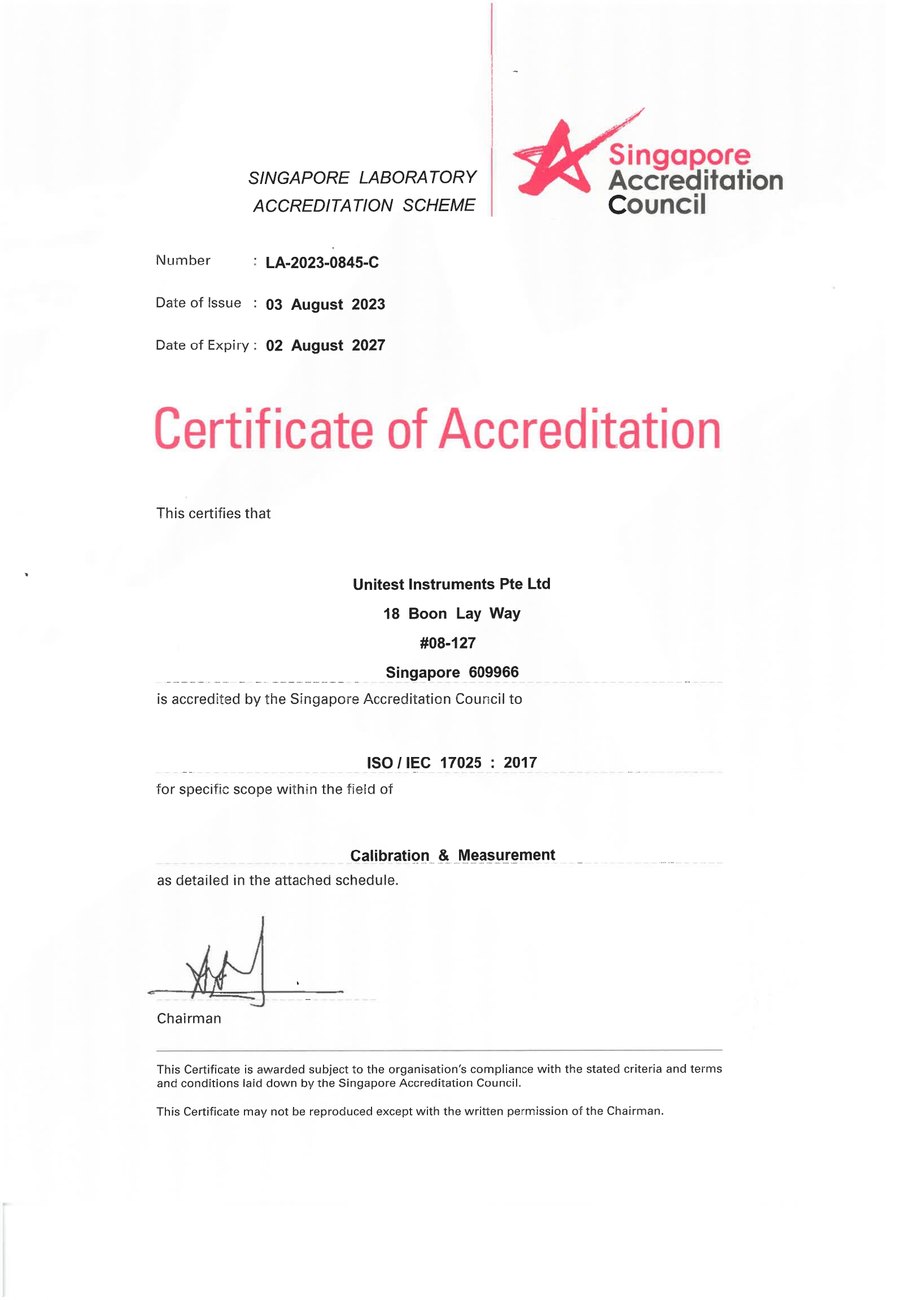
SAC-SINGLAS accredited calibration laboratory (Acc. No. LA-2023-0845-C) serving Singapore's industrial, pharmaceutical, and manufacturing sectors. All content reflects our ISO/IEC 17025 accredited scope and is reviewed by our technical calibration team.
Need acoustic instrument calibration in Singapore?
Unitest Instruments is SAC-SINGLAS accredited (Acc. No. LA-2023-0845-C) to ISO/IEC 17025. We calibrate IEC 61672 sound level meters and IEC 60942 sound calibrators with same-week turnaround. Certificates accepted by NEA, MOM, and ISO 9001 auditors.