
Key Takeaways
- SFA's Environmental Public Health (Food Hygiene) Regulations require chilled food at ≤4°C and hot food at ≥60°C. Your thermometer accuracy must give you sufficient margin to prove compliance.
- For HACCP critical control points, select a thermometer with ±0.5°C accuracy or better; ±0.3°C is recommended for export-facing food manufacturers.
- A SAC-SINGLAS accredited calibration certificate (traceable to NMC Singapore) is the recognised standard of evidence for SFA, ISO 22000, and FSSC 22000 audits in Singapore.
- Probe (contact) thermometers are mandatory for core temperature verification; infrared thermometers are a useful supplement for surface screening only.
- Calibrate food thermometers at least annually, and every six months for instruments in heavy daily use in a central kitchen environment.
Who Needs a Food Thermometer, and Why It Matters in Singapore
Temperature is the single most critical control variable in food safety. Singapore's Food Agency (SFA) enforces the Environmental Public Health (Food Hygiene) Regulations, which specify temperature limits for storage, cooking, holding, and display of food. Any F&B operator (from a hawker centre stall to a 10-tonne-per-day central production kitchen), must demonstrate that food passes through the temperature danger zone (4°C to 60°C) as quickly as possible and is held at safe temperatures at all times.
For central kitchens supplying multiple outlets, hospitals, schools, or airlines, the stakes are even higher. A single temperature excursion that goes unrecorded can trigger a food safety incident affecting hundreds of end consumers. HACCP-certified operations must identify critical control points (CCPs), set critical limits, and maintain records of continuous monitoring, and the instrument doing that monitoring needs a traceable calibration certificate to back it up in an audit.
The good news: modern food thermometers from brands like Comark, Fluke, and Amprobe are purpose-built for these environments, and getting a SAC-SINGLAS accredited calibration certificate in Singapore is straightforward through a lab like Unitest Instruments.
What to Look For: Key Specifications Explained
Before comparing models, it helps to understand which specifications actually matter in a Singapore F&B context, and which are marketing noise.
Temperature Range
Most food safety applications in Singapore require coverage from at least -25°C (blast freezer verification) to +200°C (oil and cooking surface checks). A range of -40°C to +200°C gives you headroom for every application from frozen storage to wok verification without switching instruments.
Accuracy and Resolution
Accuracy is what the instrument reads versus the true value; resolution is the smallest change it can display. For SFA compliance, ±0.5°C accuracy is the practical minimum. For HACCP CCPs and ISO 22000 or FSSC 22000 certification, many auditors look for ±0.3°C or better. Resolution of 0.1°C is standard across all recommended models.
Ingress Protection (IP) Rating
Commercial kitchen environments involve steam, water spray, and cleaning chemicals. Look for IP54 (splash-proof) at a minimum; IP65 or better for central kitchens with high-pressure wash-down cleaning. Many Comark models carry IP65, making them suitable even for the most demanding production environments.
Response Time
A slow thermometer creates workflow friction and encourages staff to skip checks. Aim for a response time under 5 seconds to a stable reading. The best probes achieve 2–3 seconds, which matters when you are checking 50 trays of cooked food leaving a production line.
Data Logging and HACCP Integration
For large central kitchens, thermometers with Bluetooth data logging (such as the Comark RF312 system) allow automatic upload of temperature records to a HACCP software platform, removing manual transcription errors and creating an audit-ready digital trail. Smaller operations can use a simple paper log and a basic thermometer, but the instrument must still have a current calibration certificate.
Model Comparison: Top Food Thermometers Available in Singapore
The following models are stocked or orderable through Unitest and its distribution network. All are available with SAC-SINGLAS accredited calibration at the point of purchase. Meaning you receive a traceable certificate alongside your instrument, ready for your first SFA or HACCP audit.
| Model | Range | Accuracy | IP Rating | Best For | Price Range (SGD) |
|---|---|---|---|---|---|
| Comark KM28/P6 | -40°C to +200°C | ±0.4°C | IP65 | Central kitchens, hawker centres, daily probe use | $180–$260 |
| Comark C9899/P1 | -50°C to +150°C | ±0.3°C | IP54 | Cold-room and chilled-display monitoring, QA labs | $240–$340 |
| Fluke 52 II | -200°C to +1372°C | ±0.05°C (type T/J) | IP40 | Food manufacturing QA, process validation, lab use | $480–$620 |
| Fluke 54 II | -200°C to +1372°C | ±0.05°C (dual input) | IP40 | Cold-room commissioning, blast-chiller validation, dual-channel logging | $680–$820 |
| Amprobe TR300 | -50°C to +200°C | ±0.5°C | IP54 | Small F&B outlets, budget-conscious operators needing calibrated instruments | $120–$180 |
Deep Dive: The Three Models That Matter Most for Singapore F&B
Comark KM28/P6. Best Overall for Central Kitchens
The Comark KM28 paired with the P6 penetration probe is the workhorse recommendation for Singapore central kitchens and mid-to-large F&B operators. The P6 probe is a 135mm stainless-steel needle probe rated for continuous immersion, making it ideal for checking the core temperature of cooked rice, soups, meat batches, and chilled products leaving a blast chiller. The IP65 body means it survives the steam and spray of a busy production kitchen without failing mid-shift.
The ±0.4°C accuracy places it comfortably within SFA's tolerance requirements and satisfies most HACCP plans for Singapore operations. The large digit display is readable with wet gloves. A seemingly minor point that becomes significant when staff are checking temperatures every 15 minutes across a production shift. Unitest stocks the KM28 with a range of interchangeable Comark probes, including surface probes for hotplate verification and air probes for chilled cabinet monitoring.
Browse the Comark range at unitestshop.com and select your probe combination based on your primary application.
Fluke 54 II. Best for Food Manufacturing QA and Validation
When a central kitchen or food manufacturer needs to commission a new blast chiller, validate an autoclave cycle, or produce temperature mapping data for a regulatory submission, the Fluke 54 II is the instrument of choice. Its dual-channel input allows simultaneous measurement of two points (for example, the inlet and outlet temperatures of a pasteurisation unit), and its ±0.05°C accuracy provides the resolution needed to detect gradients that a standard food thermometer would miss entirely.
The Fluke 54 II is less suited to routine floor-level temperature checks due to its form factor and price point, but for QA laboratories, R&D kitchens, and facilities seeking IFS Food or BRCGS certification, it provides the measurement confidence required. Unitest Instruments provides full SAC-SINGLAS accredited calibration for the Fluke 54 II against our traceable reference standards.
Amprobe TR300. Best Budget Option for Small Operators
Not every F&B operator needs a premium instrument. For a single-outlet restaurant, a hawker stall with a few temperature monitoring points, or a catering company completing its first HACCP plan, the Amprobe TR300 delivers reliable ±0.5°C performance at an accessible price. Its IP54 splash rating is sufficient for restaurant use (though not suitable for central kitchen wash-down environments), and the compact form factor fits easily in a chef's jacket pocket.
The TR300 is available through unitestshop.com with an optional SAC-SINGLAS calibration certificate. Strongly recommended even for small operators, as SFA inspectors increasingly ask to see calibration evidence for monitoring instruments regardless of business size.
Get a Calibration Certificate for Your Food Thermometer
Unitest Instruments provides SAC-SINGLAS accredited temperature calibration with same-week turnaround. Send in any food thermometer or probe sensor and receive a traceable certificate accepted by SFA-aligned HACCP auditors across Singapore.
Singapore Compliance Context: SFA, HACCP, and What Auditors Check
Singapore's food safety regulatory framework is multi-layered. At the base level, SFA enforces the Environmental Public Health (Food Hygiene) Regulations, which require licensed food businesses to maintain food at safe temperatures and to have documented temperature monitoring procedures. For central kitchens, food caterers supplying institutions, and food manufacturers exporting to regulated markets, the requirements are more rigorous: HACCP certification under the SS 444:2018 standard (the Singapore Standard for HACCP) is either mandatory or strongly incentivised.
When a HACCP auditor or SFA inspector reviews your temperature monitoring records, they will typically check three things: (1) that your monitoring instrument is appropriate for the range and accuracy required by your CCP; (2) that it has been calibrated within the past 12 months by a recognised laboratory; and (3) that the calibration certificate references a national metrological standard. In Singapore, this means traceability to the National Metrology Centre (NMC). A SAC-SINGLAS accredited calibration certificate (such as those issued by Unitest Instruments under Acc. No. LA-2023-0845-C), satisfies all three requirements and is the most efficient way to close this audit gap.
For food manufacturers seeking FSSC 22000 or BRC Global Standards certification for export to the EU, UK, or ASEAN markets, the requirements are largely the same, with the additional expectation that calibration records are retained for a minimum of three years and that out-of-calibration events are investigated and documented. Our article on how to read a calibration certificate explains what each field on your certificate means and how to store records for audit purposes.
It is also worth noting that Singapore's SS ISO 22000:2018 standard (the Food Safety Management Systems standard increasingly adopted by local food manufacturers), explicitly requires that monitoring and measuring equipment be calibrated or verified at specified intervals against measurement standards traceable to international or national standards. This is the same requirement that drives calibration needs across pharmaceutical, semiconductor, and aerospace sectors: food safety is not exempt.
The Calibration Imperative: Why Buying Is Only Half the Job
A food thermometer that reads 2°C higher than the true value is not just a metrological inconvenience. It is a food safety risk. If your instrument reads 62°C when the food is actually at 60°C, you may mistakenly clear a batch that has not reached the minimum cooking temperature. Conversely, an instrument reading 2°C lower than the truth may lead you to discard safe product unnecessarily, inflating waste costs.
The practical solution is straightforward: buy from a supplier who can provide a calibration certificate at point of sale, and establish a documented calibration interval. For central kitchens, we recommend a 12-month calibration cycle as a baseline, with six-month checks for instruments in high-frequency daily use. If an instrument is dropped, exposed to a temperature shock, or produces a reading that seems inconsistent with expectation, treat it as out of calibration and send it for immediate re-calibration before using it at any CCP.
Understanding what "traceable calibration" actually means is important for operators who want to respond confidently to auditor questions. Our guide on accredited versus non-accredited calibration explains the difference between a SAC-SINGLAS certificate and the cheaper "calibration services" offered by some equipment dealers, and why the distinction matters when your food safety management system is under review.
Buying Checklist: Before You Purchase
Use this checklist when evaluating any food thermometer for Singapore F&B use:
- Temperature range: covers your coldest application (blast freezer, typically -30°C to -40°C) and hottest (oil or wok surface, typically up to +200°C).
- Accuracy: ±0.5°C minimum; ±0.3°C for HACCP CCPs and ISO 22000 certification.
- IP rating: IP54 minimum for restaurant use; IP65 for central kitchen wash-down environments.
- Probe type: penetration probe for core temperature; surface probe for hotplate or wok checks; air probe for chilled cabinet monitoring. Many operators need more than one probe type.
- Response time: under 5 seconds to a stable reading.
- Calibration certificate: SAC-SINGLAS accredited, traceable to NMC Singapore, dated within the past 12 months.
- Probe replacement and service: confirm that replacement probes and local service support are available. Comark and Fluke both have active service networks supported through Unitest in Singapore.
Matching Probe Type to Critical Control Point
A common mistake in Singapore central kitchens is buying one thermometer with one general-purpose probe and using it across every CCP in the kitchen, from checking core temperature in a stockpot to verifying a chilled display case. Each application actually calls for a different probe geometry, and using the wrong one either damages the probe or produces a reading that does not reflect the true critical point.
Penetration probes (thin needle probes like the Comark P6) are designed to be inserted into the thickest part of a solid food item, meat, poultry, or a dense batch of rice, and are the correct choice for verifying core cooking temperature at the "danger zone" CCP. Immersion probes, with a slightly blunter tip and often a longer stem, are built for liquids: soups, sauces, and hot-holding wells, where a needle probe's thin tip can bend or where the reading needs to reflect the bulk liquid rather than a single insertion point. Surface probes, flat-faced or angled to sit flush against a hotplate, griddle, or wok surface, measure conduction temperature rather than air or core temperature, which is the correct measurement for verifying that a cooking surface has reached its target before food is placed on it. Air probes, typically a fine wire thermocouple suspended rather than inserted, are the right tool for chilled display cabinets and cold rooms, where inserting a penetration probe into packaged product is either impossible or would compromise the packaging.
Using an immersion probe to check a chilled cabinet's air temperature, or a surface probe to check core temperature in a chicken breast, will produce a reading, but it will not be the reading your HACCP plan actually needs at that CCP, and an auditor who understands probe geometry will flag the mismatch even if the instrument itself is correctly calibrated. Central kitchens running multiple CCP types are almost always better served by one base thermometer unit (such as the Comark KM28) with a small kit of interchangeable, correctly matched probes, rather than several different standalone thermometers.
Probe Hygiene and Cross-Contamination Control
A temperature probe that moves between raw and cooked product without cleaning is a direct cross-contamination vector, and this is a finding SFA inspectors and HACCP auditors specifically look for during a kitchen walk-through, independent of whether the instrument itself is in calibration. The practical control is a probe wipe protocol using food-safe alcohol sanitising wipes between every single use, not just between different food types, since even moving from one batch of the same raw product to another can transfer bacterial load onto the next surface the probe touches.
For central kitchens processing high volumes of raw protein, many operators in Singapore maintain colour-coded probes or colour-coded wipes matched to a colour-coded chopping board system (a common convention: red for raw meat, blue for raw seafood, green for ready-to-eat and vegetables), reducing the chance of a probe being used across categories by mistake during a busy shift. Whichever system you adopt, document it in your HACCP plan's prerequisite programme (rather than treating it as an informal habit), because auditors increasingly ask to see the written cleaning and sanitising procedure for temperature probes specifically, not just for general kitchen equipment. Comark and Fluke probes with a smooth, fully sealed stainless-steel stem (rather than a crimped or textured joint where the probe meets the handle) are easier to sanitise thoroughly and are worth the modest price premium over probes with visible seams near the tip.
Frequently Asked Questions
Singapore Food Agency (SFA) and the Environmental Public Health (Food Hygiene) Regulations require food to be stored and served at specified temperatures, for example, chilled food at or below 4°C and hot food at or above 60°C. Your thermometer should have an accuracy of at least ±0.5°C to provide sufficient margin for compliance. For critical control points in a HACCP plan, ±0.3°C or better is recommended. All thermometers used in critical monitoring should carry a current, SAC-SINGLAS accredited calibration certificate.
For F&B and central kitchen operations, food thermometers should be calibrated at least once every 12 months under normal use. Instruments subjected to frequent drops, temperature shocks, or heavy daily use in a central kitchen environment should be calibrated every six months. ISO 22000 and HACCP auditors in Singapore typically expect to see a current calibration certificate (dated within the past 12 months) and a documented calibration interval policy. See our full guide on calibration intervals for more detail.
A probe (contact) thermometer physically inserts into food to measure the core temperature. Essential for verifying that the centre of a roast, a batch of rice, or a soup has reached a safe temperature. An infrared (non-contact) thermometer measures surface temperature only and is faster, more hygienic for quick checks, but cannot confirm core temperature. Most SFA-aligned HACCP plans require core temperature verification at critical control points, so a calibrated probe thermometer is mandatory; an infrared unit may supplement it for rapid surface screening.
The Comark KM28/P6 is the most popular choice for central kitchens in Singapore. It offers a -40°C to +200°C range, ±0.4°C accuracy, and a stainless-steel penetration probe that survives the rigorous wash-down environments typical in large central kitchens. The KM28 series also supports data logging via Bluetooth on select variants, which is useful for automated HACCP record-keeping. All Comark units sold through Unitest are available with SAC-SINGLAS accredited calibration certificates.
If your thermometer is used at a critical control point in your HACCP plan, SFA and ISO 22000 auditors will expect documentary evidence that it is metrologically traceable. A SAC-SINGLAS accredited calibration certificate (issued by a lab like Unitest Instruments, Acc. No. LA-2023-0845-C) provides traceability to Singapore's national measurement standards held at the National Metrology Centre (NMC). This is the recognised standard of evidence for audits in Singapore and export markets. Non-accredited 'calibration' reports do not provide the same level of assurance.
Fluke precision thermometers such as the Fluke 52 II and Fluke 54 II are widely used in food manufacturing QA laboratories and cold-chain validation because of their ±0.05°C accuracy and dual-input capability. They are less commonly used for routine kitchen floor checks (their rugged but less compact form factor suits lab/QA roles), but they are ideal for commissioning cold rooms, blast chillers, and process ovens. Unitest stocks Fluke thermometers and provides SAC-SINGLAS calibration for them.
For a hawker centre, restaurant, or small F&B outlet, prioritise: (1) a measurement range covering at least -40°C to +200°C; (2) accuracy of ±0.5°C or better; (3) IP54 or better ingress protection for splashes and steam; (4) a stainless-steel, food-safe probe that is easy to sanitise; (5) fast response time (under 5 seconds); and (6) a certificate of calibration. You do not need Bluetooth or data logging for a small operation, but these become valuable once you have three or more temperature monitoring points to manage.
Unitest Instruments (SAC-SINGLAS Acc. No. LA-2023-0845-C) provides accredited temperature calibration in Singapore with same-week turnaround for most food thermometers and probe sensors. Our calibration certificates are traceable to NMC Singapore and are accepted by SFA-aligned HACCP auditors, ISO 22000 certifiers, and export-market regulatory bodies. Contact us for a quote or send your instrument in for calibration.
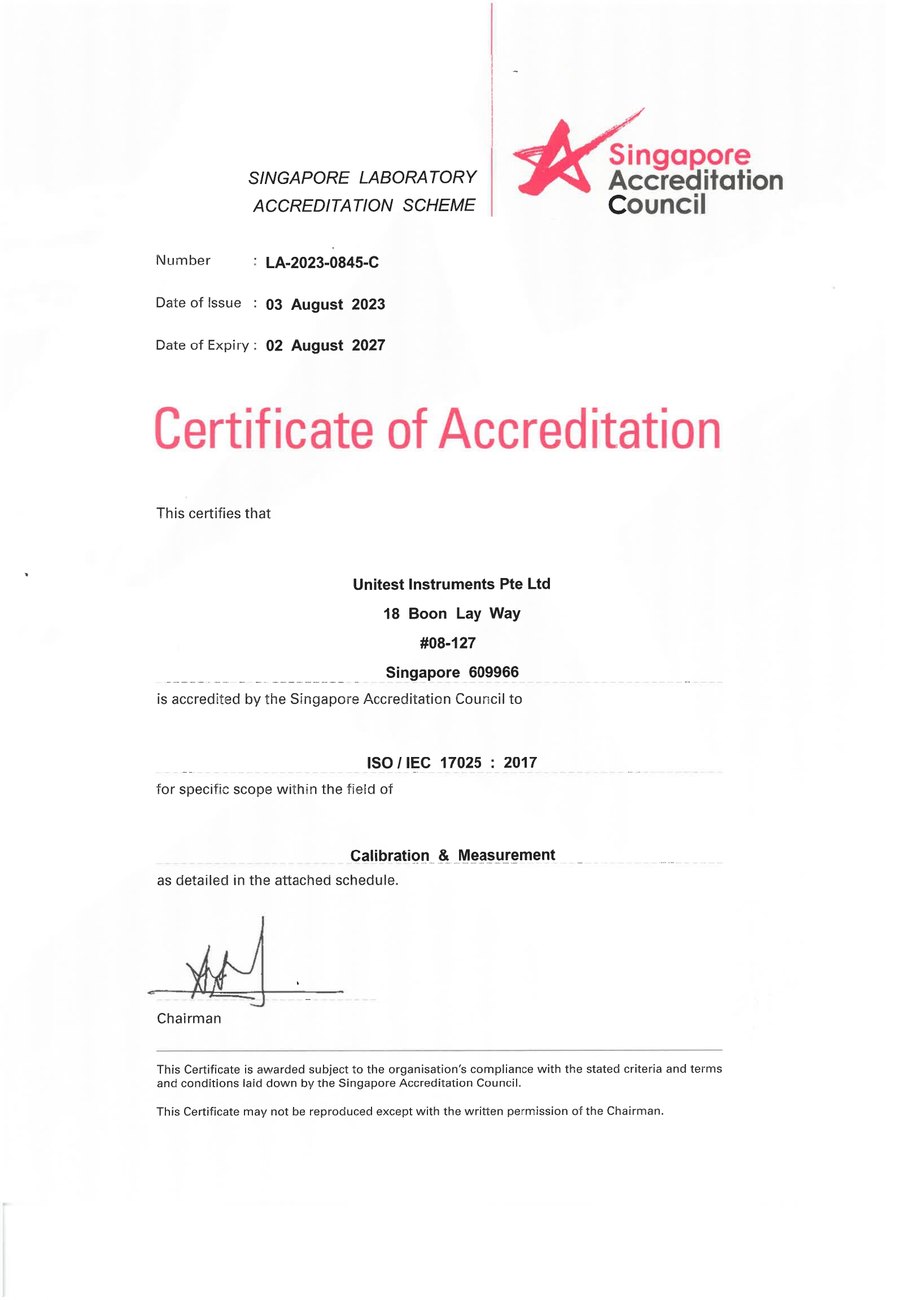
SAC-SINGLAS accredited calibration laboratory (Acc. No. LA-2023-0845-C) serving Singapore's industrial, pharmaceutical, and manufacturing sectors. All content reflects our ISO/IEC 17025 accredited scope and is reviewed by our technical calibration team.
Need food thermometer calibration in Singapore?
Unitest Instruments is SAC-SINGLAS accredited (Acc. No. LA-2023-0845-C) to ISO/IEC 17025. Same-week turnaround, certificates accepted by ISO 9001 and HACCP auditors.