
Key Takeaways
- Catalytic sensors combust the target gas on a heated platinum bead; infrared sensors measure light absorption, no chemical reaction occurs.
- Infrared sensors cannot detect hydrogen (H₂) or other homonuclear diatomic gases; catalytic sensors detect hydrogen effectively.
- Catalytic sensors can be permanently and silently poisoned by silicone compounds, tetraethyl lead, and chlorinated hydrocarbons.
- Infrared sensors offer superior long-term stability and are preferred for methane and hydrocarbon monitoring over multi-year deployments.
- Singapore's WSH (Confined Spaces) Regulations and SS 510 require calibration with traceable reference gas; SAC-SINGLAS accredited calibration certificates satisfy MOM inspector requirements.
The Two Dominant Technologies in Gas Detection
Industrial gas detection relies on two fundamentally different physical principles: catalytic combustion and optical absorption. Each principle has shaped a distinct sensor technology (the catalytic bead (pellistor) and the non-dispersive infrared (NDIR) detector), that have coexisted in safety instrumentation for over 60 years. Understanding how each works at the physics level is not merely academic: it directly determines which gases a sensor can and cannot see, how it ages, what contaminants will disable it, and how it must be calibrated to remain compliant under Singapore's Workplace Safety and Health regulations.
The global market for fixed gas detection equipment exceeded USD 1.8 billion in 2023, with catalytic bead and infrared sensors accounting for the largest share of combustible gas detection installations. Both technologies are governed by IEC 60079-29-1 (performance requirements for flammable gas detectors) and IEC 60079-29-4 (open-path systems), and both require periodic calibration with certified reference gas mixtures traceable to national measurement standards. The calibration standard applicable to the laboratory performing that calibration is ISO/IEC 17025, the international standard for testing and calibration laboratory competence.
How Catalytic Bead Sensors Work: The Physics of Pellistors
A catalytic bead sensor (often called a pellistor, from "pellet resistor"), consists of two platinum wire coils embedded in alumina beads. One bead, the active element, is coated with a platinum or palladium catalyst. The second bead, the compensator or reference element, is uncoated. Both are electrically heated to approximately 450–550 °C and connected as adjacent arms of a Wheatstone bridge circuit.
When a combustible gas reaches the active bead, it oxidises (burns) on the catalyst surface in the reaction: CH₄ + 2O₂ → CO₂ + 2H₂O + heat. The heat of combustion raises the active bead's temperature, increasing its resistance. The imbalance between the active and compensator arms of the bridge generates a millivolt-level output signal proportional to gas concentration, expressed as a percentage of the Lower Explosive Limit (% LEL). The LEL of methane in air, for reference, is 5% by volume; a reading of 50% LEL therefore corresponds to 2.5% methane by volume.
The compensator bead serves a dual purpose: it compensates for ambient temperature and humidity changes that would otherwise cause the bridge to drift, and it provides a baseline resistance that cancels common-mode electrical noise. The circuit's output is zero in clean air and rises linearly with gas concentration up to approximately 100% LEL.
Oxygen Dependency. A Critical Limitation
Because the detection mechanism requires combustion, catalytic bead sensors are fundamentally dependent on the presence of oxygen in the sample atmosphere. Below approximately 10% oxygen by volume, the sensor response becomes non-linear and attenuates significantly. In oxygen-depleted atmospheres (a common feature of confined spaces where displacement by inert gas or oxygen consumption has occurred), a catalytic bead sensor may indicate zero or sub-scale gas concentration even when explosive concentrations are present. This is a well-documented failure mode and is one reason SS 510 (Code of Practice for Work in Confined Spaces) requires multi-gas instruments that measure oxygen concentration simultaneously with flammable gas.
How Infrared Sensors Work: NDIR Spectroscopy
Non-dispersive infrared (NDIR) sensors exploit a fundamental property of molecular physics: polyatomic gas molecules with asymmetric charge distributions absorb infrared radiation at characteristic vibrational frequencies. The C–H stretching bond in methane absorbs strongly near 3.3 µm; CO₂ absorbs near 4.26 µm; carbon monoxide near 4.67 µm. Each gas has a unique infrared "fingerprint" defined by its molecular structure.
An NDIR sensor consists of an infrared source (typically a broadband incandescent filament or a pulsed solid-state emitter), an optical sample cell through which the gas sample passes, one or more narrowband optical filters to isolate the target wavelength, and a pyroelectric or thermopile detector. A reference channel at a nearby non-absorbing wavelength compensates for source aging, window fouling, and detector drift. The ratio of the active-channel signal to the reference-channel signal provides a measurement immune to those common drift sources. This dual-beam ratio technique is the principal reason infrared sensors exhibit better long-term stability than catalytic bead sensors.
Critically, no chemical reaction occurs during measurement. The gas passes through the optical cell unchanged. This means infrared sensors can operate in oxygen-depleted or oxygen-free atmospheres without any degradation in performance, and there is no catalyst to poison or consume.
The Hydrogen Blind Spot
The most important limitation of infrared detection follows directly from molecular physics: homonuclear diatomic molecules (H₂, N₂, O₂, Cl₂), are infrared-inactive. Their symmetric vibrations produce no change in electric dipole moment and therefore generate no infrared absorption band. A standard NDIR sensor is completely blind to hydrogen gas, regardless of its concentration. In any facility where hydrogen is present (electrochemical processes, fuel cell installations, battery charging rooms, hydrogen generation or dispensing), a catalytic bead sensor or an electrochemical sensor must be used for flammable gas detection. Relying on an infrared sensor in a hydrogen atmosphere is a critical safety error.
Gas Sensor Calibration in Singapore. Traceable, Certified, MOM-Compliant
Unitest Instruments calibrates catalytic bead and infrared gas detectors with certified reference gas mixtures traceable to Singapore's NMC. SAC-SINGLAS accredited certificates (Acc. No. LA-2023-0845-C) accepted by MOM inspectors and ISO 9001 auditors. Same-week turnaround available.
Head-to-Head Comparison: Key Performance Parameters
The table below summarises the most important operational differences between the two technologies. These figures are representative of typical commercial instruments; actual specifications vary by manufacturer and model.
| Parameter | Catalytic Bead (Pellistor) | Infrared (NDIR) |
|---|---|---|
| Detection principle | Catalytic combustion; measures heat of reaction | Optical absorption at characteristic IR wavelength |
| Target gases | Most combustible gases including H₂; not CO₂ or inert gases | Polyatomic gases (CH₄, CO, CO₂, propane, etc.); not H₂ or O₂ |
| Measurement range | 0–100% LEL | 0–100% LEL or 0–100% volume (high-range variants) |
| Typical accuracy | ±1–3% FSD (full-scale deflection) | ±1–2% FSD |
| T90 response time | 10–30 seconds | 5–15 seconds (point); <3 s (open-path) |
| Oxygen dependency | Yes, under-reads below ~10% O₂ | None |
| Poisoning risk | High. Silicones, lead, chlorinated compounds | None. Optical, no catalyst |
| Long-term stability | Moderate. Catalyst ages; requires frequent calibration | High. Dual-beam ratio compensates for source/detector drift |
| Typical sensor lifespan | 2–5 years (environment-dependent) | 5–10 years or more |
| Typical unit cost | Lower (sensor element) | Higher (optical components) |
| High-concentration behaviour | Reads zero above ~100% LEL (reversal effect) | Reads correctly up to 100% volume in high-range versions |
| Governing standard | IEC 60079-29-1; EN 61779; BS EN 60079-29-1 | IEC 60079-29-1; IEC 60079-29-4 (open-path) |
Calibration Implications: What Each Technology Requires
Because the two sensor technologies age and degrade through entirely different mechanisms, their calibration requirements differ in important ways. Understanding these differences helps maintenance teams design calibration schedules that are both compliant and cost-effective. For a detailed explanation of what calibration certificates must contain under ISO/IEC 17025, see our article on reading and interpreting a calibration certificate.
Catalytic Sensor Calibration
Catalytic bead sensors must be calibrated with a reference gas mixture of the specific target gas (or a certified equivalent surrogate) balanced in air at a known concentration, typically 50% LEL. The calibration establishes the relationship between the bridge output voltage and gas concentration. Because the catalyst surface area, activity, and thermal mass change with age and exposure, this relationship drifts over time. Industry practice and the recommendations of standards bodies including the UK Health and Safety Executive (HSE) call for:
- Bump test. A functional check with reference gas before each use, confirming the sensor responds; not a full calibration but essential for detecting poison-induced failure.
- Zero check. Performed in clean instrument air (not ambient air, which may contain trace hydrocarbons); recommended monthly or before critical deployments.
- Full span calibration. Typically every 3–6 months for portable instruments in regular use, or as specified by the manufacturer. Fixed-installation sensors in stable environments may be calibrated annually if bump-tested regularly.
The reference gas used for calibration must be traceable to a national measurement standard. In Singapore, traceability runs through the National Metrology Centre (NMC). An accredited calibration laboratory (such as Unitest Instruments, accredited under SAC-SINGLAS (Acc. No. LA-2023-0845-C)), uses certified reference gas mixtures with a traceable certificate of analysis and issues calibration certificates that document the measurement uncertainty of the calibration process itself. This is distinct from a simple "bump test" or in-house span adjustment. For a full explanation of what traceability means in calibration practice, see our article on measurement traceability in calibration.
Infrared Sensor Calibration
Infrared sensor calibration also requires a zero (clean air or nitrogen purge) and a span calibration with certified reference gas. However, because the dual-beam ratio technique compensates for source intensity changes, infrared sensors are inherently more stable between calibrations. Many manufacturers specify annual calibration intervals for fixed-installation NDIR sensors in clean environments, compared to six-monthly for comparable catalytic installations. The calibration procedure must account for the optical sample cell: any fogging, contamination, or scratching of the windows will attenuate the IR beam and cause the sensor to over-read (report higher concentration than actual), which in a safety context produces nuisance alarms rather than under-reads.
Common Mistakes in Sensor Selection and Operation
The technical literature and incident investigation reports identify a recurring set of mistakes made when selecting, deploying, and maintaining gas sensors. Each mistake follows directly from a misunderstanding of the underlying sensor physics.
Mistake 1: Using an Infrared Sensor in a Hydrogen Atmosphere
Hydrogen is the lightest and one of the most flammable gases in industrial use, with an LEL of just 4% by volume in air and an extremely wide flammable range extending to 75%. Because hydrogen produces no infrared absorption spectrum, an NDIR sensor installed in a hydrogen atmosphere will read zero regardless of hydrogen concentration. The sensor will not alarm. Facilities that store, use, or generate hydrogen. Including battery charging areas (lead-acid batteries off-gas hydrogen during charging), electrolysers, hydrogen fuel stations, and semiconductor fabrication processes using hydrogen in epitaxial growth. Must use catalytic or electrochemical sensors for H₂ detection.
Mistake 2: Ignoring Catalyst Poisoning
Catalyst poisoning is insidious because the sensor continues to produce output. It simply produces a reduced or zero output in the presence of combustible gas, with no fault indication. A sensor whose active bead has been poisoned by silicone vapour from a nearby sealant application may show a healthy-looking zero reading in clean air while being completely blind to 100% LEL methane. The only reliable detection method is a bump test with certified reference gas. Annual calibration without intervening bump tests is insufficient for catalytic sensors in environments where silicone compounds are in use. ATEX certification (the European standard) and UL listings for catalytic sensors include requirements for poison resistance, but no certification eliminates the risk. It only sets a minimum threshold of tolerance.
Mistake 3: The "Reversal Effect" at High Concentrations
A catalytic bead sensor reading falls back toward zero when the gas concentration exceeds 100% LEL. This occurs because the combustion reaction on the active bead is limited by the oxygen available: at very high combustible gas concentrations, oxygen is consumed faster than it can diffuse in, and the effective reaction rate (and heat output), decreases. An instrument showing zero or near-zero may therefore indicate either a clean atmosphere or a dangerously over-rich one. Operators entering an area with a reading that suddenly drops back to zero should treat it as a possible over-range condition, not an all-clear. Some modern instruments include over-range detection logic or paired electrochemical sensors to flag this condition.
Mistake 4: Calibrating with the Wrong Surrogate Gas
Infrared sensors for hydrocarbon detection are often calibrated with methane (the most stable and readily available certified gas) but are deployed to detect propane, butane, or pentane. Each gas has a different infrared absorption cross-section and a different LEL, so a methane-calibrated sensor will report an incorrect % LEL for propane. Manufacturers publish relative response factors (RRFs) that allow the indicated reading to be corrected for the actual gas, but these corrections must be applied consistently in the calibration records and in the alarm setpoints. Using an uncorrected methane-calibrated sensor to monitor propane LPG will result in systematic under-reading of the actual flammable hazard.
Frequently Asked Questions
A catalytic bead (pellistor) sensor detects combustible gas by burning it on a heated platinum coil coated with a catalyst. The heat released by combustion raises the coil's resistance, which a Wheatstone bridge circuit converts to a gas concentration reading. An infrared (NDIR) sensor shines a broadband or filtered light beam through a sample cell; gas molecules absorb energy at characteristic infrared wavelengths, and the drop in signal at the detector is proportional to concentration. No combustion occurs in an infrared sensor, so the gas is not consumed during measurement.
Both technologies can achieve ±1–2% of full-scale accuracy for methane when properly calibrated and within their operating specifications. Infrared (NDIR) sensors generally offer better long-term stability for methane because methane's C–H stretching absorption band near 3.3 µm is strong and specific. Catalytic sensors can drift more over time and are susceptible to poisoning by silicones or lead compounds, which permanently degrades their output without triggering an alarm. For continuous methane monitoring in confined spaces, infrared sensors are therefore considered more reliable over a 3–5 year operational life.
No. Infrared sensors require the target gas to absorb infrared radiation at a measurable wavelength. Diatomic homonuclear gases (hydrogen (H₂), nitrogen (N₂), oxygen (O₂)), have no infrared-active vibrational modes and cannot be detected by NDIR sensors. This is a critical limitation: a flammable hydrogen atmosphere is completely invisible to an infrared sensor. Catalytic bead sensors detect hydrogen effectively. Heteroatomic gases such as methane, propane, butane, CO, and CO₂ are readily detected by infrared sensors. Always match sensor technology to the specific hazardous gas present in your facility.
Singapore's Workplace Safety and Health (Confined Spaces) Regulations 2009 require that gas detectors used for confined space entry be maintained in serviceable condition and calibrated according to the manufacturer's schedule. The industry norm under SS 510 (Code of Practice for confined space entry) recommends bump testing before every use and full calibration with certified reference gas at least every 6 months for catalytic sensors and every 12 months for infrared sensors, or as specified in the instrument manual, whichever interval is shorter. High-use or contaminated environments may require more frequent checks. Calibration must be traceable to national measurement standards; Unitest Instruments provides SAC-SINGLAS accredited (Acc. No. LA-2023-0845-C) calibration certificates recognised by MOM inspectors.
Catalytic bead sensors can be permanently poisoned by silicone compounds (common in lubricants, sealants, and mould-release agents), tetraethyl lead, chlorinated hydrocarbons, and high concentrations of hydrogen sulphide. Poisoning deactivates the platinum catalyst, reducing or eliminating the sensor's response to combustible gas without raising an alarm, making the instrument dangerously misleading. Environments using silicone-based products, such as semiconductor fabrication or food processing facilities using silicone sealants, are particularly high-risk. Regular bump testing with certified reference gas is the only reliable way to detect catalyst poisoning before field deployment.
Both sensor types are typically calibrated using reference gas mixtures expressed as a percentage of the Lower Explosive Limit (% LEL) for flammable gas detection, or as parts per million (ppm) for toxic gas detection. Calibration gas must be traceable to recognised standards, in Singapore, to the National Metrology Centre (NMC) via an accredited laboratory. Common calibration spans for catalytic sensors are 50% LEL methane in air; infrared sensors may use the same span gas but require the optical path to be clear and the sample cell purged before zero calibration. Both sensor types need both zero (clean air) and span (reference gas) calibration points; single-point span-only calibration is not sufficient for compliance.
Catalytic bead sensors generally exhibit a T90 response time (time to reach 90% of final reading) of 10–30 seconds depending on flow rate and sensor design. Infrared sensors can be faster (some NDIR fixed-point detectors achieve T90 in 5–15 seconds), but open-path infrared systems measuring gas clouds across a beam path can respond in under 3 seconds due to the large sampling volume. IEC 60079-29-1 specifies maximum T90 times that instruments must meet for certification. Faster response time is critical in rapidly ventilated areas or where a gas release scenario requires immediate alarm activation.
Infrared sensors generally handle high-humidity environments better than catalytic bead sensors. High relative humidity can affect the thermal conductivity of the gas mixture surrounding a catalytic bead, introducing measurement errors, and condensed water on the sensing element can extinguish the heated bead. Some NDIR sensors include humidity compensation algorithms. However, water vapour itself absorbs infrared radiation and can interfere with certain wavelength bands, so quality NDIR instruments use wavelength filters or reference channels to compensate. For environments with frequent condensation (such as Singapore's climate in outdoor or poorly ventilated installations), verify the sensor's IP rating (IP65 or above is recommended) and confirm the manufacturer's humidity specification before selection.
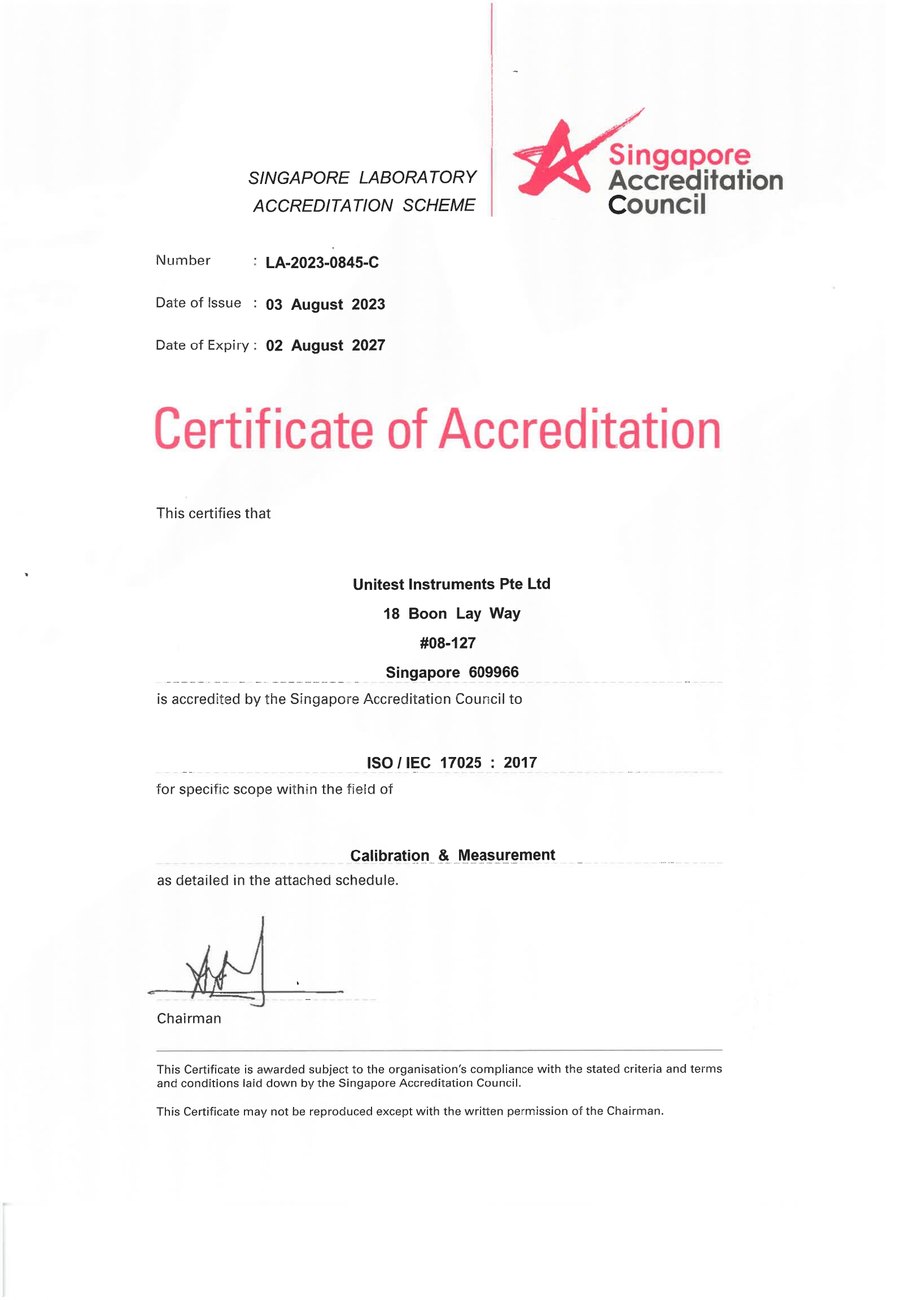
SAC-SINGLAS accredited calibration laboratory (Acc. No. LA-2023-0845-C) serving Singapore's industrial, pharmaceutical, and manufacturing sectors. All content reflects our ISO/IEC 17025 accredited scope and is reviewed by our technical calibration team.
Need gas detector calibration in Singapore?
Unitest Instruments is SAC-SINGLAS accredited (Acc. No. LA-2023-0845-C) to ISO/IEC 17025. Same-week turnaround, certificates accepted by ISO 9001 auditors and MOM inspectors.