
Key Takeaways
- HACCP requires food thermometers calibrated at temperature points that match your Critical Control Point (CCP) limits. Minimum 0 °C, 75 °C, and 100 °C for most Singapore food businesses.
- Laboratory calibration must be traceable to NMC Singapore and documented with measurement uncertainty. A certificate without uncertainty figures will be rejected by ISO 22000 auditors.
- The ice-point method (0 °C ice-water slush) is a valid daily field check but cannot replace annual SAC-SINGLAS accredited calibration under Acc. No. LA-2023-0845-C.
- Singapore Food Agency (SFA) Food Hygiene Regulations and the FSMS programme require documented calibration records for all monitoring instruments at licensed premises.
- Thermometers that fail an ice-point check by more than ±1 °C must be withdrawn from service immediately and sent for laboratory calibration before further use.
- Infrared food thermometers require specialist blackbody calibration and are not suitable as primary HACCP monitoring instruments. Contact probe thermometers remain the standard.
What Happens During Food Thermometer Calibration?
When you send a food thermometer to Unitest's SAC-SINGLAS accredited laboratory (Acc. No. LA-2023-0845-C), it undergoes a structured comparison process against a reference standard whose accuracy is traceable to Singapore's National Metrology Centre (NMC), and ultimately to the International Bureau of Weights and Measures (BIPM). This chain of traceability is what separates a formal calibration from a kitchen field check.
The technician begins by allowing both the reference standard and the unit under test to stabilise at each target temperature in a calibrated temperature bath or dry-block calibrator. For food thermometers, the standard test points align with HACCP Critical Control Points: 0 °C (refrigeration/chilled storage boundary), 5 °C (maximum safe chilled storage temperature per SFA guidelines), 63 °C (minimum hot-holding temperature), 75 °C (minimum internal cooking temperature required by SFA for meat and poultry), and 100 °C (boiling, relevant to sterilisation checks). At each point, multiple readings are taken to average out random variation.
The resulting calibration certificate records the reference value, your thermometer's displayed reading, the calculated error (correction), and the expanded measurement uncertainty at each point. Typically expressed as U = 0.2 °C at k=2, corresponding to a 95% confidence interval. This uncertainty figure is mandatory under ISO/IEC 17025 and is one of the first things an ISO 22000 or HACCP auditor checks. See our article on what a calibration certificate must show for a full breakdown of every required field.
Ice-Point and Boiling-Point Field Checks: How to Do Them Correctly
Field verification checks are a cornerstone of daily HACCP monitoring. They are fast, require no specialist equipment, and give your kitchen team an immediate signal if a thermometer has drifted badly between annual calibrations. Performed correctly, they form a robust first line of defence; performed carelessly, they give false confidence.
Ice-Point Method (0 °C)
Fill a clean, insulated container (a vacuum flask or a deep polystyrene box works well), with finely crushed ice. Add just enough cold water to fill the air gaps between the ice crystals and create a slush. The equilibrium temperature of this mixture is 0 °C ± 0.1 °C at sea level, making it the most reproducible field reference available without laboratory equipment. Insert the probe at least 5 cm into the slush, ensuring it does not touch the container walls. Wait a minimum of 30 seconds after the reading stabilises before recording. A properly calibrated food-grade probe thermometer should read between −0.5 °C and +0.5 °C for high-accuracy instruments, or within ±1.0 °C for general-purpose models.
Record the result in your HACCP monitoring log. Date, time, thermometer ID, ice-point reading, and the name of the staff member conducting the check. Any reading outside your acceptance criterion triggers an immediate corrective action: remove the thermometer from service, attach an OUT-OF-SERVICE label, and arrange accredited laboratory calibration before returning it to use.
Boiling-Point Method (approximately 100 °C)
The boiling point of water varies with altitude and atmospheric pressure. In Singapore, which is essentially at sea level, water boils at approximately 99.6 °C to 100.0 °C under normal atmospheric conditions. Bring clean tap water to a full rolling boil in a deep pot. The probe must be fully immersed and not touching the base or sides. The stabilised reading should fall within the expected range. Note that this check is harder to control than the ice-point method because of steam interference and the variability of boiling behaviour; it is most useful as a secondary confirmation when you suspect a probe is reading high.
Field Calibration vs. Laboratory Calibration: Which Does Your HACCP Plan Need?
The question of field versus laboratory calibration comes up frequently in Singapore's food manufacturing and catering sector. The short answer is: you need both, in different roles. The table below clarifies the distinction so you can correctly document each type in your HACCP plan.
| Factor | Field Verification (Ice/Boiling Point) | Laboratory Calibration (SAC-SINGLAS) |
|---|---|---|
| Who performs it | Kitchen staff, supervisors | Accredited calibration technician |
| Reference standard | Ice-water equilibrium / boiling water | PRT or SPRT traceable to NMC Singapore |
| Temperature points | 0 °C and/or ~100 °C only | Full CCP range: 0 °C, 5 °C, 63 °C, 75 °C, 100 °C |
| Uncertainty statement | Not available | Expanded uncertainty at k=2, 95% confidence |
| Traceability chain | None (physical reference only) | NMC Singapore → BIPM (international) |
| Formal certificate | No. Internal log entry only | Yes. ISO/IEC 17025 accredited certificate |
| Frequency | Daily or per shift | Annually (or 6-monthly for intensive use) |
| Accepted by SFA / ISO 22000 auditors | As supporting record only | Yes. Primary compliance evidence |
| Approximate cost | Negligible (staff time only) | From S$45–S$120 per instrument |
Need accredited food thermometer calibration for your HACCP audit?
Unitest issues traceable calibration certificates accepted by SFA, ISO 22000 certification bodies, and international food safety auditors. Same-week turnaround available for urgent HACCP compliance needs.
Singapore Regulatory Context: SFA, AVA, and HACCP Requirements
Singapore's food safety regulatory landscape consolidated significantly in April 2019 when the Singapore Food Agency (SFA) was established, absorbing the food-related functions of the Agri-Food and Veterinary Authority (AVA), the National Environment Agency (NEA), and the Health Sciences Authority (HSA) into a single agency. Today, SFA administers the Sale of Food Act (Cap. 283) and its subsidiary legislation including the Food Hygiene Regulations, which govern food safety standards for all licensed food businesses.
For food manufacturers, central kitchens, and caterers with annual turnover above S$1 million or those operating under SFA's mandatory Food Safety Management System (FSMS) programme, maintaining a documented HACCP plan is a licensing condition, not optional. The FSMS framework explicitly requires businesses to identify all monitoring equipment, establish calibration procedures, maintain calibration records, and ensure equipment is calibrated against standards traceable to national or international standards. This language directly maps to ISO/IEC 17025 accredited calibration: a SAC-SINGLAS certificate from Unitest (Acc. No. LA-2023-0845-C) satisfies the traceability requirement on its face.
Smaller food retail licensees (hawker stalls, coffeeshops, restaurants), are subject to the Food Hygiene Regulations' general requirement to maintain food at safe temperatures (below 5 °C for chilled, above 60 °C for hot-holding). While these operators are not mandated to hold formal calibration certificates for every thermometer, demonstrating that monitoring equipment is functioning correctly is part of SFA's inspection framework. A calibration certificate significantly reduces the risk of enforcement action if a temperature exceedance is disputed. For businesses pursuing halal certification through MUIS or BizSAFE recognition through WSH, documented calibration records are similarly valued.
Food businesses in Singapore's pharmaceutical supply chain or those supplying hospitals under MOH's Healthcare Supply Chain Management programme face an additional layer: HSA's Good Manufacturing Practice (GMP) requirements for certain product categories require temperature monitoring equipment to be calibrated to traceable standards with documented uncertainty. Again, exactly what a SAC-SINGLAS accredited calibration certificate provides.
Understanding which specific regulations apply to your operation is essential before deciding on calibration frequency and scope. Our article on accredited vs non-accredited calibration explains why the SAC-SINGLAS accreditation mark matters for regulatory acceptance, beyond just technical accuracy.
What a Valid Food Thermometer Calibration Certificate Must Show
Not all calibration certificates are equal. Singapore's ISO 22000 and HACCP certification bodies (including those operating under the Singapore Accreditation Council (SAC) frameworks), routinely reject certificates that are missing mandatory fields. Before filing a certificate in your HACCP documentation, verify it contains all of the following:
- Instrument identification: Make, model, serial number, and your internal asset/tag number. Without a unique identifier, the certificate cannot be linked to the specific instrument used at your CCP.
- Calibration date and recommended recalibration date: The certificate must show when calibration was performed. A next-due date is strongly recommended, auditors will ask for it.
- Reference standard details: The reference thermometer or temperature bath used, including its own calibration certificate number and traceability statement back to NMC Singapore or an equivalent NMI.
- Measured data at each test point: The reference temperature, your thermometer's displayed reading, and the calculated error (or correction) at each calibrated point. For a food thermometer, expect data at 0 °C, 63 °C, 75 °C, and 100 °C minimum.
- Expanded measurement uncertainty: Stated as U = X °C at a coverage factor k=2 (95% confidence level). This is a mandatory element of ISO/IEC 17025 and its absence is a non-conformance.
- Accreditation mark and number: For certificates issued by Unitest, the SAC-SINGLAS accreditation mark and Acc. No. LA-2023-0845-C must appear. This is your audit-ready proof of laboratory competence.
- Authorised signatory: The name and signature of the laboratory's authorised technical signatory. Not just a general "Calibration Team" stamp.
- Conditions of calibration: The ambient temperature and humidity during calibration, particularly relevant for field calibrations where environmental variation can affect results.
For a detailed walkthrough of every field on a standard calibration certificate and how auditors interpret them, refer to our dedicated guide on reading and interpreting a calibration certificate.
Calibration Interval Recommendations for Food Thermometers
How often should you send food thermometers for laboratory calibration? The answer depends on usage intensity, the consequences of an error, and the thermometer's own drift characteristics. The table below provides practical guidance aligned with Singapore's food safety environment.
| Use Case | Recommended Lab Calibration Interval | Daily Field Check? | Notes |
|---|---|---|---|
| Central kitchen / food manufacturer (FSMS) | Every 6 months | Yes. Each shift | High regulatory scrutiny; frequent calibration strengthens audit evidence |
| Caterer / events kitchen | Every 12 months | Yes. Daily | Probe thermometers subject to transport stress; check more often after events |
| Restaurant / hotel kitchen | Every 12 months | Yes. Daily | ISO 22000 and HACCP certification requires traceable annual certificate |
| Cold-chain logistics / supermarket | Every 12 months | Yes. Per delivery | Focus on 0–5 °C range; additional calibration after any cold-chain exceedance |
| After instrument impact or repair | Immediately (before return to service) | N/A | Never return a dropped or repaired probe to CCP monitoring without recalibration |
| Infrared (IR) food thermometer | Every 12 months (blackbody lab calibration) | Not applicable | Cannot be ice-point checked; not primary CCP instrument |
These intervals are consistent with the guidance in our article on how to determine calibration intervals for your instruments, which covers the risk-based interval-setting methodology recommended under ISO 9001 and ISO 22000.
Purchasing Food Thermometers: What to Look for Before You Calibrate
Calibration is only as useful as the thermometer being calibrated. Before committing to a model, there are several technical specifications that determine whether an instrument is suitable as a primary HACCP monitoring tool, and whether it will hold calibration reliably between annual checks.
Resolution and accuracy class: For HACCP applications in Singapore, a thermometer with 0.1 °C resolution and a manufacturer-stated accuracy of ±0.5 °C or better across the food-safety range (−20 °C to +120 °C) is the practical minimum. Instruments with ±1 °C accuracy leave little margin when your CCP limit is, for example, "internal temperature ≥75 °C". A ±1 °C error means you could be serving food at 74 °C while your thermometer reads 75 °C.
Probe type: K-type thermocouple probes are fast-responding and economical but can drift more than platinum resistance thermometers (PRTs) under repeated thermal cycling. For critical CCPs, an instrument with a PRT or NTC thermistor sensor offers lower drift and more stable calibration intervals. Discuss your application with our technical team before purchasing.
IP rating: Food environments involve regular washing. An IP67 or IP68 rated thermometer can be immersed in water for cleaning without damage to the probe or electronics. Reducing the risk of moisture ingress that can shift calibration.
You can browse a range of food-grade thermometers suitable for HACCP applications at unitestshop.com. Our technical team can advise on models within our accredited calibration scope and provide a quotation for calibration at the point of purchase, so your instruments arrive with a valid certificate from day one.
Frequently Asked Questions
Your food thermometer is compared against a calibrated reference standard. Typically a platinum resistance thermometer (PRT) or standard platinum resistance thermometer (SPRT) traceable to Singapore's National Metrology Centre, at multiple temperature points relevant to food safety. These commonly include 0 °C (ice point), 75 °C (SFA minimum cooking temperature), and 100 °C (boiling point), plus intermediate points at 5 °C and 63 °C. At each point, the technician records your thermometer's displayed reading, calculates the error against the reference, and determines the expanded measurement uncertainty. The resulting SAC-SINGLAS accredited certificate (Acc. No. LA-2023-0845-C) documents every measured error and uncertainty value. The primary evidence your HACCP auditor will request.
Fill a clean insulated container with crushed ice and add just enough cold water to create a slush. The equilibrium of ice and water at sea level is 0 °C. Insert the thermometer probe at least 5 cm into the slush, not touching the sides or bottom. Wait 30 seconds for the reading to stabilise. A correctly calibrated probe should read within ±0.5 °C of 0 °C for high-accuracy instruments, or ±1 °C for general-purpose models. Record the reading, date, time, and thermometer ID in your HACCP log. If the reading falls outside your acceptance criterion, remove the instrument from service and arrange laboratory calibration. Note: an ice-point check is a field verification, not a formal calibration. An annual accredited laboratory certificate is still required for regulatory compliance.
Annual laboratory calibration is the standard recommendation under SFA's FSMS framework and ISO 22000. For high-intensity use (central kitchens, catering operations, or instruments subject to frequent drops or washdowns), a 6-month interval provides stronger HACCP evidence and reduces the risk of undetected drift. Daily or per-shift ice-point field checks should be used between annual calibrations as a monitoring control. Any thermometer that fails a field check must be removed from service and sent for laboratory calibration before further use, regardless of when the last annual certificate was issued.
The Singapore Food Agency (SFA) (which absorbed AVA's food functions in 2019), enforces the Sale of Food Act and Food Hygiene Regulations. Businesses under the mandatory FSMS programme must maintain calibrated monitoring equipment with documented traceability. While SFA does not prescribe SAC-SINGLAS accreditation by name, ISO 22000 and HACCP certification bodies operating in Singapore require that calibration certificates demonstrate traceability to a national standard, making SAC-SINGLAS accredited calibration (Acc. No. LA-2023-0845-C) the practical industry standard. SFA inspectors increasingly expect traceable certificates during food safety audits of licensed central kitchens and caterers.
A compliant ISO/IEC 17025 calibration certificate for a food thermometer must include: the instrument's make, model, and serial number; calibration date and recommended next-calibration date; the reference standard used and its traceability chain to NMC Singapore; measured readings at each test point with reference values and calculated errors; the expanded measurement uncertainty (e.g. U = 0.2 °C at k=2, 95% confidence level); the laboratory's SAC-SINGLAS accreditation number (Unitest: LA-2023-0845-C); and the authorised signatory's name and signature. A certificate missing the uncertainty statement is non-compliant with ISO/IEC 17025 and will typically be rejected by ISO 22000 auditors.
An ice-point field check confirms the thermometer has not drifted grossly beyond a single reference point (0 °C). It requires no specialist equipment, can be done in minutes, and is a valuable daily control. However, it cannot quantify exact deviation across the full food-safety range, produces no traceable uncertainty statement, and is not accepted as a formal calibration by SFA or ISO 22000 bodies. A laboratory calibration uses a reference standard traceable to NMC Singapore, covers multiple temperature points aligned with your CCPs, and produces an ISO/IEC 17025 accredited certificate with a full uncertainty statement. Both are needed: laboratory calibration annually, field checks daily.
No. Infrared thermometers measure surface radiance and are strongly affected by the emissivity of the surface being measured. The ice-point slush method does not apply. Ice and water surfaces do not behave as ideal blackbodies, so readings are unreliable. IR thermometers require calibration against a calibrated blackbody source in a temperature-controlled laboratory. For HACCP applications, IR thermometers are considered screening tools only; SFA and HACCP auditors expect a contact probe thermometer with a valid laboratory calibration certificate as the primary monitoring instrument at critical control points.
A standard HACCP-focused calibration covers temperature points aligned with Singapore's Critical Control Point limits: 0 °C (ice point. Refrigeration and cold-chain monitoring), 5 °C (maximum safe chilled storage per SFA guidelines), 63 °C (minimum hot-holding temperature), 75 °C (SFA minimum internal cooking temperature for meat and poultry), and 100 °C (boiling. Relevant to sterilisation checks and hot-holding validation). Unitest's accredited scope under SAC-SINGLAS Acc. No. LA-2023-0845-C covers this full temperature range, ensuring every relevant CCP is supported by a traceable calibration point on your certificate.
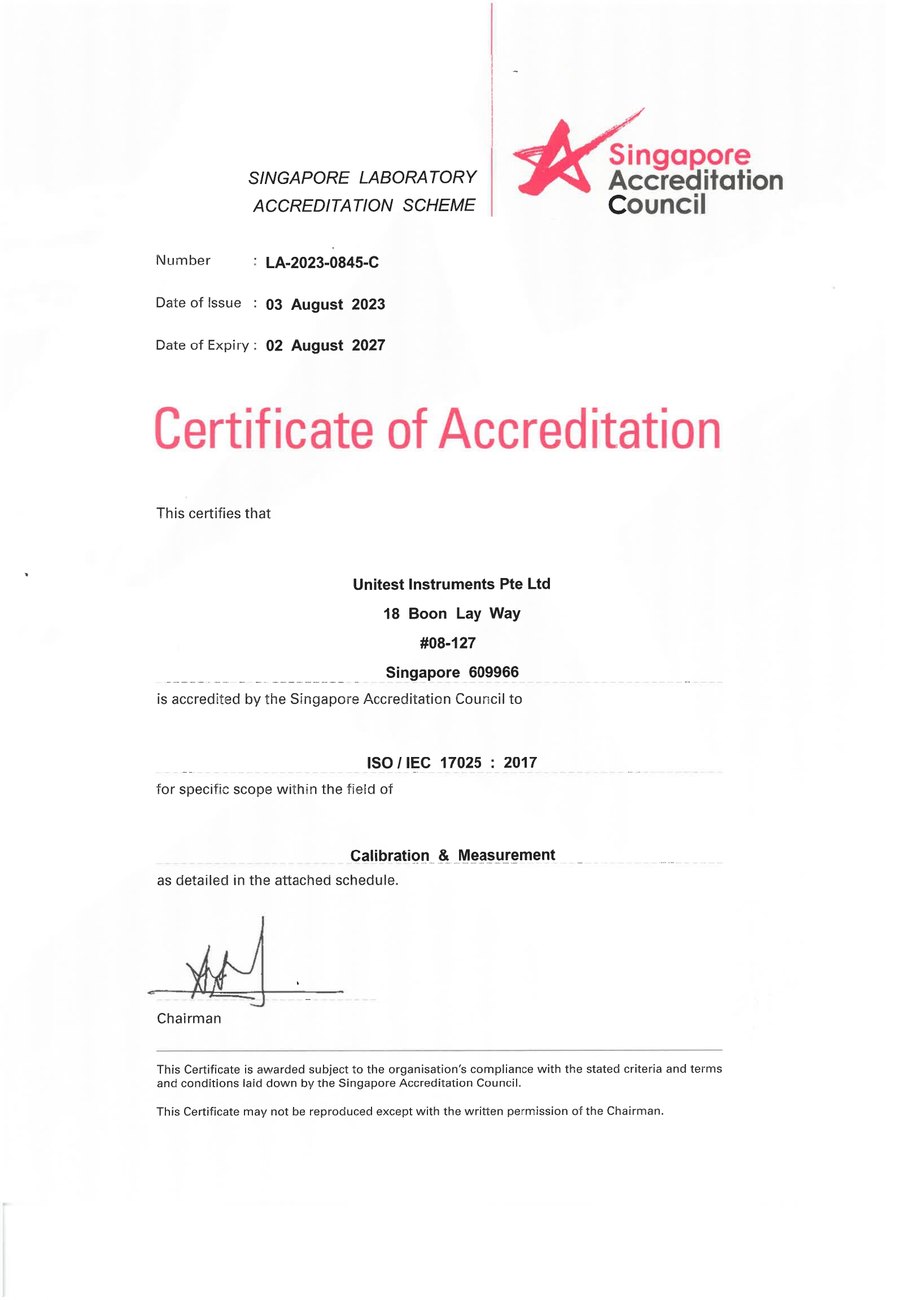
SAC-SINGLAS accredited calibration laboratory (Acc. No. LA-2023-0845-C) serving Singapore's industrial, pharmaceutical, and manufacturing sectors. All content reflects our ISO/IEC 17025 accredited scope and is reviewed by our technical calibration team.
Need food thermometer calibration in Singapore?
Unitest Instruments is SAC-SINGLAS accredited (Acc. No. LA-2023-0845-C) to ISO/IEC 17025. Same-week turnaround, certificates accepted by SFA, ISO 22000, and HACCP certification bodies.