
Key Takeaways
- SFA requires chilled food at ≤4°C and frozen food at ≤−12°C; the food danger zone is 5°C to 60°C.
- Temperature records must be taken at least twice daily and retained for a minimum of one year.
- All thermometers used at Critical Control Points must be calibrated. ISO/IEC 17025 accredited calibration is the accepted standard for HACCP audits.
- Probe thermometers should have a resolution of 0.1°C and accuracy of ±0.5°C or better; infrared guns cannot verify core temperatures alone.
- Non-compliance can attract fines up to S$10,000 per offence and potential licence suspension under the Sale of Food Act.
- Food caterers with annual turnover above S$5 million must implement a SFA-recognised HACCP plan, which mandates calibrated monitoring instruments.
The Regulatory Framework: Which Laws Apply
Food safety temperature monitoring in Singapore sits at the intersection of several statutes and regulations. The primary legislation governing food businesses is the Sale of Food Act (Cap. 283), which is administered by the Singapore Food Agency (SFA). The Environmental Public Health (Food Hygiene) Regulations (EPH Regulations) under the Environmental Public Health Act set out day-to-day operational hygiene requirements, including temperature control.
For facilities managers, two further instruments are essential reading. Singapore Standard SS 590: 2013 covers HACCP-based food safety management systems for the food manufacturing sector, while SS 668: 2021 applies to the food service sector. Both standards require that temperature controls are documented, verified, and supported by calibrated instruments. SFA also publishes Food Safety Guidelines for caterers, food retailers, and central kitchens that translate the statutory requirements into operational checklists.
Beyond SFA, food facilities that also handle imported food must be aware of import conditions set by SFA under the Agri-Food and Veterinary Authority (AVA) legacy framework, now consolidated under SFA since 2019. Cold-chain integrity (including temperature), is part of the import licensing conditions.
SFA Temperature Limits: The Numbers That Matter
The specific temperature thresholds prescribed by SFA and the EPH Regulations are the foundation of any food safety temperature monitoring programme. Compliance officers should know these numbers precisely, because departures (even marginal ones), constitute breaches that an inspector can act on immediately.
| Food Category | Required Storage Temperature | Regulatory Basis |
|---|---|---|
| Chilled ready-to-eat (RTE) food | ≤ 4°C | EPH (Food Hygiene) Regulations; SFA Food Safety Guidelines |
| Raw meat, poultry, seafood (chilled) | ≤ 4°C | EPH (Food Hygiene) Regulations |
| Frozen food | ≤ −12°C (best practice: −18°C) | SFA Food Safety Guidelines; SS 590 |
| Hot-holding (cooked food for service) | ≥ 60°C | EPH (Food Hygiene) Regulations |
| Cooked food (minimum cooking core temp) | ≥ 75°C (poultry: ≥ 82°C) | SFA HACCP Guidelines; SS 668 |
| Cooling (cooked food) | From 60°C to ≤ 20°C within 2 hrs; to ≤ 4°C within 4 hrs | SFA Food Safety Guidelines; SS 590 |
| Food transport (chilled) | ≤ 4°C throughout | SFA Food Safety Guidelines for caterers |
The danger zone (5°C to 60°C), is the temperature range where pathogenic bacteria multiply most rapidly. SFA's position is that food must not remain in the danger zone for more than 4 cumulative hours. Any food exceeding this limit must be discarded and the event recorded. Facilities managers should design their monitoring schedules so that any exceedance is detected well within the 4-hour window, not after the fact.
Step-by-Step Compliance Process for Food Businesses
Meeting SFA's temperature monitoring requirements is not just about having thermometers on site. It requires a documented system with four interconnected components: the right instruments, a monitoring schedule, a records regime, and a corrective action plan. Here is the step-by-step approach that SFA auditors expect to see.
Step 1. Map Your Temperature Control Points
Begin by identifying every point in your operation where temperature control is critical. For a food service operation this typically includes: receiving (checking incoming delivery temperatures), cold storage (refrigerators, blast chillers, freezers), food preparation (time out of temperature), cooking (core temperature), hot-holding, cooling, and transport. For food manufacturers, additional points such as pasteurisation, fermentation, and packaging environments may apply. Document these as Critical Control Points (CCPs) or monitoring points in your food safety plan.
Step 2. Select Appropriate Instruments
Each monitoring point may require a different instrument type. Probe (insertion) thermometers are mandatory for verifying core food temperatures during cooking and cooling. Infrared thermometers may supplement surface checks during receiving but cannot substitute for probe checks. Data loggers are the preferred choice for continuous cold storage monitoring, as they provide an automatic time-stamped record without relying on manual readings. For HACCP CCPs, instruments must have a resolution of at least 0.1°C and an accuracy of ±0.5°C or better.
Step 3. Establish a Calibration Schedule
Every temperature instrument in your food safety programme must be calibrated at defined intervals. How often you calibrate depends on instrument type, usage intensity, and criticality of the measurement point. For food safety instruments at CCPs, a six-monthly calibration interval is widely accepted in HACCP audits, with annual calibration as the minimum for lower-risk monitoring points. Calibration must be performed by a competent laboratory, for audit acceptance, calibration by a SAC-SINGLAS accredited laboratory to ISO/IEC 17025 is the recognised standard in Singapore.
Step 4. Implement the Monitoring Schedule and Records
SFA requires temperature records to be taken at least twice daily for refrigeration and cold storage. In practice, HACCP-compliant operations record temperatures at the start and end of each shift as a minimum. Records must include: the date and time, the measured temperature, the name of the person recording, and any corrective actions taken. Records must be retained for at least one year and be readily available to SFA inspectors.
Step 5. Define and Execute Corrective Actions
A corrective action procedure must be documented for every scenario where a temperature limit is breached. For cold storage exceedances, this typically involves: moving food to an alternative unit, investigating the cause (compressor fault, door left open), documenting the duration of the exceedance, assessing food safety risk, and recording whether the food was held, reworked, or discarded. Inspectors will check that corrective actions are not just documented but that they were actually followed through. A corrective action log with no entries over a long period is a red flag, not a sign of compliance.
Calibrate Your Food Safety Thermometers to SFA-Accepted Standards
Unitest Instruments is SAC-SINGLAS accredited (Acc. No. LA-2023-0845-C) to calibrate temperature instruments used in food safety, HACCP, and cold chain applications. Certificates are accepted by SFA auditors and ISO 9001 certification bodies.
Calibration Instrument Requirements for Food Safety
The calibration of temperature instruments is where many food businesses fall short. Not because they lack thermometers, but because their instruments have never been formally calibrated or the calibration certificates they hold are not from an accredited source. Understanding what a compliant calibration looks like is essential for facilities managers preparing for SFA inspections or third-party HACCP audits.
Accredited calibration differs from non-accredited calibration in a legally significant way: an accredited calibration certificate carries the SAC-SINGLAS mark and provides a measured value with a stated measurement uncertainty, traceable to Singapore's National Measurement Centre (NMC) and ultimately to SI units. A non-accredited certificate may simply state that the instrument "passed" a check. Without measurement uncertainty, traceability, or the endorsement of an independent competency authority. SFA and HACCP auditors can and do distinguish between the two.
What a Calibration Certificate Must Show
For food safety instruments, a compliant calibration certificate should include: the identification of the instrument (make, model, serial number), the calibration date and due date, the calibration points tested (covering the instrument's operational range. Typically 0°C, 4°C, 37°C, 60°C, 75°C or similar), the measured error at each point, the expanded measurement uncertainty, and the accreditation body's mark and laboratory registration number. A full breakdown of what each field on a calibration certificate means will help your team verify that certificates received from a service provider are complete and correct.
Instrument Types and Their Calibration Considerations
Probe thermometers should be calibrated across the full range they are used in. A thermometer used to check cooking temperatures (75°C) and cold storage temperatures (4°C) must be calibrated at both extremes, not just at a single point. Data loggers should be calibrated with the probe attached, as the probe is the primary sensing element. Infrared thermometers require calibration using a blackbody source at the relevant temperature. A practice calibration check against melting ice or boiling water is not a substitute for accredited calibration.
Penalties for Non-Compliance
The consequences of failing to meet SFA's temperature monitoring requirements are substantial and have increased in severity under recent amendments to Singapore's food safety legislation. Facilities managers and compliance officers should treat these not as abstract risks but as concrete liabilities that attach to named licence holders.
Under the Sale of Food Act (Cap. 283), a food business operator found to be in breach of food safety requirements (including temperature control failures), can be liable to a fine of up to S$10,000 for a first offence. For a second or subsequent offence, fines can rise to S$20,000, and there is the additional risk of imprisonment in cases involving deliberate or reckless conduct. Beyond the financial penalty, SFA has the power to suspend or revoke a food establishment licence, which is an existential consequence for any food business.
Inspectors from SFA conduct routine and unannounced inspections. During an inspection, an officer may use their own calibrated reference thermometer to check the temperature of food and equipment on site. If a temperature breach is found (and particularly if monitoring records show that the breach was ongoing and undetected), SFA can order the immediate disposal of all food at risk. The financial cost of discarded stock, plus the reputational damage of a public enforcement action, far exceeds the cost of a robust monitoring and calibration programme.
HACCP Obligations and How They Interact with SFA Requirements
Singapore's SFA mandates HACCP implementation for food caterers with an annual turnover exceeding S$5 million. Beyond this statutory requirement, many food manufacturers, central kitchens, and export-oriented food businesses voluntarily implement HACCP as a prerequisite for export certifications and for qualification as approved suppliers to hotels, airlines, and healthcare institutions. Under HACCP, temperature monitoring is not optional: it is the primary verification activity at the majority of CCPs.
The seven HACCP principles require that each CCP has a critical limit (the temperature threshold), a monitoring procedure (who, how, when), corrective actions (what happens when the limit is breached), verification procedures (confirming that monitoring is working), and record-keeping. Instrument calibration is part of the verification procedure: HACCP auditors will ask for calibration records as evidence that the thermometers used at CCPs produce reliable data. An uncalibrated probe at a CCP is a major non-conformity in any HACCP audit. It calls into question the validity of every temperature record taken with that instrument.
For food businesses seeking BizSAFE certification or ISO 22000 certification (which are increasingly required by hospital networks, airline catering tenders, and government contracts), the calibration requirement is equally explicit. ISO/IEC 17025 sets the international benchmark for calibration laboratory competence, and instruments calibrated by accredited laboratories provide the documented traceability chain that ISO 22000 and FSSC 22000 auditors require.
Practical Guidance for Facilities Managers
Pulling all of the above together into a workable system requires discipline rather than complexity. The following practical measures will give most Singapore food facilities a robust, audit-ready temperature monitoring programme.
Maintain an Instrument Register
Create and maintain a register of every temperature-measuring instrument in use: probe thermometers, data loggers, oven thermostats, blast chiller controllers, refrigerator display thermometers, and any instruments used during food transport. For each instrument, record the make, model, serial number, location, calibration date, calibration due date, and the calibration laboratory used. Review the register monthly and schedule calibrations before due dates, not after.
Use Data Loggers for Continuous Storage Monitoring
Manual twice-daily temperature records meet the minimum SFA requirement, but they leave a 12-hour gap between readings during which a cold storage unit could fail without detection. Data loggers with real-time alarm outputs (either audible on-site alarms or SMS/email alerts), provide continuous oversight at low cost. Ensure data loggers are calibrated as complete units, probe included, by an accredited laboratory.
Train Staff on Correct Probe Use
A calibrated thermometer used incorrectly still produces bad data. Staff responsible for temperature monitoring should be trained to: allow probe thermometers to stabilise before reading (typically 30 seconds for food probes), insert probes to the geometric centre of the food product, clean and sanitise probes between uses, and recognise signs that an instrument may be malfunctioning (erratic readings, display faults, physical damage).
Integrate Calibration into Your Audit Calendar
Calibration is not a one-off event. It is a recurring activity that should be built into your annual compliance calendar alongside SFA licence renewals, pest control contracts, and internal HACCP reviews. Scheduling calibration 4 to 6 weeks before a known SFA inspection or third-party audit ensures you have current certificates in hand when they are requested.
Frequently Asked Questions
Under SFA requirements, chilled ready-to-eat (RTE) food must be stored at or below 4°C. Raw meats and seafood must also be kept at or below 4°C, while frozen foods must be maintained at or below −12°C (ideally −18°C for best quality). These limits apply to all food business operators licensed under the Environmental Public Health (Food Hygiene) Regulations and the Sale of Food Act.
SFA requires food business operators to monitor and record temperatures at least twice daily for refrigeration and cold storage units. High-risk operations such as large-scale catering companies may be required to record temperatures more frequently. Records must be retained for a minimum of one year and made available to SFA inspectors upon request.
Yes. SFA's food hygiene guidelines and Singapore Standard SS 668 (Food Safety Management System for Food Service Sector) require that temperature-measuring instruments used in food operations are calibrated and maintained in working order. For HACCP-certified premises, ISO/IEC 17025 accredited calibration is the recognised standard for demonstrating traceability to national measurement standards. Uncalibrated instruments are a major non-conformity in HACCP and ISO 22000 audits.
The food danger zone is defined as between 5°C and 60°C. The range in which foodborne bacteria such as Salmonella, Listeria, and Staphylococcus aureus multiply rapidly. SFA requires that food not be left in the danger zone for more than 4 cumulative hours. Food that has spent more than 4 hours in the danger zone must be discarded and the event recorded in your monitoring log.
Under the Sale of Food Act (Cap. 283) and the Environmental Public Health Act, food operators in breach of temperature storage requirements may face fines of up to S$10,000 for a first offence. Repeated or serious violations can result in suspension or revocation of the food establishment licence. SFA also has powers to order the immediate disposal of food that presents a public health risk, adding significant stock-loss costs on top of any fine.
SFA and HACCP auditors accept probe/insertion thermometers, infrared (IR) surface thermometers, and data loggers. Probe thermometers with a resolution of at least 0.1°C and an accuracy of ±0.5°C or better are recommended for core temperature checks. Infrared thermometers are suitable for surface checks during receiving but must not be used as the sole means of verifying core food temperatures. All instruments must be calibrated at defined intervals by a competent laboratory.
SFA mandates HACCP implementation for food caterers with annual turnover above S$5 million and certain other high-risk food operations. Under HACCP, temperature control at Critical Control Points (cooking, cooling, cold storage, and hot-holding), must be verified using calibrated instruments. Calibration records form a required part of the HACCP verification procedure and are routinely requested during SFA audits and third-party certifications such as ISO 22000 and FSSC 22000.
SFA and Singapore Standard SS 590 recommend that temperature instruments used in food safety applications be calibrated at least annually. For instruments used at Critical Control Points in HACCP plans, a six-monthly calibration interval is common practice. Any instrument that is dropped, repaired, or gives suspect readings should be recalibrated immediately regardless of when the last calibration was performed. A risk-based approach to setting calibration intervals takes into account instrument type, usage frequency, and consequence of error.
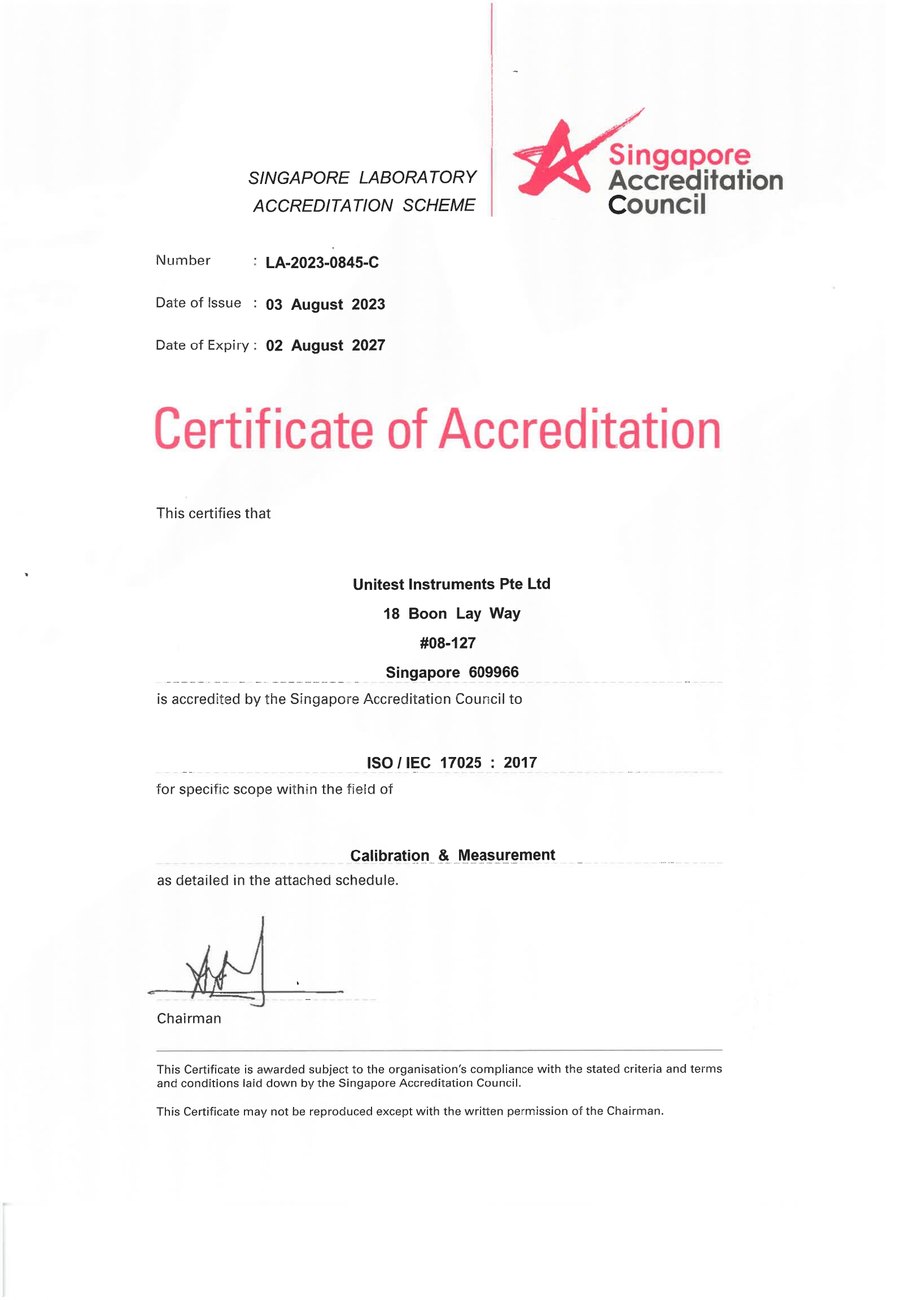
SAC-SINGLAS accredited calibration laboratory (Acc. No. LA-2023-0845-C) serving Singapore's industrial, pharmaceutical, and manufacturing sectors. All content reflects our ISO/IEC 17025 accredited scope and is reviewed by our technical calibration team.
Need food safety thermometer calibration in Singapore?
Unitest Instruments is SAC-SINGLAS accredited (Acc. No. LA-2023-0845-C) to ISO/IEC 17025. Same-week turnaround, certificates accepted by SFA auditors and ISO 9001 certification bodies.