
Key Takeaways
- The Fluke 87V has 0.05% basic DC accuracy vs the Amprobe AM-570's 0.5%. A 10× difference that matters in precision measurement and calibration reference work.
- Fluke 87V is rated CAT III 1000V / CAT IV 600V; Amprobe AM-570 is rated CAT III 600V / CAT IV 300V. The Fluke covers higher-voltage industrial panels.
- Only the Fluke 87V includes a low-pass filter (LPF) for accurate readings on variable frequency drives and motor drives. A critical differentiator for industrial electrical teams.
- The Amprobe AM-570 includes built-in Type K thermocouple temperature input and capacitance measurement out of the box, making it more versatile for HVAC and building services.
- Both models are sold and calibrated by Unitest Instruments under our SAC-SINGLAS accreditation (Acc. No. LA-2023-0845-C), so you get a traceable calibration certificate regardless of which you choose.
Why This Comparison Matters for Singapore Buyers
The Fluke 87V and Amprobe AM-570 are both aimed at professional electricians and industrial maintenance technicians, and both are widely stocked by test-and-measurement distributors in Singapore. At first glance they look similar: true-RMS, CAT-rated safety, large displays, rugged construction. But a closer read of the specifications (and a realistic look at where each excels), reveals that they are optimised for meaningfully different tasks.
Singapore procurement teams face a real decision. The Fluke 87V has been a benchmark industrial multimeter for decades and commands a corresponding price. The Amprobe AM-570 is positioned as a professional-grade instrument at a more accessible price point. Neither decision is wrong in isolation. What matters is matching the instrument to the actual measurement environment and the consequences of a bad reading.
From the perspective of a SAC-SINGLAS accredited calibration laboratory, we see both instruments regularly. Our calibration team works with the full range of parameters on each: DC and AC voltage, resistance, DC current, frequency, and (where applicable), temperature. The observations in this article reflect that practical, hands-on familiarity, not just a comparison of published spec sheets.
Full Specification Comparison
The table below covers the most decision-relevant specifications. Where manufacturers publish tolerance ranges, we have used the conservative (worst-case) published figure.
| Feature / Specification | Fluke 87V | Amprobe AM-570 |
|---|---|---|
| Basic DC Voltage Accuracy | ±0.05% + 1 digit | ±0.5% + 2 digits |
| AC Voltage Accuracy (true-RMS) | ±0.5% + 2 digits (45–500 Hz) | ±1.0% + 3 digits (45–400 Hz) |
| DC Voltage Range | 0.1 mV – 1000 V | 0.1 mV – 1000 V |
| Display Resolution | 6,000 count / 20,000 count (hi-res mode) | 6,000 count |
| AC Frequency Response | 45 Hz – 20 kHz (with LPF: 1 kHz) | 45 Hz – 400 Hz |
| Low-Pass Filter (LPF) | Yes. Switchable (for VFD/motor drive work) | No |
| True-RMS | Yes | Yes |
| DC Current Range | 0.1 µA – 10 A | 0.01 µA – 10 A |
| Resistance Range | 0.1 Ω – 50 MΩ | 0.1 Ω – 40 MΩ |
| Capacitance | 1 nF – 9,999 µF (optional) | 1 nF – 9,999 µF (built-in) |
| Temperature | Optional (with probe accessory) | Built-in Type K input (-40 to 1000 °C) |
| Frequency / Duty Cycle | 0.5 Hz – 200 kHz / 0.01% – 99.99% | 1 Hz – 50 kHz / 0.1% – 99.9% |
| Safety Rating | CAT III 1000V / CAT IV 600V | CAT III 600V / CAT IV 300V |
| Input Protection | 1000V across all inputs | 600V across voltage inputs |
| Ingress Protection | IP67 (dust-tight, water-immersion rated) | IP54 (dust-protected, splash-resistant) |
| Drop Rating | 3-metre drop tested | 1-metre drop tested |
| Backlight | Yes | Yes |
| Relative Measurement (REL) | Yes | Yes |
| Min/Max/Average Capture | Yes | Yes |
| Battery Life | ~400 hours (without backlight) | ~500 hours (without backlight) |
| Weight | 475 g with batteries | 330 g with batteries |
| Warranty | 3 years | 3 years |
Where the Fluke 87V Clearly Wins
Variable Frequency Drives and Motor Systems
This is the single most important differentiator in an industrial setting. VFDs and motor drives generate high-frequency switching noise that fools most true-RMS multimeters into displaying inflated or unstable voltage readings. The Fluke 87V includes a dedicated low-pass filter (LPF) that, when switched on, limits the measurement bandwidth to 1 kHz. Cutting out the switching noise and delivering accurate fundamental-frequency readings at the motor terminals.
The Amprobe AM-570 has no equivalent function. Its true-RMS measurement is accurate in conventional sinusoidal environments, but on a VFD output it will display readings that are not representative of the fundamental voltage the motor is actually seeing. For teams maintaining conveyor systems, pumps, air handling units, and compressors controlled by drives (which describes a large proportion of Singapore's manufacturing and process plants), this is a genuine limitation.
Higher Safety Ratings for Switchgear and MV Distribution
The Fluke 87V's CAT III 1000V / CAT IV 600V rating provides greater transient overvoltage withstand capability than the Amprobe AM-570's CAT III 600V / CAT IV 300V. In practical terms, this means the Fluke 87V can be used on industrial MCC (Motor Control Centre) buses operating at voltages up to 1000V in a CAT III environment, and on service entry points up to 600V in a CAT IV environment.
For most commercial building electrical work in Singapore (LV distribution boards, sub-mains, and final sub-circuits operating at 400/230V), both instruments are safely rated. The difference matters most when working on industrial switchgear, large motor control panels, and any environment close to the utility supply entry point.
Accuracy for Calibration and Precision Work
The Fluke 87V's 0.05% basic DC accuracy, combined with its 20,000-count high-resolution mode, makes it suitable as a working reference instrument in many calibration and commissioning scenarios. When you need to verify a panel meter, confirm a PLC analog input, or establish a baseline measurement for equipment records, the Fluke's accuracy provides a meaningful margin over the Amprobe. As an ISO/IEC 17025 accredited laboratory, Unitest uses reference standards considerably more accurate than either instrument, but for field calibration checks and equipment verification work, the Fluke 87V is the more capable tool.
Need your Fluke or Amprobe multimeter calibrated in Singapore?
Unitest Instruments calibrates both models under our SAC-SINGLAS accreditation (Acc. No. LA-2023-0845-C). Certificates are traceable to Singapore's NMC and accepted by ISO 9001, BizSAFE, and government auditors. Same-week turnaround available.
Where the Amprobe AM-570 Holds Its Own. Or Wins
HVAC, Building Services, and Facilities Management
The Amprobe AM-570's built-in Type K thermocouple input and capacitance measurement make it a more immediately practical tool for HVAC commissioning and maintenance. An HVAC technician can measure supply air temperature, condenser coil temperature, and compressor terminal voltage without carrying additional accessories. The Fluke 87V can measure temperature, but requires a separately purchased temperature probe and adapter. Adding cost and an extra item to manage on site.
For facilities managers maintaining commercial buildings in Singapore (where HVAC represents a dominant portion of the electrical load and maintenance activity), the AM-570's integrated feature set translates to genuine day-to-day convenience. Its lighter weight (330g vs 475g for the Fluke) is also noticeable across a long day of panel-to-panel checks.
Value for General Electrical Maintenance Teams
For a maintenance team performing routine electrical checks. Verifying supply voltages, checking continuity, testing motor winding resistance, and confirming circuit breaker operation. The Amprobe AM-570 covers the full range of required measurements. Its 0.5% DC accuracy is more than adequate for fault-finding and maintenance verification work where you are checking that a reading is in a normal range, not measuring a precise value. The cost saving compared to the Fluke 87V can equip an additional technician on a team budget, which is a realistic consideration for facilities departments and SME contractors in Singapore.
IP54 Durability for Most Field Environments
The Amprobe AM-570's IP54 rating (dust-protected and splash-resistant), is adequate for the vast majority of site environments in Singapore, including outdoor work in tropical rain conditions. The Fluke 87V's IP67 full water-immersion rating and 3-metre drop test are genuine advantages in harsh industrial environments: petrochemical plants, water treatment facilities, and construction sites. For standard commercial and light-industrial work, IP54 is rarely a practical limitation.
Head-to-Head Use Case Recommendations
| Application / User | Recommended Choice | Reason |
|---|---|---|
| Industrial electrician, manufacturing plant | Fluke 87V | VFD/motor work, higher CAT rating, accuracy |
| HVAC technician, building services | Amprobe AM-570 | Built-in temperature, capacitance, lighter weight |
| Facilities manager, commercial building | Amprobe AM-570 | Strong value, covers all routine checks |
| Electrical contractor, LV distribution | Amprobe AM-570 | Meets CAT ratings for the application at lower cost |
| Petrochemical / process plant technician | Fluke 87V | IP67, CAT III 1000V, accuracy, LPF for drives |
| Calibration / metrology technician | Fluke 87V | 0.05% DC accuracy, 20,000-count hi-res mode |
| SME maintenance team, mixed duties | Amprobe AM-570 | Cost-effective, broad feature set for general use |
| Switchgear testing, MCC panels | Fluke 87V | CAT III 1000V, input protection, ruggedness |
Calibration Considerations for Singapore Compliance
Regardless of which multimeter you choose, calibration is not optional if your measurements support quality management systems, safety inspections, or government-regulated processes. ISO 9001:2015 clause 7.1.5 requires that measuring instruments used in controlled processes be calibrated on a documented schedule against standards traceable to national or international references. Singapore's BizSAFE and OHSAS 18001/ISO 45001 frameworks carry similar requirements for safety-critical measurements.
Understanding what a calibration certificate actually means (and what measurement uncertainty tells you about your instrument's real-world performance), is important context for procurement decisions. Our article on what a calibration certificate contains and how to read it walks through the key fields, including the difference between a calibration certificate and a simple test report. If your organisation is working toward ISO/IEC 17025 compliance or needs to demonstrate traceability to auditors, our guide on ISO/IEC 17025 calibration requirements explains the specific obligations in plain language.
Unitest Instruments sells and calibrates both the Fluke 87V and the Amprobe AM-570 under our SAC-SINGLAS accreditation (Acc. No. LA-2023-0845-C). Our calibration scope covers the key electrical parameters for both instruments: DC voltage, AC voltage, DC current, resistance, and frequency. Calibration certificates issued by our laboratory include measurement uncertainty statements and are traceable to Singapore's National Metrology Centre (NMC). The same traceability chain described in our article on what calibration traceability means and why it matters.
Honest Trade-Off Summary
There is no universally better multimeter in this comparison. The Fluke 87V is the right choice when accuracy, safety margin, and motor-drive measurement capability are genuinely required by the application. It is a premium instrument with a premium price, and for the right user in the right environment, the investment is justified by reduced measurement error risk and a longer useful service life in demanding conditions.
The Amprobe AM-570 is not a compromise instrument. It is a well-engineered professional tool that delivers strong performance for its intended applications. HVAC technicians, facilities managers, and general maintenance teams will find it covers their measurement needs fully, with a built-in feature set that in some respects (temperature, capacitance as standard) exceeds the Fluke's out-of-box capabilities. At a meaningfully lower price point, it makes professional-grade measurement accessible without overspending on capabilities that will never be used.
Both instruments benefit from regular accredited calibration to maintain their accuracy specifications. An uncalibrated multimeter (regardless of brand or original accuracy), degrades over time and provides no assurance that its readings are within specification. Establishing and following a documented calibration interval is the single most important step any organisation can take to ensure their measurement equipment is actually delivering reliable data.
Total Cost of Ownership Over Five Years
The purchase price gap between the two instruments is real, but it is not the whole cost picture. A meaningful comparison for a Singapore facilities or maintenance team should factor in three additional cost elements over the instrument's typical five-year service life: accredited calibration (annually for most regulated environments), consumables (test leads and fuses, which do wear and occasionally blow), and replacement risk from field damage. On calibration alone, both instruments cost roughly the same to calibrate at Unitest, since the parameters tested (DC/AC voltage, resistance, current, frequency) are largely equivalent in scope, so this line item does not meaningfully favour either brand.
Where the total cost picture genuinely diverges is field damage risk. The Fluke 87V's 3-metre drop rating and IP67 housing mean an accidental drop from a ladder or a rain-exposed outdoor measurement is far less likely to end the instrument's service life prematurely, whereas the Amprobe AM-570's 1-metre drop rating and IP54 splash resistance, while entirely adequate for controlled indoor environments, carry a higher realistic probability of a damage-driven replacement for teams working construction sites, rooftops, or outdoor switchgear in Singapore's monsoon conditions. For a facilities team doing controlled indoor panel checks, this risk is low and the AM-570's lower purchase price wins outright over five years. For a team regularly working elevated, outdoor, or harsh industrial locations, the probability-weighted cost of an early Amprobe replacement can close, or even reverse, the initial price advantage, which is worth modelling explicitly against your own team's actual working conditions rather than assuming the cheaper unit is automatically the better five-year value.
What Our Calibration Bench Sees: Common Failure and Damage Patterns
Because Unitest calibrates both models in volume, our technicians see recurring, brand-specific patterns in the units that arrive with an out-of-tolerance or damaged condition, and these patterns are a useful practical guide beyond the published specifications. The most common Fluke 87V issue we see is not electronic failure at all but a blown internal fuse on the current input, almost always traced to a user attempting a current measurement while the leads were still plugged into the voltage/resistance jacks, or measuring current on a circuit whose actual current exceeded the fused range; the instrument's rugged housing survives, but the fuse (a genuine Fluke replacement part, not a generic substitute, matters for maintaining the CAT rating) needs replacing before the unit will read correctly again.
On the Amprobe AM-570, the most common finding is drift in the basic DC accuracy following a drop event that did not visibly crack the housing; because the AM-570's 1-metre drop rating provides a real but narrower margin than the Fluke's 3-metre rating, an impact that the housing absorbs without visible damage can still be enough to shift the internal reference components slightly out of specification, which is precisely the kind of silent drift that only shows up on a full accredited calibration, not on a quick continuity check in the field. This is a useful reminder for both instruments: a multimeter that "still works fine" after being dropped is not the same as one that is still accurate, and any drop event significant enough to be noticed by the user is a reasonable trigger for an out-of-cycle calibration check regardless of which brand you carry.
A smaller but recurring finding across both brands is corrosion or intermittent contact at the input jacks and test lead tips, particularly on units used outdoors or in Singapore's humid plant environments without being wiped down and stored dry between uses. This shows up as an unstable or erratic reading that can look like an internal fault but is usually resolved with contact cleaner and a lead inspection rather than a service repair. Building a simple pre-use visual check (leads, jacks, housing seals) into your team's routine, alongside the scheduled accredited calibration, catches most of these issues before they affect a genuine measurement decision.
Frequently Asked Questions
For most critical industrial applications (motor drives, variable frequency drives, and environments with high electrical noise), yes. The Fluke 87V's 0.05% basic DC accuracy, true-RMS with low-pass filter, and superior noise rejection justify the premium. For general electrical maintenance, commercial facilities management, or budget-sensitive procurement, the Amprobe AM-570 delivers strong value at a significantly lower price point. The right answer depends on your measurement environment and how often accuracy genuinely matters to your process.
The Amprobe AM-570 has true-RMS capability and is rated CAT III 600V / CAT IV 300V, so it is rated for most industrial distribution environments. However, it lacks the dedicated low-pass filter found in the Fluke 87V. On variable frequency drives (VFDs) and motor drives that produce high-frequency switching noise, this can result in inflated or unstable readings. For VFD work specifically, the Fluke 87V with its low-pass filter switched on is the more reliable choice.
IEC 61010-1 CAT ratings indicate the level of transient overvoltage protection. For industrial panel work in Singapore (MV distribution, motor control centres, switchgear), you need at minimum CAT III 1000V. For utility connections or outdoor distribution, CAT IV 600V or higher is appropriate. Both the Fluke 87V (CAT III 1000V / CAT IV 600V) and the Amprobe AM-570 (CAT III 600V / CAT IV 300V) cover most commercial and light-industrial environments. The Fluke 87V has the edge for higher-voltage industrial panels.
Yes. Unitest Instruments is a SAC-SINGLAS accredited calibration laboratory (Acc. No. LA-2023-0845-C) to ISO/IEC 17025. We calibrate both the Fluke 87V and Amprobe AM-570, covering DC voltage, AC voltage, DC current, resistance, and frequency parameters within our accredited scope. Calibration certificates issued by Unitest include measurement uncertainty statements and are traceable to Singapore's National Metrology Centre (NMC), making them acceptable for ISO 9001, BizSAFE, and government audit purposes.
Most calibration standards and equipment manufacturers recommend an annual calibration interval as a starting point. If your multimeter is used daily in harsh industrial environments, subjected to physical shock, or used for safety-critical measurements, a 6-month interval may be more appropriate. Singapore's quality management frameworks (ISO 9001, BizSAFE) require that measuring instruments used in controlled processes be calibrated on a documented schedule. Unitest can advise on a risk-based calibration interval appropriate for your specific application and usage pattern.
The Amprobe AM-570 is a strong choice for HVAC and building services work. It includes built-in temperature measurement (Type K thermocouple input), capacitance measurement, and a duty-cycle function. Features frequently needed for HVAC commissioning and fault-finding. Its CAT III 600V rating covers the distribution voltages typically encountered in Singapore commercial buildings. The Fluke 87V can handle HVAC work equally well but costs significantly more; unless you also need its motor-drive measurement capabilities, the AM-570's feature set maps more directly to HVAC tasks at a better price.
The Fluke 87V features a 6000-count primary display with a secondary bargraph, and switches to a 20,000-count high-resolution mode for more precise readings. The Amprobe AM-570 uses a 6000-count display. In practical terms, both are sufficient for most fault-finding and maintenance work. The Fluke's high-resolution mode becomes valuable when you need to resolve fine changes, for example, measuring small resistance changes in motor windings or detecting voltage drift in sensitive control circuits.
Yes. ISO 9001:2015 clause 7.1.5 requires that measuring equipment used in monitoring and measurement processes be calibrated or verified at specified intervals, against measurement standards traceable to international or national standards. A calibration certificate from Unitest Instruments (as a SAC-SINGLAS accredited laboratory (ISO/IEC 17025, Acc. No. LA-2023-0845-C)), meets this requirement. Our certificates include a statement of measurement uncertainty, the calibration method, environmental conditions, and traceability to Singapore's NMC.
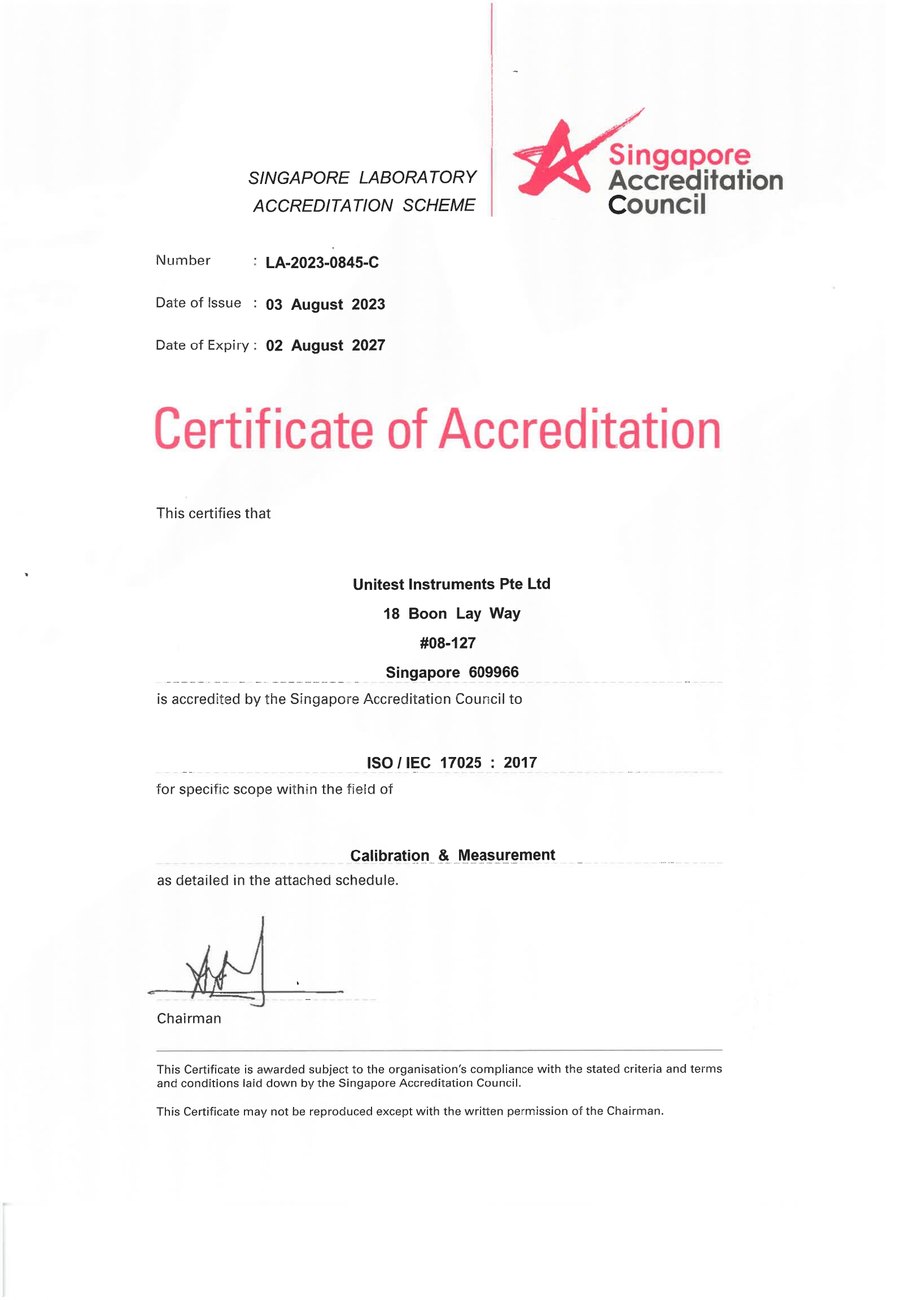
SAC-SINGLAS accredited calibration laboratory (Acc. No. LA-2023-0845-C) serving Singapore's industrial, pharmaceutical, and manufacturing sectors. All content reflects our ISO/IEC 17025 accredited scope and is reviewed by our technical calibration team.
Need multimeter calibration in Singapore?
Unitest Instruments is SAC-SINGLAS accredited (Acc. No. LA-2023-0845-C) to ISO/IEC 17025. Same-week turnaround, certificates accepted by ISO 9001 auditors.