
Key Takeaways
- SS 638:2018 is the mandatory standard for all EV charging system design, installation, and testing in Singapore.
- An EMA-registered Licensed Electrical Worker (LEW) must supervise all installation and commissioning work, no exemptions.
- Six core electrical safety tests are required before any charger is energised: insulation resistance, earth continuity, earth fault loop impedance, RCD trip verification, polarity, and functional protocol testing.
- All test instruments must carry valid calibration certificates traceable to Singapore's National Metrology Centre (NMC), uncalibrated instruments invalidate results.
- BCA Green Mark assessments and ISO 9001 audits will request these records; retain them for at least 5 years or the duration of the installation, whichever is longer.
The Regulatory Landscape: Who Governs EV Charger Safety in Singapore?
Unlike a single-regulator model, EV charger compliance in Singapore involves at least four agencies with overlapping but distinct mandates. Understanding which agency owns which requirement prevents the most common compliance gaps, and the most expensive surprises at audit time.
Energy Market Authority (EMA)
EMA is the primary statutory regulator for electrical installations under the Electricity Act (Cap. 89A). Every EV charging installation constitutes an electrical installation under the Act. EMA requires that a Licensed Electrical Worker (LEW) (registered with EMA at the appropriate grade), supervises all installation, testing, and commissioning work. For installations with a demand exceeding 45 kVA (typically DC fast chargers or multi-charger arrays), a Licensed Electrical Engineer (LEEng) must be appointed instead. Upon completion, the LEW or LEEng submits a Declaration of Compliance to EMA before the installation is energised for public or commercial use.
Building and Construction Authority (BCA)
BCA's mandate covers EV-ready provisions in new and substantially retrofitted buildings. The Green Mark Scheme (2021 revision) mandates EV-ready car park provisions (conduit pathways, sub-metering, and dedicated electrical capacity), in all new non-residential buildings with car parks above a defined size threshold. Facilities managers in existing buildings seeking Green Mark recertification must demonstrate that EV charger installations comply with both BCA's EV-readiness criteria and SS 638. BCA does not conduct charger-level electrical testing itself, but its inspectors will review the LEW certification and test records as part of the building submission.
National Environment Agency (NEA)
NEA's role is primarily indirect: it administers the Energy Efficiency Fund (E2F) and related incentive schemes that subsidise EV charger deployment. To qualify for these grants, installations must meet defined energy performance specifications and be type-tested to applicable IEC standards. NEA may also be involved if the charger installation is part of a NEA-registered energy management system under the Energy Conservation Act, requiring metered energy data to be reported annually.
SP Group and Grid Connection
SP Group (the electricity grid operator) must be notified and, for larger installations, must approve the grid connection. For installations that increase a building's contracted demand by more than 10% or exceed the existing contracted capacity, a formal capacity application is required. SP Group sets technical requirements for metering, power quality (harmonic limits per SS 495), and protection relay settings that interface directly with the charger's internal protection systems.
| Agency | Regulatory Basis | Key Requirement for EV Chargers | Facilities Manager Action |
|---|---|---|---|
| EMA | Electricity Act (Cap. 89A) | LEW/LEEng supervision; EMA Declaration of Compliance | Appoint LEW; retain EMA EC4 certificate |
| BCA | Building Control Act; Green Mark 2021 | EV-ready provisions; sub-metering; conduit sizing | Include in building submission; retain for GM audit |
| NEA | Energy Conservation Act; E2F grant conditions | Type-test certificates; energy metering for ECA sites | Request IEC 61851 type-test cert from charger supplier |
| SP Group | SP Grid Connection Requirements | Capacity application; harmonic compliance (SS 495) | Submit load application for new capacity; retain SP approval letter |
| LTA | EV Masterplan; public charging sites | Charger specifications for public tender sites | Follow LTA tender specifications if on public site |
Singapore Standard SS 638:2018. What the Standard Requires
SS 638:2018 (Code of Practice for Electric Vehicle Charging Systems) is the definitive technical standard for EV charging in Singapore. Published by Enterprise Singapore, it adopts and localises IEC 61851 (Electric Vehicle Conductive Charging Systems) and IEC 62196 (Plugs, Socket-Outlets and Vehicle Couplers) for Singapore's electrical environment (230 V / 400 V, 50 Hz, TN-S earthing system).
Scope and Charging Modes
SS 638 applies to all four IEC 61851 charging modes. Mode 1 (standard socket, no control pilot) is explicitly restricted in Singapore to temporary or domestic use only and is not permitted for permanently installed charging points. Mode 2 (portable EVSE with in-cable control box) is permitted for temporary use. Mode 3 (dedicated AC charging point with control pilot) is the standard for commercial and residential charging installations. Mode 4 (DC fast charging with off-board charger) applies to rapid chargers at commercial and fleet facilities.
Installation Design Requirements
SS 638 mandates that the electrical supply circuit to each charging point is protected by a Type A or Type B RCD with a rated residual operating current of no more than 30 mA. Type B RCDs (which detect both AC and pulsating DC fault currents) are required wherever Mode 4 DC chargers or Mode 3 chargers incorporating DC components are installed. The standard also specifies minimum IP ratings for the charging equipment enclosure (IP44 for indoor, IP55 for outdoor, IP65 for locations exposed to pressure washing), cable entry protection, and cable management to prevent mechanical damage. Earthing must comply with CP 5 (Code of Practice for the Electrical Installation) with earth electrode resistance tested to confirm continuity.
The Step-by-Step Commissioning Test Process
Before any EV charger installation is energised for operational use, the LEW must conduct and document a defined sequence of safety tests. The following sequence follows SS 638 and CP 5 requirements and represents the minimum mandatory scope. Each test must be performed using calibrated instruments and the measured results recorded on a formal test schedule.
Step 1. Insulation Resistance Test
With the charger de-energised and disconnected from the supply, insulation resistance is measured between all live conductors (L and N) connected together and the protective earth conductor, using a 500 V DC test voltage for 230 V systems. The minimum acceptable insulation resistance is 1 MΩ. For new installations, values below 10 MΩ warrant further investigation. The test instrument (insulation resistance tester / Megger) must be calibrated. An uncalibrated instrument producing a reading of, say, 0.95 MΩ with ±10% uncertainty could result in a failing installation being passed, or vice versa.
Step 2. Earth Continuity and Protective Conductor Resistance
Earth continuity is verified from the MET to each charger's protective earth terminal using a low-resistance ohmmeter (or the bonding test function of a multifunction installation tester). The measured resistance must not exceed the values specified in CP 5 Table 54A, and for Mode 3 chargers specifically, must not exceed 0.5 Ω as noted above. This test confirms that the protective conductor pathway is intact and will carry fault current safely to trip the upstream protective device.
Step 3. Earth Fault Loop Impedance (EFLI)
EFLI is measured at the charger's supply terminals using a loop impedance tester. The measured Zs value must be low enough to ensure that, under a line-to-earth fault condition, the upstream protective device operates within the disconnection time required by CP 5. For a 32 A Type B MCB, maximum Zs is typically 1.09 Ω (at 230 V). This test is performed with the installation energised and requires the instrument to inject a test current. Accuracy is critical, and calibration of the loop tester directly affects whether the calculated fault current meets the disconnection criterion.
Step 4. RCD Trip Time and Current Verification
Every RCD protecting an EV charger circuit must be tested to verify both its trip current (must trip at 100% rated residual current Idn, must not trip at 50% Idn) and its trip time (must trip within 300 ms at 1× Idn; within 40 ms at 5× Idn for general-purpose RCDs). For socket-outlet circuits, the 5× test at 40 ms is mandatory. RCD test instruments must be calibrated. Trip time errors of even a few milliseconds can cause a borderline device to be incorrectly passed or failed.
Step 5. Polarity Check
A polarity check confirms that line, neutral, and earth conductors are connected to the correct terminals throughout the circuit. An incorrectly wired neutral or earth can prevent the RCD from operating correctly and may leave exposed metalwork live under fault conditions. This is typically verified using a multifunction tester's continuity function or a dedicated polarity tester.
Step 6. Functional and Protocol Test
For Mode 3 and Mode 4 chargers, a functional test using a compatible EV test adaptor (or the vehicle itself) verifies that the control pilot signal (CP signal, ±12 V PWM at 1 kHz per IEC 61851-1) is correctly generated, that the charger transitions through states A–E correctly, and that the outlet is only energised when a vehicle is properly connected. For networked chargers, communication functionality (OCPP compliance) is verified separately but is not a statutory EMA requirement.
Need calibration certificates for your EV charger test instruments?
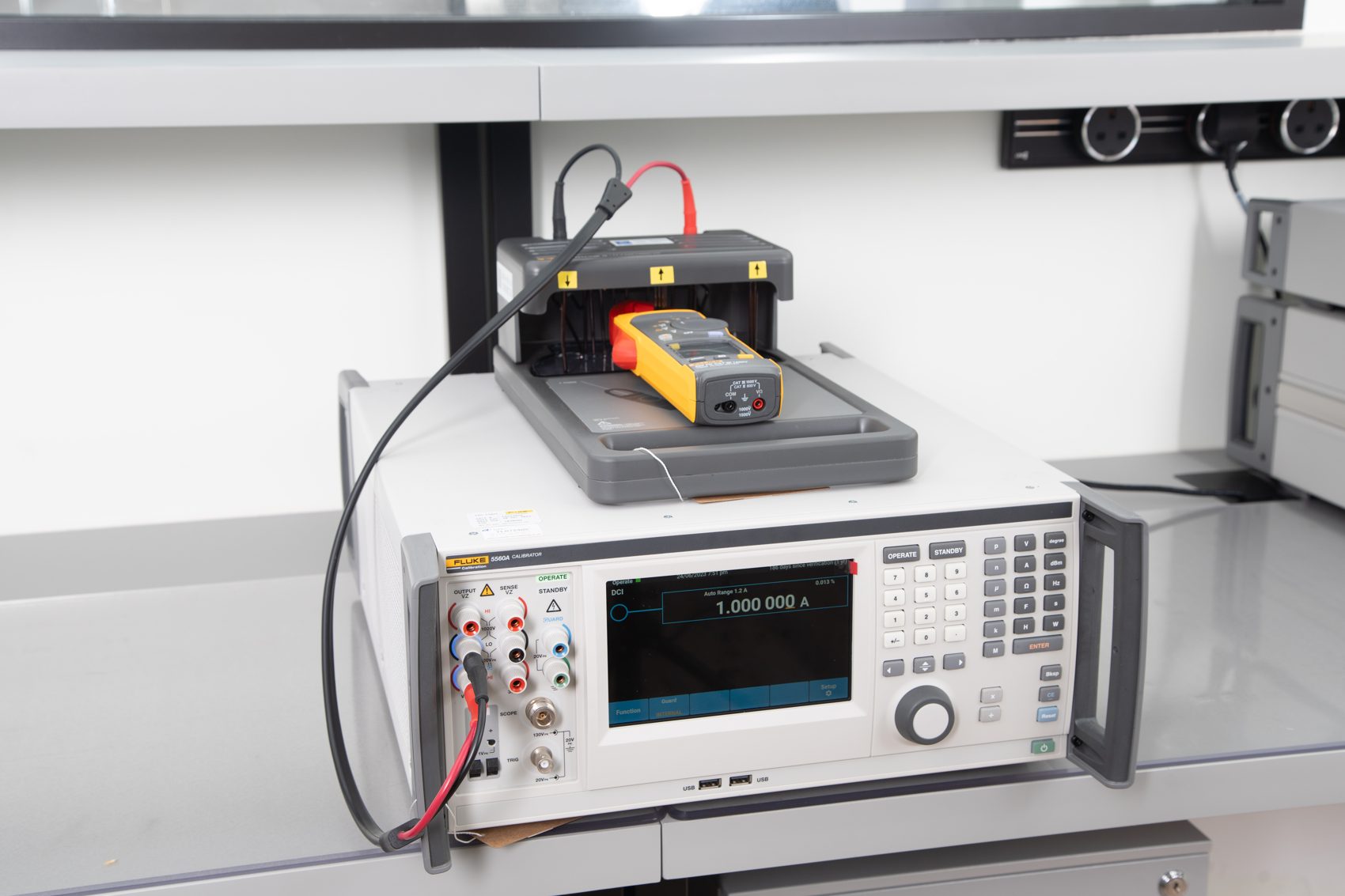
Unitest Instruments calibrates multifunction installation testers, insulation resistance testers, loop impedance testers, and RCD testers to ISO/IEC 17025 standards, with certificates traceable to NMC Singapore. Accepted by EMA, BCA, and ISO 9001 auditors.
Calibration Instrument Requirements for EV Charger Testing
One of the most frequently overlooked compliance requirements is the calibration status of the instruments used to perform the commissioning tests. The results are only as trustworthy as the instruments producing them. This is not merely good practice. It is a regulatory expectation and, in many cases, a contractual requirement for insurance and warranty purposes.
The instruments most commonly used in EV charger commissioning, and their calibration requirements, are set out below. As explained in our article on what a calibration certificate contains and what it means, a valid certificate must state the measurement uncertainty, reference the calibration standard used, and identify the instrument uniquely by serial number.
| Instrument | Test It Performs | Key Parameter to Calibrate | Typical Calibration Interval |
|---|---|---|---|
| Multifunction installation tester | EFLI, RCD, continuity, insulation, polarity | Loop impedance accuracy; RCD trip time timing circuit | 12 months |
| Insulation resistance tester | Insulation resistance (Megger test) | Test voltage accuracy; resistance measurement accuracy | 12 months |
| Low-resistance ohmmeter | Earth continuity; bonding resistance | Resistance accuracy at sub-Ω range | 12 months |
| Dedicated RCD tester | RCD trip current and trip time | Current accuracy; timing accuracy (ms) | 12 months |
| Clamp meter / power analyser | Load current; power quality (harmonics) | AC current accuracy; frequency response | 12 months |
Calibration must be traceable to national measurement standards. In Singapore, the National Metrology Centre (NMC) at A*STAR maintains the national measurement standards. SAC-SINGLAS accredited laboratories (including Unitest Instruments (Acc. No. LA-2023-0845-C)), are the recognised route for obtaining traceable calibration certificates in Singapore. Certificates from non-accredited laboratories may not be accepted by EMA statutory inspectors or ISO 9001 auditors. For a deeper explanation of why traceability matters, see our guide on what calibration traceability means and why it is required.
Penalties for Non-Compliance
The consequences of operating a non-compliant EV charging installation in Singapore are severe and multi-layered. Facilities managers who assume that EV charger compliance is a one-time installation tick-box exercise risk significant legal, financial, and reputational exposure.
Statutory Penalties Under the Electricity Act
Section 83 of the Electricity Act creates an offence for any person who carries out, supervises, or causes electrical installation work to be carried out without the appropriate licence. On conviction, individuals face fines up to S$10,000 and/or 12 months' imprisonment per offence. Corporate bodies face fines up to S$50,000 per offence in some categories. EMA enforcement officers have the power to disconnect non-compliant installations immediately and require reinstatement of compliant works at the owner's cost.
Insurance and Civil Liability
Most commercial property and public liability insurance policies contain a condition that all electrical installations comply with applicable statutory requirements. An EV charger fire or electrocution incident involving a non-compliant installation may give the insurer grounds to deny the claim entirely. Leaving the building owner or strata corporation liable for property damage, personal injury, and third-party claims without insurance cover. This exposure can dwarf the cost of achieving compliance in the first place.
BCA Green Mark and Tenancy Obligations
For buildings with Green Mark certification, a non-compliant EV charging installation can result in the withdrawal of the certification, triggering consequences under leases or financing agreements that carry Green Mark covenants. Government-owned commercial buildings and many Grade A office developments now include Green Mark maintenance as a tenancy condition.
Periodic Inspection and Ongoing Compliance
Commissioning compliance is the starting point, not the endpoint. SS 638 and CP 5 both require periodic inspection and testing of EV charging installations throughout their operational life. For commercial and industrial installations, the maximum periodic inspection interval is 5 years. However, given the duty cycle and environmental exposure typical of public or shared charging facilities, annual functional tests and RCD verification are strongly recommended.
Any modification to the installation (including adding chargers, upgrading supply capacity, or changing protection devices), triggers a full re-commissioning test equivalent to the original commissioning scope. Facilities managers should instruct their maintenance contractors to report all modifications, however minor, so that re-testing obligations are not inadvertently overlooked.
The question of how frequently test instruments themselves should be recalibrated is addressed in detail in our article on how to determine the right calibration interval for your instruments. As a rule of thumb, instruments used in regular commissioning work should be calibrated annually, and any instrument that has been dropped, subjected to overload, or stored in adverse conditions should be calibrated before its next use regardless of the calendar interval.
Frequently Asked Questions
The primary standard is Singapore Standard SS 638:2018 (Code of Practice for Electric Vehicle Charging Systems), published by Enterprise Singapore. It sets out requirements for the design, installation, operation, and maintenance of EV charging systems. Compliance with SS 638 is mandatory for all new EV charging installations in Singapore, and it aligns with IEC 61851 (Electric Vehicle Conductive Charging Systems) for equipment-level type testing.
Several agencies play distinct roles. The Energy Market Authority (EMA) regulates electrical installations and requires a Licensed Electrical Worker (LEW) to supervise any installation. The Building and Construction Authority (BCA) oversees building code compliance, including EV-ready provisions under the Green Mark scheme. The National Environment Agency (NEA) administers the Energy Efficiency Fund and energy performance requirements. SP Group must be notified for grid connections above certain capacity thresholds. LTA coordinates EV infrastructure policy but does not directly conduct safety testing.
Before commissioning, the following tests are required under SS 638 and CP 5: insulation resistance testing (minimum 1 MΩ at 500 V DC), earth continuity and earth fault loop impedance testing, RCD trip time and current verification, polarity checks, prospective short-circuit current measurement, and functional testing of the charging protocol (Mode 2, 3, or 4 as applicable). AC chargers must also verify pilot signal communication with the vehicle per IEC 61851-1.
Yes. All instruments used for EV charger commissioning and periodic testing. Including multifunction electrical installation testers, insulation resistance testers, earth fault loop impedance testers, and RCD testers. Must be calibrated and traceable to national measurement standards. For results accepted by statutory inspections and ISO 9001 audits, calibration by a SAC-SINGLAS accredited laboratory such as Unitest Instruments (Acc. No. LA-2023-0845-C) is the recognised standard in Singapore. Certificates from non-accredited laboratories may not be accepted.
Under the Electricity Act (Cap. 89A), operating an unlicensed or non-compliant electrical installation carries fines of up to S$10,000 and/or up to 12 months' imprisonment per offence for individuals. Corporate bodies may face higher fines. EMA can issue stop-work orders and require removal of non-compliant equipment at the owner's expense. Insurance policies may be voided if an incident occurs on a non-compliant installation, leaving the property owner exposed to full civil liability.
SS 638 recommends periodic inspections at intervals not exceeding 5 years for commercial and industrial installations, consistent with CP 5 requirements for general electrical installations. However, operators in high-throughput environments (car parks, fleet depots) are advised to conduct annual functional checks and RCD tests. Any modification to the charging installation triggers a full re-commissioning test. Instrument calibration intervals for the test equipment itself should follow the manufacturer's recommendation, typically annually.
Yes. Under the Electricity Act, any electrical installation work (including EV charger installation), must be carried out under the supervision of an EMA-registered Licensed Electrical Worker (LEW). The LEW is responsible for ensuring the work complies with CP 5 and SS 638, certifying the installation upon completion, and submitting the required documentation to EMA. For installations exceeding 45 kVA demand, a Licensed Electrical Engineer (LEEng) must be appointed. Facilities managers must retain the LEW's certification records as evidence of compliance.
Facilities managers should retain: the LEW's electrical installation certificate (EMA Form EC4 or equivalent), test result schedules showing all measured values against pass/fail criteria, calibration certificates for all instruments used during testing (with traceability to NMC Singapore), as-built single-line diagrams, product type test certificates for the charger hardware (IEC 61851, IEC 62196), and any SP Group connection approval letters. These records are required during BCA Green Mark assessments, ISO 9001 audits, and EMA periodic inspections. Retain for at least 5 years or the life of the installation.
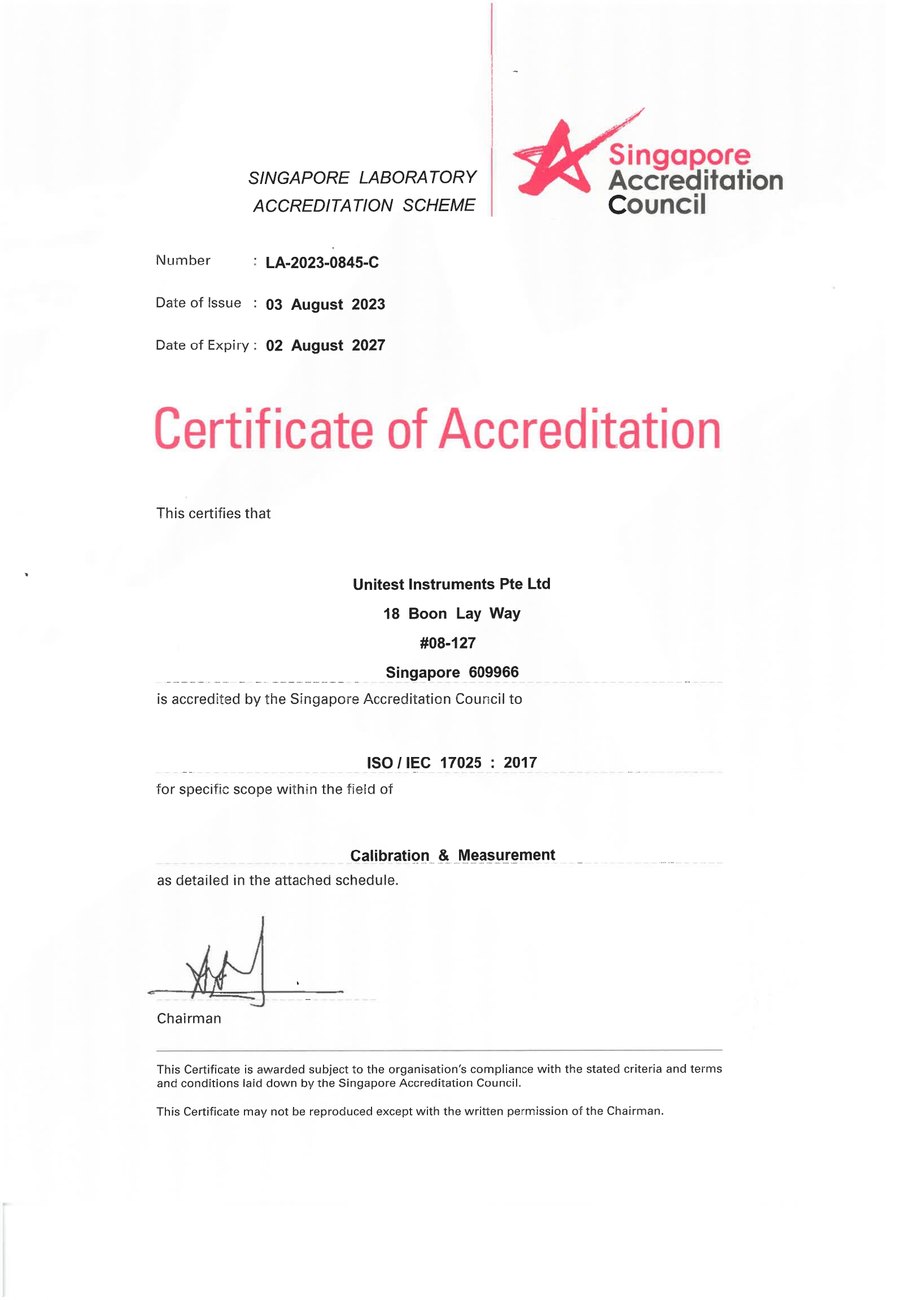
SAC-SINGLAS accredited calibration laboratory (Acc. No. LA-2023-0845-C) serving Singapore's industrial, pharmaceutical, and manufacturing sectors. All content reflects our ISO/IEC 17025 accredited scope and is reviewed by our technical calibration team.
Need electrical test instrument calibration in Singapore?
Unitest Instruments is SAC-SINGLAS accredited (Acc. No. LA-2023-0845-C) to ISO/IEC 17025. Same-week turnaround, certificates accepted by ISO 9001 auditors.