
Key Takeaways
- Temperature and humidity sensors are the highest-priority calibration items in any Singapore data centre. ASHRAE A1 class allows only ±1°C tolerance.
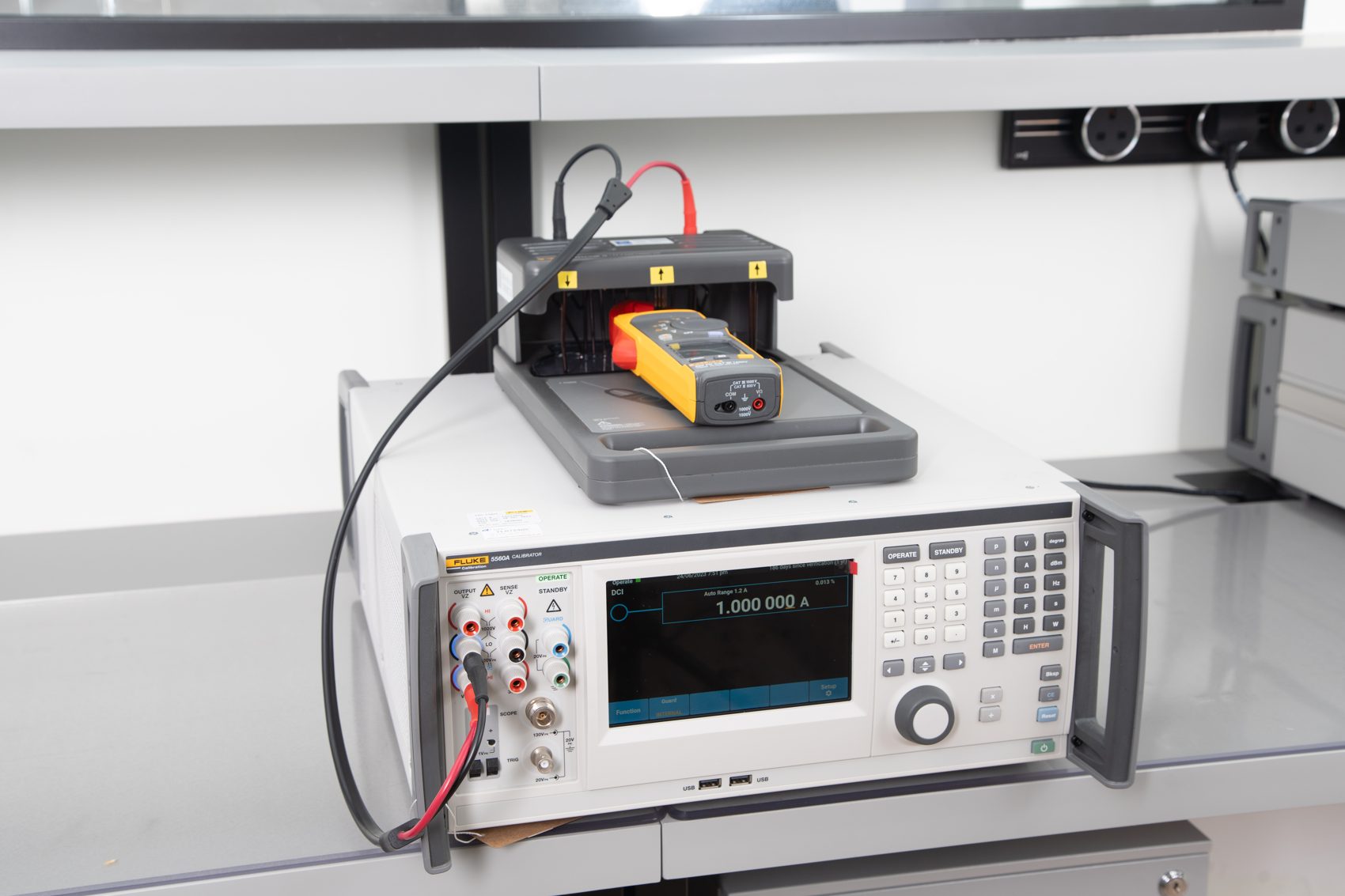
- Power quality analysers, UPS test sets, and current clamps must be calibrated to verify PUE reporting and protect against undetected electrical faults.
- SAC-SINGLAS accredited calibration certificates are traceable to Singapore's NMC and are accepted by ISO 9001, ISO 50001, and TIA-942 auditors without further qualification.
- Most data centre instruments should be calibrated annually; sensors in critical hot-aisle environments are often placed on a 6-month cycle.
- A calibration register (listing every instrument, location, due date, and certificate number), is the single most auditable piece of evidence a QA or facilities team can maintain.
Why Calibration Is a Tier-1 Risk Control for Data Centres
A data centre is, at its core, a precision environment. Servers generate dense heat loads (modern GPU clusters can exceed 40 kW per rack), and the entire cooling infrastructure is designed around sensor readings. If a temperature sensor drifts by 3°C, the cooling system may throttle airflow at the wrong threshold, allowing a rack to exceed ASHRAE's recommended 27°C inlet limit before any alarm fires. That silent drift is operationally invisible until hardware starts throttling or failing.
The same principle applies to electrical measurements. An uncalibrated power quality analyser may report clean power when harmonics are eroding UPS battery life. A current clamp that reads 5% low means the facilities team is operating closer to breaker capacity than they believe. In Singapore's colocation market, where Tier III and Tier IV uptime SLAs carry financial penalties measured in hundreds of thousands of dollars per hour, these are not theoretical risks.
Calibration converts trust in a number into evidence of trust. An auditable, dated, signed certificate that says: this instrument was compared against a traceable standard, and here is the measured deviation and uncertainty. Without it, every monitoring dashboard in the NOC is a belief system, not a measurement system.
Key Parameters Measured in a Data Centre, and Why They Need Calibration
The following table covers the principal measurands, the instruments used, typical accuracy requirements, and the consequences of calibration drift in a live data centre environment.
| Parameter | Instrument | Typical Accuracy Requirement | Recommended Interval | Consequence of Drift |
|---|---|---|---|---|
| Air Temperature | RTD / thermocouple sensors, data loggers | ±0.5–1.0°C | 6–12 months | Cooling under/overrun, server throttling, missed high-temp alarms |
| Relative Humidity | Capacitive humidity sensors, hygrometers | ±2–3% RH | 6–12 months | Static discharge risk (low RH) or condensation (high RH) |
| Differential Air Pressure | Differential pressure gauges / transmitters | ±0.5–2 Pa | 12 months | Incorrect raised-floor tile management, hot-aisle containment failure |
| Electrical Voltage (AC) | Digital multimeters, power analysers | ±0.1–0.5% | 12 months | UPS under/overvoltage alarms misread; incorrect power budgeting |
| AC Current | Clamp meters, CT-based analysers | ±0.5–1% | 12 months | Overcurrent risk undetected; PUE calculations incorrect |
| Power Factor / Harmonics | Power quality analysers | THD to ±0.5% | 12 months | Hidden harmonic distortion shortens UPS/transformer life |
| UPS Battery Impedance | Battery impedance testers | Per manufacturer spec | 6–12 months | Degraded batteries passed as healthy; runtime shortfall on outage |
| Airflow Velocity | Anemometers, pitot tube probes | ±2–3% of reading | 12 months | Hot-spot identification inaccurate; containment audits invalidated |
Which Instruments Require Priority Calibration
Temperature and Humidity Sensors
These are the highest-priority calibration items in any data centre. Server inlet temperatures are the primary trigger for cooling decisions. Every degree of inaccuracy translates directly into either wasted cooling energy or undetected thermal stress. In Singapore's tropical climate, where ambient outdoor temperatures regularly exceed 33°C and humidity is persistently high, CRAC units and in-row coolers work harder than in temperate climates. A 6-month calibration interval is recommended for sensors in hot-aisle containment zones or near high-density GPU racks.
Humidity sensors deserve equal attention. Most capacitive sensors drift over 12–24 months of continuous exposure to humidity cycling. A sensor that reads 55% RH when the actual condition is 72% RH will not trigger dehumidification, risking condensation on cold surfaces. A failure mode that is invisible until water is found on a motherboard.
Power Quality Analysers and Electrical Test Equipment
Power quality analysers are used both for continuous monitoring and for periodic audits of UPS output, generator transfer times, and feeder harmonics. An uncalibrated analyser may pass a harmonic distortion audit when actual THD is above the 5% limit recommended by IEEE 519. Current clamps are particularly prone to drift at the lower end of their range. A problem in modern data centres where high-efficiency servers draw low, high-frequency currents that stress the clamp's magnetic core.
For facilities teams reporting Power Usage Effectiveness (PUE) (Singapore's Green Mark for Data Centres programme and many enterprise SLAs require it), the accuracy of power measurement instruments directly affects the credibility of the PUE figure. A PUE of 1.45 reported with uncalibrated meters is not a PUE of 1.45; it is an estimate with unknown error bounds.
UPS Battery Testers
Battery impedance testers are used to assess battery health without a full discharge test. If the tester itself is not calibrated, a degraded battery string may be passed as serviceable. In a power outage, a battery string believed to hold 10 minutes of runtime may deliver only 6, which, for a hot-failover sequence, may not be enough time to bring generators online. This is one of the clearest examples of how calibration error translates into direct operational risk.
Calibrate Your Data Centre Instruments with Confidence
Unitest Instruments issues traceable calibration certificates accepted by ISO 9001, TIA-942, and Green Mark auditors. Same-week turnaround available for critical instruments.
SAC-SINGLAS Accreditation. The Compliance Standard Singapore Auditors Expect
Singapore's national accreditation body (the Singapore Accreditation Council (SAC)), operates the SINGLAS (Singapore Laboratory Accreditation Scheme) under ISO/IEC 17025. A laboratory accredited under SINGLAS has been independently assessed for technical competence, measurement traceability, equipment condition, and staff qualifications. Certificates issued under a SINGLAS accreditation number (such as LA-2023-0845-C), carry internationally recognised authority under the ILAC Mutual Recognition Arrangement, meaning they are accepted in over 100 countries without re-testing.
For a Singapore data centre, this matters in several practical ways. ISO 9001 auditors performing surveillance audits will ask to see calibration certificates for all measurement equipment used in quality-affecting processes. If your certificates come from a non-accredited provider, the auditor may raise a non-conformance requiring you to re-calibrate with an accredited lab. An unplanned cost and scheduling disruption. TIA-942 site audits for Tier III and Tier IV certification include explicit requirements for calibrated instrumentation used in commissioning and testing. Green Mark for Data Centres (BCA/IDA joint scheme) assessors review PUE measurement methodology, which includes the calibration status of metering equipment.
Understanding what a calibration certificate actually contains (and what it proves), is a foundational skill for any QA manager. Our guide on how to read a calibration certificate walks through each section of a SAC-SINGLAS certificate and explains how to verify that the stated uncertainty covers your instrument's required accuracy.
Calibration Intervals. Setting the Right Schedule for a Data Centre
There is no single mandated calibration interval for data centre instruments. Instead, the interval should be determined by a combination of four factors: manufacturer recommendation, instrument stability history, the severity of consequences if the instrument is out of tolerance, and the requirements of your applicable standards (ISO 9001, TIA-942, ISO 50001).
As a starting framework, most data centre instruments fall into one of three risk categories:
- High-consequence, 6-month interval: Server inlet temperature sensors in hot-aisle containment; humidity sensors in rooms with condensation risk; UPS battery testers used to make go/no-go decisions on battery replacement.
- Standard, 12-month interval: General-purpose data loggers, power quality analysers, current clamps, anemometers, differential pressure transmitters, and multimeters used in periodic maintenance.
- Extended, 24-month interval (with documented justification): Instruments with a demonstrated history of low drift, used in lower-consequence measurement roles, where a second reference instrument provides cross-check coverage.
The decision to extend an interval should always be documented in your quality management system and reviewed after each calibration. If as-found deviations are increasing over successive calibrations, the interval should be shortened, not maintained. Our article on how often instruments should be calibrated covers the statistical methods for setting intervals based on historical calibration data.
What a Facilities or QA Team Actually Needs to Do. A Practical Checklist
The process of running a compliant calibration programme for a data centre does not need to be complex. It needs to be consistent. Here is a practical sequence that works for both in-house teams and outsourced facilities management:
Step 1: Build the Instrument Register
Create a centralised list of every measurement instrument in the facility. For each instrument, record: asset tag or serial number, instrument type and manufacturer model, physical location (e.g. "Cold Aisle (Row 4), Position 2"), last calibration date and certificate number, next calibration due date, and the name of the approved calibration provider. This register is the primary document an auditor will request. It should be updated within 24 hours of any new calibration being completed.
Step 2: Engage a SAC-SINGLAS Accredited Laboratory
Confirm that the laboratory holds a current SAC-SINGLAS accreditation covering the parameters you need. Temperature, humidity, electrical, pressure, and flow are the most common for data centres. The laboratory's scope of accreditation is publicly listed on the SAC website. Unitest Instruments (Acc. No. LA-2023-0845-C) covers all primary data centre measurement parameters under a single accreditation, which simplifies procurement and certificate management.
Step 3: Plan On-site vs. In-lab Calibration
Not all instruments can be removed from service without disrupting monitoring. For permanently installed temperature and humidity transmitters, on-site calibration (where the laboratory brings reference standards to your facility) is often necessary. For portable instruments (clamp meters, multimeters, anemometers), in-lab calibration is standard and typically faster. Plan your calibration schedule with the laboratory 4–6 weeks in advance to ensure reference standards and qualified technicians are available.
Step 4: Receive, Review, and File Certificates
When certificates arrive, verify that they include: the accreditation number, measurement results with as-found and as-left values, expanded measurement uncertainty at 95% confidence, and the calibration date and next due date. Check that the as-found deviation does not exceed your instrument's required accuracy for its application. If it does, a formal out-of-tolerance investigation is required. You need to assess whether any measurements taken since the last calibration were affected. Understanding what a calibration certificate says (and what it does not say), is covered in detail in our guide on accredited vs non-accredited calibration.
Step 5: Manage Reminders and Renewals
Set automated reminders in your CMMS or quality system 30–45 days before each instrument's due date. This lead time allows for procurement approval, scheduling with the laboratory, and any transport logistics. Never allow an instrument to remain in service past its calibration due date without a documented risk assessment and interim controls.
Calibrating a Redundant Sensor Network Without Losing Monitoring Coverage
Most Tier III and Tier IV data centres deploy sensor networks with a degree of built-in redundancy, multiple temperature probes per rack row, duplicate humidity sensors feeding the BMS, precisely because a single sensor going offline should never create a monitoring blind spot. This redundancy is also the key to calibrating a live facility's sensors without disrupting the monitoring coverage the operations team depends on.
The practical approach most Singapore data centres adopt is a rolling calibration schedule: rather than pulling an entire zone's sensors for calibration simultaneously, sensors are calibrated one at a time or in small groups, with the BMS temporarily relying on the remaining in-service sensors in that zone for coverage during the brief calibration window. For permanently installed sensors that cannot be physically removed without disrupting wiring, on-site calibration (bringing a calibrated reference probe to sit alongside the installed sensor for direct comparison) avoids the need to take the sensor out of service at all. Facilities running this rolling model should document, in their instrument register, which specific sensor in a redundant group was most recently calibrated and which is next due, so the calibration burden is spread evenly across the group rather than allowing one sensor to become the de facto "trusted" one while its redundant pair quietly runs years out of calibration.
Out-of-Tolerance Findings and Their Impact on Historical SLA Reporting
An out-of-tolerance finding at calibration, an instrument found reading meaningfully outside its acceptable accuracy when checked against the reference standard, carries a specific complication in a data centre context that is worth planning for in advance: it raises the question of whether historical monitoring data and any SLA uptime or environmental compliance reports generated using that instrument's readings during the drift period remain valid.
Unlike a one-off measurement in a laboratory setting, a data centre's temperature and power quality sensors generate a continuous historical record that clients and auditors may reference months after the fact, a PUE figure reported to a tenant, an uptime report submitted against an SLA, or an environmental compliance log presented during a client's own audit. When an instrument is found out-of-tolerance, the facilities team should review the calibration history to establish the likely onset of drift (comparing the as-found deviation against the previous calibration's as-left values gives a reasonable estimate) and assess whether any reports issued during that window need a caveat or correction. Building this review step into your standard operating procedure for handling an out-of-tolerance finding, rather than treating it purely as an instrument-replacement decision, protects the facility's credibility with tenants and auditors far more effectively than discovering the gap only when a client questions a historical figure directly.
Coordinating Calibration Windows Around Change Management
Data centres run under strict change management discipline, and calibration activities involving physical access to live racks, sensor removal, or connection of external test equipment to energised panels should be planned through the same change control process as any other maintenance activity, not treated as a routine administrative task that bypasses it.
Scheduling calibration visits to align with existing planned maintenance windows, rather than as standalone events, reduces the number of separate change requests, minimises the number of times a technician needs facility access approval, and lets the operations team consolidate any brief monitoring gaps into a single, already-approved window rather than creating several smaller unplanned ones throughout the year. For facilities working with an external calibration provider, sharing the annual maintenance calendar in advance allows the provider to propose a batched calibration schedule that fits naturally around existing PM windows, which in our experience at Unitest is consistently the single most effective way Singapore data centre teams reduce the operational friction of running a genuinely compliant, fully traceable calibration programme year after year.
Frequently Asked Questions
The primary instruments requiring periodic calibration in a data centre include temperature and humidity sensors (in server rooms, hot/cold aisles, and CRAC units), power quality analysers, UPS battery testers, current clamp meters, differential pressure gauges (for raised-floor airflow), thermal imaging cameras, and electrical multimeters used for maintenance. Any instrument used to verify a parameter that affects uptime, safety, or regulatory compliance should be on a calibration schedule.
Most data centre measurement instruments should be calibrated annually as a baseline. Temperature and humidity sensors in critical environments are often calibrated every 6 to 12 months. Power quality analysers and UPS test equipment typically follow a 12-month cycle. High-precision instruments or those in safety-critical roles may require 6-monthly intervals. Calibration intervals should be set based on instrument stability history, manufacturer recommendations, and your ISO 9001 or TIA-942 audit requirements.
While SAC-SINGLAS accreditation is not mandated by law for all data centres, it is strongly recommended for compliance with ISO 9001, ISO 50001 (energy management), and TIA-942 standards. Many enterprise clients, government agencies, and multinational tenants require evidence of traceable, accredited calibration in their SLAs and supply chain audits. A SAC-SINGLAS accredited certificate (such as those issued under Acc. No. LA-2023-0845-C) provides internationally recognised proof of traceability to national measurement standards.
Measurement traceability means that a calibration result can be linked, through an unbroken chain of comparisons, to a national or international measurement standard, in Singapore, this is the National Metrology Centre (NMC). For data centres, traceability matters because it ensures that temperature, humidity, and power readings are accurate and comparable across instruments and sites. Without traceability, two sensors in the same room could give readings that differ by more than their stated accuracy, leading to false alarms or missed thermal events.
Core parameters include: dry-bulb air temperature (server inlet/outlet, hot aisle, cold aisle), relative humidity, differential air pressure across raised floor tiles, electrical voltage, current, power factor, harmonics (THD), UPS output voltage and frequency, battery impedance, and airflow velocity. Tier III and Tier IV facilities may also calibrate fire suppression pressure gauges, generator load test equipment, and precision cooling flow meters.
You can, but it carries audit risk. Non-accredited calibration certificates do not carry the same evidential weight with ISO 9001, ISO 50001, or TIA-942 auditors. If your facility is audited and certificates cannot demonstrate traceability to a national standard through an accredited chain, non-conformances may be raised. In Singapore's competitive colocation market, enterprise and government clients increasingly specify SAC-SINGLAS accredited calibration in their procurement requirements.
An accredited calibration certificate issued by a SAC-SINGLAS laboratory includes: the instrument's unique identification and serial number, the calibration date and next due date, reference standards used (with their own traceability chain), as-found and as-left measurement values, measurement uncertainty expressed to a stated confidence level (typically 95%), the accreditation body's logo and the laboratory's accreditation number, and the authorised signatory's details. This information is what auditors and clients inspect to verify compliance.
Best practice is to maintain a calibration register. A centralised log of every instrument, its location, calibration due date, certificate number, and the responsible technician. This is typically held in a CMMS or a quality management system. Set automated reminders 4 to 6 weeks before each due date to allow procurement lead time. Keep original calibration certificates for at least 5 years, or for the life of the instrument, whichever is longer. During audits, you should be able to produce any certificate within minutes.
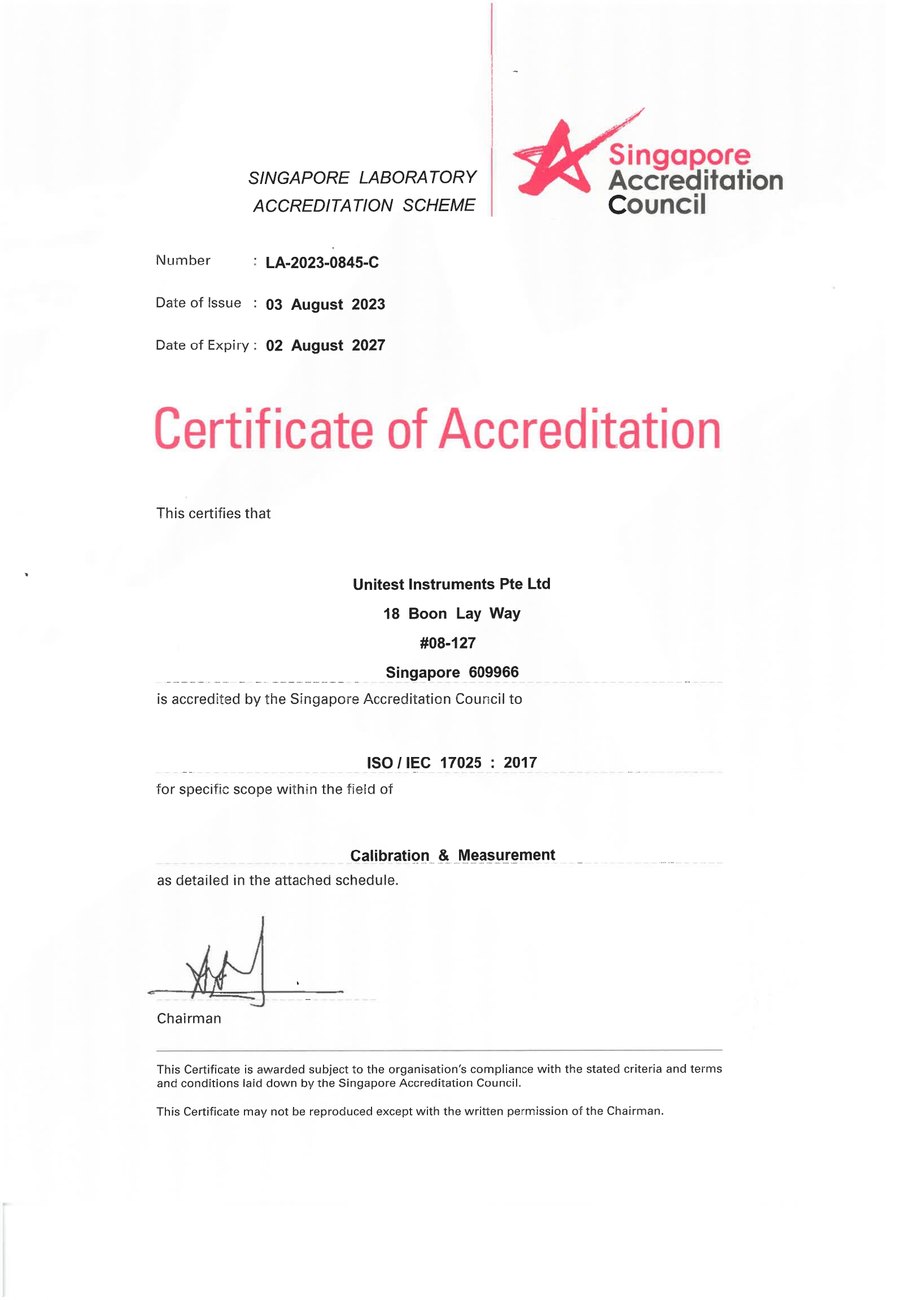
SAC-SINGLAS accredited calibration laboratory (Acc. No. LA-2023-0845-C) serving Singapore's industrial, pharmaceutical, and manufacturing sectors. All content reflects our ISO/IEC 17025 accredited scope and is reviewed by our technical calibration team.
Need data centre calibration in Singapore?
Unitest Instruments is SAC-SINGLAS accredited (Acc. No. LA-2023-0845-C) to ISO/IEC 17025. Same-week turnaround, certificates accepted by ISO 9001, TIA-942, and Green Mark auditors.