
Key Takeaways
- Accuracy of ±1–2 mm over 100 m is standard for professional-grade laser distance meters. Far superior to tape measures on long or diagonal spans.
- IP54 dust and splash protection is the practical minimum for Singapore's tropical construction environments.
- Green-laser models (520 nm) are significantly easier to see outdoors in bright Singapore sunlight compared with standard red-laser instruments.
- A SAC-SINGLAS calibration certificate (Acc. No. LA-2023-0845-C) is required by ISO 9001 auditors and is accepted for BCA regulatory submissions.
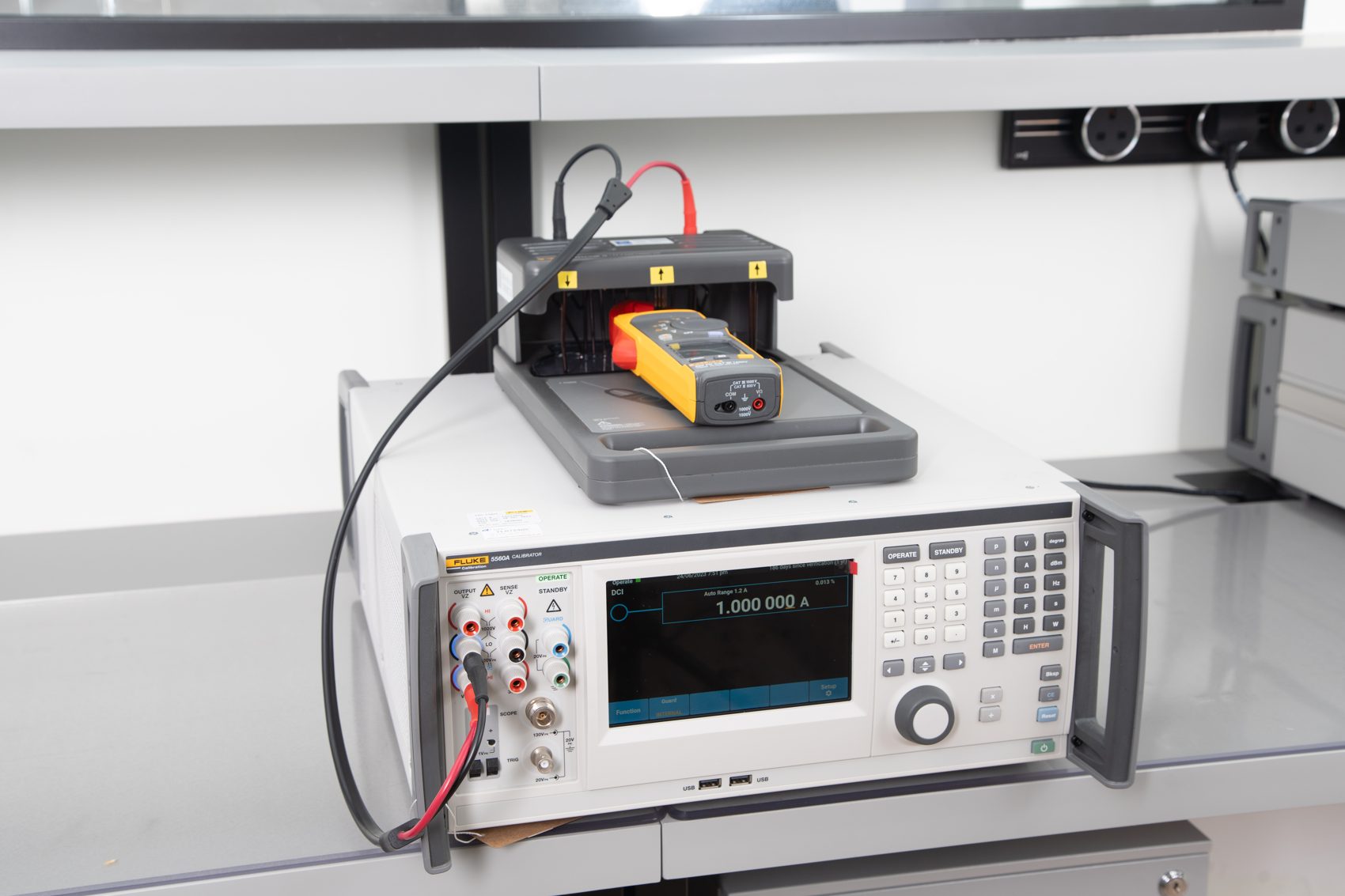
- Calibrate newly purchased instruments before first use. Factory calibration may not be traceable to Singapore's NMC and is typically not documented to ISO/IEC 17025 standard.
Who Needs a Laser Distance Meter, and What to Look For First
Laser distance meters (LDMs) have largely displaced tape measures on Singapore construction sites, in M&E coordination, and in quantity surveying practices. The technology fires a pulse of laser light at a target, measures the time-of-flight or phase shift of the returning signal, and computes distance to millimetre precision, in seconds, without a second person holding the other end of a tape.
The primary buyers in Singapore's built environment fall into four groups: main contractors and site supervisors who need a robust everyday tool for layout, setout verification, and progress measurement; M&E consultants and coordinators who measure duct runs, pipe offsets, and ceiling void depths; quantity surveyors and project managers who require documentable, traceable readings for variation claims and BCA submissions; and licensed surveyors who need instruments complying with Singapore Land Authority (SLA) precision requirements for cadastral and topographic work.
Before comparing models, determine three things: the maximum measurement range you need (interior fit-out vs. open-site outdoor); whether you need Bluetooth data transfer to a tablet or site app; and whether your measurements will be submitted to a regulatory body (BCA, SLA, ISO 9001 auditor), which determines whether you need a SAC-SINGLAS calibration certificate.
Key Specifications Explained
Range and Accuracy
Professional LDMs are rated for range under ideal conditions (dark target, indoors). Real-world range (especially outdoors in Singapore's glare), is typically 30–50% of the rated maximum without a target plate. Accuracy figures (e.g. ±1.5 mm) are stated at a reference temperature (usually 20°C); high humidity and temperatures of 30–35°C common on Singapore sites can introduce additional error of 0.5–1 mm over 50 m if the instrument has not been temperature-characterised.
IP Rating
Singapore's monsoon season, pervasive construction dust from concrete cutting, and high ambient humidity make IP rating critical. IP54 (dust-limited, splash-resistant) is the sensible minimum. The first digit (5) means dust cannot enter in sufficient quantity to interfere with the instrument; the second digit (4) covers water splashing from any direction. Some premium models carry IP65 (fully dust-tight, low-pressure water jets). Worth specifying for wet-trade environments such as external waterproofing or structural topping works.
Laser Class and Outdoor Visibility
Most consumer and prosumer LDMs use Class 2 red lasers (635–670 nm, <1 mW). The dot is nearly invisible beyond 15–20 m in direct tropical sunlight. Professional-grade instruments solve this in two ways: target plates (reflective cards that bounce the beam back clearly, extending indoor range) or green lasers (520 nm, perceived as ~4× brighter than red at the same power level). For Singapore outdoor work, a green-laser model or a red-laser model with a compatible laser receiver is strongly recommended.
Tilt / Inclination Sensor
An integrated inclinometer (typically ±45° range) allows the instrument to calculate horizontal or vertical distance components from an angled measurement. Eliminating the need for Pythagoras calculations and target placement on uneven terrain. This is especially valuable for ramp gradients, façade heights measured from the ground, and sloped floor surveys.
Top Laser Distance Meters Available Through Unitest & Partners
The models below are representative of the professional-grade instruments available through unitestshop.com and Unitest's distribution network, spanning Fluke's industrial measurement range and complementary brands. All are suitable for SAC-SINGLAS calibration at Unitest Instruments.
| Model | Range | Accuracy | IP Rating | Laser | Key Feature | Best For | Approx. Price (SGD) |
|---|---|---|---|---|---|---|---|
| Fluke 424D | 100 m | ±1.5 mm | IP54 | Red Class 2 | Real Min/Max, angle measurement, Bluetooth | General construction, M&E, QS | S$380–450 |
| Fluke 416D | 50 m | ±1.5 mm | IP54 | Red Class 2 | Compact, rugged, area/volume | Interior fit-out, M&E coordination | S$220–280 |
| Bosch GLM 50-27 CG | 50 m | ±1.5 mm | IP54 | Green Class 2 | Green laser, colour display, Bluetooth | Outdoor layout in bright sunlight | S$260–320 |
| Leica DISTO D510 | 200 m | ±1.0 mm | IP54 | Red Class 2 | Pointfinder camera, 360° tilt sensor | Façade surveys, long-range outdoor | S$680–780 |
| Leica DISTO D810 Touch | 300 m | ±1.0 mm | IP65 | Red Class 2 | Touchscreen, laser receiver compatible, 360° tilt | Licensed surveying, large-site setout | S$1,050–1,200 |
All models listed are available for purchase via unitestshop.com. Unitest also stocks calibration-ready accessories including tripod adapters (5/8" thread), reflective target plates, and laser receivers for the Leica DISTO range.
Model Deep-Dives: When to Choose Each
Fluke 424D. The Site Workhorse
The Fluke 424D is Unitest's most recommended general-purpose LDM for Singapore's main contractors and QS firms. At 100 m range with ±1.5 mm accuracy and IP54 protection, it covers the vast majority of on-site tasks. The integrated inclinometer enables indirect height and distance measurements, and the real-time Min/Max function is invaluable for checking flatness of structural slabs or wall plumb. Bluetooth connectivity syncs with Fluke's Connect app for direct export to site records. A meaningful productivity gain on documentation-heavy GLS and MRT project environments.
For teams that already use Fluke multimeters and clamp meters (ubiquitous in Singapore's M&E sector), the 424D integrates naturally into the same documentation workflow. Calibration at Unitest covers the full measurement range and produces a certificate directly referencing the Fluke 424D's serial number and the SAC-SINGLAS scope.
Fluke 416D. Compact Interior Specialist
The 416D trades range (50 m) for a smaller, lighter body that fits in a vest pocket. Useful for M&E coordinators who are primarily measuring duct clearances, electrical board setbacks, and ceiling void dimensions inside completed floors. The area and volume calculation modes are well-implemented. It shares the 424D's IP54 rating, which matters even indoors on active construction sites where cement dust is ever-present. At roughly S$220–280, it is a cost-effective first LDM for subcontractors and fit-out specialists.
Bosch GLM 50-27 CG. Outdoor Green Laser
The green laser in the GLM 50-27 CG is the single most practical feature for Singapore's outdoor environment. Where a red-laser instrument becomes difficult to use beyond 20 m in midday sun, the green laser remains clearly visible to 40–50 m without a target plate. The 50 m range is sufficient for most single-storey industrial and landscape layout work. The colour display reads well in glare. For civil engineering subcontractors doing external paving setout, drainage channel marking, and landscape grading, this is the most practical choice under S$350.
Leica DISTO D510. Long-Range Façade Surveys
With 200 m range, ±1.0 mm accuracy, and a built-in 4× zoom pointfinder camera, the D510 is designed for measurements that cannot be made from directly in front of the target. Façade heights measured from street level, building-to-boundary setbacks, and cross-street distance checks during setout verification. The 360° tilt sensor enables slope-corrected horizontal and vertical components from any angle. For licensed architects verifying GFA setout or fire engineers measuring separation distances, the D510 is the minimum practical instrument.
Leica DISTO D810 Touch. Professional Survey-Grade
The D810 is the closest a handheld LDM comes to a licensed surveying instrument. IP65 protection, 300 m range, touchscreen operation, and compatibility with Leica's laser receiver (for use in full sunlight at 300 m) make it appropriate for primary setout control on large sites. It can pair with a theodolite or total station via Bluetooth to supplement distance measurement, and its data is exportable in formats compatible with most site CAD packages. For BCA-licensed surveyors and SLA-registered cadastral practices requiring traceable distance measurement as part of a survey control network, the D810 is the benchmark.
Calibrate Your Laser Distance Meter Before It Goes on Site
Unitest Instruments issues SAC-SINGLAS traceable calibration certificates for laser distance meters. Accepted by ISO 9001 auditors and BCA-regulated projects. Same-week turnaround available for most instruments.
Singapore Standards and Regulatory Context
Distance measurement in Singapore's built environment is governed by a layered framework of standards and regulatory requirements. The primary reference for construction setout and survey measurement is SS ISO 7078:2020 (Building construction (Procedures for setting out, measurement and surveying), Vocabulary and guidance notes), which defines accuracy classes for instruments and procedures. Field test requirements for surveying instruments (including LDMs), are addressed in SS EN 17123, the Singapore adoption of ISO 17123 Part 4 (Electro-optical distance meters).
For BCA-regulated projects (public housing, infrastructure, government land sales), the Quality Management Plan typically requires that all measurement instruments be listed with their calibration status. ISO 9001:2015 Clause 7.1.5 mandates that monitoring and measuring equipment be calibrated at specified intervals against measurement standards traceable to national or international standards. Making a SAC-SINGLAS certificate the most defensible form of compliance evidence in Singapore. As explained in our article on accredited vs non-accredited calibration, only SAC-SINGLAS certificates provide the level of traceability and technical rigour that ISO 9001 auditors and government procurement officers expect.
For land boundary surveys under SLA jurisdiction, calibrated instruments are a prerequisite for licensed surveyors' submissions. The SLA's Technical Reference on Survey Standards references ISO 17123 accuracy classes and requires that instruments be within their calibrated validity period at the time of survey.
Why Calibration Matters, and What the Certificate Tells You
Many site managers assume a new laser distance meter from a reputable brand is "accurate out of the box" and does not require calibration. This assumption is technically incorrect for two reasons. First, the factory calibration performed by manufacturers is typically a production-line adjustment. Not a formal ISO/IEC 17025 traceable procedure with documented measurement uncertainty. Second, shipping, storage in non-climate-controlled warehouses, and the thermal shock of Singapore's air-conditioned offices to outdoor tropical conditions can all shift an instrument's systematic error before it has taken a single site reading.
A SAC-SINGLAS calibration certificate from Unitest Instruments tells you three things: the actual measured error of your specific instrument at multiple points across its range; the expanded measurement uncertainty of that error determination (so you know how confident the result is); and the traceability chain linking your instrument's readings back to Singapore's National Metrology Centre (NMC), which is in turn linked to the International System of Units (SI). Our article on what a calibration certificate contains walks through each section of the document in detail.
For quantity surveyors and contractors, this matters practically: if a measurement error leads to a variation claim dispute, a SAC-SINGLAS certificate is primary evidence that the instrument was performing within its stated accuracy at the time of measurement. An uncalibrated instrument (or one calibrated by a non-accredited provider), provides no such assurance.
Selecting and Buying: A Practical Checklist
Use this checklist before purchase to avoid common specification mismatches in Singapore's construction environment:
- Confirm your maximum measurement range, and apply a 40% deduction for outdoor use without a target plate.
- Check the IP rating. Specify IP54 minimum; IP65 for wet-trade or external applications.
- Assess laser visibility. If you work outdoors in daytime, prioritise green laser or a compatible laser receiver.
- Verify Bluetooth / data export. Required if measurements feed directly into BIM models or site management systems.
- Check tilt sensor range , 360° is preferable to ±45° for façade and slope work.
- Confirm calibration serviceability in Singapore. Not all models are covered by SAC-SINGLAS accredited laboratories. Unitest covers all Fluke and Leica DISTO models in its scope.
- Budget for calibration on delivery. Add approximately S$80–150 for initial SAC-SINGLAS calibration to your instrument cost.
All models featured in this guide are available at unitestshop.com. Unitest's team can advise on model selection and arrange same-day dispatch of calibration intake for instruments purchased through the shop.
Getting Reliable Readings on a Live Construction Site
Even the right instrument delivers unreliable data if site technique does not account for the realities of an active construction environment. Measuring against unfinished or textured surfaces, exposed formwork, raw concrete, or scaffold boarding, is one of the most common sources of poor returns on a Singapore site, since these surfaces scatter the laser beam unevenly and can produce weak or noisy readings that a target plate resolves immediately by presenting the instrument with a consistent, known reflectivity surface. Site teams that carry a reflective target plate as standard kit, rather than reaching for one only after a measurement fails, generally get faster and more repeatable results, particularly for the long-range outdoor setout work common on GLS and infrastructure projects where target surfaces (site hoarding, distant structural columns) are often far from ideal.
Dust is the second practical hazard specific to construction sites, and it affects laser distance meters in two distinct ways: airborne dust from concrete cutting or demolition scatters the beam over longer ranges in the same way fog does, degrading both range and accuracy, while dust settling on the instrument's own lens over the course of a working day gradually weakens the signal in a way that is easy to miss until a reading unexpectedly fails. A quick lens check and wipe at the start of each shift, standard practice for site surveying equipment generally, takes seconds and prevents most dust-related measurement failures. Teams working through Singapore's wet season should also be alert to condensation forming on the lens when an instrument is moved from an air-conditioned site office into humid outdoor air, a brief acclimatisation period before taking readings avoids this entirely.
Feeding LDM Data Into BIM and Site Documentation
The productivity case for professional-grade LDMs on Singapore projects increasingly rests on how directly their data flows into digital project records rather than on the measurement itself. Instruments with Bluetooth export, such as the Fluke 424D and the Leica DISTO range covered above, can push individual readings directly into site apps, BIM coordination tools, and as-built documentation platforms, removing the manual transcription step that has historically been a source of both delay and simple data entry error on measurement-heavy trades like M&E coordination and quantity surveying. For BCA submissions and variation claims specifically, having a digital, timestamped, and instrument-attributed measurement record is considerably stronger evidence than a handwritten site note, particularly when that record can be tied directly back to a specific instrument's SAC-SINGLAS calibration certificate and serial number.
Teams standardising on a single LDM brand and model across a project team gain a further, less obvious benefit: consistent data formatting across the whole site, which simplifies both BIM integration and the calibration management process, since a single instrument register with one export format and one calibration provider is considerably easier to audit than a mixed fleet of instruments purchased ad hoc by individual subcontractors. Where budget allows, standardising on instruments already within Unitest's SAC-SINGLAS accredited scope, rather than mixing in unsupported grey-market models, keeps the entire project's distance measurement evidence chain consistent and defensible from setout through to as-built handover.
Frequently Asked Questions
For most Singapore construction sites, the Fluke 424D is the strongest all-round choice: 100 m range, ±1.5 mm accuracy, IP54 dust and splash protection, and reliable performance in tropical humidity. Professionals needing longer range (up to 200 m) or integrated tilt measurement should consider the Leica DISTO D510 or D810. Bosch's GLM 50-27 CG is an excellent cost-effective option for interior fit-out and M&E work, particularly where outdoor green-laser visibility matters.
High-quality laser distance meters achieve ±1 mm to ±2 mm accuracy over ranges up to 100 m. Significantly better than tape measures for long or diagonal distances, where tape sag, thermal expansion, and parallax error can introduce errors of 5–20 mm. For certified measurements (quantity surveying reports, BCA submissions, SLA compliance), a calibrated laser distance meter traceable to national standards is the only defensible option.
Yes. Like all precision measurement instruments, laser distance meters drift over time due to thermal cycling, mechanical shock on site, and component ageing. Singapore's ISO 9001-certified contractors and BCA-registered QPs typically require instruments to be calibrated at least annually. Calibration by a SAC-SINGLAS accredited laboratory (such as Unitest Instruments, Acc. No. LA-2023-0845-C) produces a traceable certificate accepted by ISO 9001 and BCA auditors.
Key references include SS ISO 7078 (Building construction. Procedures for setting out, measurement and surveying), SS EN 17123 (Field procedures for testing surveying instruments), and BCA's Code of Practice on Quality Management. MAS-regulated projects and GLS tender submissions increasingly require traceable calibration certificates. For land surveying, the Singapore Land Authority (SLA) sets precision requirements aligned with the ISO 17123 series.
IP54 means the device is protected against dust ingress (level 5 (limited dust, no harmful deposit) and water splashing from any direction (level 4). On Singapore construction sites), with tropical rain, cement dust, and high ambient humidity. IP54 is the practical minimum for a laser distance meter. Instruments rated below IP54 are more likely to fog internally or suffer sensor contamination, accelerating measurement drift and shortening service life.
Standard red-laser meters (635–670 nm) can be difficult to see beyond 20–30 m in direct Singapore sunlight. Practical solutions are: (1) use a laser receiver or target plate, extending usable range to 60–80 m even in bright conditions; (2) select a green-laser model (520 nm), visible at roughly 4× the luminous intensity of red. The Bosch GLM 50-27 CG uses a green laser specifically for outdoor use; or (3) choose a model with a built-in colour display that shows the reading without needing to see the dot directly.
Annual calibration is the industry standard for construction instruments used in ISO 9001 or BCA-regulated work. Instruments subjected to heavy site use (drops, vibration, temperature extremes), should be calibrated more frequently, or immediately after any significant impact event. Unitest Instruments (SAC-SINGLAS Acc. No. LA-2023-0845-C) offers fast turnaround calibration with certificates traceable to Singapore's National Metrology Centre (NMC).
A laser distance meter measures straight-line distance only. Fast, portable, and suited to construction layout, interior fit-out, M&E coordination, and quantity take-off. A total station is a full surveying instrument that measures distance, horizontal angle, and vertical angle simultaneously, enabling precise coordinate determination and large-scale site control. For most on-site measurement tasks, a quality laser distance meter is faster and more cost-effective; total stations are required for primary control surveys, cadastral work, and SLA-regulated land boundary surveys.
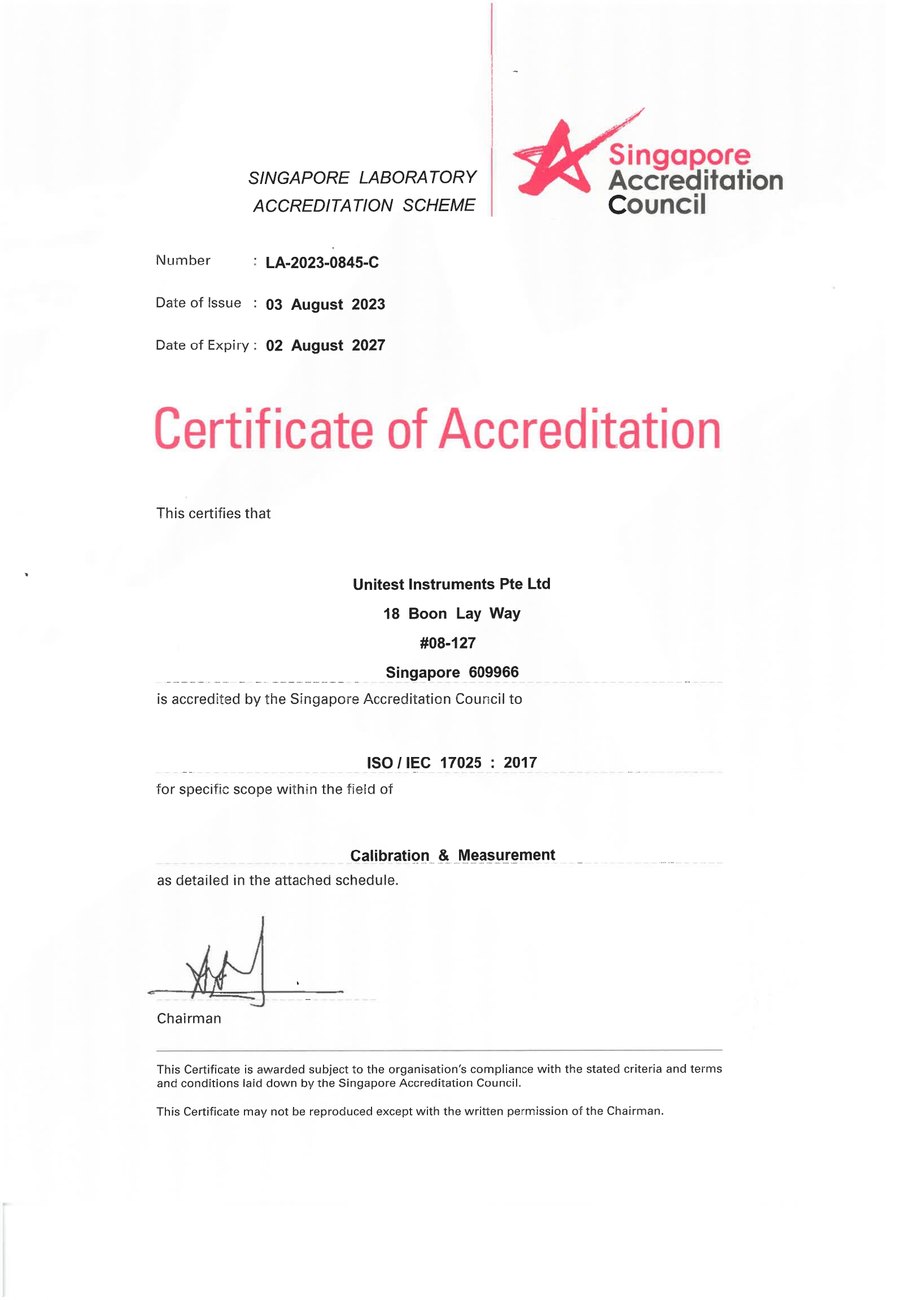
SAC-SINGLAS accredited calibration laboratory (Acc. No. LA-2023-0845-C) serving Singapore's industrial, pharmaceutical, and manufacturing sectors. All content reflects our ISO/IEC 17025 accredited scope and is reviewed by our technical calibration team.
Need laser distance meter calibration in Singapore?
Unitest Instruments is SAC-SINGLAS accredited (Acc. No. LA-2023-0845-C) to ISO/IEC 17025. Same-week turnaround, certificates accepted by ISO 9001 auditors and BCA-regulated projects.