
Key Takeaways
- Velocity (mm/s RMS) is the standard parameter for general rotating machinery. Align measurements to ISO 10816 / ISO 20816 severity zones.
- Match the meter to your machine population: entry-level meters for route-based screening; full vibration analysers for fault diagnosis and spectral trending.
- Fluke dominates the portable vibration market for industrial use; the 805 FC, 810, and 835 cover most Singapore facility and manufacturing needs.
- Amprobe VIB-200A is a cost-effective entry point for facilities teams needing basic velocity and acceleration screening.
- Always establish calibrated baseline readings. A vibration reading is only meaningful when compared against a traceable reference. Annual SAC-SINGLAS calibration is standard.
Who Needs a Vibration Meter, and Why It Matters in Singapore
Unplanned downtime costs Singapore's manufacturing sector billions of dollars annually. In a country where labour is expensive, space is limited, and just-in-time production is the norm, a single failed motor or pump can cascade into a line shutdown that erases weeks of margin. Predictive maintenance (PdM) (the practice of measuring machine condition continuously or at regular intervals to detect deterioration before failure), is the primary tool used to prevent this.
Vibration is the most information-rich signal a rotating machine emits. Changes in vibration level and frequency content reveal imbalance (a weight distribution problem), misalignment (shaft or coupling issues), looseness (structural or mechanical), and bearing defects. Often weeks or months before the machine fails. A portable vibration meter is the entry-level instrument for any PdM program, enabling maintenance technicians to walk a route, touch a sensor to a bearing housing, and record a reading in seconds.
Singapore-specific context matters here. High ambient temperatures (up to 35°C outdoors, often 28–30°C in non-air-conditioned plant rooms) accelerate bearing grease degradation, making vibration monitoring especially valuable for motor-driven equipment. Industries particularly active in Singapore. Semiconductor wafer fabrication, pharmaceutical manufacturing, petrochemicals on Jurong Island, and commercial real estate facilities management. All operate vibration monitoring programs as a requirement of their ISO 9001, ISO 14001, or Good Manufacturing Practice (GMP) quality systems.
What to Look For: Key Specifications Explained
Before comparing models, understand the specifications that actually determine whether a vibration meter is fit for your application.
Measurement Parameters
Velocity (mm/s RMS or in/s RMS) is the workhorse parameter for general rotating machinery from 600 to 60,000 RPM. It correlates best with the energy being transmitted through machine structures and is the parameter used by ISO 10816-3 and ISO 20816 for severity assessment. If you are starting a PdM program and can only measure one parameter, measure velocity.
Acceleration (g or m/s²) is more sensitive at higher frequencies (above 1 kHz), making it the preferred parameter for bearing fault detection, gearbox monitoring, and high-speed spindles. Most vibration meters express acceleration in g (multiples of gravitational acceleration, 9.81 m/s²).
Displacement (microns or mils peak-to-peak) is used for low-speed machines (below 600 RPM) and for shaft vibration measurements on large turbomachinery with proximity probes. Portable meters measuring displacement are less common; this parameter is more relevant to fixed monitoring systems.
Bearing condition indicators (proprietary indices such as Fluke's BCI or enveloped acceleration), detect the impulsive energy characteristic of early-stage bearing defects before they appear in broadband velocity readings. Meters with built-in bearing condition scoring are significantly more valuable for bearing-focused programs.
Frequency Range
A meter's frequency range determines which fault types it can detect. For general machinery (motors, pumps, fans, compressors), a range of 10 Hz to 1 kHz covers most relevant faults. For bearing and gearbox monitoring, extend this to 10 kHz or higher. Some analysers measure to 20 kHz or beyond for high-frequency resonance and ultrasonic detection.
Connectivity and Data Logging
Route-based PdM programs generate large volumes of data. A meter with wireless data logging (Bluetooth to a smartphone app, or USB to a PC) saves significant technician time compared to manual transcription and enables trend analysis. The most powerful aspect of PdM. Look for meters compatible with a CMMS (computerised maintenance management system) or at minimum a data management app.
| Model | Key Parameters | Frequency Range | Connectivity | Price Range (SGD) | Best For |
|---|---|---|---|---|---|
| Fluke 805 FC | Velocity, Acceleration, Bearing Condition Index (BCI), Temperature | 10 Hz – 1 kHz (velocity); 4 kHz (bearing) | Fluke Connect wireless (Bluetooth) | S$1,800 – S$2,400 | Route-based PdM, general plant, HVAC |
| Fluke 810 | Velocity, Acceleration, FFT spectrum, expert diagnostic engine | 2 Hz – 20 kHz | USB, SD card, PC software | S$5,500 – S$7,000 | Full vibration analysis, fault diagnosis |
| Fluke 835 | Laser shaft alignment + vibration screening | 10 Hz – 1 kHz | Bluetooth, USB | S$4,200 – S$5,500 | Alignment correction and vibration verification |
| Amprobe VIB-200A | Velocity, Acceleration, Displacement | 10 Hz – 1 kHz | USB data output | S$380 – S$550 | Entry-level screening, facilities teams |
| Fluke 3560 FC Vibration Sensor | Continuous velocity and temperature monitoring | 2 Hz – 1 kHz | Fluke Connect wireless (always-on) | S$900 – S$1,200 per node | Fixed-point continuous monitoring, remote assets |
Price ranges are indicative for Singapore market. Contact unitestshop.com for current pricing and availability. All instruments should be calibrated by a SAC-SINGLAS accredited laboratory before first use.
Model-by-Model Breakdown
Fluke 805 FC. Best Overall for Route-Based PdM
The Fluke 805 FC is the instrument most Singapore maintenance teams reach for when establishing a new PdM program. Its integrated sensor tip contains both an accelerometer and a temperature sensor, so you get velocity, acceleration, bearing condition index, and surface temperature in a single measurement, without changing probes. The colour-coded severity scale (green / yellow / red) gives technicians an instant pass/warning/danger reading without needing deep vibration expertise, making it practical for teams where the PdM technician is also responsible for a broad range of maintenance tasks.
The Fluke Connect wireless link is the feature that sets the 805 FC apart at its price point. Readings are automatically uploaded to the Fluke Connect cloud platform (or logged locally), enabling trending over time and remote viewing by maintenance supervisors. For Singapore facility managers overseeing multiple sites, this remote visibility is operationally significant. The instrument is rated IP40, acceptable for indoor plant environments, and its rubber over-moulding handles the inevitable drops that occur in active maintenance work. Browse the Unitest shop for current availability of Fluke vibration meters.
Fluke 810 Vibration Tester. Best for Fault Diagnosis
When the 805 FC raises an alarm, the Fluke 810 is the instrument you send in to diagnose the fault. Its built-in expert diagnostic engine analyses the FFT spectrum and bearing database to produce a plain-English diagnosis: "Outer race bearing fault, replace bearing within 2 weeks." This guided diagnostic approach makes spectral analysis accessible to technicians who have not spent years interpreting vibration spectra manually. The 810 measures across a 2 Hz to 20 kHz range, wide enough to capture bearing fault frequencies on most industrial machines.
The 810 is significantly more expensive than the 805 FC, and for many facilities the right answer is to own several 805 FC units for daily route measurements and one 810 for follow-up analysis. The 810's PC software enables spectral trend comparison. A powerful capability when you want to watch a developing fault deteriorate over weeks and plan the repair at the optimal time.
Fluke 835, for Teams That Also Do Shaft Alignment
Misalignment between a motor and pump (or any coupled machine pair) is one of the most common causes of elevated vibration in Singapore's industrial plants. The Fluke 835 combines laser shaft alignment measurement with vibration screening, allowing a technician to align the machine and immediately verify that vibration has dropped, without switching instruments. This combination is particularly relevant in Singapore's pharmaceutical and semiconductor sectors where installation quality is closely audited.
Amprobe VIB-200A. Entry-Level Screening
For facilities teams that need to perform basic vibration checks on HVAC equipment, cooling towers, and building services motors, the Amprobe VIB-200A offers velocity, acceleration, and displacement measurement at a fraction of the cost of the Fluke range. It lacks connectivity and bearing condition scoring, but for a team performing monthly checks with manual data recording it does the job. The VIB-200A is a sensible first instrument for a facilities team that is not yet ready to invest in a full PdM program but wants to start collecting baseline data. Available through Unitest shop.
Fluke 3560 FC, for Continuous Fixed-Point Monitoring
Not every critical asset can be measured by a technician walking a route. Remote, difficult-to-access, or continuously critical assets (cooling water pumps, compressor motors, critical process fans), benefit from permanently installed vibration sensors that transmit readings around the clock. The Fluke 3560 FC is a wireless vibration and temperature sensor that mounts to a machine and streams data to Fluke Connect. For Singapore facilities running 24/7 operations, continuous monitoring on the top five to ten most critical assets provides the earliest possible warning of developing faults.
Calibrate Your Vibration Meter Before Your First Baseline Reading
An uncalibrated vibration meter produces numbers, not measurements. Unitest Instruments (Acc. No. LA-2023-0845-C) provides traceable vibration instrument calibration accepted by ISO 9001 auditors, with same-week turnaround in Singapore.
Singapore Industry Standards and Regulatory Context
Singapore does not publish its own vibration severity standards. Instead, industry references the international ISO 10816 and ISO 20816 series, which have been adopted globally and are accepted by Singapore's Ministry of Manpower (MOM) and relevant industry regulators. The key standards are:
- ISO 10816-3: Vibration severity limits for industrial machines above 15 kW with rated speeds between 600 and 30,000 RPM mounted on rigid foundations. The most commonly referenced standard for motors, pumps, fans, and compressors in Singapore factories.
- ISO 10816-7: Specifically covers rotodynamic pumps. Widely used in Singapore's water treatment and semiconductor cooling systems.
- ISO 20816-1: The updated framework (superseding parts of ISO 10816) covering determination of evaluation criteria and measurement procedures.
- SS 559: Singapore Standard for machinery noise and vibration. Applicable to building services equipment and relevant to MOM noise regulations.
For facilities operating under a formal quality management system (ISO 9001) or an environmental management system (ISO 14001), vibration monitoring forms part of the preventive maintenance records that are audited during certification reviews. This makes calibration traceability non-negotiable: calibration certificates must reference a national measurement standard. In Singapore, this means calibration by a SAC-SINGLAS accredited laboratory. The only route to certificates that Singapore-based ISO 9001 auditors will accept without question. For a deeper understanding of what calibration traceability means and why it matters, read our article on what traceability means in calibration.
How to Set Up a Vibration Monitoring Program
Buying the right meter is only the first step. The value of vibration monitoring comes from consistent, repeatable measurements taken at the same measurement points, at the same intervals, with the same instrument orientation. Compared against baselines established when the machine was in a known-good condition.
Step 1: Identify and Prioritise Assets
Not every motor and pump needs to be on your vibration route. Prioritise assets based on criticality (consequence of failure), accessibility (can you safely reach the measurement points?), and failure history. A criticality ranking exercise (typically scoring assets on production impact, safety risk, and repair lead time), produces a Tier 1/Tier 2/Tier 3 list. Tier 1 assets get the highest measurement frequency and may justify permanent sensors.
Step 2: Establish Measurement Points and Directions
For each machine, define fixed measurement points on the bearing housings. Typically horizontal, vertical, and axial directions at each bearing. Mark measurement points with paint markers or stickers so that every technician measures at exactly the same location. Variability in measurement point location is one of the most common sources of false alarms in vibration programs.
Step 3: Establish Calibrated Baselines
Take baseline readings on newly installed or recently overhauled machines in a known-good condition. These baselines are your reference. Before taking baselines, confirm that your vibration meter has a current calibration certificate from a SAC-SINGLAS accredited laboratory. A baseline taken with an uncalibrated meter is not traceable and cannot be used to set meaningful alarm thresholds. For guidance on calibration intervals and when to recalibrate, see our article on how often to calibrate your instruments.
Step 4: Set Alarm Thresholds and Measurement Frequency
Set warning and danger thresholds based on your baselines and the ISO 10816-3 severity zones. Measure Tier 1 assets monthly (or weekly for high-criticality machines in hot environments), Tier 2 quarterly, and Tier 3 semi-annually. Review and tighten thresholds as your baseline dataset grows.
Calibration: The Step Most Teams Skip, and Shouldn't
The most common gap in Singapore vibration monitoring programs is not the instrument choice. It is the absence of a current, traceable calibration certificate. Many teams purchase a vibration meter, set baselines on day one with an uncalibrated instrument, and then measure against those baselines for years. The problem: if the meter was reading 3% high on day one, every alarm threshold set from those baselines is systematically wrong.
SAC-SINGLAS accredited calibration traces your instrument's sensitivity back through an unbroken chain of comparisons to Singapore's National Metrology Centre (NMC), which itself is linked to the International Bureau of Weights and Measures (BIPM). This traceability chain is what makes your calibration certificate legally and technically defensible. To a customer, an auditor, or a court. For a full explanation of what traceability means in practice, read our guide on measurement traceability in calibration.
Unitest Instruments (SAC-SINGLAS Acc. No. LA-2023-0845-C) calibrates vibration meters and accelerometers as part of our accredited scope. We issue certificates with full uncertainty statements that meet the requirements of ISO/IEC 17025 and are accepted by all Singapore ISO 9001 auditors. Same-week turnaround is available for most instruments, minimising downtime in your monitoring program. To understand what your calibration certificate should contain, see our explainer on how to read a calibration certificate.
Frequently Asked Questions
A vibration meter measures overall vibration levels (typically velocity (mm/s RMS) or acceleration (g)), giving you a single number to compare against alarm thresholds. A vibration analyser additionally performs frequency-domain analysis (FFT spectrum), allowing you to identify the specific fault causing elevated vibration, such as imbalance, misalignment, looseness, or bearing defects. For entry-level predictive maintenance routes, a good meter is sufficient. For root-cause diagnosis, you need a full analyser.
The correct parameter depends on machine speed and fault type. Velocity (mm/s RMS) is the most widely used for general rotating machinery in the 10–1000 Hz range and is preferred by ISO 10816/ISO 20816. Acceleration (g) is better for high-frequency bearing faults and gearboxes. Displacement (microns peak-to-peak) is used for low-speed machines and shaft orbit analysis on sleeve-bearing machines. Most portable vibration meters offer all three, so select the parameter that matches your machine speed and the fault type you are targeting.
Singapore's industrial sector generally references international standards rather than local ones. The most applicable are ISO 10816-3 (industrial machines above 15 kW, 600–30,000 RPM) and the newer ISO 20816 series, which expands coverage to pumps, fans, compressors, and wind turbines. These define four vibration severity zones (A–D) based on velocity RMS, with Zone D indicating potentially damaging levels. Facilities holding ISO 9001 or ISO 14001 certification often reference these standards as part of their maintenance management system.
Yes. Vibration meters contain piezoelectric accelerometers whose sensitivity can drift over time, especially after mechanical shock or temperature cycling. For most industrial predictive maintenance programs, annual calibration is standard. If the meter is used in safety-critical or regulated environments (pharmaceutical cleanrooms, petrochemical plants), a shorter interval of 6 months may be required. Calibration should be performed by a SAC-SINGLAS accredited laboratory to ensure traceability to Singapore's national measurement standards. Unitest Instruments (Acc. No. LA-2023-0845-C) provides traceable vibration calibration with same-week turnaround.
In-house calibration is possible only if your organisation operates a calibrated reference vibration source (calibration exciter or shaker) that is itself traceable to a national metrology institute. This requires significant equipment investment and technical competence. For most Singapore SMEs and even large manufacturers, it is more practical and cost-effective to send instruments to an accredited external laboratory. Only an accredited calibration certificate provides the metrological traceability required by ISO 9001 quality auditors and regulatory bodies.
For HVAC and building services (AHUs, chillers, cooling tower fans, pumps), the Fluke 805 FC or Fluke 810 are strong choices. They measure velocity and acceleration, include bearing condition indicators, and the 805 FC can log data to Fluke Connect for remote monitoring. Useful in high-humidity Singapore conditions where frequent manual rounds are impractical. Always calibrate before commissioning and annually thereafter to ensure your baseline readings are traceable.
The best practice is to establish baseline readings on healthy machines first, then set warning and danger thresholds relative to that baseline. Typically 2× baseline for warning and 4× baseline for danger. Alternatively, use the absolute severity zones from ISO 10816-3 as a starting point: for rigid-mounted machines above 15 kW, a velocity RMS exceeding 4.5 mm/s enters Zone C (alarm) and above 7.1 mm/s enters Zone D (danger). Always cross-reference baseline trends with absolute limits and adjust thresholds based on your machine's criticality and consequence of failure.
Cleanroom and semiconductor environments impose additional requirements: the meter should have a smooth, easy-to-clean housing with no particle-trapping crevices; it should be ESD-safe or rated for controlled environments; and the measurement range should extend to higher frequencies (above 10 kHz) to capture bearing and spindle faults on precision equipment. The Fluke 810 Vibration Tester with its expert diagnostic engine is frequently used in Singapore's semiconductor fabs. Calibration of the instrument in a clean, temperature-controlled laboratory environment is essential to maintain accuracy.
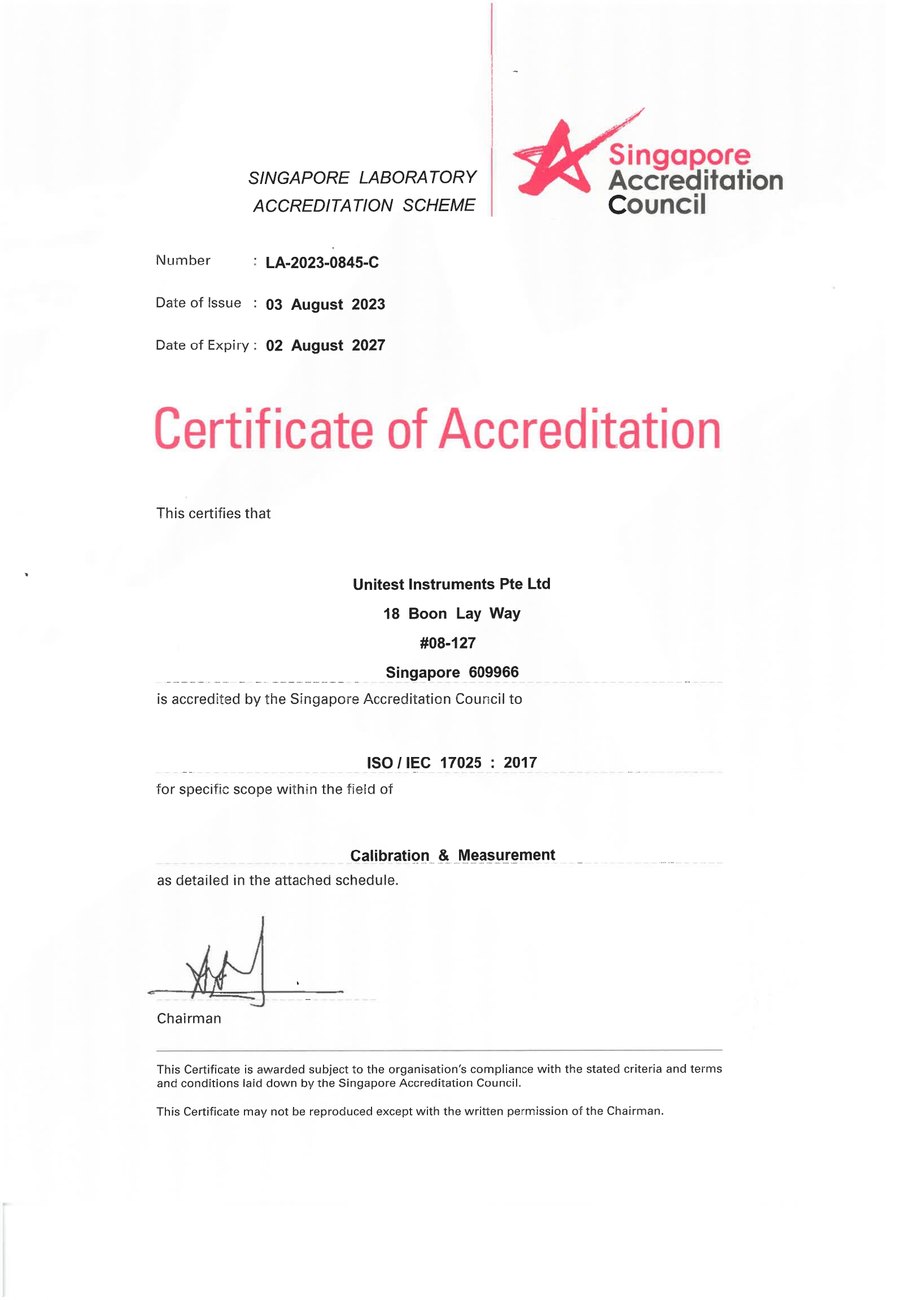
SAC-SINGLAS accredited calibration laboratory (Acc. No. LA-2023-0845-C) serving Singapore's industrial, pharmaceutical, and manufacturing sectors. All content reflects our ISO/IEC 17025 accredited scope and is reviewed by our technical calibration team.
Need vibration meter calibration in Singapore?
Unitest Instruments is SAC-SINGLAS accredited (Acc. No. LA-2023-0845-C) to ISO/IEC 17025. Same-week turnaround, certificates accepted by ISO 9001 auditors.